Read the state-wise dengue table and Tamil Nadu looks like India's problem case. The National Centre for Vector Borne Diseases Control's tally shows Tamil Nadu recording 2,873 dengue cases by the end of February 2026, more than four times Kerala's 670, in figures still provisional to that date. By caseload alone, Tamil Nadu is carrying the bigger outbreak. It carried India's largest dengue count the year before too, logging 15,796 cases through early October 2025.
Flip to the death column and the story reverses. In that same NCVBDC table, Kerala recorded 9 deaths against Tamil Nadu's 1 for the period to February 2026, despite having a quarter of Tamil Nadu's cases. Kerala's dengue problem is not the size of its outbreak. It is what happens once someone catches it.
Kerala's dengue patients died at about twelve times Tamil Nadu's rate across 2024 and 2025 combined.
That combined figure is our calculation: NCVBDC's full-year counts put Kerala at 128 deaths from 20,674 cases in 2024 and 65 deaths from 10,923 cases in 2025, versus Tamil Nadu's 13 deaths from 27,378 cases in 2024 and 12 deaths from 23,407 cases in 2025. Pooling both years, Kerala lost about 6.1 patients per 1,000 reported cases; Tamil Nadu lost about 0.5. The 2026 year-to-date column is too thin to trust on its own (9 deaths on 670 cases is a small, early sample before the monsoon season fills it out), so the two complete years are the fairer read, and they tell the same story on their own: 13 times over in 2024, nearly 12 times over in 2025.
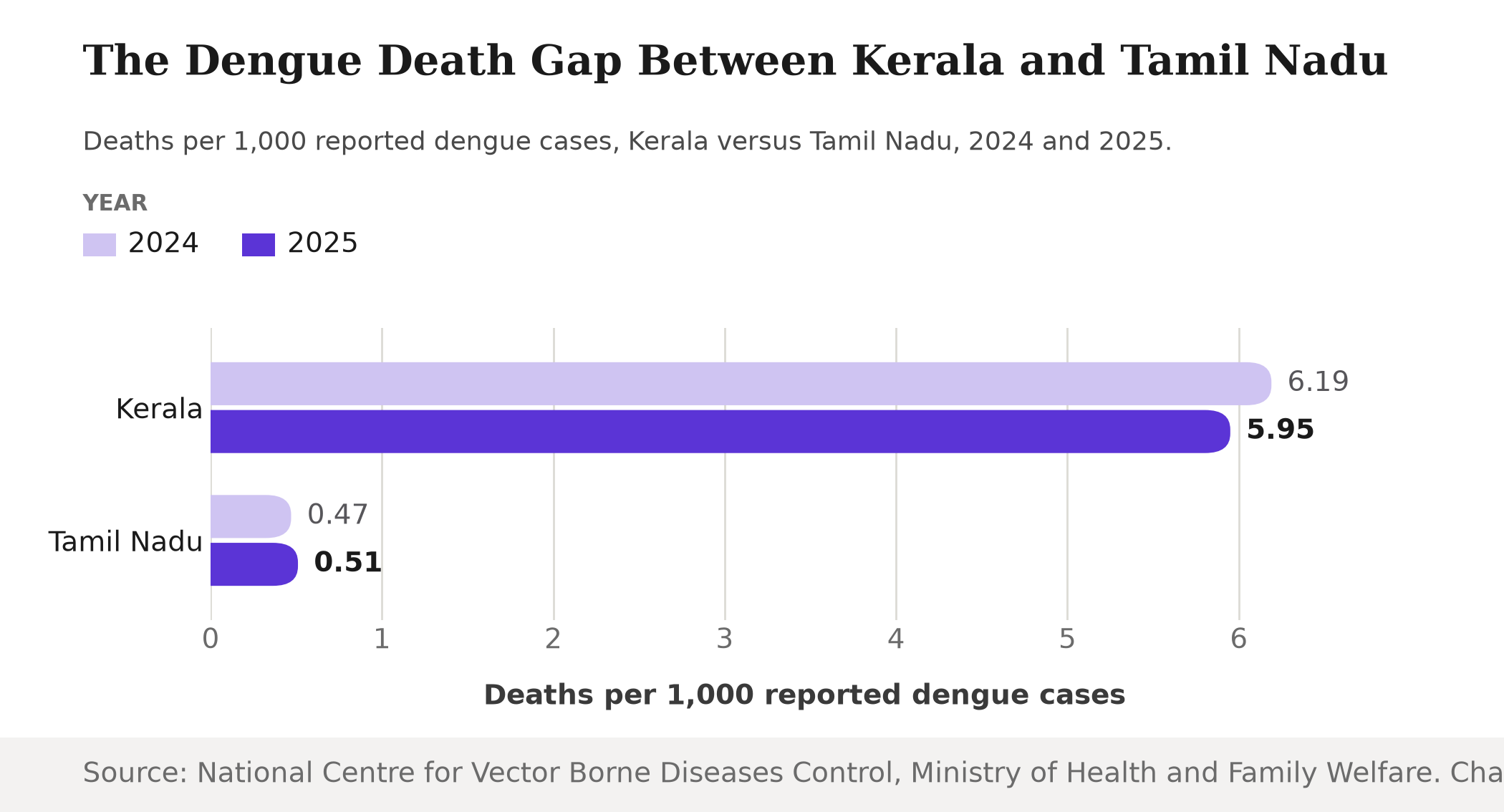
Source: NCVBDC's state-wise dengue table. Rates are The Signal's calculations. Chart: The Signal.
The pattern holds across two separate counts
It is worth checking whether this is a quirk of one dataset. A second, independent count of Tamil Nadu's 2025 season, from the state's own Directorate of Public Health via The Federal, put the toll at 15,796 cases and 8 deaths as of early October 2025: a death rate of about 0.5 per 1,000 cases, almost identical to NCVBDC's own year-end Tamil Nadu figure. Two different sources, counted at two different points in the season, land on the same low number. Tamil Nadu's low fatality rate is not a data artifact.
Kerala's own government does not dispute that its rate is elevated; it is actively working the problem. Kerala's health minister told the state Assembly on 21 July 2026 that the dengue mortality rate had declined from six deaths per thousand patients in 2025 to two per thousand in 2026. The "six per thousand" figure for 2025 lines up closely with NCVBDC's own 5.95-per-1,000 count for 2025, a reassuring cross-check. But the minister's more complete, mid-year 2026 figure and NCVBDC's partial, February-only 2026 snapshot are not the same measurement window, so they should not be read as contradicting one another: Kerala's own accounting says the rate is improving this year, even as the two-year baseline against Tamil Nadu remains wide.
Why the same infection kills more often in Kerala
Nothing in the national trend explains it. India's overall dengue burden nearly halved between 2023 and 2025, from 289,235 cases and 485 deaths to 121,824 cases and 131 deaths, a national case-fatality rate that fell from roughly 0.17% to roughly 0.11%. Kerala's own rate, at around 0.6% across 2024 and 2025, sits several times above even that national average. The country is not seeing a resurgent, more lethal strain; Kerala is an outlier within a shrinking epidemic.
The more likely answer is who gets infected, not what infects them. Kerala has the highest share of residents aged 60 and over of any major Indian state, 16.5% in 2021, against 13.6% in second-ranked Tamil Nadu. Age is not a minor factor in dengue mortality. A case-control study of dengue deaths at a Kerala tertiary-care hospital found patients over 40 were 9.3 times more likely to die than younger patients, with diabetes raising the odds 26-fold and hypertension raising them 44-fold. And hypertension specifically is where Kerala stands apart: a BMC Geriatrics study using Longitudinal Ageing Study in India data found hypertension-linked multimorbidity was highest in Kerala, at 83.7% of older adults, ahead of every other state surveyed.
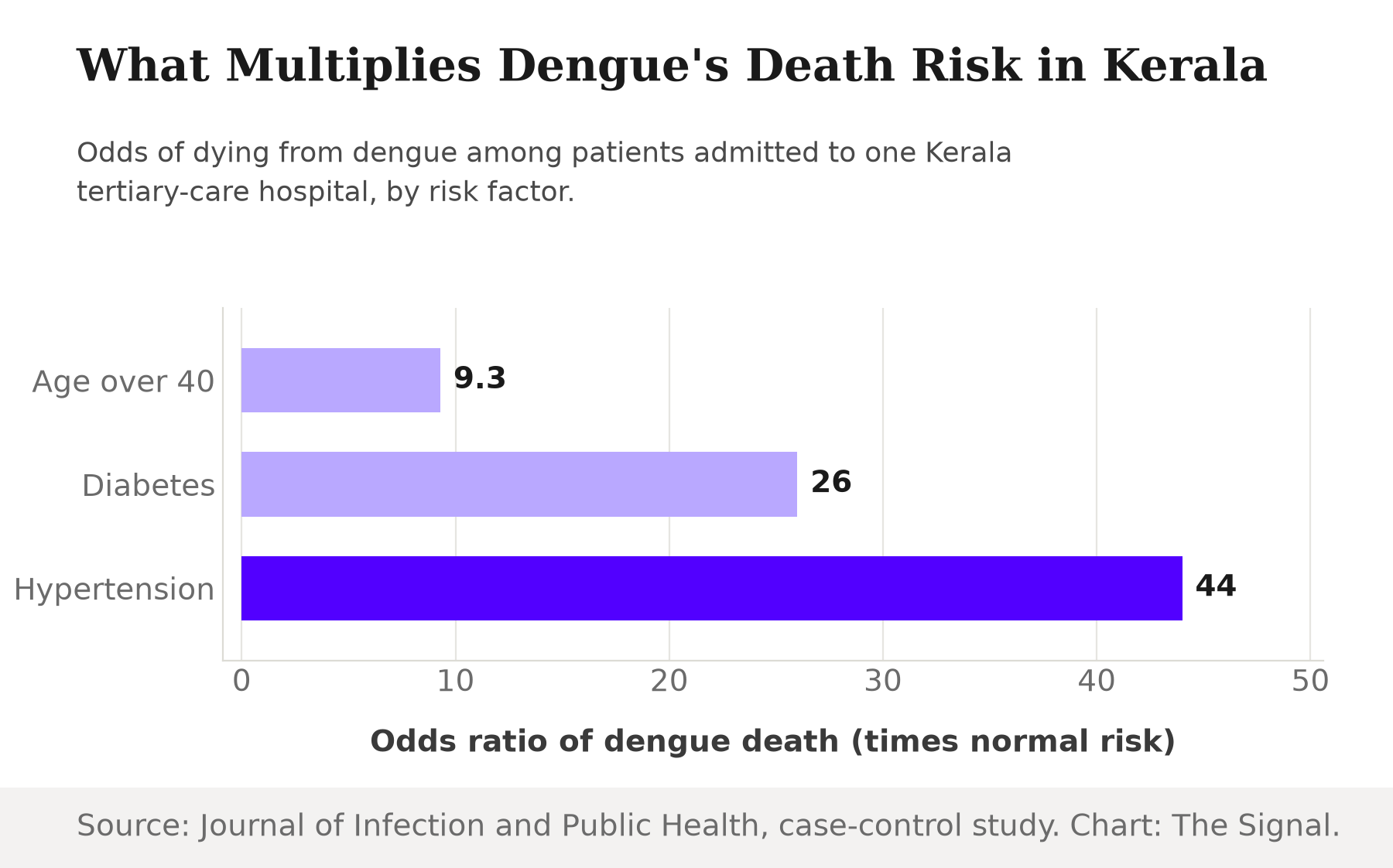
Source: Journal of Infection and Public Health, Kerala tertiary-care case-control study. Chart: The Signal.
| State | Population aged 60 and over, 2021 |
|---|---|
| Kerala | 16.5% |
| Tamil Nadu | 13.6% |
| Himachal Pradesh | 13.1% |
Source: National Statistical Office's Elderly in India 2021 report, via ThePrint.
Put the two facts together: the state with India's oldest population and its heaviest hypertension burden is also the state whose dengue patients are dying at the highest multiple of any comparison available. The CDC's severe dengue case definition puts the case-fatality rate as high as 10% if untreated, versus about 0.1% with appropriate clinical management: Kerala's overall rate, at roughly six times that 0.1% floor, looks less like a treatment failure and more like a population that arrives at the hospital carrying more of the risk factors the tertiary-hospital study flagged.
The honest objection
The strongest case against a demographic explanation is that Kerala might simply be counting more honestly. A state with better surveillance catches milder cases too, but it also catches and attributes more deaths to dengue rather than filing them under a comorbidity. Undercounting mild infections would show an artificially inflated rate, not a lower one, so better counting alone does not explain Kerala's number being high. It could still explain part of Tamil Nadu's number being low, if Tamil Nadu's much larger case count includes proportionally more mild, unconfirmed infections in the denominator. That is a real limitation of comparing raw case-fatality rates across two different surveillance systems, and the data here cannot rule it out.
What the surveillance-quality objection cannot explain is the consistency of the pattern itself. The same rough twelve-fold gap in deaths per case shows up in both 2024 and 2025 in the same NCVBDC dataset, and Tamil Nadu's independently counted 2025 death rate landed at almost the same low level as NCVBDC's own figure for the state. Kerala, meanwhile, is the state that already holds the country's highest share of residents aged 60 and over and the highest hypertension-linked multimorbidity among older adults. A counting artifact would have to be unusually stable across two years and two data sources, in exactly the state whose demographics already predict a higher death rate, to explain the gap away.
A different biological explanation is also worth checking: does Kerala simply have a more dangerous strain circulating? A nationwide ICMR laboratory-network study covering May 2023 to May 2025 found Kerala's dengue infections dominated by one serotype, DENV-2, at nearly 60%, while Tamil Nadu's cases split more evenly across three serotypes, DENV-2 at about 42% and DENV-1 and DENV-3 at about 29% each. If anything, that cuts against a clean serotype story: a wider mix of co-circulating serotypes is what raises the odds of a second infection with a different serotype, the scenario known to worsen severe dengue, so Tamil Nadu's more diverse serotype mix should point toward higher risk there, not lower. The serotype data does not explain Kerala's higher death rate; it leaves the demographic story as the better fit.
The Signal
Kerala is not losing a bigger fight against dengue. It is losing a smaller one, more often, because the patients who catch it are older and sicker than in most of the country. That is a different policy problem than the one Tamil Nadu's headline case count suggests: Tamil Nadu needs to keep the mosquito population down; Kerala needs its dengue wards to triage by age and comorbidity from the moment a patient is admitted, not after the fever spikes. The state's own health minister already reports the mortality rate narrowing, from six deaths per thousand patients in 2025 to two in 2026. Watch whether that improvement holds once the 2026 season's full count replaces February's partial one. If it does, the story becomes better dengue care for an old, sick population. If it does not, the gap to Tamil Nadu was never about the mosquito at all.
Reporting basis: the state-wise dengue case and death counts for 2024, 2025, and year-to-date 2026 are from the National Centre for Vector Borne Diseases Control's published table. Tamil Nadu's 2025 season also carries an independent count from its Directorate of Public Health, as reported by The Federal. Kerala's 2025-to-2026 mortality-rate comparison is per the state health minister's statement to the Assembly, as reported by Deccan Chronicle. India's 2023 and 2025 national case and death totals are per Al Jazeera, citing national surveillance data. The untreated-versus-treated case-fatality benchmark for severe dengue is the US CDC's case definition. The age and comorbidity mortality odds are from a single-hospital case-control study published in the Journal of Infection and Public Health, and the Kerala hypertension-multimorbidity figure is from a BMC Geriatrics study using LASI Wave 1 data; both describe patterns at specific sites and survey waves, not a real-time national count. The elderly-population shares are from the National Statistical Office's Elderly in India 2021 report, via ThePrint. The serotype breakdown is from an ICMR Virus Research and Diagnostic Laboratory network study covering May 2023 to May 2025, as reported by The South First. The per-1,000 death rates, the two-year combined rates, and the twelvefold comparison are The Signal's calculations from those NCVBDC figures.