India's transplant program had a record year. In 2024 the country performed 18,900 organ transplants, its highest total ever and nearly four times the fewer-than-5,000 it managed in 2013. The health ministry says that haul ranks India third in the world for total transplant volume, behind only the United States and China. Read only that line, and a poorer country appears to have built a transplant system that out-produces almost every rich one.
It is worth slowing down on that. A Lancet Regional Health, Southeast Asia study published on July 29, 2026 modeled how much of India's actual transplant need that record volume covers, using disease incidence and clinical eligibility rules rather than the raw procedure count. For 2021, the most recent year it could fully model: India met just 0.2 percent of its estimated national need for heart transplants, and 7.2 percent for kidney, 1.5 percent for liver, and 1.2 percent for lung, against estimated annual needs of 83,841 hearts, 125,894 kidneys, 184,542 livers, and 11,253 lungs. Only 151 heart transplants happened in 2021 against a modeled need of nearly 84,000.
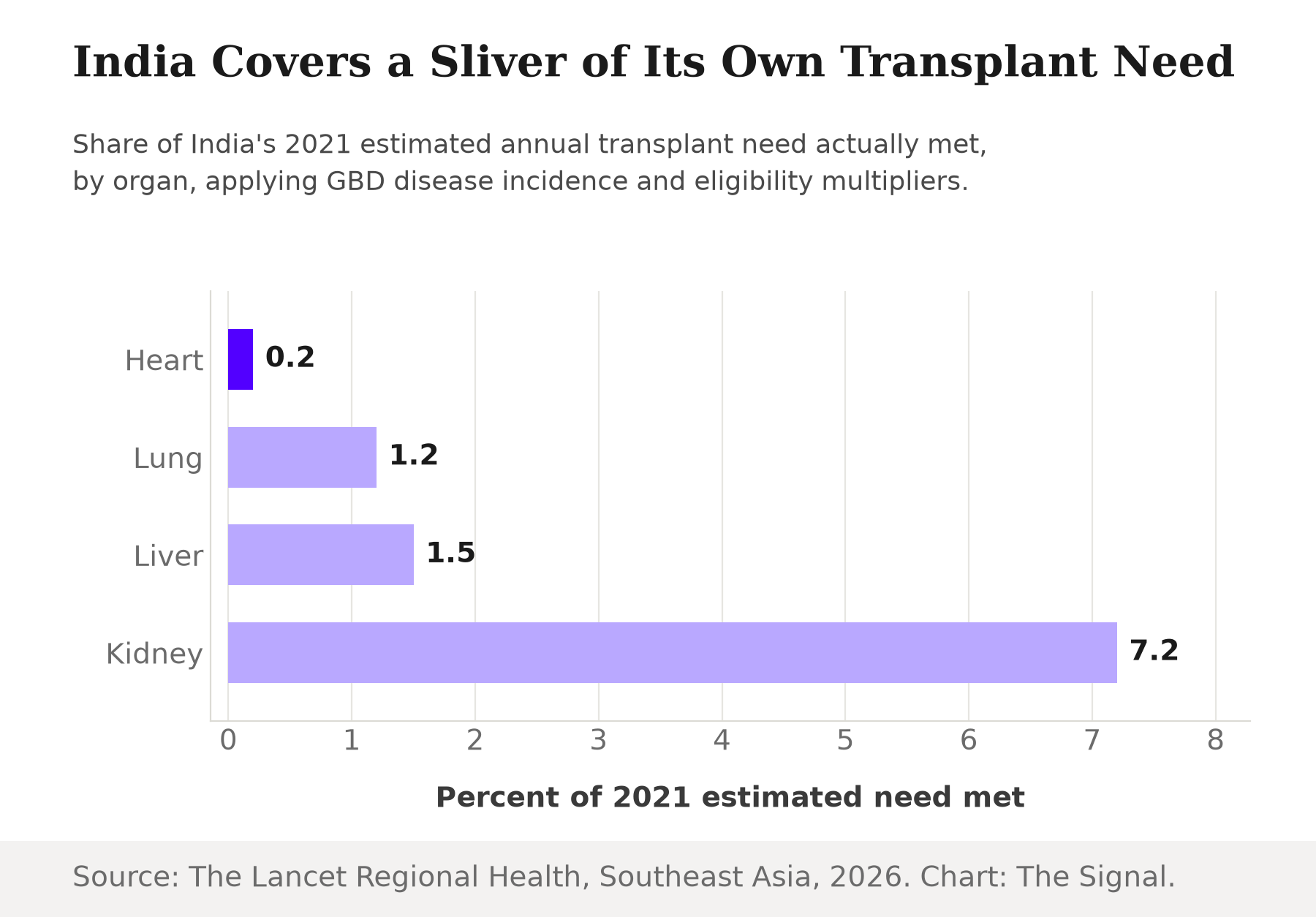
A record volume and a rounding error, at once
Both numbers are true of the same country in overlapping years. Global transplant volumes across 194 countries from 2008 to 2023 show the United States, China, and India as the three biggest producers by raw count: India's total climbed from 5,855 transplants in 2008 to 18,378 in 2023. But that same study notes that once volume is adjusted for population size, China and India's transplant rates fall well below the world average, the predictable effect of dividing a large number by an even larger population. Rank on absolute volume and rank on coverage of domestic need are different measurements, and India's health ministry has so far publicized the one that looks like an achievement.
The unmet need is not abstract. As of August 2025, more than 63,000 people in India were on the waiting list for a kidney transplant and about 22,000 for a liver transplant, with the ministry describing the national organ donation rate as still under 1 percent of the population. Kidney transplantation carries the largest capacity gap of any organ worldwide, more than 200,000 procedures short of ideal per-capita benchmarks as of 2023, and India alone accounts for nearly 50,000 of those missing kidney transplants. India is not a marginal contributor to the world's transplant shortfall; it is one of the two or three biggest single sources of it.
A geography problem, not a population problem
The instinctive defense is that India's coverage percentages look tiny only because the denominator, 1.4 billion people, is enormous. That defense does not survive a look inside India's own borders. Five states, Tamil Nadu, Delhi NCR, Kerala, Maharashtra, and Telangana, held just 29.3 percent of India's population in 2024 but performed 79.6 percent of its kidney transplants, 87.4 percent of liver, 87.0 percent of heart, and 96.1 percent of lung transplants. If the shortfall were purely a function of population size, capacity would track population evenly across states. It does not: Uttar Pradesh, India's most populous state, performed only 447 kidney transplants in 2024, a rate of 1.9 per million people, and Bihar performed just 31, a rate of 0.2 per million, with several north-eastern states reporting zero. The gap goes deeper than underused capacity: registered infrastructure itself is missing across much of the country. India had 183 centres registered for liver transplants as of 2022, and Tamil Nadu alone held 42 of them and Maharashtra 36, while Uttar Pradesh had just 5, Bihar had 1, and eleven states, most of them in the northeast, had none at all. Building more centres in Lucknow or Patna, not just filling the ones that exist elsewhere, is the fix this data points to.
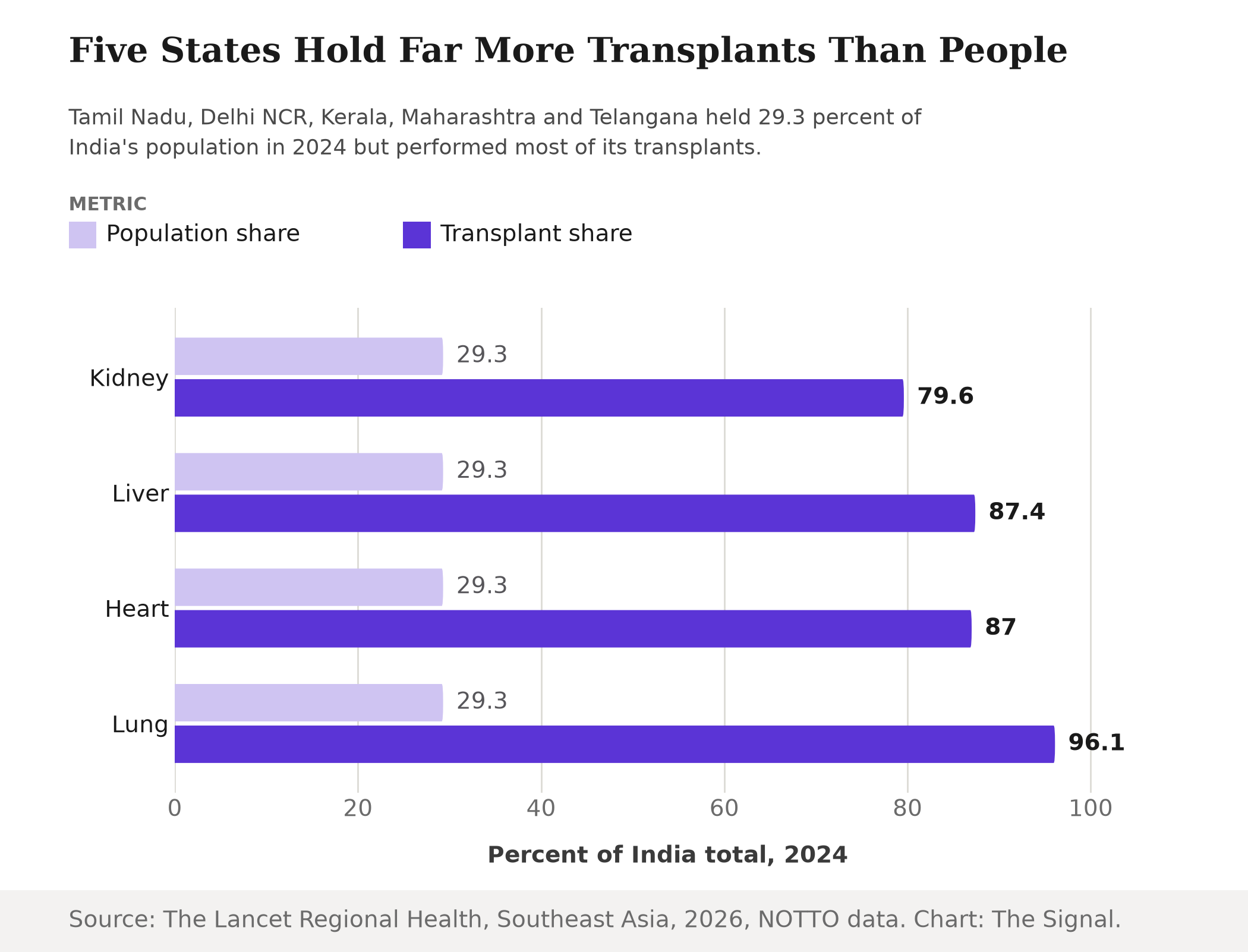
The study's own authors, at the Institute of Liver and Biliary Sciences and Fortis Vasant Kunj, name the mechanism directly: continued transplant capacity growth driven largely by private, urban-centred hospitals is unlikely to close the national gap and may deepen the existing inequity between states that already have transplant infrastructure and states that do not. A hospital that adds capacity in Chennai or Delhi serves patients who can already reach Chennai or Delhi. It does nothing for a patient in Patna.
Reaching one of those hospitals is only half the barrier; paying for it is the other half. A peer-reviewed study of kidney-transplant patients even at a public, subsidized hospital in Chandigarh found direct treatment costs of $2,151 to $23,792, and 82 percent of patients suffered a financial crisis during treatment, severe for 54 percent of them. That is the subsidized public system. The private, urban hospitals where most of India's transplant capacity actually sits do not charge less. A patient who travels from Patna to Chennai for a transplant still has to afford one.
The supply chain starts with donors, and India's is thin
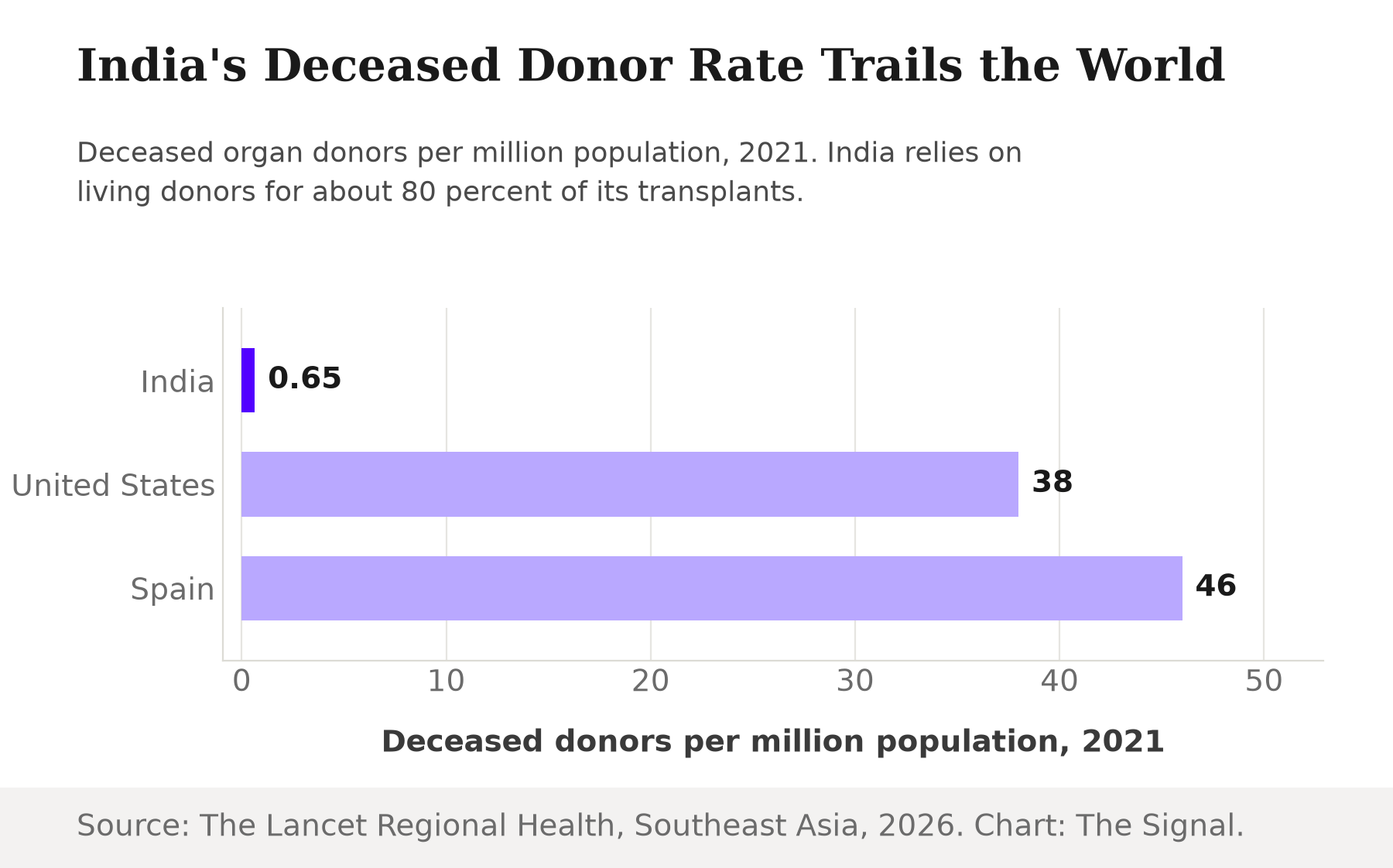
Part of why capacity concentrates where it already exists is that India's transplants mostly do not depend on a national deceased-donor pipeline, the kind of infrastructure that can serve any region with an intensive care unit and a retrieval team. India's deceased-organ-donor rate was 0.65 per million population in 2021, a figure 70-fold lower than Spain's rate of 46 per million and 58-fold lower than the United States' rate of 38 per million, and roughly 80 percent of India's transplants still come from living donors. A living-donor transplant needs a willing, compatible relative and a hospital that can run two operations at once, a model that scales with private investment in a handful of cities. It does not build the death-notification and retrieval network that turns a death anywhere in the country into a transplant somewhere else in it. Spain and the United States built that second network; India has largely built the first.
The trajectory does not close the gap
The same study modeled India's transplant need forward to 2040 and tested how far realistic supply growth could close today's gap. By 2040, annual need is projected to reach 143,722 kidney, 210,649 liver, 95,711 heart, and 12,846 lung transplants. Even its moderate-reform scenario, assuming 8 to 10 percent annual growth in supply, a pace few health systems sustain for over a decade, leaves the country far short.
Even under faster supply growth, most organs stay under 7 percent coverage through 2040.
| Organ | Projected annual need by 2040 | Coverage in 2030 (moderate reform) | Coverage in 2040 (moderate reform) |
|---|---|---|---|
| Kidney | 143,722 | 14.2% | 32.6% |
| Liver | 210,649 | 3.1% | 6.9% |
| Heart | 95,711 | 0.4% | 0.8% |
| Lung | 12,846 | 2.3% | 5.3% |
Source: The Lancet Regional Health, Southeast Asia, 2026.
Even in that scenario, 2040 coverage reaches only 32.6 percent for kidney and stays below 7 percent for liver, heart, and lung. Kidney coverage more than doubles between 2030 and 2040 in the model, 14.2 percent to 32.6 percent, while heart coverage doubles from a base so small, 0.4 percent to 0.8 percent, that it stays a rounding error either way. Fourteen years of sustained, above-trend growth still leaves three of four organs short of one transplant in ten.
The honest objection
The strongest case against calling this a distributional failure is that India's transplant system is genuinely young and still compounding: volume rose from 5,855 procedures in 2008 to 18,378 in 2023, and a system growing that fast may simply need more time to reach states it has not yet reached, the way infrastructure typically spreads outward from the first cities. On this view, Uttar Pradesh and Bihar simply sit earlier on the same curve Tamil Nadu and Kerala already climbed.
That case would be stronger if the study's own forward model did not already price in fourteen more years of above-trend growth and still find heart coverage stuck at 0.8 percent by 2040. A system on a genuine spreading curve should show the gap between leading and lagging states narrowing over time. Modeling the supply side directly rather than assuming diffusion, the study's authors conclude the opposite: more of the same kind of growth, private and urban, is likely to widen that gap, not close it. The disagreement is not about whether India's transplant system is growing. It plainly is. It is about whether growing the same model faster changes the outcome, and the study's own projection says it does not.
The Signal
India's transplant numbers support two true headlines at once, and for years the health ministry has needed to publish only one of them. The volume headline, a record 18,900 transplants and third place globally, is real. The coverage headline, 0.2 percent of national heart-transplant need met, is also real, describes the same country in the same period, and is the one that determines whether a specific patient in Lucknow or Patna gets an organ. What ties them together is not population size, since a five-state cluster with under a third of India's people already performs most of its transplants. It is geography and business model: capacity has grown where private hospitals and paying patients already cluster, not where deceased-donor infrastructure could reach every state. That July 2026 study is the first to model that gap out to 2040 and show that building the same way again does not close it. What to watch is whether India's transplant policy shifts toward deceased-donor retrieval networks that can serve Uttar Pradesh and Bihar as readily as Chennai and Delhi. If the next expansion looks like the last one, more private beds in the same five states, the national number will keep climbing while the coverage number barely moves. A transplant program is not judged by how many procedures it can perform. It is judged by how many of the people who need one can reach it.
Reporting basis: the 2021 and 2040-projection coverage figures, the five-state concentration data, the deceased-donor-rate comparison, and the private-urban-concentration conclusion are all from the same Lancet Regional Health, Southeast Asia study by researchers at the Institute of Liver and Biliary Sciences and Fortis Vasant Kunj, published July 29, 2026, and are therefore a single origin appearing across multiple figures of one paper. The 2024 record-transplant-volume figure and the kidney and liver waiting-list counts are from India's Ministry of Health and Family Welfare and NOTTO, via Press Information Bureau releases, a second origin. The 2008-2023 global volume trend and the global kidney-transplant-gap estimate are from a separate peer-reviewed eClinicalMedicine study covering 194 countries, a third origin. The 2022 liver-transplant-centre registration data by state is from a peer-reviewed study in The National Medical Journal of India, a fourth origin. The out-of-pocket cost and financial-crisis figures are from a 2013 peer-reviewed PLOS ONE study of patients at a public hospital in Chandigarh, a fifth origin. The characterization of India's growth trajectory as outpacing coverage growth, and the 2030-to-2040 kidney coverage comparison, are The Signal's calculations from those figures.