A cohort study out of Bengaluru is reshaping how India talks about dementia risk. Among 589 adults aged 45 and older whom the Indian Institute of Science's Centre for Brain Research followed, using data collected in 2022, participants with hearing loss were 1.69 times more likely to have cognitive impairment than those without it, after adjusting for other factors. Impairment showed up in 20.6 percent of those with hearing loss against 13.6 percent of those without. After the same full statistical adjustment, only diabetes and sex remained significantly associated with cognitive impairment in that cohort. People with diabetes had cognitive impairment at nearly double the rate of those without, 23.9 percent against 12.8 percent, and women showed higher prevalence than men, 18.5 percent against 14.2 percent. Read on its own, that is a clean, specific India story: swap the West's cardiometabolic checklist for diabetes, hearing and sex, and you have India's dementia profile.
It is worth slowing down on that. A cohort of 589 people from one city is not India's national dementia profile, and India already has one. The Longitudinal Aging Study in India, Diagnostic Assessment of Dementia (LASI-DAD), the first nationally representative dementia study in the country, estimates that 7.4 percent of Indians aged 60 and older live with dementia, about 8.8 million people nationally, using data gathered in 2019. When the same LASI-DAD investigators ranked risk factors by how much of the national dementia burden each one could theoretically explain, a lack of formal education carried the single largest weight, about 22 percent, while diabetes showed no statistically significant association with dementia at the national level. That is an India-specific profile, diverging from the global benchmark that most prevention guidance draws on. The country's own largest study does not rank diabetes as a leading national driver at all.
A cohort and a country are not the same population
The Bengaluru cohort and the national LASI-DAD survey were built to answer different questions, and they answer them differently.
| IISc Centre for Brain Research cohort | LASI-DAD national study | |
|---|---|---|
| Scope | 589 adults, age 45+, one city | Nationally representative, age 60+ |
| Data collected | 2022 | 2019 |
| Published | 2025 (Alzheimer's & Dementia: DADM) | 2023 to 2024 (Alzheimer's & Dementia; BMJ Public Health) |
| Factors that stayed significant after adjustment | Diabetes, sex, hearing loss | Lack of formal education (about 22 percent of national cases) |
| Diabetes finding | Nearly double the impairment rate | Not statistically significant nationally |
Source: Agrawal et al., Alzheimer's & Dementia: DADM, 2025; Lee et al., Alzheimer's & Dementia, 2023; LASI-DAD population-attributable-fraction study, BMJ Public Health, 2024.
A single urban cohort can measure hearing and blood sugar with more clinical precision than a national household survey ever will. What it cannot do is tell you what drives dementia for the country as a whole, because 589 people in one city are not a sample of India. That is precisely what LASI-DAD's national sample is built for, and its answer does not match the cohort's.
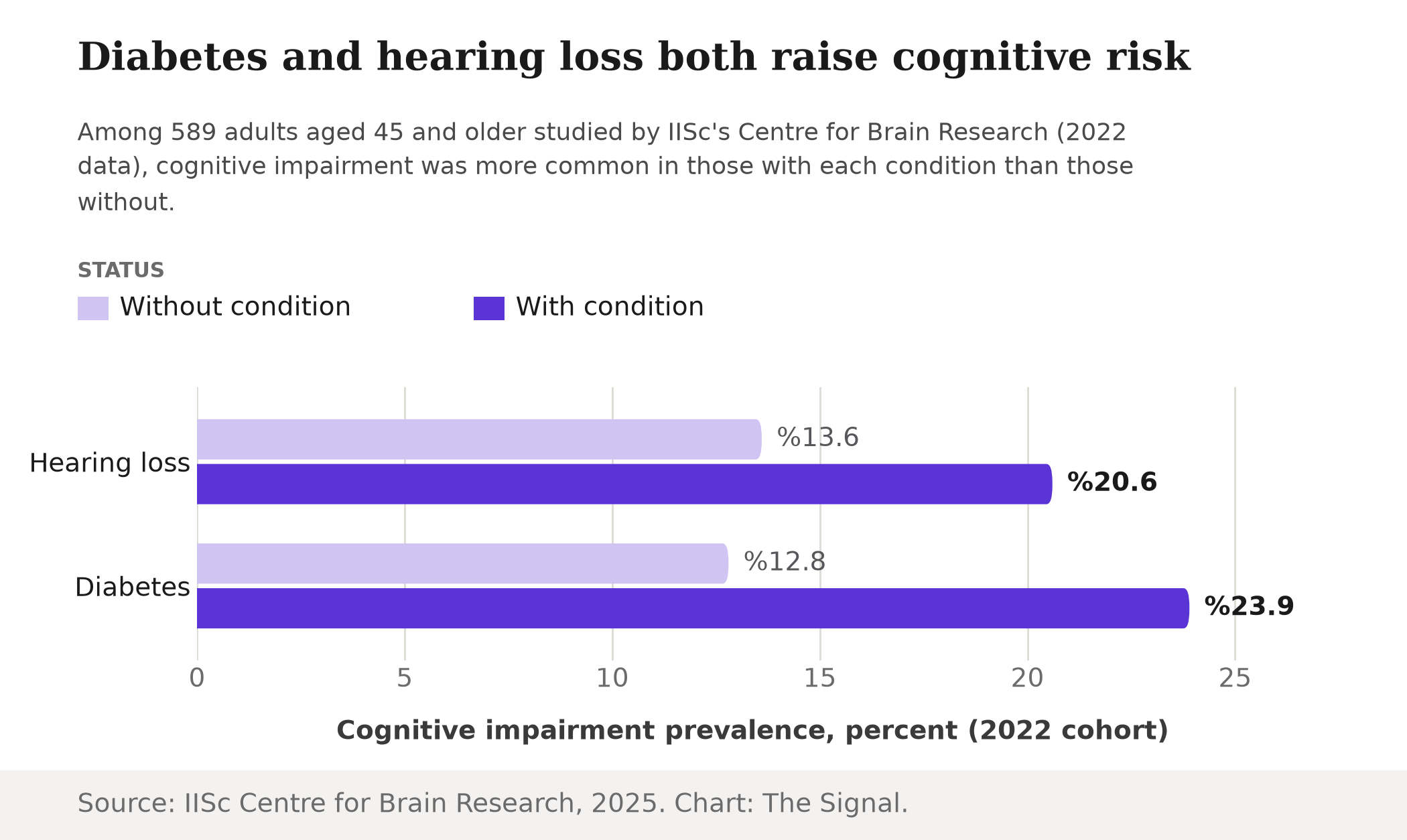
Source: Agrawal et al., Alzheimer's & Dementia: DADM, 2025; companion paper on diabetes and sex. Chart: The Signal.
Where the sex gap disappears
The cohort's finding that women showed higher cognitive impairment than men, 18.5 percent against 14.2 percent, echoes a pattern the national data shows too, and then complicates. Nationally, raw dementia prevalence is almost double among women versus men, 9.0 percent against 5.8 percent, in the 2019 LASI-DAD data. But once the same national analysis adjusts for age and education, the sex gap becomes statistically insignificant, an odds ratio of 1.2 with a 95 percent confidence interval of 0.9 to 1.6, suggesting the raw gap reflects women being older and less educated on average rather than sex itself.
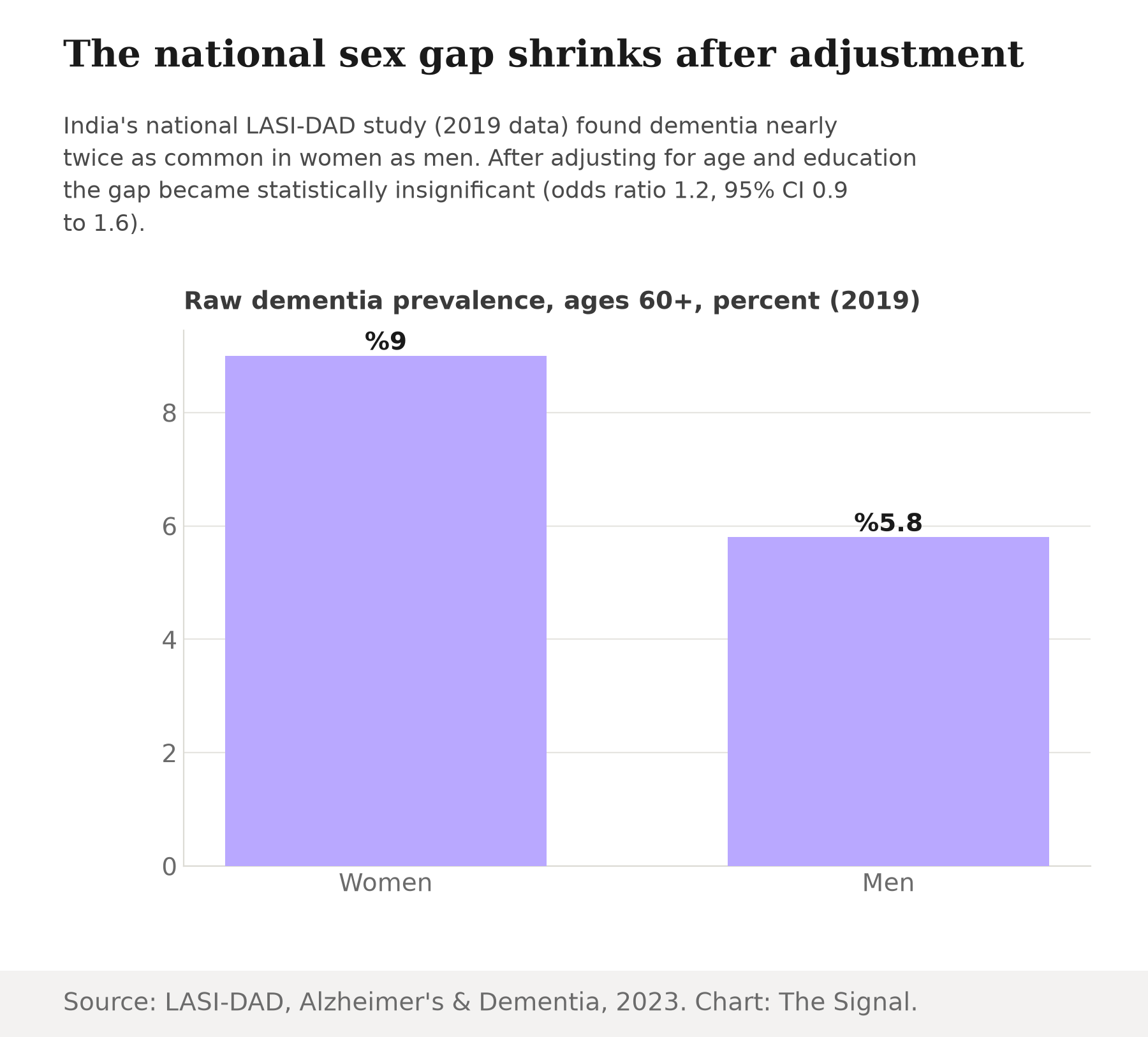
Source: LASI-DAD sex differences in dementia prevalence, IIPS. Chart: The Signal.
That is a preview of the same trap the diabetes finding falls into. A raw, unadjusted comparison in India's dementia data keeps surfacing gaps that look causal and are not. Sex looked like a driver until age and education were priced in. The honest question is whether diabetes survives the same scrutiny nationally, and the national data says it does not.
A too-common condition with no traceable national link
India had an estimated 101 million people living with diabetes in 2021, per the ICMR-INDIAB national survey, the country's largest population-based study of diabetes and metabolic disease. Against the roughly 8.8 million Indians aged 60 and older living with dementia in 2019, that is a population more than eleven times larger, and a condition that reaches nearly every extended family in the country. Yet at the national level, the same LASI-DAD analysis that named lack of education the largest single risk factor found diabetes carried a smaller estimated relative risk that was not statistically different from one, the technical way of saying the data cannot distinguish its effect from no effect at all.
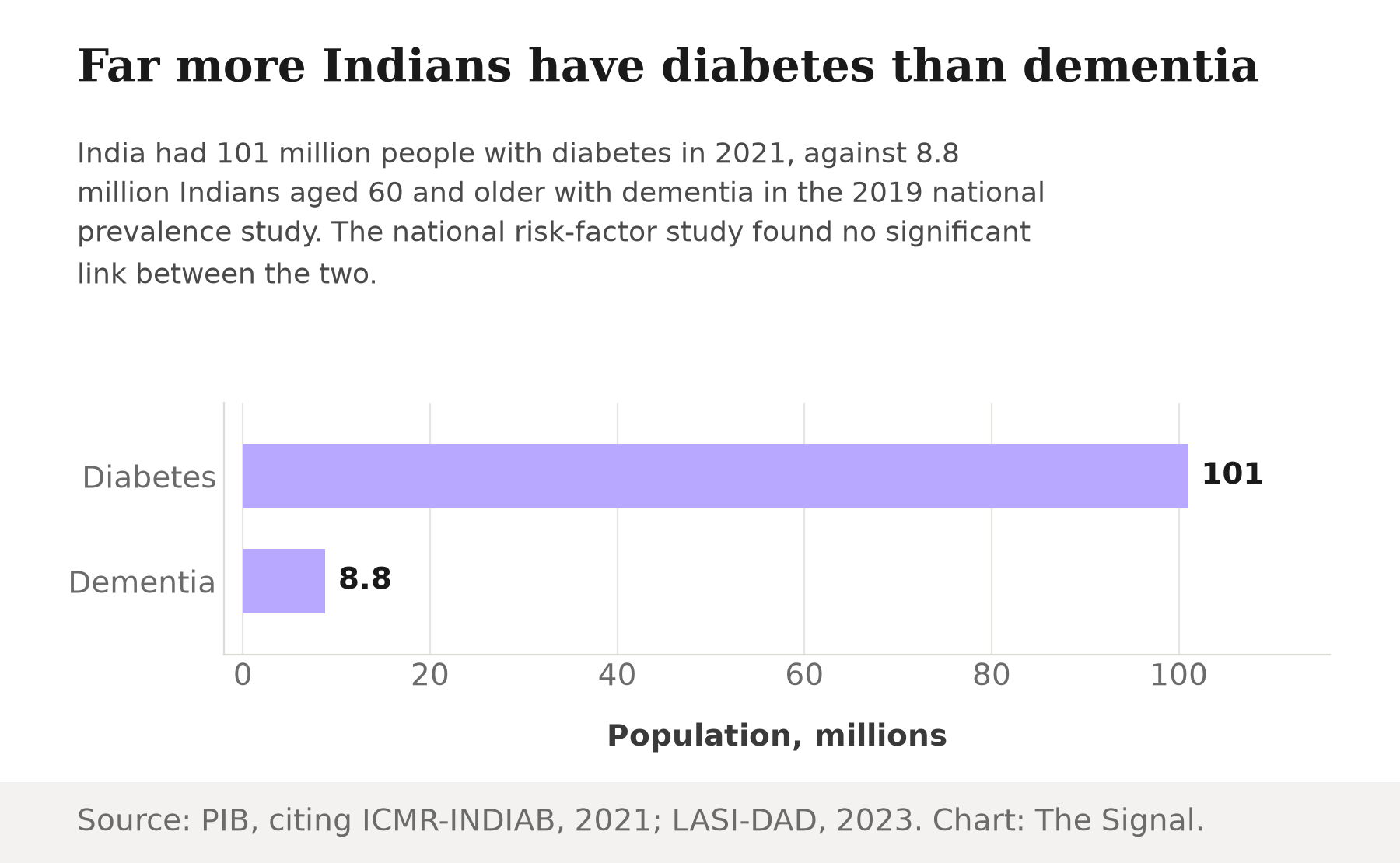
Source: PIB: ICMR-INDIAB national diabetes prevalence; LASI-DAD: prevalence of dementia in India; LASI-DAD population-attributable-fraction study. Population comparison is The Signal's calculation. Chart: The Signal.
That gap between scale and significance is the whole point of a population-attributable-fraction study. It is not asking whether diabetes ever contributes to an individual's cognitive decline. The question is how much of the national dementia count would shrink if diabetes were removed from the population, and on the current national data the honest answer is: not enough to measure with confidence.
The global weight India doesn't carry
The 2024 update to the Lancet Commission on dementia estimates that around 45 percent of dementia cases globally are theoretically preventable by addressing 14 modifiable risk factors across the life course, and that framework is the one current prevention guidance, including in India, generally draws its risk-factor weightings from. India's own national numbers do not simply confirm a smaller local version of that global list. The LASI-DAD population-attributable-fraction analysis found lack of education carrying the largest single share of national risk, an India-specific profile that diverges from the global Lancet Commission ranking. A framework built mostly on high-income cohorts, where cardiometabolic risk factors carry more of the explanatory weight because basic schooling is close to universal, does not automatically transfer to a country where large numbers of older adults never had that schooling to begin with.
The honest objection
The strongest case for taking the Bengaluru cohort seriously anyway is that it measured things the national survey could not. Hearing loss and diabetes in the IISc cohort came from audiometric testing and clinical diagnosis, not self-report, in a defined group of older urban adults. A local, clinically precise finding can be real even when a national, self-reported survey fails to detect the same effect at population scale, particularly if the effect is concentrated in cities or in a specific age band the national average smooths over.
That case does not fail, but it should not be read as a contradiction of the national number either. The population-attributable-fraction study did not find that diabetes has zero effect on individual risk. It found that diabetes's estimated relative risk nationally was small and statistically indistinguishable from one, which is compatible with a real but modest individual effect that the education gap simply dwarfs at population scale. The two studies are not fighting over the same fact. One measures what raises an individual's odds in a clinical sample. The other asks what would move the national count if it were fixed. India's screening rupee has to pick one of those two questions before it can be well spent.
The size of the population behind that 22 percent figure is not small. In the National Sample Survey's 75th Round, the most recent nationally representative count of education levels among India's elderly, only 40.5 percent of Indians aged 60 and older were literate through formal schooling, meaning close to three in five had never received formal schooling, including 58.1 percent who were not literate at all. That is not a narrow subgroup a screening program can afford to treat as a footnote. It is most of the country's older population.
The Signal
Two studies, two honest answers, and they point in different directions once you ask what a policy rupee should chase. If the goal is treating the patients already in front of a clinic, the Bengaluru cohort's message holds: screen for hearing loss and diabetes, because both tracked with worse cognitive outcomes in that group. If the goal is shrinking India's national dementia count, the LASI-DAD numbers are the ones to act on, and they point at cognitive stimulation and education access for adults who missed schooling decades ago, not a blood sugar test. Watch which number the next national dementia strategy cites. A plan built around diabetes screening is answering the clinic's question. A plan built around adult literacy and cognitive engagement for the undereducated old is answering the country's.
Reporting basis: the hearing loss and diabetes cohort findings are from a single 2025 study by Agrawal and colleagues, also reported in a companion paper on diabetes and sex, based on 2022 data collected by IISc's Centre for Brain Research in Bengaluru, one origin for both findings. National dementia prevalence and the raw sex gap are from the LASI-DAD study published by Lee and colleagues, with the sex-adjustment figures via IIPS, drawing on 2019 survey data. The national population-attributable-fraction ranking of risk factors, including the education and diabetes findings, is from a separate 2024 analysis of the same LASI-DAD survey data published in BMJ Public Health, a distinct study built on the same underlying dataset. India's diabetes prevalence figure is from the ICMR-INDIAB national survey as reported by the Press Information Bureau. The global preventable-dementia share and the 14-factor framework are from the Lancet Commission's 2024 update. The population-scale comparison between India's diabetes and dementia counts is The Signal's calculation from those figures. The education-level figures for India's elderly are from the Ministry of Statistics and Programme Implementation's "Elderly in India 2021" report, citing NSS 75th Round data.