On 28 February 2026, India's health ministry launched a free, nationwide HPV vaccination programme for 14-year-old girls. News on AIR, the Government of India's news service, reports the initiative aims to vaccinate approximately 1.15 crore girls, about 11.5 million, every year across every state and union territory. Read only the launch announcement and the story is simple: the country carrying one of the world's largest cervical cancer burdens is finally rolling out the vaccine that prevents it, for free, through the public health system built to reach furthest.
The reveal: a district beating a capital-region city five to one
It is worth slowing down on that. Five months into the drive, the places actually hitting their targets are not the ones with India's best hospitals and busiest health bureaucracies. They are smaller, less-watched districts nobody would have picked as the programme's early success story. By early May 2026, The Indian Practitioner reports, citing Haryana's National Health Mission U-WIN data, Karnal, a mid-sized Haryana district, had reached 37 percent of its HPV vaccination target, 4,525 cumulative doses. Faridabad, the Haryana city inside the National Capital Region with some of the state's best-equipped hospitals, had reached just 7 percent, 1,503 doses, in the same window. Karnal is out-vaccinating Faridabad five to one.
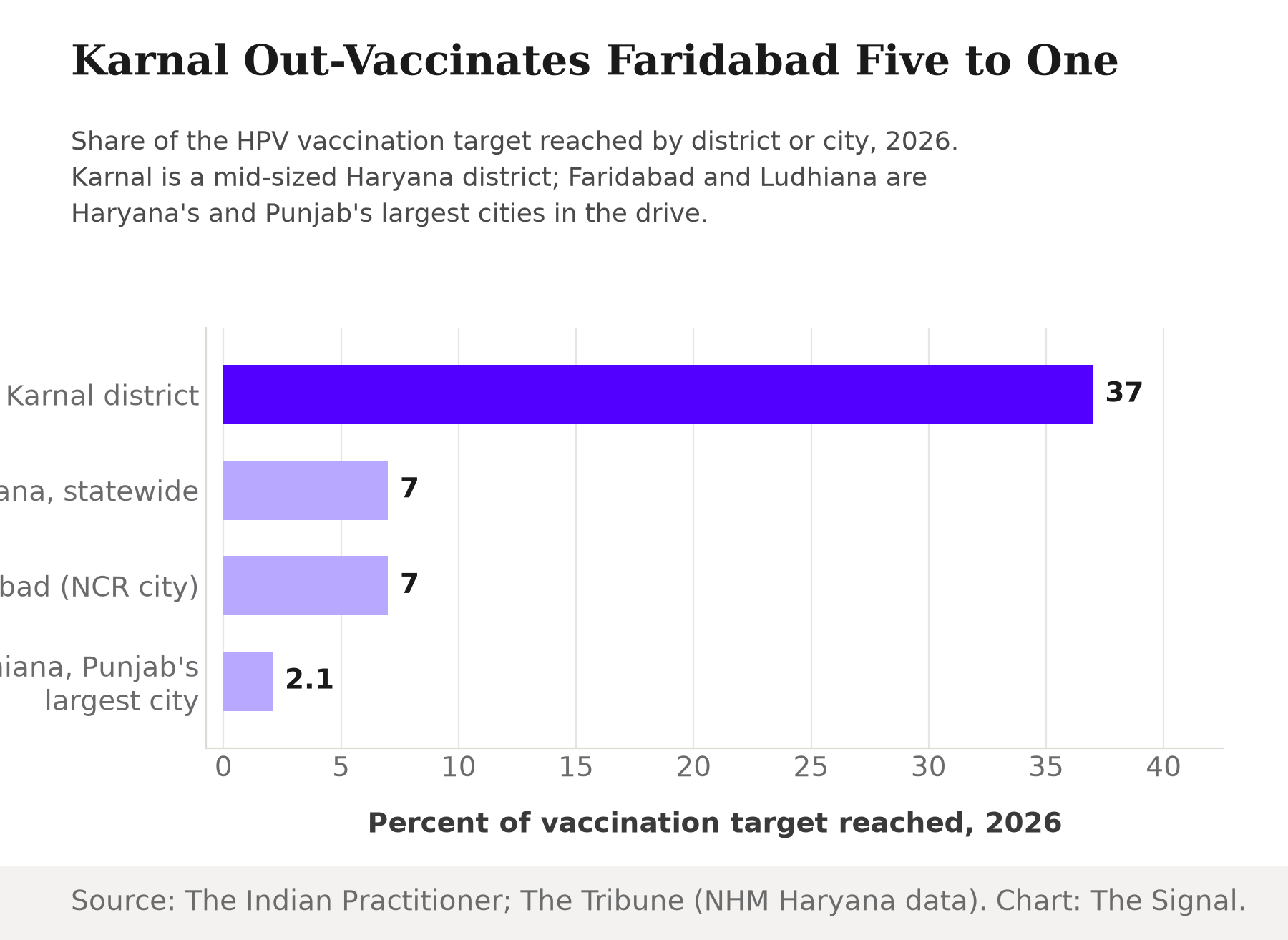
Source: The Indian Practitioner, citing Haryana's National Health Mission U-WIN data; The Tribune; The Tribune. Chart: The Signal.
Karnal's lead is not unexplained. The Tribune reports the district administration pulled in the Education, Panchayati Raj and Zila Parishad departments to press parents directly, sent teams door-to-door and into schools to work through misconceptions face to face, and had ASHA workers visit families after school hours so no eligible girl was missed. That is not a bigger budget or better hospitals; it is more people, in more households, more often, which is exactly the kind of effort a sprawling metro health department has to spread thinner.
The lag is not one city's stumble
The gap is not a Faridabad-specific problem. The Tribune reports, citing Haryana's Health Department, statewide, only 19,300 girls, 7 percent of the estimated target population, had been vaccinated in the drive's first two months. The same shortfall turns up outside Haryana, too. In Ludhiana, Punjab's largest city, The Tribune reports only 825 vaccinations had been completed by early June 2026 against a target of 40,000 girls, about 2 percent, so far behind that officials extended the drive by another 90 days.
Two states, two of their biggest cities, both trailing a district few outside Haryana had heard of before this drive.
| Location | Type | Doses given | Coverage of target | As of |
|---|---|---|---|---|
| Karnal district, Haryana | Mid-sized district | 4,525 | 37% | Early May 2026 |
| Faridabad, Haryana | NCR city, major hospitals | 1,503 | 7% | Early May 2026 |
| Haryana, statewide | Entire state | 19,300 | 7% | First two months of the drive |
| Ludhiana, Punjab | State's largest city | 825 (of 40,000 target) | About 2% | Early June 2026 |
Source: The Indian Practitioner; The Tribune; The Tribune.
What the vaccine is racing against
The stakes behind these numbers are not abstract. A peer-reviewed analysis of GLOBOCAN 2022 estimates, published via PMC, finds that China and India together accounted for 39 percent of the world's cervical cancer deaths in 2022, 16 percent from China and 23 percent from India.
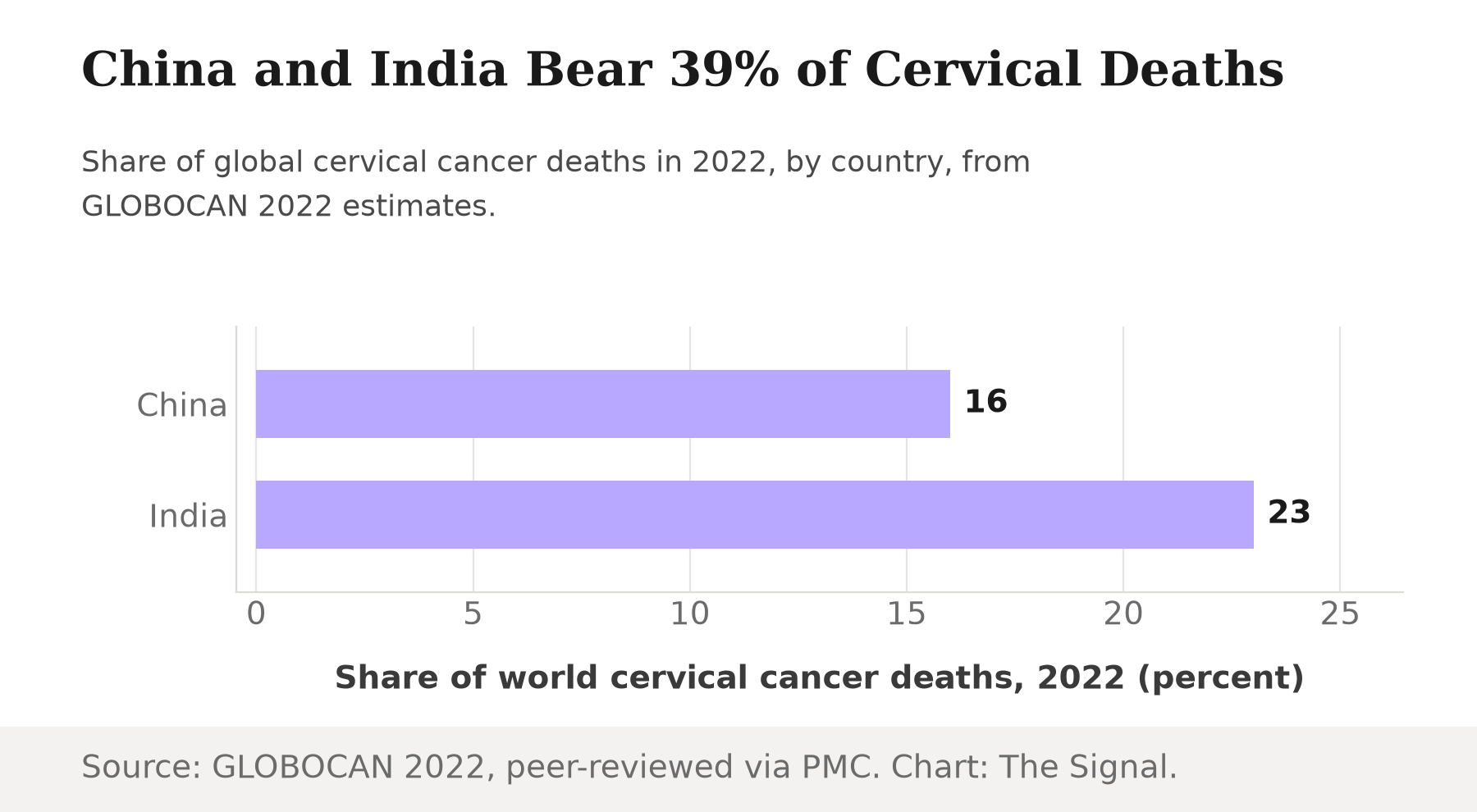
Source: Cervical cancer burden and prevention in India: an analysis of GLOBOCAN 2022 estimates, via PMC. Chart: The Signal.
That 23 percent share, per the same GLOBOCAN 2022 analysis, is the scale of the disease the vaccination programme is meant to work against over the coming decades. A drive that reaches 37 percent of its target in one district and 2 percent in another is not distributing that protection evenly, and the cities with the resources to do better are not where it is landing.
The awareness gap the drive inherited
Part of the answer may sit further upstream than any single clinic's outreach. In a 2023 field study across underserved communities in Delhi-NCR, Tripura and Karnataka, conducted before India's national programme existed, a peer-reviewed study in Frontiers in Global Women's Health finds only four of 174 participants had prior knowledge of the HPV vaccine.
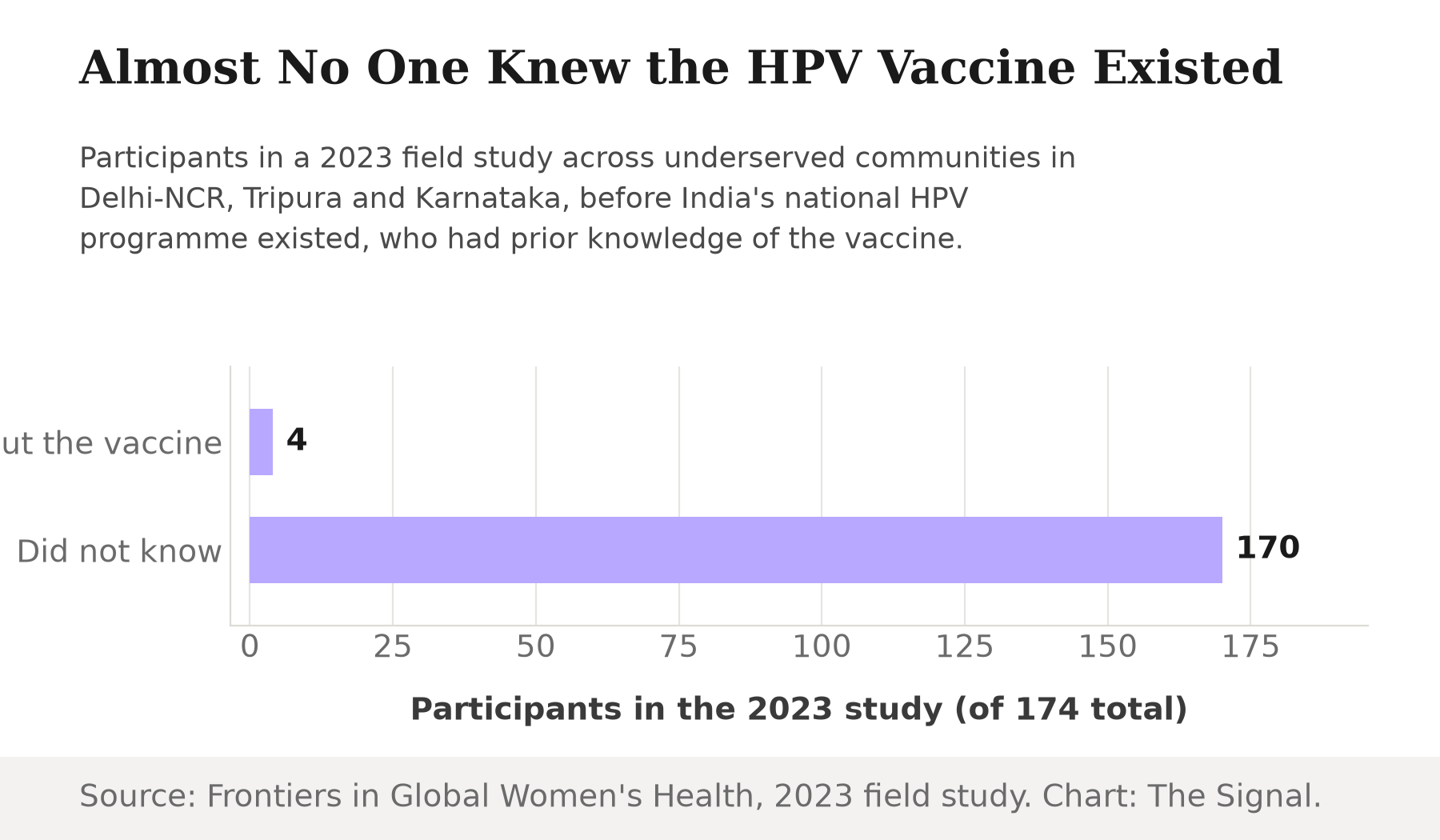
Source: Frontiers in Global Women's Health. Chart: The Signal.
The national drive did not launch into a population primed to say yes. Per the same 2023 field study, it launched into one that, three years earlier and in some of the same geography this drive now covers, had barely heard the vaccine existed. Closing that gap takes sustained, face-to-face outreach, the kind smaller health administrations with fewer competing priorities may find easier to run than a sprawling metro health department does.
Some of that blank slate has a specific history. An Observer Research Foundation analysis finds seven girls died during a 2009 HPV vaccine demonstration project in India; a government-appointed inquiry concluded none of the deaths was likely caused by the vaccine, and a 2013 parliamentary committee report that followed criticised the project's consent and oversight failures rather than the vaccine itself. But the distinction between a regulatory failure and a vaccine danger did not survive public memory intact, and the episode still shadows this drive seventeen years on.
In July 2026, India also placed a different kind of bet. The Hans India reports the Indian Council of Medical Research licensed SHetA2, an indigenous anti-HPV therapeutic candidate for treating precancerous cervical lesions, to Emcure Pharmaceuticals. A homegrown drug candidate for lesions the virus has already caused would be a genuine advance if it clears development. But it treats what the vaccine is meant to prevent. It does nothing for a 14-year-old in Faridabad or Ludhiana who has not yet had the shot that would keep her from needing it.
The honest objection
The strongest case against reading this as an urban problem is that Faridabad's 7 percent is not actually below Haryana's own state average of 7 percent. It is exactly at it. If the whole state is clustered near 7 percent, singling out one National Capital Region city for underperforming may be unfair. On this reading, Karnal is the real outlier, a district that for some local reason, more effective health workers, less rumour-driven resistance, is executing well, while the rest of the state, urban and rural alike, is simply running behind together.
That case holds for Faridabad on its own. It does not hold once Ludhiana's roughly 2 percent enters the picture. Ludhiana sits in a different state, under a different health department, running on its own timeline, and that coverage is well below Haryana's statewide 7 percent, not merely in line with it. If a single struggling capital-region city were the whole story, a similarly large city two states away, with no shared administration, would not be lagging even further behind. The pattern that survives both cases is narrower than "cities lag": India's two biggest cities in this drive, in two different states, are underperforming a rollout that at least one smaller district is executing well, and that gap needs its own explanation, not just more time.
The Signal
The launch numbers said this would be a story about scale, 1.15 crore girls a year, delivered free, nationwide. Five months in, it is a story about distribution: a mid-sized Haryana district is proving the model works, while Faridabad and Ludhiana, the two places best equipped on paper to run it, are among the furthest behind. Watch what Ludhiana's extended 90-day window and Haryana's coming months do to that gap. If the big cities catch up once outreach intensifies, this was a slow start. Karnal's pattern spreading instead would mean the standard story about vaccine access, that infrastructure is the bottleneck, has it backwards for this vaccine, in these cities. A free dose sitting in a clinic does not protect anyone. Only the one that reaches an arm does.
Reporting basis: the national programme's launch and target are per News on AIR, the Government of India's news service. Karnal and Faridabad's coverage figures are per The Indian Practitioner, citing Haryana's National Health Mission U-WIN dashboard. Haryana's statewide figure and Ludhiana's district figure are both per The Tribune, citing the Haryana Health Department and Ludhiana's district health department respectively; these are two separate Tribune reports on two separate health administrations. The global cervical cancer death shares are from a peer-reviewed analysis of GLOBOCAN 2022 estimates, via PMC. The 2023 awareness-gap finding is from a peer-reviewed field study in Frontiers in Global Women's Health. The SHetA2 licensing is per The Hans India. Karnal's outreach tactics are per The Tribune, citing Karnal's district administration. The 2009 demonstration-project history is per an Observer Research Foundation analysis. The five-to-one comparison between Karnal and Faridabad is The Signal's calculation from those two figures.