Shanghai Jiao Tong University's medical school has opened a formal investigation into the death of a 6-year-old patient who was treated at its affiliated Xinhua Hospital with an experimental gene-editing therapy, and who died about a week after a spinal infusion of the treatment. The instinctive read is the one most coverage has reached for: a fringe trial, thin oversight, a family failed by a regulatory vacuum. The parents had put together more than $860,000 of their own savings and money borrowed from relatives to finance a base-editing therapy built specifically for their daughter.
It is worth slowing down on that read. Xinhua Hospital is not a back-alley clinic. It is the teaching hospital of one of China's most prominent medical schools, the kind of institution that runs its own ethics review and answers to a research bureaucracy most fringe operators never see. That process still cleared the trial: the hospital's ethics committee approved it without having reviewed the final report of the primate safety study, which found that all four treated monkeys had developed moderate to severe liver damage. A trial run inside that system still ended in a death, and the accountability that followed it was thin. The hospital paid a fine of only about 24,000 yuan, roughly $3,500, to local health authorities in September 2025 after the girl's death.
Line up the two numbers the case actually produced and the story stops being about missing rules and starts being about incentives. The fine came to about $3,500 against the family's $860,000, smaller by a factor of roughly 245.
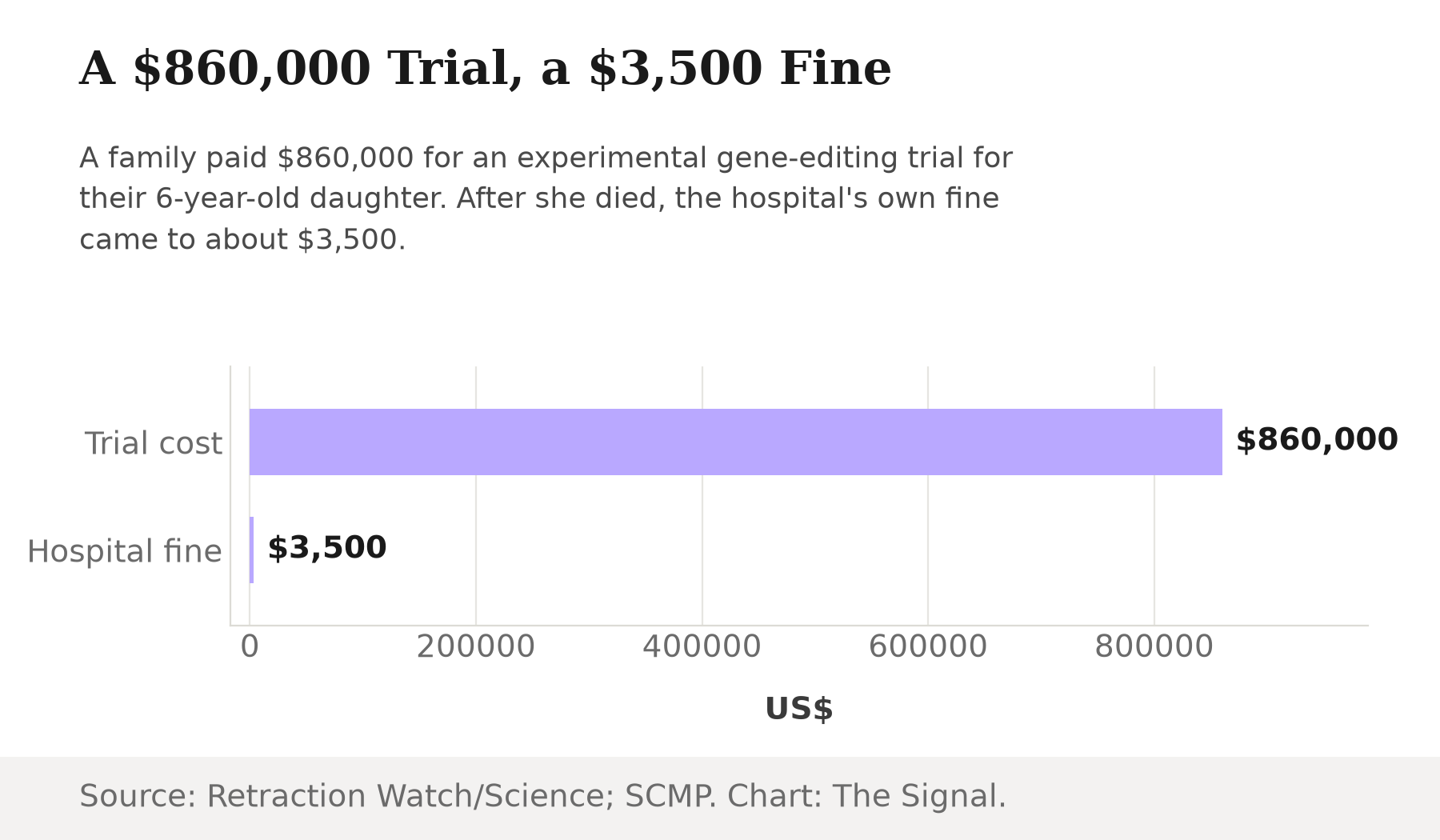
A fine built to change an institution's behavior would need to outweigh what that institution stood to gain from running the trial at all. One priced at $3,500 against $860,000 already spent changes nothing: for any hospital weighing whether to run another paid, one-patient experimental case, the downside is negligible next to the fees such a case can generate.
The market that pays regardless of the outcome
The complaint that gene-editing science outran its regulators gets the mechanism backward. Shanghai Jiao Tong University's medical school says it attaches great importance to the matter and has set up a special working group to conduct a comprehensive investigation into the incident, which is what a functioning academic institution does after a death, not what an unregulated one does. The failure sits earlier than that. A family can pay for an experimental therapy built around their own child, a hospital can run it, and if the outcome is fatal the cost to the institution is a fine two orders of magnitude smaller than the money that changed hands. The family's $860,000 came directly from their own savings and relatives, not from a grant or a sponsor whose future funding depended on the trial working. A market like that does not care whether the science succeeds. It only needs someone willing to pay for the attempt, and a fine small enough to not change the arithmetic of taking that payment again.
India runs the same trade under different paperwork
India's National Guidelines for Stem Cell Research, issued in 2017 by the Indian Council of Medical Research and the Department of Biotechnology, carry no legislative basis, and neither body can enforce them or penalize a clinic that ignores them. That is not a hypothetical gap sitting unused. 117 clinical trials involving stem-cell interventions were formally registered in India as of 2025.
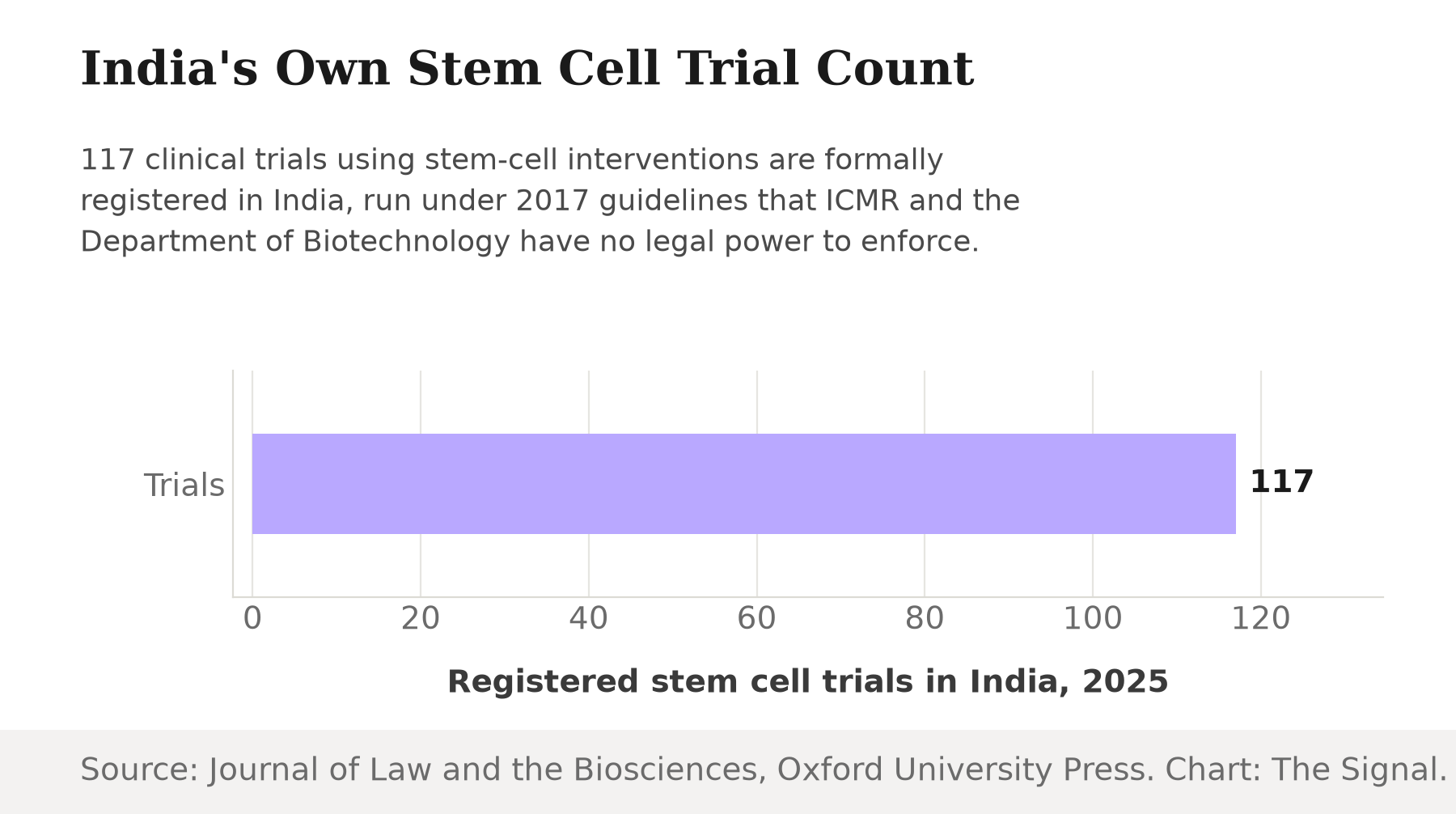
Every one of those registrations sits inside a system that can log a study but cannot discipline the clinic running it, the same asymmetry that let Xinhua Hospital absorb a $3,500 fine and move on. India's Supreme Court ruled in January 2026 that offering unproven stem-cell therapy fails doctors' own standard of care and that such treatment cannot continue as a commercial venture outside an approved clinical trial, a ruling that reaches directly at the fee-for-unproven-treatment model China's case exposed. A court ruling is not an enforcement agency, though. Until the ICMR or the DBT is actually handed the power to shut a clinic down, the judgment changes the legal record before it changes what a paying family can walk into and buy.
The honest objection
The strongest defense of what happened in Shanghai is that frontier medicine has nowhere else to go. A base-editing therapy built for one patient has no approved drug to test against and no established protocol a regulator can hold it to; demanding conventional trial infrastructure before any experimental gene therapy proceeds would foreclose the exact research that eventually produces approved treatments. Ethics review at a university hospital is a real check, not a formality, and the majority of compassionate-use cases like this one never make the news precisely because they do not end in death.
That case holds for the therapy itself, but not for the fine. Nothing about the novelty of base editing required the penalty for a fatal outcome to land at $3,500, an amount that changes no hospital's calculation about whether to run the next paid experimental case. The frontier justifies the science being unproven. It does not justify accountability being priced at a rounding error.
The Signal
China's investigation will likely produce findings about consent, dosage, or trial design. None of that will fix the actual defect, which sits upstream of the science: a fee-for-treatment market where a fatal outcome costs the provider a four-figure fine against a six-figure fee. India's own 117 registered stem-cell trials sit inside exactly that structure, guidelines with a name and a mission but no power to enforce, right up until a court case forces the argument. The number worth watching next is not whether China's investigation finds negligence. It is whether the fine for it, whenever it lands, is still smaller than what the family paid trying to save her.
Reporting basis: the girl's death and the university's investigation into it are per a joint Retraction Watch and Science investigation, and an Agence France-Presse dispatch carried here via Free Malaysia Today. The hospital's fine is per the South China Morning Post. The ethics committee's approval of the trial without reviewing the primate safety report is per Ara's coverage of the same Science/Retraction Watch investigation. The Indian regulatory detail, the guidelines' lack of enforcement power and the 117 registered trials, comes from a single peer-reviewed legal analysis in the Journal of Law and the Biosciences. The Supreme Court ruling is per the Supreme Court Observer's coverage of the judgment. The fine-to-fee ratio is The Signal's calculation from the family's payment and the hospital's fine.