On May 29, 2026, the Ministry of Health and Family Welfare and the International Institute for Population Sciences released NFHS-6, India's sixth National Family Health Survey, fieldwork 2023-24. The headline the ministry led with was a genuine win: under-5 child stunting fell from 35.5% in NFHS-5 (2019-21) to 29.3% nationally, a six-point drop in five years, "reflecting improvement in long-term nutritional outcomes." Read the press note and stop there, and the story is straightforward: India is finally winning a decades-old fight against child malnutrition.
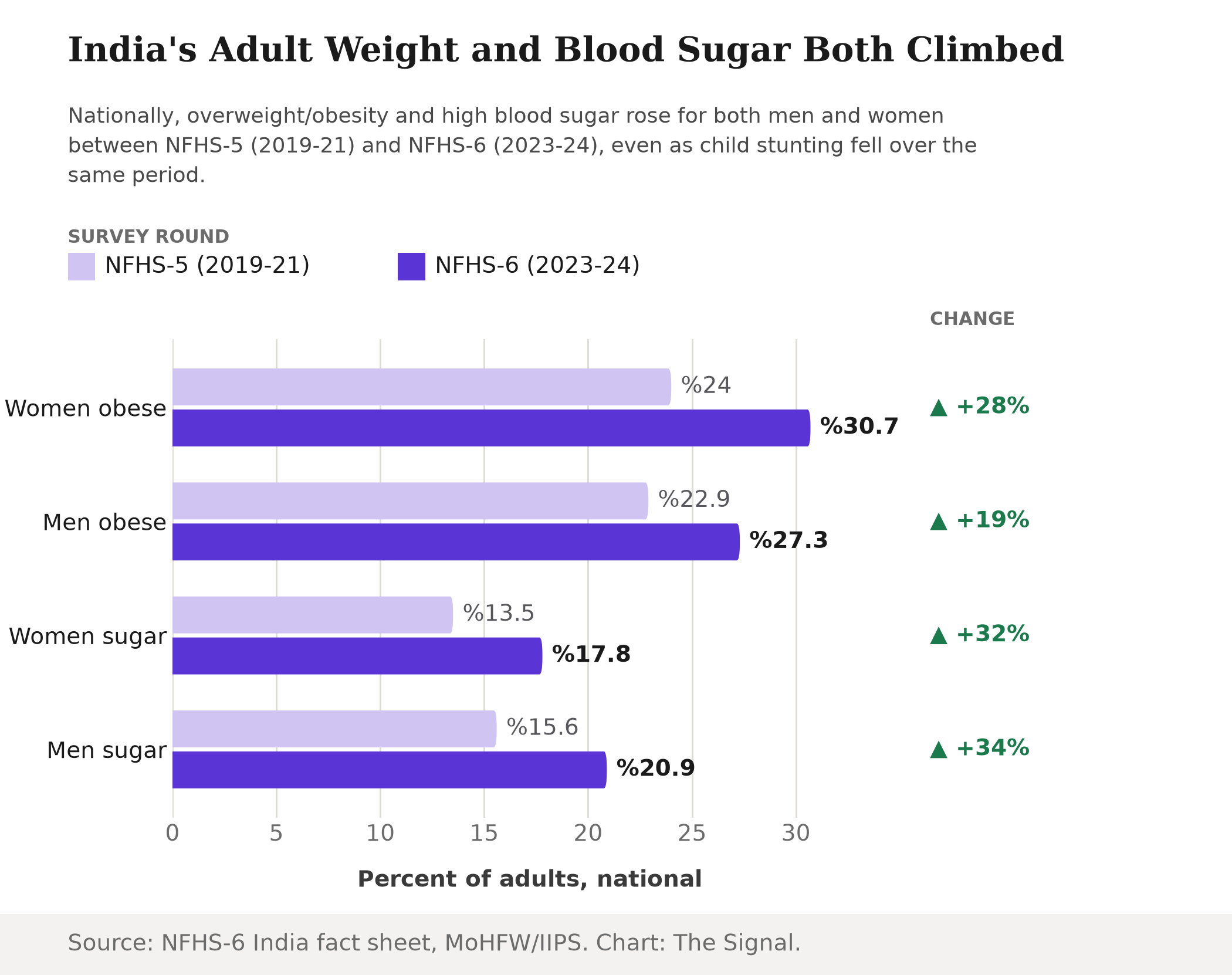
It is worth slowing down on that. The same fact sheets that report the stunting decline also report what happened to the adults in those households over the same five years, and it is not a mirror image of good news. Nationally, women's overweight and obesity rose from 24.0% to 30.7% and men's from 22.9% to 27.3%; women with high or very-high blood sugar, or on medication for it, rose from 13.5% to 17.8% and men's from 15.6% to 20.9%. Every one of those four indicators rose by at least a fifth in relative terms in the same five-year window that child stunting fell.
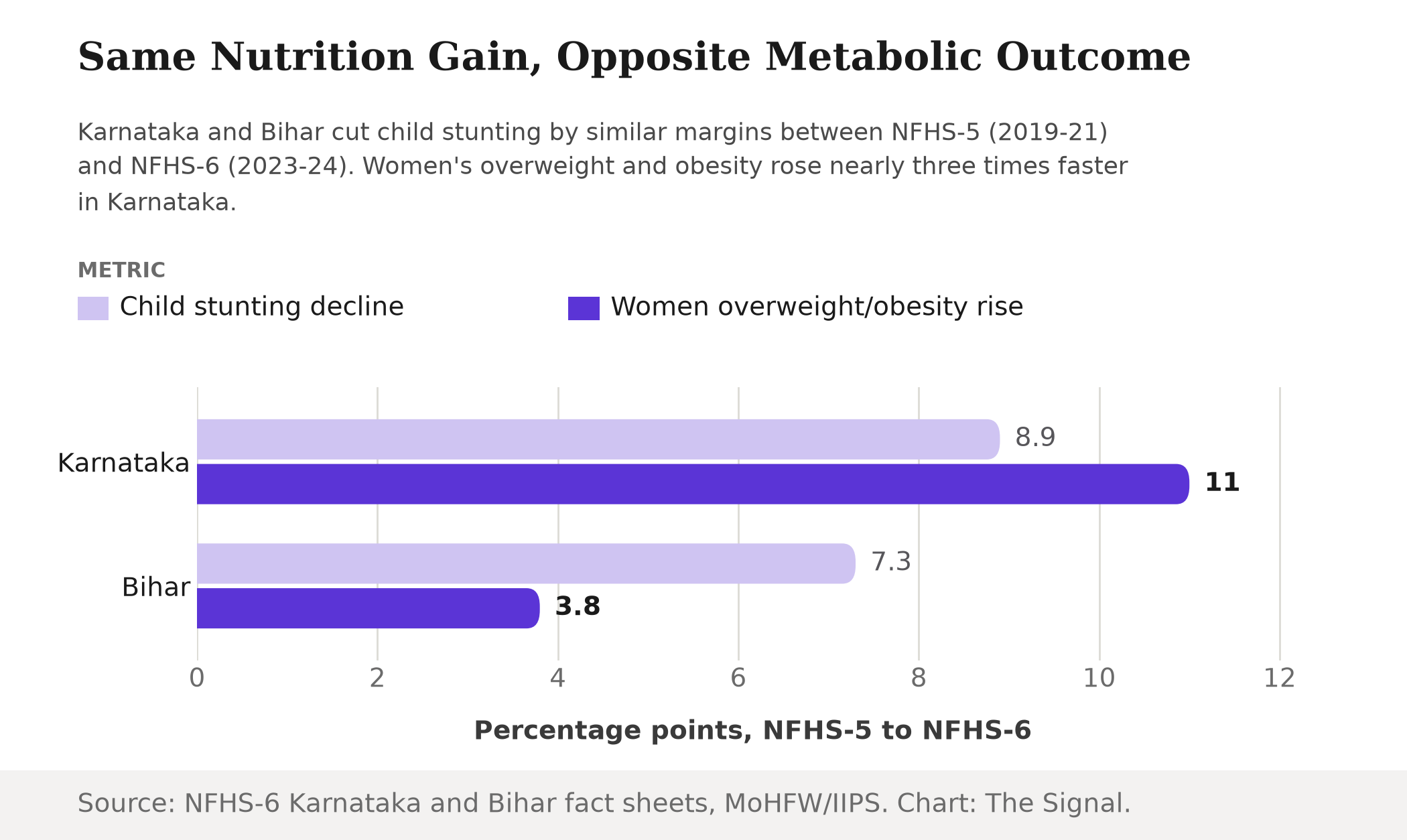
Karnataka's stunting decline was matched by an even larger diabetes-indicator rise.
Zoom into the state that improved fastest and the pattern sharpens. Karnataka's under-5 stunting rate fell from 35.4% to 26.5% between NFHS-5 and NFHS-6, an 8.9-point drop and one of the steepest state-level nutrition gains in the country. Over the identical five years, Karnataka's women's overweight/obesity rose from 30.2% to 41.2%, up 11.0 points, and men's high or very-high blood sugar rose from 15.6% to 26.1%, up 10.5 points: in percentage-point terms, the adult metabolic rise outran the child nutrition gain in the same state, in the same five years.
The national picture is not a Karnataka quirk
Karnataka is the sharpest example, not an outlier in isolation. The same before-and-after shows up, at smaller scale, in the national numbers themselves and in every large southern state the fact sheets cover.
Tamil Nadu's women's overweight/obesity rose from 40.5% to 44.2% and men's high blood sugar from 22.1% to 26.7% over the same five years. Telangana's women's overweight/obesity rose from 30.1% to 36.3% and men's high blood sugar from 18.1% to 24.5%. And Kerala now carries the country's highest state-level adult diabetes burden of the states in this comparison: 31.9% of men and 28.9% of women have high or very-high blood sugar or are on medication for it.
Kerala looks like an exception, but on close inspection it fits the pattern. Its under-5 stunting rate barely moved between NFHS-5 and NFHS-6, falling just 3.3 points from 23.4% to 20.1%, a far smaller drop than Karnataka's 8.9 points or Bihar's 7.3. Kerala is not in the middle of a fast nutrition transition; it went through one decades ago and is further along the same curve, which is consistent with carrying the country's highest cumulative diabetes burden rather than its steepest recent rise.
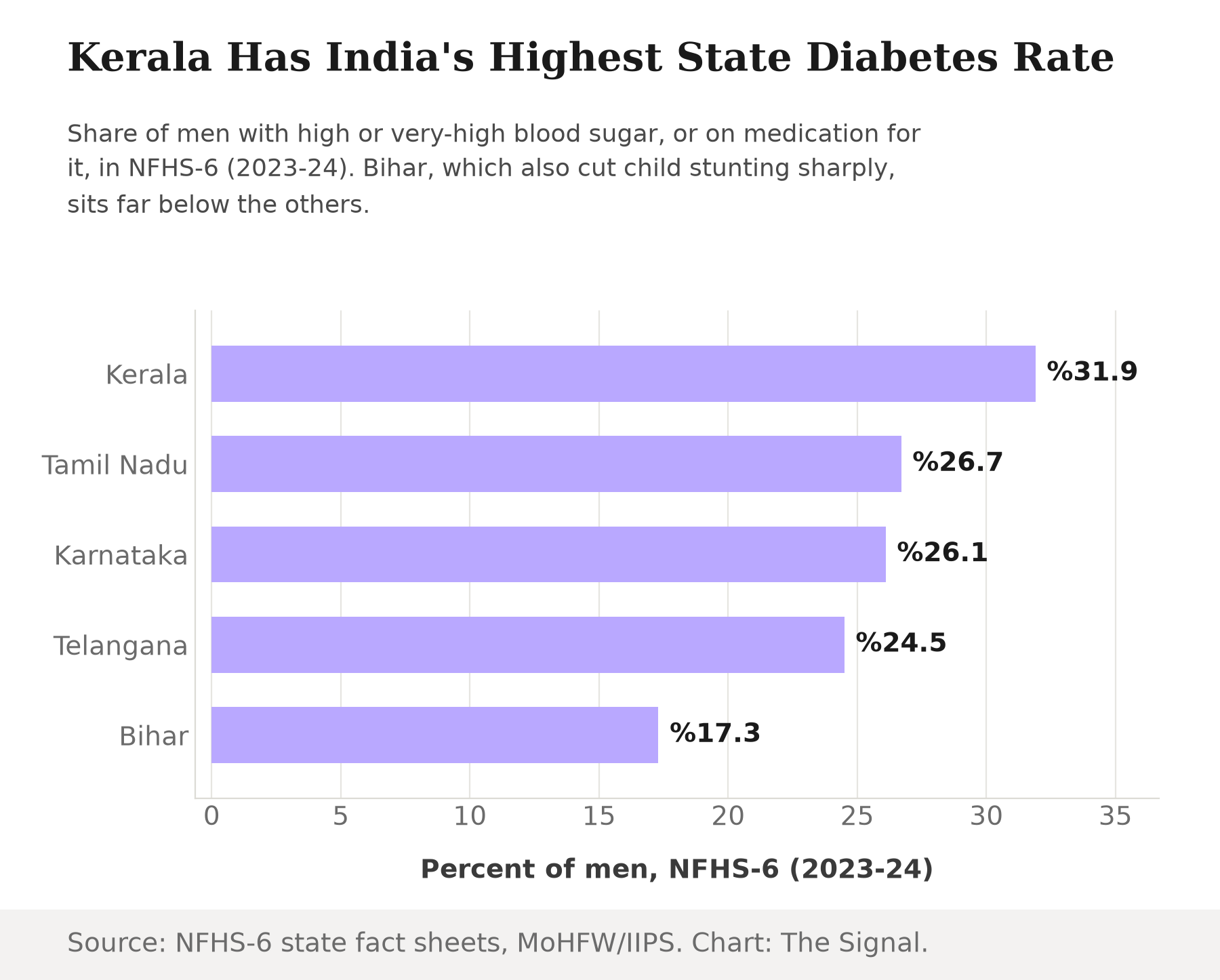
Bihar is the useful control case. Bihar's under-5 stunting rate fell from 42.9% to 35.6%, a 7.3-point decline of similar magnitude to Karnataka's. But Bihar's adult overweight/obesity and diabetes levels stayed comparatively low: women's overweight/obesity only rose from 16.0% to 19.8%, a 3.8-point rise, and men's high blood sugar only from 16.2% to 17.3%, barely a point. Two states cut child stunting by a comparable margin. Karnataka's women's obesity rise ran nearly three times Bihar's; its men's blood sugar rise ran nearly ten times Bihar's.
A body built for scarcity, fed abundance
The gap between Karnataka and Bihar is not proof of a mechanism on its own. But there is a documented biological reason to expect exactly this divergence, and it predates NFHS-6 by years. A 2017 peer-reviewed review in the European Journal of Clinical Nutrition, by Krishnaveni and Yajnik, describes how intrauterine and early-childhood undernutrition can produce a characteristic "thin-fat" body composition in Indians, a legacy of the developmental-origins mechanism, sometimes called the thrifty phenotype: a body that develops to conserve energy under scarcity, then carries elevated insulin resistance once it is exposed to more food than it was built for. The review states plainly that "intrauterine programming may underlie the characteristic Indian 'thin-fat' phenotype and the current unprecedented epidemic of diabetes."
That mechanism predicts something specific: a state that pulls children out of undernutrition quickly, into households where food availability is also rising quickly, should see more of its population carrying that thin-fat metabolic setup into an environment of caloric abundance, not less. A state where undernutrition and food scarcity both persist longer has fewer children experiencing that particular whiplash. Speed of change, not just the direction of it, is what the thin-fat mechanism runs on.
What state health budgets are being asked to do
India's primary-care NCD screening effort is not starting from zero. As of November 30, 2025, 39.50 crore hypertension screenings and 36.70 crore diabetes screenings had been completed under the Ayushman Arogya Mandir program, a scale built specifically to catch this kind of rise. But that infrastructure was largely designed and funded against an older assumption: that a state's health burden shifts from undernutrition toward non-communicable disease as it develops, on a multi-decade timeline. NFHS-6 shows the shift happening inside a single five-year survey cycle, in the same states, sometimes in the same households whose children were the undernutrition success story the previous round.
That compresses the budgeting problem. A state health department that is still funding anganwadi feeding programs and micronutrient supplementation for residual child undernutrition now also needs diabetes and hypertension screening capacity scaling at the pace Karnataka's, Tamil Nadu's and Telangana's numbers show, not the pace a slower development timeline would have implied. Insurance schemes built around catastrophic-illness cover for an older, sicker population now need to price in a working-age cohort acquiring metabolic risk earlier in life than the actuarial tables assumed.
The honest objection
The strongest case against reading this as one mechanism is that Karnataka, Tamil Nadu, Telangana and Kerala are also India's more urbanized, higher-income southern states, where sedentary work, processed food and diagnosed disease commonly rise alongside income, regardless of what happened to any individual's nutrition in early childhood. On that view, fast stunting cuts and fast diabetes-indicator rises both trace back to the same underlying variable, income growth, and the thin-fat mechanism is a plausible but unproven overlay on top of a simpler story.
That case is real and NFHS-6's state fact sheets cannot rule it out; NFHS-6 was not designed to trace individual children from the stunted cohort into the adults now being measured for blood sugar. But it does not fully explain Bihar, which is a poorer, less urbanized state by any conventional measure and still cut child stunting nearly as fast as Karnataka did, while its adult metabolic indicators barely moved. If income and urbanization alone explained the divergence, a state as far behind Karnataka on both should not have kept pace on the nutrition side at all. On balance, income and urbanization read as accelerants sitting on top of the developmental-origins mechanism, not a full substitute for it.
The Signal
NFHS-6's stunting numbers are a real public health achievement, and nothing here argues India should slow down on child nutrition. But the same NFHS-6 round that documents the achievement also documents its side effect arriving on the same timeline, in the same states, and the health system built to handle "undernutrition now, NCDs later" does not have decades to adjust to "both, at once." The number to watch in NFHS-7 is not whether stunting keeps falling but whether the states that improved child nutrition sharply this round, Karnataka foremost among them, show their adult obesity and diabetes indicators still climbing at a steep angle, or beginning to plateau as screening and prevention catch up. A nutrition transition that outruns its own health system is not a success story yet. It is a success story with an unpaid bill.
Reporting basis: the national and state child-stunting and adult overweight/obesity/blood-sugar figures are from the NFHS-6 (2023-24) India, Karnataka, Kerala, Tamil Nadu, Telangana and Bihar fact sheets, published jointly by the Ministry of Health and Family Welfare and the International Institute for Population Sciences; the national stunting decline is as reported in a Press Information Bureau release on the survey's national launch. The thin-fat phenotype and developmental-origins mechanism is per a single 2017 peer-reviewed review by Krishnaveni and Yajnik in the European Journal of Clinical Nutrition, and that review is the sole source for the mechanism; it is a documented biological hypothesis applied here to state-level survey data that was not designed to test it directly, not a proven causal chain. The Ayushman Arogya Mandir screening totals are from a Press Information Bureau release on the program's progress. The percentage-point changes between NFHS-5 and NFHS-6, and the comparison between Karnataka's and Bihar's respective changes, are The Signal's calculations from those fact-sheet figures.