On July 20, 2026, India's drug regulator cleared Takeda's Qdenga as the country's first dengue vaccine, approved for anyone aged 4 to 60. The Federal reports that the approval eliminates the need for pre-vaccination screening, resting on trial data showing 80.2 percent efficacy against confirmed dengue at 12 months and 84.1 percent efficacy against hospitalisation at 4.5 years. Read as a headline, this is exactly the shot India has been waiting for: a country that accounts for 34 percent of the world's dengue burden, where modelled infections rose from 16.44 million in 1990 to 28.0 million in 2019, finally has a vaccine anyone can walk in and take, no blood test first.
It is worth slowing down on that last part. No pre-vaccination screening is not a minor administrative detail. It is the single design choice that the world's only other dengue vaccine was rebuilt around, after that vaccine hurt the people it was supposed to protect.
Takeda followed participants in its TIDES trial for 57 months, and in people who had never had dengue before vaccination, the vaccine's own data show efficacy estimates of negative 15.5 percent against DENV-3 and negative 105.6 percent against DENV-4 through that follow-up. Negative efficacy means the point estimate favours the unvaccinated group, not the vaccinated one, for two of the four dengue strains, in exactly the people who cannot be identified without the screening test India just made optional.
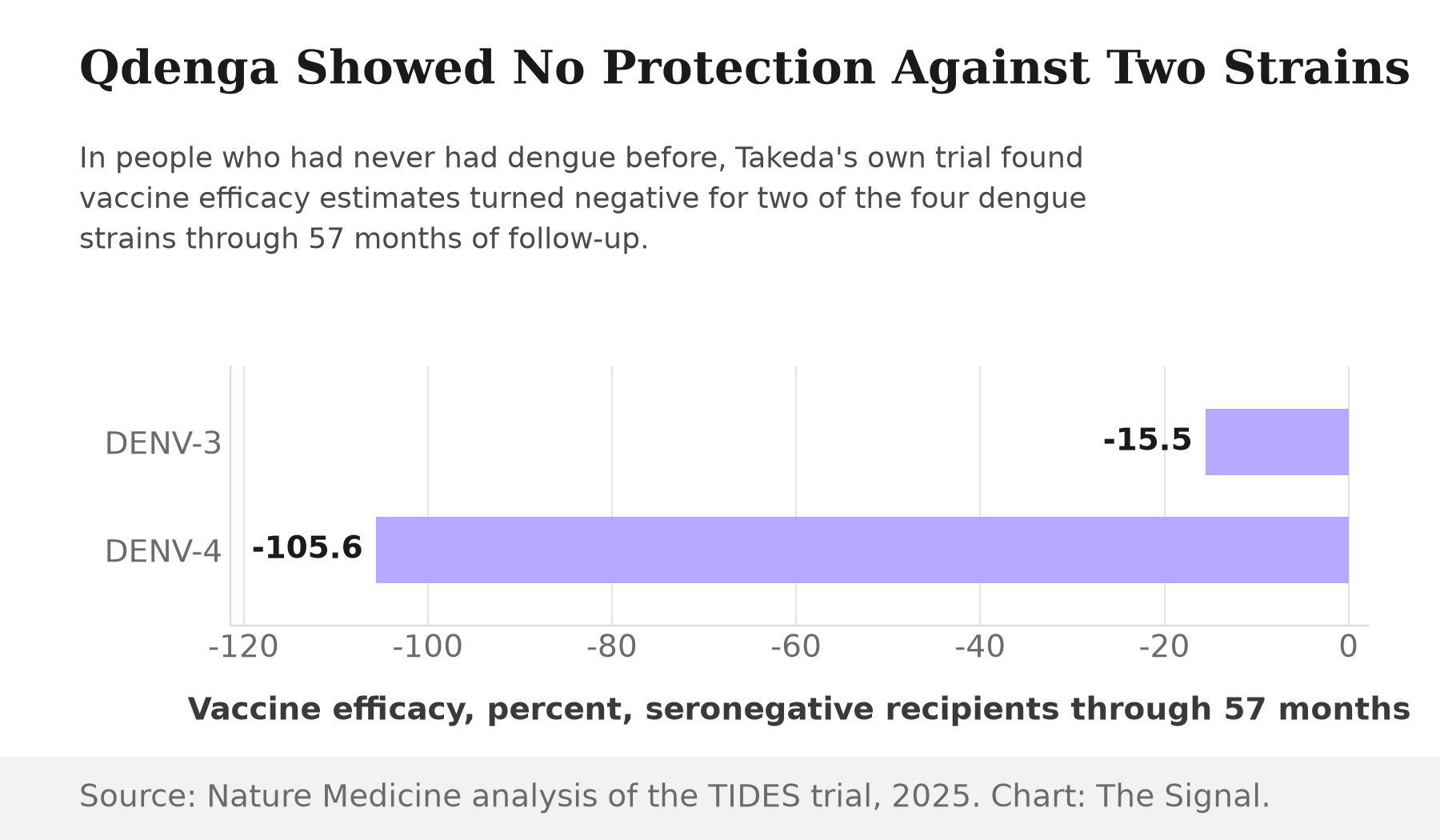
Source: Nature Medicine TIDES analysis. Chart: The Signal.
The vaccine that made screening standard
Dengvaxia, made by Sanofi, was the world's first dengue vaccine and the reason serostatus screening exists as a category of medical practice. In its original trials, seronegative children aged 2 to 16 who were vaccinated had 1.75 times the hazard of hospitalisation for confirmed dengue compared with seronegative unvaccinated controls over five years, a 2018 New England Journal of Medicine study found. That risk turned out to be concrete, not theoretical: a retrospective analysis found an excess of hospitalised and severe dengue in seronegative Dengvaxia recipients in year three after vaccination, and WHO's resulting 2018 position paper restricted the vaccine to people with confirmed evidence of a past dengue infection, requiring pre-vaccination screening. Screening was not a bureaucratic afterthought bolted onto Dengvaxia. It was the fix for a documented harm.
Qdenga was developed and tested with that history in the room. WHO does not recommend programmatic use of Qdenga in low-to-moderate dengue transmission settings, stating plainly that the efficacy-risk profile for DENV-3 and DENV-4 in seronegative people has not been thoroughly assessed. That is WHO, the body that prequalified the vaccine, declining to say the seronegative question is settled. Its own programmatic recommendation for Qdenga is narrower than India's approval in a second way too: WHO recommends the vaccine for children aged 6 to 16 in settings with high dengue burden and transmission intensity, not a general population aged 4 to 60.
Dengvaxia was restricted after the fact. Qdenga is being approved broadly before the same question is closed.
| Dengvaxia (Sanofi) | Qdenga (Takeda), India, 2026 | |
|---|---|---|
| Pre-vaccination screening | Required, added in 2018 after harm was found | Not required |
| Approved population | Ages 9-45, seropositive only, post-2018 | Ages 4-60, general population |
| Signal in seronegative recipients | 1.75x hazard of hospitalisation vs. unvaccinated over 5 years | Negative efficacy vs. DENV-3 and DENV-4 through 57 months |
| Regulator/WHO response | WHO restricted use to the seropositive | WHO recommends only ages 6-16, high-transmission settings; no programmatic use in low-to-moderate settings |
Sources: The Federal; NEJM (Sridhar et al., 2018); review of WHO's 2018 position paper; Nature Medicine TIDES analysis; WHO; WHO prequalification notice.
Why "no screening" is not a small gap for India specifically
A single national screening rule would matter less if India's dengue picture were stable and dominated by one predictable strain. It is neither. Reported dengue cases peaked at 289,235 in 2023, the highest of the last five years, before falling to 121,824 in 2025, a swing that changes how "high transmission" applies to India from one year to the next, and with it whether WHO's own narrower recommendation would even cover most of the country.
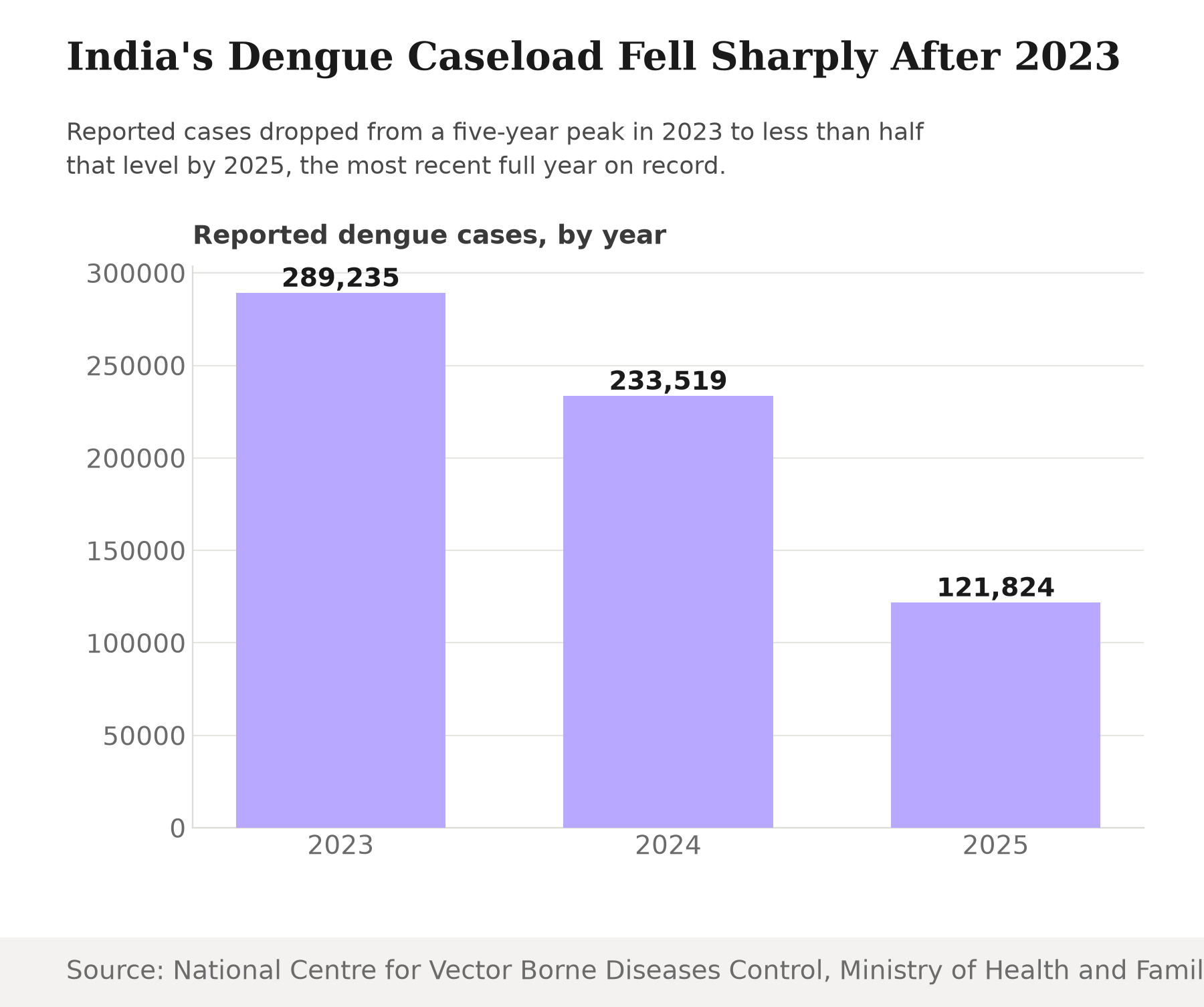
Source: National Centre for Vector Borne Diseases Control. Chart: The Signal.
Underneath that national count, the circulating serotype itself does not hold still. In West Bengal, the dominant dengue serotype flipped three times between 2015 and 2019: DENV-3 led in 2015 at 63.5 percent of typed samples, DENV-1 took over in 2016 at 52.8 percent, and DENV-2 became dominant from 2017 through 2019, its own share swinging from 73.5 percent to 76.0 percent to 47.2 percent, a study in the Indian Journal of Medical Research found. A vaccine whose own trial data separate cleanly by serotype is being deployed into a country where the serotype in circulation changes by state and by year. That is not a decade-old pattern, either: a 2026 study covering Goa through 2024 found DENV-2 led overall from 2019 to 2024 at 58.6 percent of typed samples, but in 2024 alone DENV-1 overtook it, accounting for 41.37 percent of 2024's samples, the same flip-by-year pattern West Bengal showed, playing out in the most recent data available.
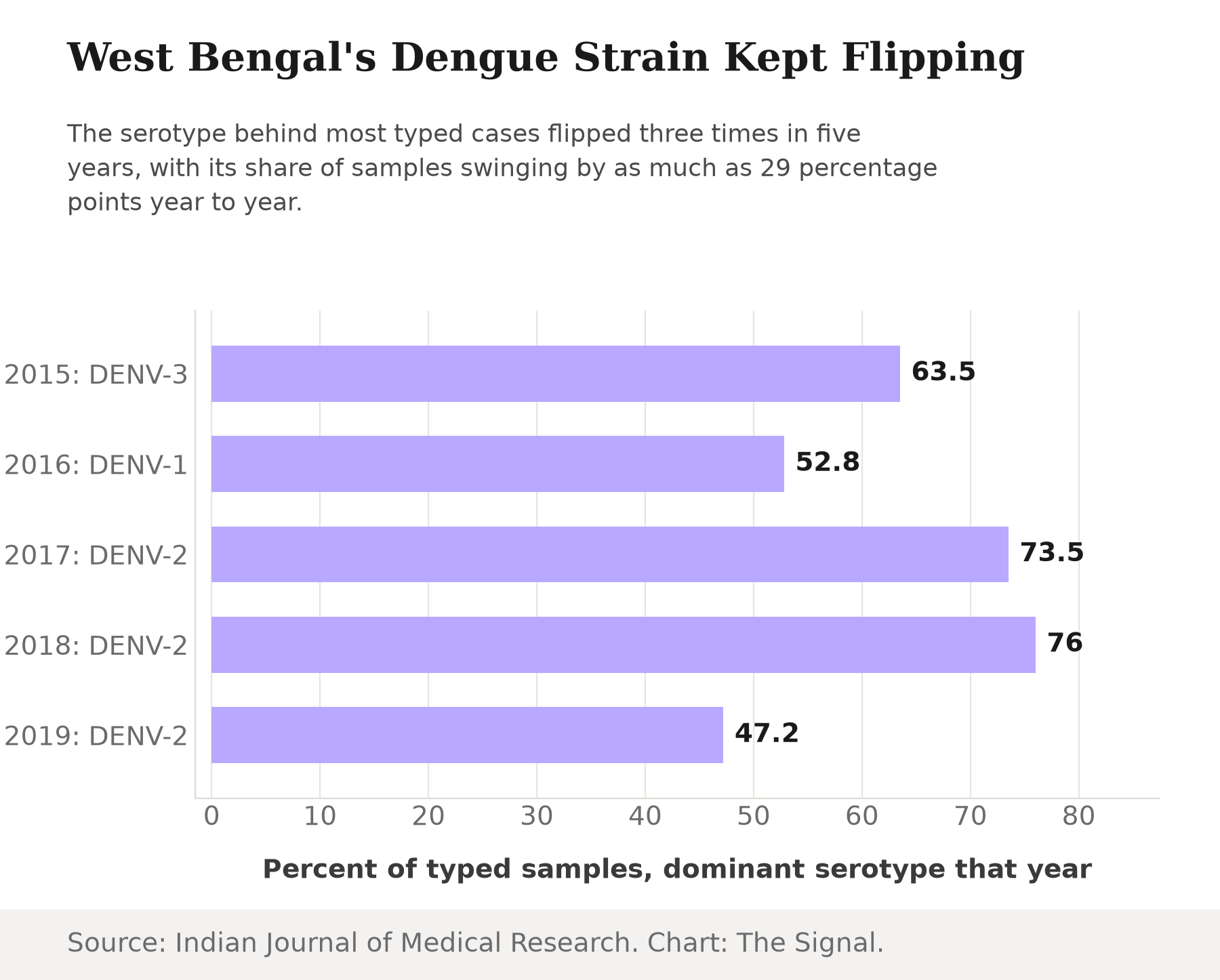
Source: Indian Journal of Medical Research. Chart: The Signal.
Put the two gaps together. Nobody knows a given recipient's prior dengue exposure, since that test is optional, and which serotype they are likeliest to meet next is just as uncertain, since the mix moves. Dengvaxia's screening rule managed exactly this kind of uncertainty at the point of vaccination; Qdenga's approval in India simply skips that step.
The honest objection
The strongest case for India's decision is that Qdenga is simply not Dengvaxia. Takeda's trial data through 4.5 years show 84.1 percent efficacy against hospitalisation across the trial population, run regardless of prior infection status, a headline result Dengvaxia never produced in its seronegative recipients, who instead saw a statistically significant excess of hospitalisations. And the negative point estimates against DENV-3 and DENV-4 in seronegative recipients carry wide confidence intervals, running from negative 108.2 to positive 35.9 percent for DENV-3 and negative 628.7 to positive 42.0 percent for DENV-4, wide enough that they do not, on their own, prove Qdenga causes the kind of confirmed harm Dengvaxia did. Absence of demonstrated protection against two strains is a real gap. It is not the same claim as demonstrated harm.
That case is real, and it is why WHO prequalified Qdenga at all rather than blocking it outright. India's regulator did not wave the seronegative question through unconditionally, either: CDSCO's Subject Expert Committee recommended approval on the explicit condition that Takeda run a post-marketing safety and effectiveness study in the Indian population within six months of the vaccine's launch. But a required study is not the same as a completed one, and it does not explain why India chose to approve broader use than WHO itself recommends, in a population where serostatus and circulating serotype both vary, without the one test that would let a doctor tell which recipients are walking into the trial's best-case scenario and which are walking into its most uncertain one.
The Signal
India has not repeated Dengvaxia's outcome. It has repeated Dengvaxia's starting conditions: a vaccine with serotype-dependent, serostatus-dependent performance, deployed to a population where nobody is checked for either variable, in a country whose own case counts and serotype mix do not sit still year to year. The difference this time is that regulators are moving before the seronegative question is closed, not after it produces a documented harm. What to watch is not whether India's overall hospitalisation numbers improve, since a vaccine with strong topline efficacy can lift the aggregate even while a minority of recipients are left exposed. India's regulator has already built in one place to look: Takeda is required to deliver a post-marketing safety and effectiveness study in the Indian population within six months of launch. Watch whether that study, or any state-level dengue surveillance broken out by vaccination status, reports serostatus- and serotype-specific results. That is the only evidence that would show whether the DENV-3 and DENV-4 gap in Takeda's own trial data is showing up in India's seronegative recipients, now that nobody is screening for prior infection status. A study that reports only an aggregate hospitalisation rate would not answer that question.
Reporting basis: the DCGI's approval of Qdenga and its stated efficacy figures are as reported by The Federal. The TIDES trial's serotype- and serostatus-specific efficacy estimates, including their confidence intervals, come from a Nature Medicine analysis of that trial. WHO's programmatic recommendations and its stated reservations about the seronegative DENV-3/DENV-4 risk profile are from two separate WHO publications, its dengue vaccine questions-and-answers page and its 2024 prequalification announcement. Dengvaxia's seronegative hazard ratio is from Sridhar et al.'s 2018 New England Journal of Medicine study; the WHO policy response to that finding is from a peer-reviewed review of WHO's 2018 position paper. India's national case and death counts are from the National Centre for Vector Borne Diseases Control. India's share of global dengue burden and its long-run infection trend are from a Global Burden of Disease Study 2019 analysis, and are the most recent published estimates of that kind; they describe 2019, not the current year. The West Bengal serotype data are from a single study in the Indian Journal of Medical Research covering 2015 through 2019; the more recent Goa serotype data, through 2024, are from a 2026 study in PLOS Neglected Tropical Diseases. Both cover a single state each and are not necessarily representative of India's current national serotype mix. The condition attached to CDSCO's approval, requiring a post-marketing safety and effectiveness study within six months of launch, is as reported by The South First, citing the Subject Expert Committee's minutes.