In February 2026, specialists from 15 medical societies agreed on something doctors had never formally settled: what to call fat building up inside the pancreas. The International Multidisciplinary Consensus Report on Fatty Pancreas, endorsed by 15 medical societies, adopted "fatty pancreas" as the standardized and inclusive term to describe all forms of fat accumulation in the pancreas, the first formal definition of its kind. Read as housekeeping, it looks minor: a naming convention so studies, trials and hospital charts finally describe the same condition the same way.
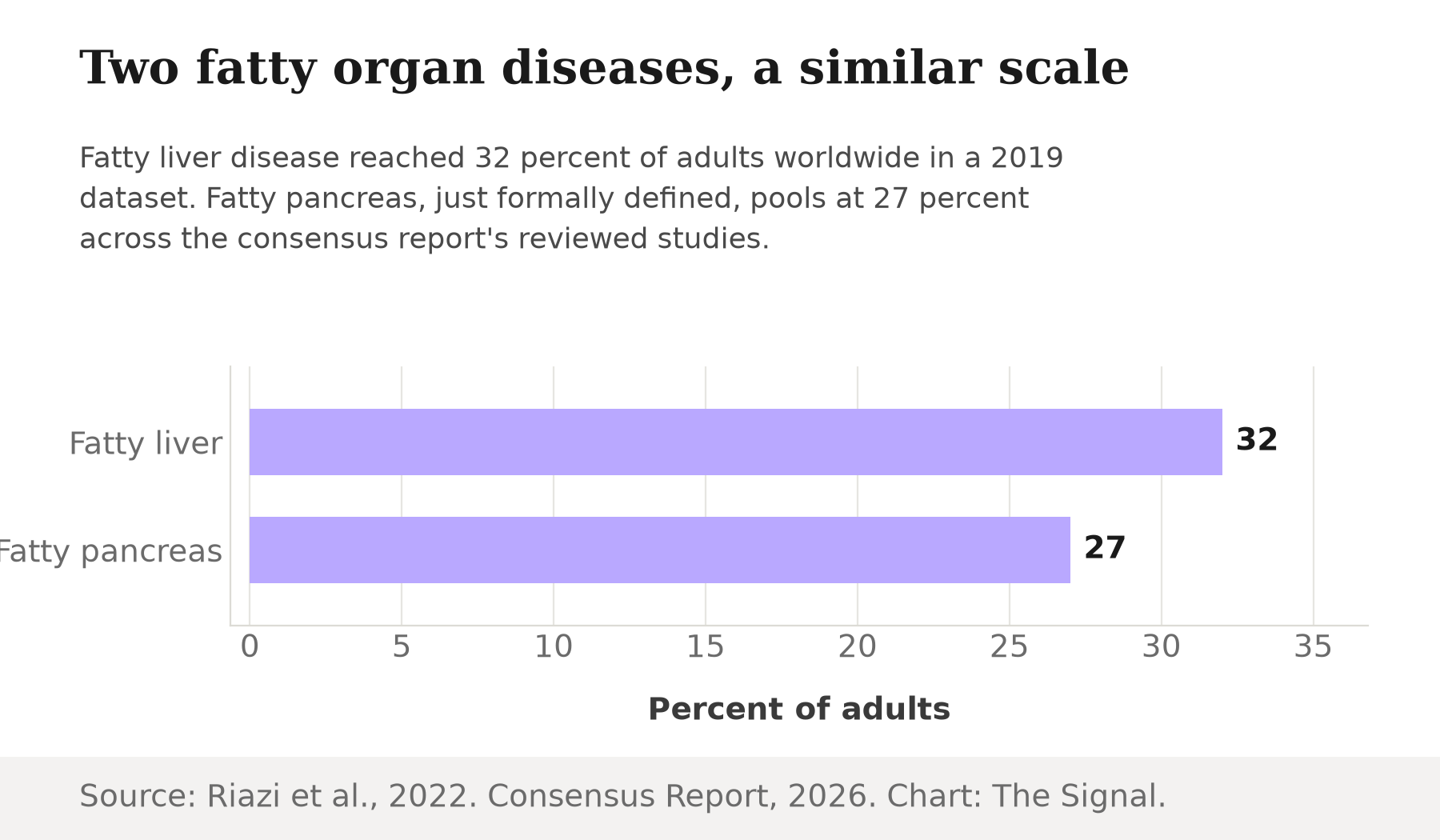
It is worth slowing down on that reading. The consensus report's own review of 26 adult population studies found a pooled prevalence of 27 percent, with a range from 1.2 percent to 70.8 percent depending on the population and the imaging method used. A condition that common was, until February 2026, not a diagnosis at all. It had no single name, no standard criteria, and no place in a doctor's coding system. Now it has all three, and more than a quarter of adults may be walking around with it.
More than a quarter of adults may carry a disease that had no name before February 2026.
Source: Riazi et al., Clinical and Molecular Hepatology, 2022; International Multidisciplinary Consensus Report on Fatty Pancreas, 2026. Chart: The Signal.
A name doctors already needed
Fatty pancreas is not arriving as a novelty. A 2022 meta-analysis of 72 studies covering more than a million people put global fatty liver disease prevalence at 32 percent of adults, based on data through 2019, and that condition only reached its own current, agreed name in 2023, when a Delphi consensus of 236 experts from 56 countries, voting to a 67 percent supermajority threshold, renamed it metabolic dysfunction-associated steatotic liver disease. That 2023 rename was not fatty liver's first name. The term "non-alcoholic fatty liver disease" was coined in 1986, by researchers who also named the related condition nonalcoholic steatohepatitis in the early 1980s, four decades before fatty pancreas got its own first formal definition this February. Fatty pancreas is following the same consensus-first route, just faster: one report rather than decades of accumulating evidence and terminology. The two conditions sit at similar scale, 27 percent against 32 percent, and both required the same first step: doctors had to agree what they were looking at before either could be screened for, treated for, or billed for consistently.
That mechanism is not cosmetic. A disease without a standard name cannot anchor a clinical guideline, a reimbursement code, or a screening recommendation. Naming is the step before all three.
Why the name matters: a cancer link, not just a metabolic curiosity
The clearest reason fatty pancreas needed a formal definition sits in a single 2024 finding, from a single cohort. A UK Biobank prospective cohort study of 42,599 adults, published in the American Journal of Gastroenterology, found that each one-quintile rise in intrapancreatic fat deposition was associated with a 36.5 percent higher risk of incident pancreatic cancer, with a hazard ratio of 1.365. No second cohort has yet confirmed it, but the finding is not marginal: the same fat the consensus just agreed to name is tied to one of the harder cancers to catch early, in a large cohort followed over time.
Pair that with how common the underlying condition already is, and the practical question stops being definitional. It becomes: who gets scanned, and where.
India's numbers against the new definition
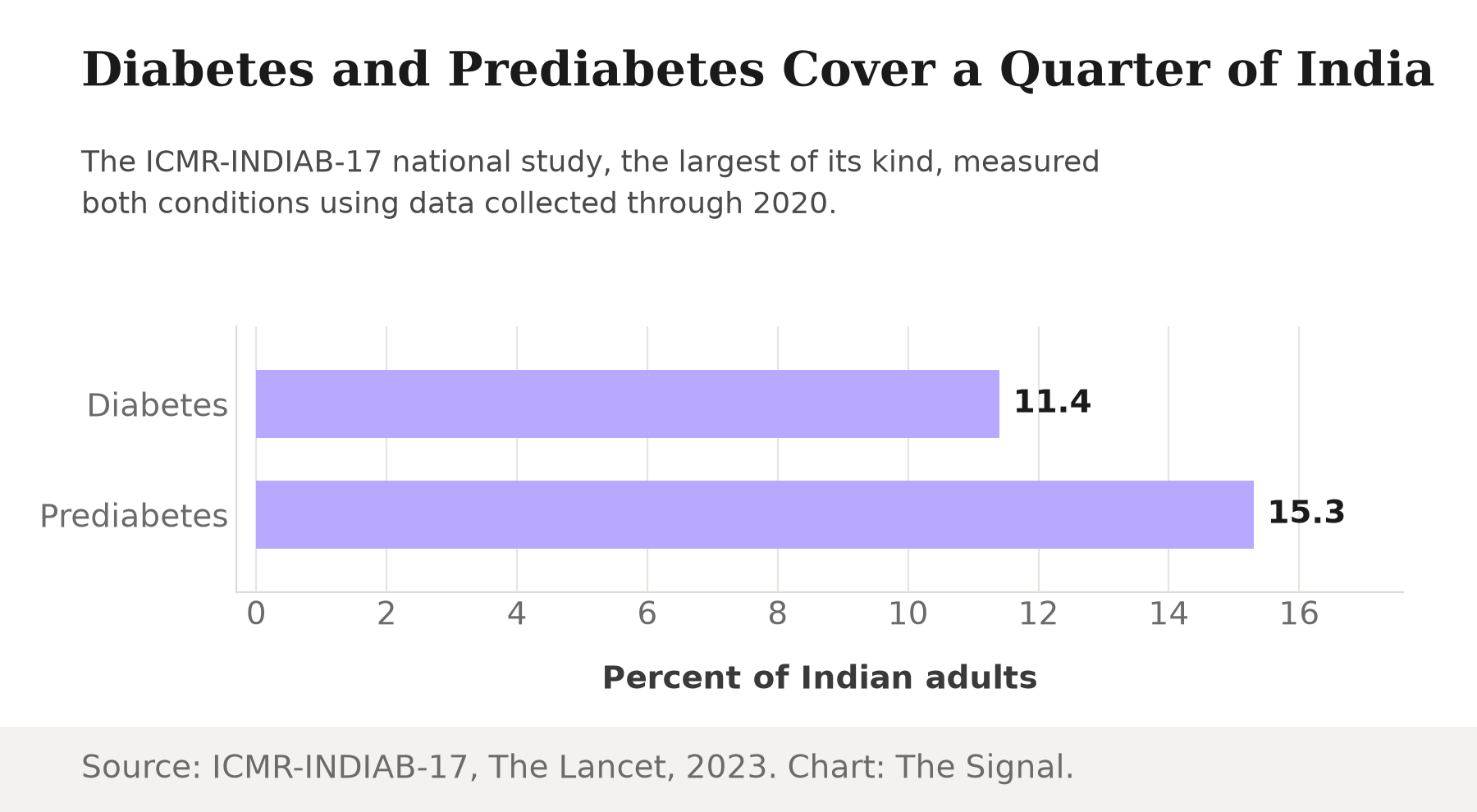
India is not a peripheral case for this question. China and India have the largest number of adults living with diabetes in the world, with China ranking first and India second, ahead of the USA, as of 2024, and the world's diabetic population was estimated at 589 million adults aged 20 to 79 in 2024, 11.1 percent of the world's adults in that age group. The ICMR-INDIAB-17 national study, the largest of its kind, found a diabetes prevalence of 11.4 percent and a prediabetes prevalence of 15.3 percent among Indian adults, based on data collected through 2020. Add the two together and more than a quarter of Indian adults already sit somewhere on that spectrum, before fatty pancreas screening is even part of the conversation.
More than a quarter of Indian adults already have diabetes or prediabetes.
Source: ICMR-INDIAB-17, The Lancet Diabetes & Endocrinology. Chart: The Signal.
Diabetes and fatty pancreas travel together clinically. But India's system does not reliably know who has diabetes in the first place. A national analysis of NFHS-5 survey data, covering data collected in 2021, found that 24.82 percent of Indians aged 15 to 49 with diabetes remained undiagnosed. A population this large, with roughly a quarter of its own diabetes cases still undiagnosed, is not a population with spare imaging capacity waiting to screen for a condition that only got a name this year.
A cancer that barely registers today
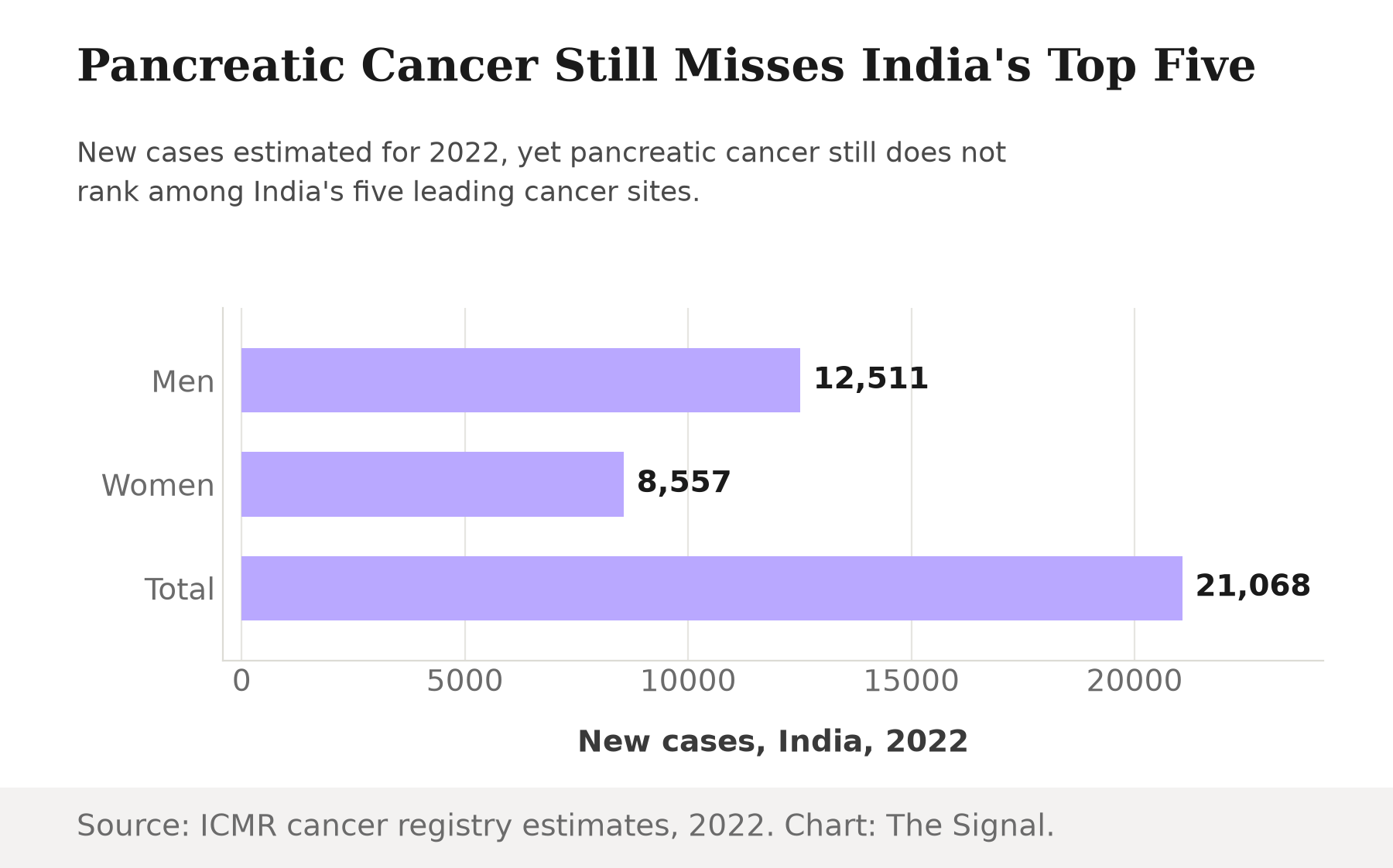
The gap between the new stakes and the old infrastructure shows most clearly in pancreatic cancer. India recorded an estimated 21,068 new pancreatic cancer cases in 2022, split 12,511 in men and 8,557 in women, a crude incidence rate of 1.4 per 100,000, per the ICMR's national cancer registry estimates. Pancreatic cancer still does not rank among the country's five leading cancer sites.
Pancreatic cancer is common enough to count in the tens of thousands and still not crack India's top five cancers.
Source: ICMR National Centre for Disease Informatics and Research, cancer incidence estimates for 2022. Chart: The Signal.
That low rank is precisely the problem. A cancer that does not crack the top five does not draw the screening budgets or the specialist attention that bigger cancers do, even though the same fat now formally named "fatty pancreas" is tied to meaningfully higher pancreatic cancer risk in that UK Biobank cohort. The new diagnosis and the country with the diabetic population most likely to need it are arriving at the same moment. Neither the guideline nor the imaging pathway to connect them yet exists.
The honest objection
The strongest case against reading much into this is that naming alone has a poor track record of changing outcomes. Fatty liver disease had a broadly agreed name for years before its own 2023 renaming, yet global fatty liver prevalence still stood at 32 percent of adults in the most recent large meta-analysis, based on data through 2019. A name did not shrink the disease. On this view, fatty pancreas getting a name changes vocabulary before it changes a single scan ordered in an Indian clinic, and calling the report a turning point overstates what a definition can do alone.
That case has real force: prevalence was never going to fall on publication alone. But it answers a different question than the one that matters here. The fatty liver precedent is also the proof that a name is the prerequisite, not the substitute, for what comes after it: the same kind of pooled evidence synthesis that just produced fatty pancreas's 27 percent prevalence figure was only possible once researchers were comparing the same defined condition across studies. Guidelines and screening recommendations carry that same requirement. Fatty pancreas has now cleared that first step. Whether it clears the second, in a country with India's diabetes numbers and undiagnosed share, is a separate and still open question.
The Signal
The February 2026 consensus solved a vocabulary problem that had blocked coordinated research and clinical practice on fatty pancreas for years. It did not solve a resourcing problem. India sits at the intersection of the two facts that make this diagnosis matter most: a diabetic population second only to China's, and a pancreatic cancer risk that the UK Biobank data now ties directly to the same fat this consensus just named. What India does not have, going into this, is a cancer that ranks high enough today to already command screening infrastructure, or a diabetes system that has finished diagnosing the population it already knows about. The consensus gave doctors a word. Watch whether India's diabetes clinics get an imaging referral pathway to go with it, or whether "fatty pancreas" simply becomes a diagnosis available to the minority of patients who already get scanned for something else.
Reporting basis: the fatty pancreas definition and its pooled prevalence figure are from the International Multidisciplinary Consensus Report on Fatty Pancreas (Vujasinovic et al.), published in the United European Gastroenterology Journal in February 2026. The pancreatic cancer risk finding rests on a single source, a UK Biobank prospective cohort study published in the American Journal of Gastroenterology in 2024, not yet corroborated by a second cohort. Global and country-level diabetes figures are from the International Diabetes Federation's IDF Diabetes Atlas, 11th edition, covering 2024 data. India's diabetes and prediabetes prevalence are from the ICMR-INDIAB-17 national study, published in The Lancet Diabetes & Endocrinology in 2023, based on data collected through 2020; the undiagnosed-diabetes share is from a separate analysis of NFHS-5 survey data, published in the Journal of Global Health in 2023, covering data collected in 2021. India's pancreatic cancer incidence is from the ICMR National Centre for Disease Informatics and Research's national cancer registry estimates for 2022. The global fatty liver prevalence figure is from a 2022 meta-analysis in Clinical and Molecular Hepatology covering data through 2019; its renaming to MASLD is from the 2023 multisociety Delphi consensus statement published in Hepatology; and the 1986 origin of the earlier "non-alcoholic fatty liver disease" term is from a history of NAFLD terminology published in Metabolites. The combined diabetes-and-prediabetes share of Indian adults is The Signal's calculation from the ICMR-INDIAB-17 figures.