A blood clot inside the brain's draining veins, cerebral venous thrombosis (CVT), has long been taught as a disease of bad luck. Unlike the arterial strokes that dominate public health messaging, CVT's textbook workup points first toward an inherited clotting disorder: a missing anticoagulant protein, a faulty gene, some inbuilt tendency to clot that no lifestyle choice could have prevented. Order the genetic panel, counsel the family, move on. That default is not unreasonable on its face. Genetic thrombophilias are well documented in the medical literature, and a young, otherwise healthy patient with a brain clot looks exactly like the case textbooks describe as needing a hereditary workup.
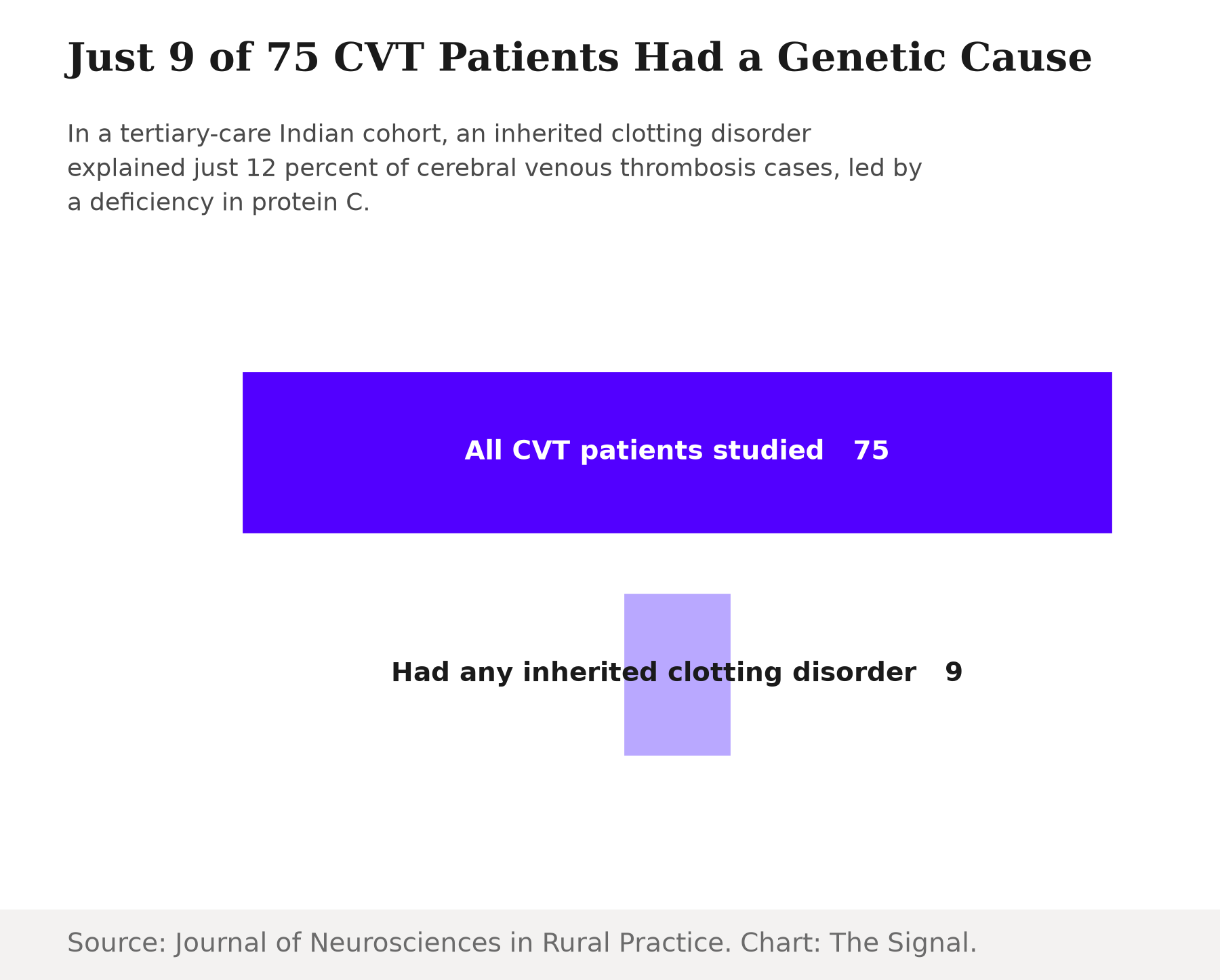
That assumption does not survive contact with India's own hospital data. In a 75-patient CVT cohort at a tertiary-care Indian hospital, published in 2022, any inherited procoagulant state, the umbrella term for genetic clotting disorders, turned up in just 9 patients, 12 percent of the total, led by a deficiency in protein C.
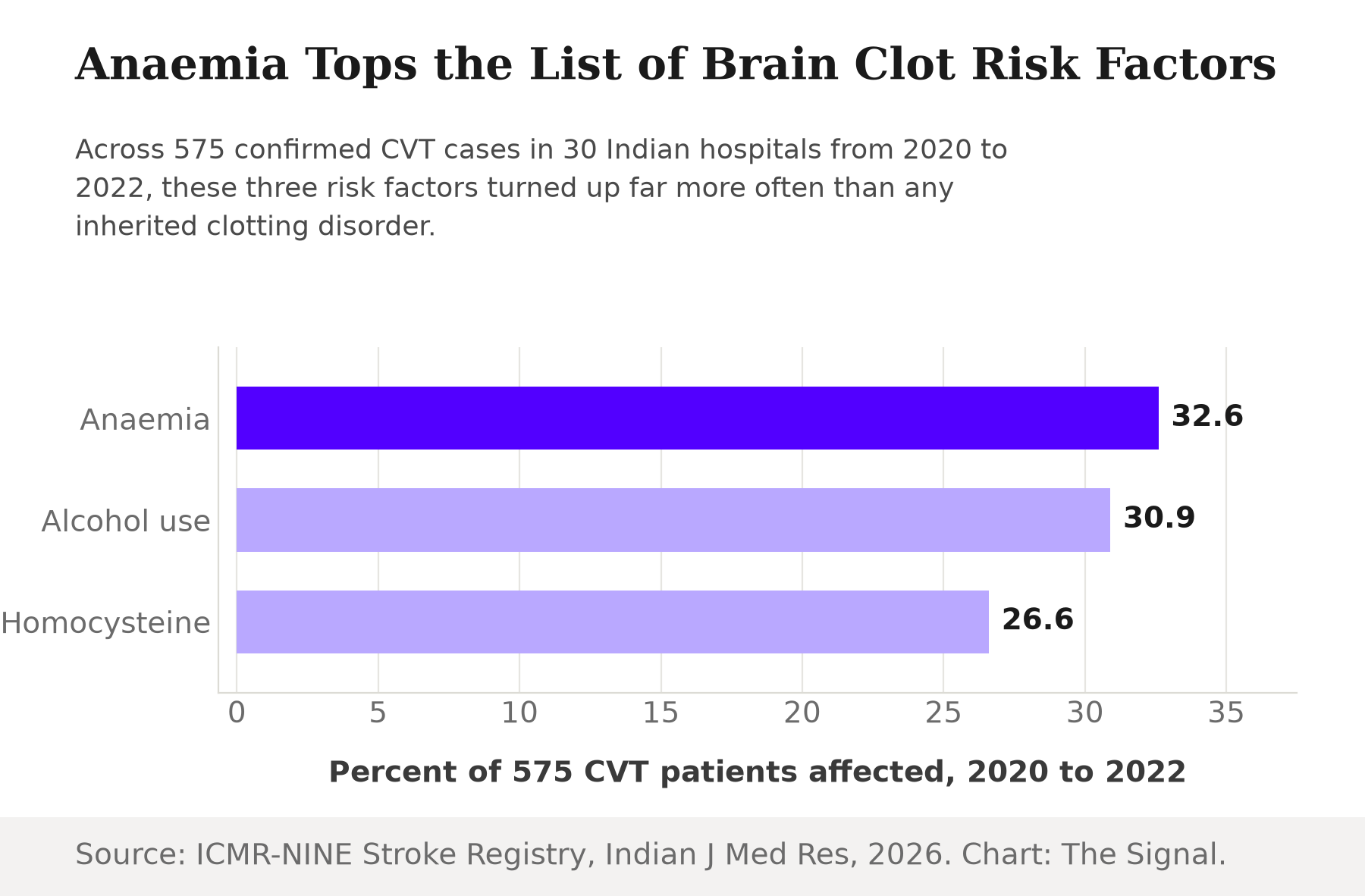
The most complete Indian answer to what actually drives CVT arrived earlier this month. On 1 July 2026, the Indian Journal of Medical Research published the ICMR-National Institute of Non-communicable Disease Epidemiology's Hospital-Based Stroke Registry Programme, built from cases collected across 30 hospitals nationwide between January 2020 and December 2022. Of 34,792 registered stroke cases, 575 (1.6 percent) were CVT, and the leading risk factors among them were anaemia (32.6 percent), alcohol use (30.9 percent) and hyperhomocysteinemia, elevated blood homocysteine (26.6 percent). Every one of those three factors is more common in the registry than an inherited clotting disorder was in the separate 75-patient cohort.
The registry establishes that anaemia predicts CVT. It stops short of explaining why. Untreated iron-deficiency anaemia is understood to raise clotting risk through reactive thrombocytosis. Iron deficiency drives up erythropoietin, which also stimulates platelet overproduction, because red-cell and platelet progenitors share a common bone-marrow lineage, giving the anaemia-CVT link a mechanism, not just a correlation. That chain runs in reverse too: in one 2021 case report, a patient's cerebral venous clot burden receded only after her iron deficiency was corrected.
The male shift no one predicted
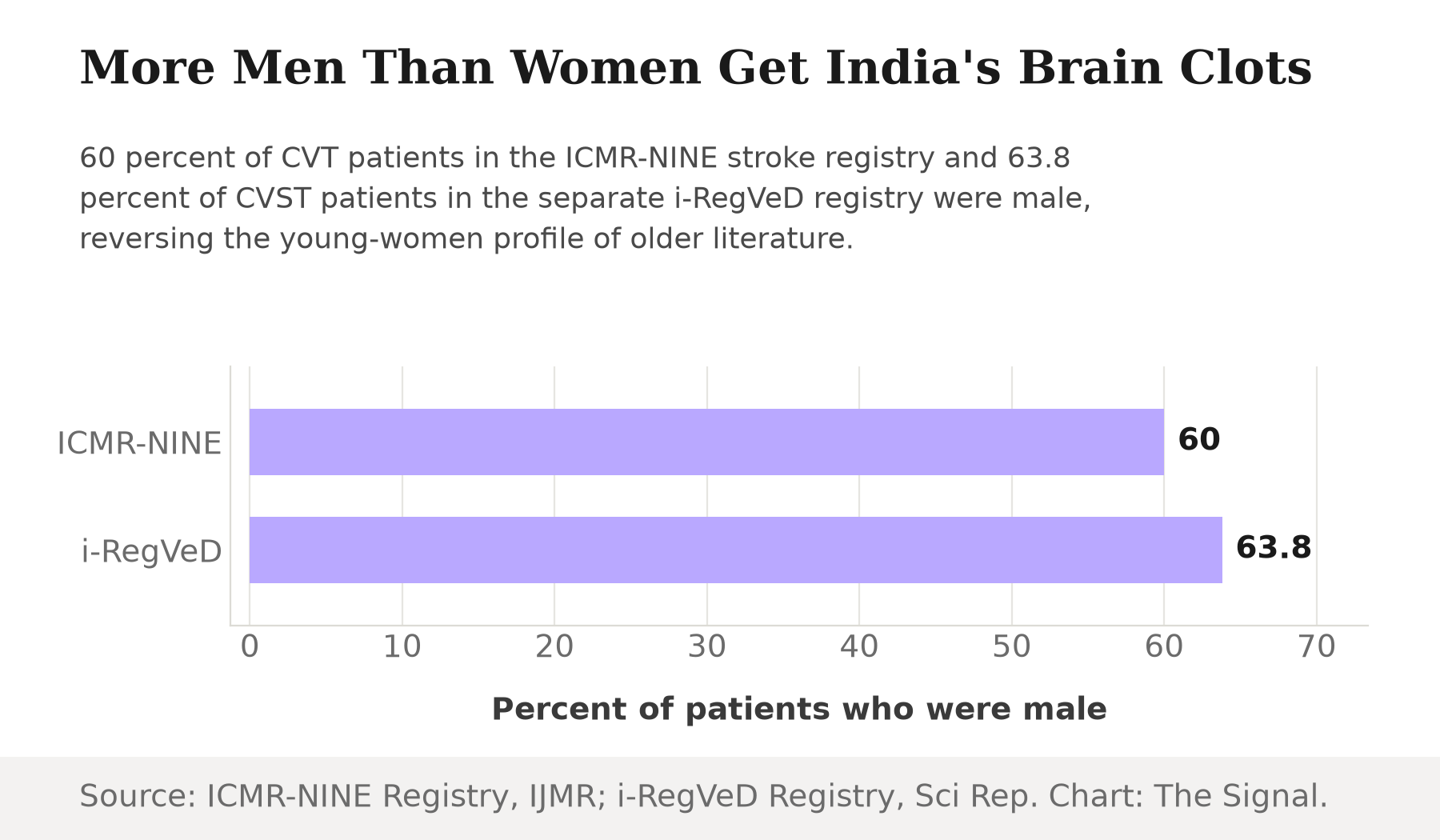
The registry also overturned CVT's classic demographic. 60 percent of its 575 CVT patients were male, a reversal of the older picture of CVT as a young woman's disease driven by pregnancy and oral contraceptives. That is not one dataset's quirk. A separate ICMR multicentre venous-thromboembolism registry, i-RegVeD, published in 2023, independently found men significantly outnumbering women among 152 CVST cases across seven Indian hospitals, 63.8 percent against 36.2 percent, corroborating the shift from a second, unrelated dataset.
Where the anaemia number sits nationally
Anaemia's rise to the top of the CVT risk-factor list lands against a large national backdrop, and the registry's own numbers make the comparison direct rather than aggregate. Anaemia affected 102 of the registry's female CVT patients, 44.7 percent, against 84 of its male CVT patients, 24.5 percent, a highly significant split. Nationally, 57 percent of women aged 15 to 49 in India were anaemic, per the most recent National Family Health Survey, conducted in 2019-21, while about one-fourth of Indian men, surveyed at ages 15 to 54, were anaemic, per the same NFHS-5 round. Set side by side, that comparison cuts against the simplest reading. Male CVT patients' anaemia share, 24.5 percent, sits almost exactly at the national male rate. Among women, 44.7 percent of CVT patients had anaemia, well below the national female rate of 57 percent: anaemia is still the single biggest risk factor found in the registry, without female CVT patients even being disproportionately anaemic relative to Indian women generally.
Speed still decides who survives
The registry's mortality data carries its own warning. Patients arriving 12 to 24 hours after CVT symptom onset, along with older age, impaired consciousness and dysphagia at onset, predicted higher mortality. A modifiable risk factor is only useful if the disease is caught in time to act on it.
A pattern shifting away from the Western textbook
The registry's findings indicate a changing pattern of CVT in India, with nutritional deficiencies and lifestyle factors playing a greater role than the pregnancy-related conditions that dominate the classic profile emphasised in Western literature. The Western literature's classic profile centres on young women affected by pregnancy, the postpartum period and oral contraceptive use, categories that assume a reproductive-age female patient first and look elsewhere only when that story does not fit. That template was built on a different population's case mix. India's own registry now has enough cases to write its own.
The honest objection
The strongest case against calling this a settled reframe is arithmetic. Anaemia was present in 32.6 percent of CVT patients, alcohol use in 30.9 percent and hyperhomocysteinemia in 26.6 percent, so no single factor explains most cases on its own, and two in three CVT patients had no anaemia at all. Doctors who still order a thrombophilia panel are not chasing a phantom either: 12 percent of a comparable Indian cohort did carry a genuine inherited clotting disorder, a share too large to drop from clinical practice.
That case is real, but it argues for broader testing, not a return to genetics-first defaults. A risk factor present in a third of patients is still more common than the inherited-disorder share found in Indian cohorts, which changes where the first question in the workup should point, even if it does not explain every case on its own. Anaemia and alcohol use are also things a hospital can screen for and treat before a clot forms; a gene mutation is not.
The Signal
The clinical instinct CVT trained into Indian doctors, order a thrombophilia panel first, chase a mutation, was built on a case mix that India's own hospitals do not reproduce. ICMR's registry says the more useful first question is nutritional and behavioural: does this patient have anaemia, and does this patient drink. Both are things a ward can act on before a clot forms, not after. What to watch is whether that changes intake protocols, whether the 12-to-24-hour presentation delay that predicts higher mortality narrows in the next registry, and whether a follow-up registry tests the reactive-thrombocytosis mechanism directly in Indian CVT patients rather than leaving it inferred from a single case. A clot in a vein is not fate until the workup proves it is.
Reporting basis: the CVT case mix, risk-factor shares and mortality predictors are from the ICMR-NINE Hospital-Based Stroke Registry Programme, published in the Indian Journal of Medical Research on 1 July 2026, with the mortality detail as also reported by The Tribune and the changing-pattern framing as also reported by The South First. The inherited-clotting-disorder share in a separate cohort is from a Journal of Neurosciences in Rural Practice study of a Command Hospital, Lucknow patient series. The male-predominance corroboration is from the ICMR i-RegVeD registry, published in Scientific Reports, a distinct dataset from the same ICMR network. The national anaemia figures are from peer-reviewed analyses of National Family Health Survey (NFHS-5) data, for women and for men. The reactive-thrombocytosis mechanism and its single-case illustration are from a case report in the peer-reviewed journal Cureus. No figure in this piece is The Signal's own calculation.