In March 2026, the American College of Cardiology and American Heart Association released an updated joint dyslipidemia guideline that, for the first time, names South Asian ancestry as a formal risk-enhancing factor in cardiovascular risk assessment. The natural reading is progress: a major Western clinical guideline finally acknowledging that South Asian patients carry cardiovascular risk the standard numbers do not fully capture, and adjusting for it.
It is worth slowing down on what that admission implies. The "standard numbers" in question are the LDL, HDL, and triglyceride cutoffs that decide whether an Indian patient's blood test comes back "normal" or "abnormal." Those cutoffs were not built in India, and India never rebuilt them. What it did instead, years before Washington's acknowledgment, was quietly compensate somewhere else in the system.
A test built from someone else's heart attacks
The cutoffs in question trace back to the US National Cholesterol Education Program's Adult Treatment Panel III, universally known as NCEP-ATP III. Its expert panel derived the numbers from Framingham cohort risk scoring, and its 2001 executive summary is explicit that it considered adjusting them for race and ethnicity: the panel concluded the evidence "did not appear sufficient to lead the ATP III panel to modify general recommendations for cholesterol management" for non-white groups. It kept one set of thresholds for everyone.
India's own national metabolic-disease survey adopted those thresholds wholesale. ICMR-INDIAB Phase 1, fieldwork run November 2008 to April 2010 across 16,607 adults in four states, defined its lipid-abnormality categories using the NCEP-ATP III cut-offs: cholesterol at or above 200 mg/dl, LDL at or above 130, HDL below 40 in men and below 50 in women, triglycerides at or above 150. By those imported numbers, 79 percent of subjects had at least one lipid abnormality in that 2008-10 window, driven overwhelmingly by low HDL cholesterol, present in 72.3 percent of the sample.
That would be a reasonable one-off finding if Indian lipid biology matched the American cohort the cutoffs were built on. It does not. A 2014 cross-sectional study of urban Asian Indians found that the region's dyslipidemia follows a distinct pattern: borderline-high LDL, low HDL, and high triglycerides together, known as atherogenic dyslipidemia, rather than the very-high total cholesterol pattern the ATP III thresholds were built to flag. A cutoff calibrated to catch severe hypercholesterolemia in a mostly white American population was applied to a population whose lipid problem sits somewhere else on the panel entirely.
The same four in five, a decade apart
The scale of what that produces has not moved. ICMR-INDIAB-17, India's largest national metabolic-disease survey, sampling 113,043 adults across 31 states and Union Territories, found the weighted prevalence of dyslipidaemia to be 81.2 percent as of its 2020 fieldwork. Low HDL cholesterol was again the single most common abnormality, present in 66.9 percent of adults, per a 2024 Indian Heart Journal review of that survey.
Four in five Indian adults were flagged abnormal in both the 2008-10 and 2020 surveys, at nearly identical rates.
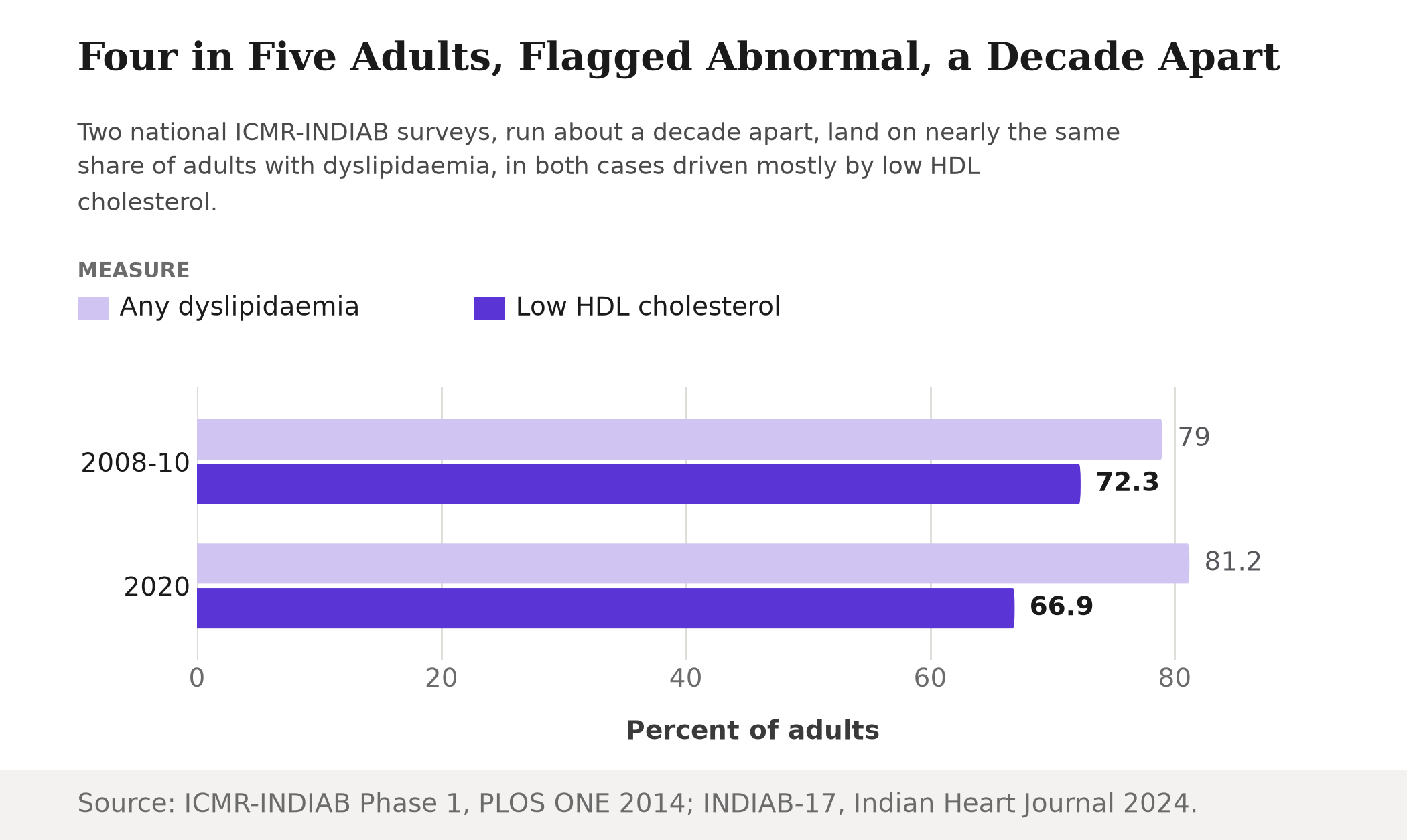
Two national surveys, run a decade apart, using thresholds drawn from the same imported tradition, land within two points of each other. Both times, the single largest driver is the same one: low HDL, the exact abnormality the 2014 urban-Indian study flagged as characteristic rather than exceptional. That stability is not evidence of a stable epidemic. It is what you get when you keep asking the same, uncalibrated question of the same population.
Compensating on the back end
Indian cardiology did not leave this unaddressed. It just addressed it at the treatment stage rather than the diagnostic one. Believing South Asians face higher cardiovascular risk than Western populations at the same measured cholesterol level, Indian lipid experts set consensus LDL-C treatment goals below NCEP-ATP III's: below 70 mg/dl for high-risk patients and below 50 mg/dl for very-high-risk patients, according to a 2022 Indian Heart Journal review of Indian dyslipidaemia guidelines. The Cardiological Society of India's 2023 clinical practice guideline goes further still, setting an LDL-C target below 100 mg/dl even for its lowest-risk tier: the general population with no risk factors at all. That is the same numeric ceiling ATP III reserves only for patients who already have coronary heart disease.
India's lowest-risk LDL-C target equals the US ceiling reserved for existing heart-disease patients.
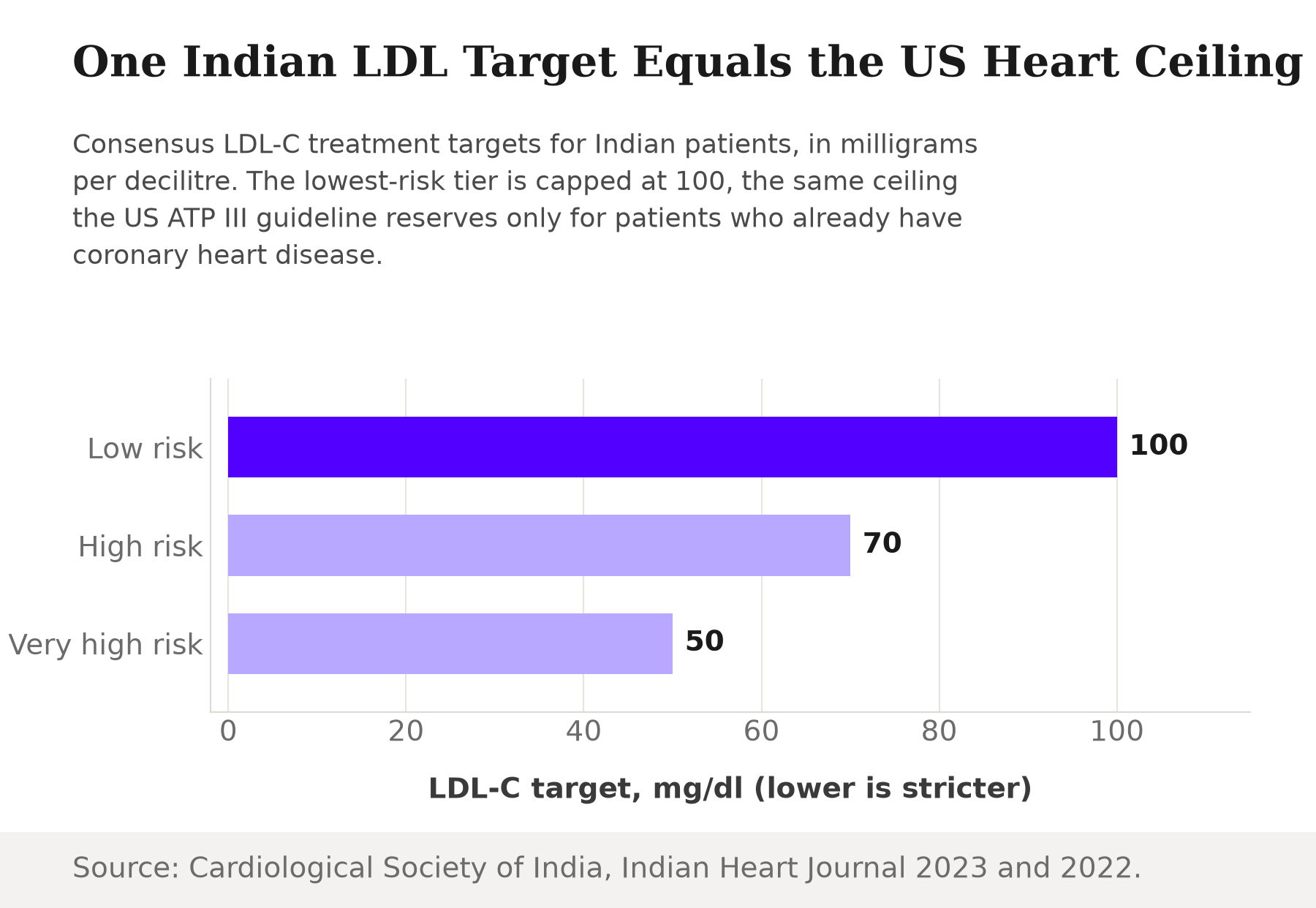
The logic is coherent on its own terms: if a population's baseline risk at any given cholesterol reading is genuinely higher, tightening the number that triggers treatment is a defensible response. But it is a response built entirely downstream of diagnosis. The test that decides whether a patient is called "abnormal" at all, the one four in five adults fail, was never rebuilt for the population taking it. Only the trigger for what happens next was.
| Framework | Origin | What it adjusted |
|---|---|---|
| NCEP-ATP III diagnostic cutoffs | US, 2001, Framingham cohort | Nothing for race or ethnicity, by design |
| Indian consensus LDL-C targets | India, 2022 review | Treatment trigger, lowered for high and very-high risk |
| Cardiological Society of India guideline | India, 2023 | Treatment trigger, lowered even for the lowest-risk tier |
| ACC/AHA multisociety guideline | US, March 2026 | Risk assessment, adds South Asian ancestry as a risk-enhancing factor |
Source: as linked in each row. Table: The Signal.
The honest objection
The strongest defense of this arrangement is that it may not matter which end of the pipeline gets adjusted, as long as the pipeline produces the right clinical outcome. A patient whose LDL-C is being brought down to below 70 mg/dl because Indian consensus guidelines say so is being treated appropriately, whatever the original diagnostic label on their chart said. On this view, the ATP III cutoffs are just an entry gate. The real clinical decisions happen later, at the treatment-target stage, exactly where Indian cardiology has already made its adjustment.
That case holds for patients already inside a cardiologist's treatment pathway. It holds less well for the diagnostic label itself, which is what a patient, a primary-care doctor, an insurer, or a screening program sees before any treatment pathway begins. Four in five adults return an "abnormal" result off a threshold that never distinguished a genuine Indian atherogenic pattern from population variation. Whatever happens downstream, that is a screening signal with very little discriminating power left in it. And the ACC/AHA's own March 2026 update is itself an admission that the upstream side has been under-adjusted, not just the downstream side: naming South Asian ancestry as a formal risk-enhancing factor is exactly the kind of population-specific recalibration ATP III's 2001 panel considered and declined to make.
The Signal
The 81.2 percent figure reads like a health crisis headline. It is better read as a measurement artifact wearing a health crisis's clothes: a threshold assembled from a different population's heart attacks, applied unchanged to a population with a documented different lipid pattern. That went on for over a decade, without anyone rebuilding the test itself. India's cardiology establishment noticed the mismatch and responded exactly where it had the authority to respond: the treatment target. It tightened that target well below the American original. What it could not do on its own was rewrite the diagnostic cutoff that decides who gets called abnormal in the first place, because that number belongs to a guideline written in Washington. That may be starting to change: ICMR's own Taskforce on Establishment of Reference Intervals in Indian Population says plainly that reference intervals used in India, lipid profile included, are mostly borrowed from Western data rather than measured in Indians, and it is now working toward what it calls Bharat-specific reference intervals. Watch whether that effort actually reaches adult lipid cutoffs and gets published, rather than an India-adjusted treatment target bolted onto someone else's test. Until then, the number to trust is not 81.2 percent. It is whichever number comes after India builds its own cutoff.
Reporting basis: the ICMR-INDIAB Phase 1 findings are per Iyer et al.'s 2014 PLOS ONE study; the ICMR-INDIAB-17 prevalence figure is per the study's PubMed abstract (Anjana et al., The Lancet Diabetes & Endocrinology, 2023), with the low-HDL breakdown as cited in a 2024 Indian Heart Journal review of that same survey. The NCEP-ATP III cutoffs and the panel's stated position on ethnic adjustment are from the US National Heart, Lung, and Blood Institute's ATP III Executive Summary. The distinct Indian lipid pattern is from a 2014 cross-sectional study of urban Asian Indians. The Indian consensus LDL-C targets and the Cardiological Society of India's 2023 guideline are each from their respective Indian Heart Journal publications. The 2026 ACC/AHA guideline update is per the American College of Cardiology's own press release. The status of ICMR's reference-interval taskforce is per ICMR's own Expression of Interest document for TERIIP Phase II. No figure in this piece is a Signal calculation; every number is reported directly by its cited source.