
Europe's late-June 2026 heatwave produced a number within days: precise, official, and grim. France recorded 2,025 additional deaths, a nearly 30 percent increase in mortality, in the week beginning 22 June as the heatwave peaked. Belgium's Sciensano put the toll at 1,747 more deaths than expected between 18 June and 1 July, a 48 percent jump and the highest heatwave death toll the institute has recorded since it began keeping score in 2000. In England and Wales, a joint analysis by Imperial College London, the UK Met Office and the London School of Hygiene and Tropical Medicine estimates around 550 heat deaths between 21 and 29 May and nearly 2,200 more between 18 and 28 June, a combined toll of at least 2,700. Three countries, three fast, specific tolls.
It is worth asking how those numbers arrive so quickly and so exactly. They are not body counts read off death certificates that say "heatstroke." They are excess-mortality estimates: a comparison of how many people actually died in a given week against how many were expected to die in an ordinary one, with the gap attributed to the heat. EuroMOMO, the mortality-monitoring network backed by the European Centre for Disease Prevention and Control and the World Health Organization, exists precisely to keep that comparison running continuously on a standardised basis across 27 countries, which is why a health ministry can name a heatwave's toll almost as soon as the heatwave ends.
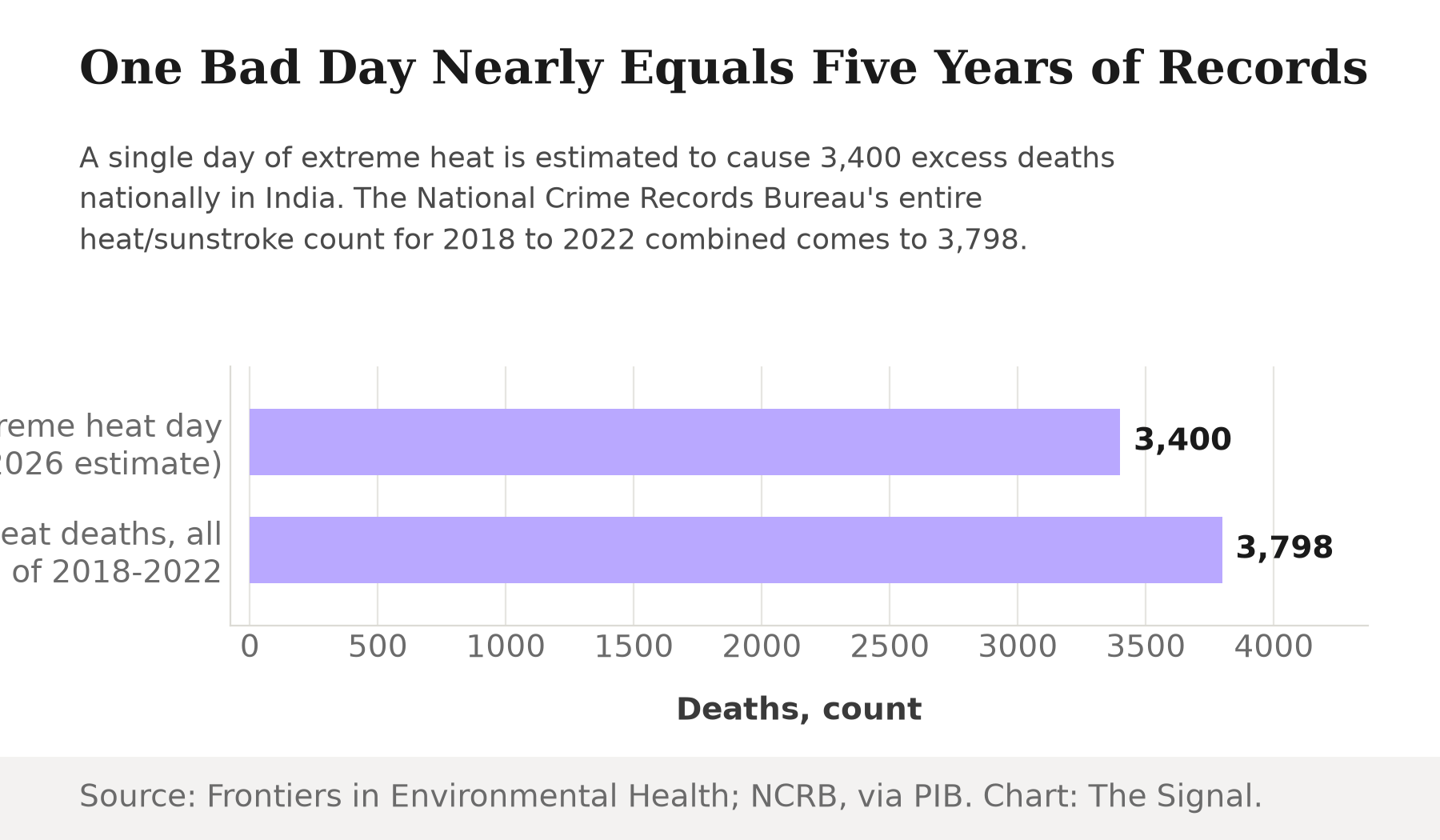
India runs no equivalent system, and the gap that leaves is not small. A single day of extreme heat, one that crosses the district-level 97th percentile threshold, is estimated to cause approximately 3,400 excess deaths nationally across India, according to a May 2026 study in Frontiers in Environmental Health. India's National Crime Records Bureau, by contrast, recorded 3,798 heat and sunstroke deaths in total across the five entire years from 2018 to 2022.
One extreme day in India nearly matches five years of its official heat-death count.
What the official count actually measures
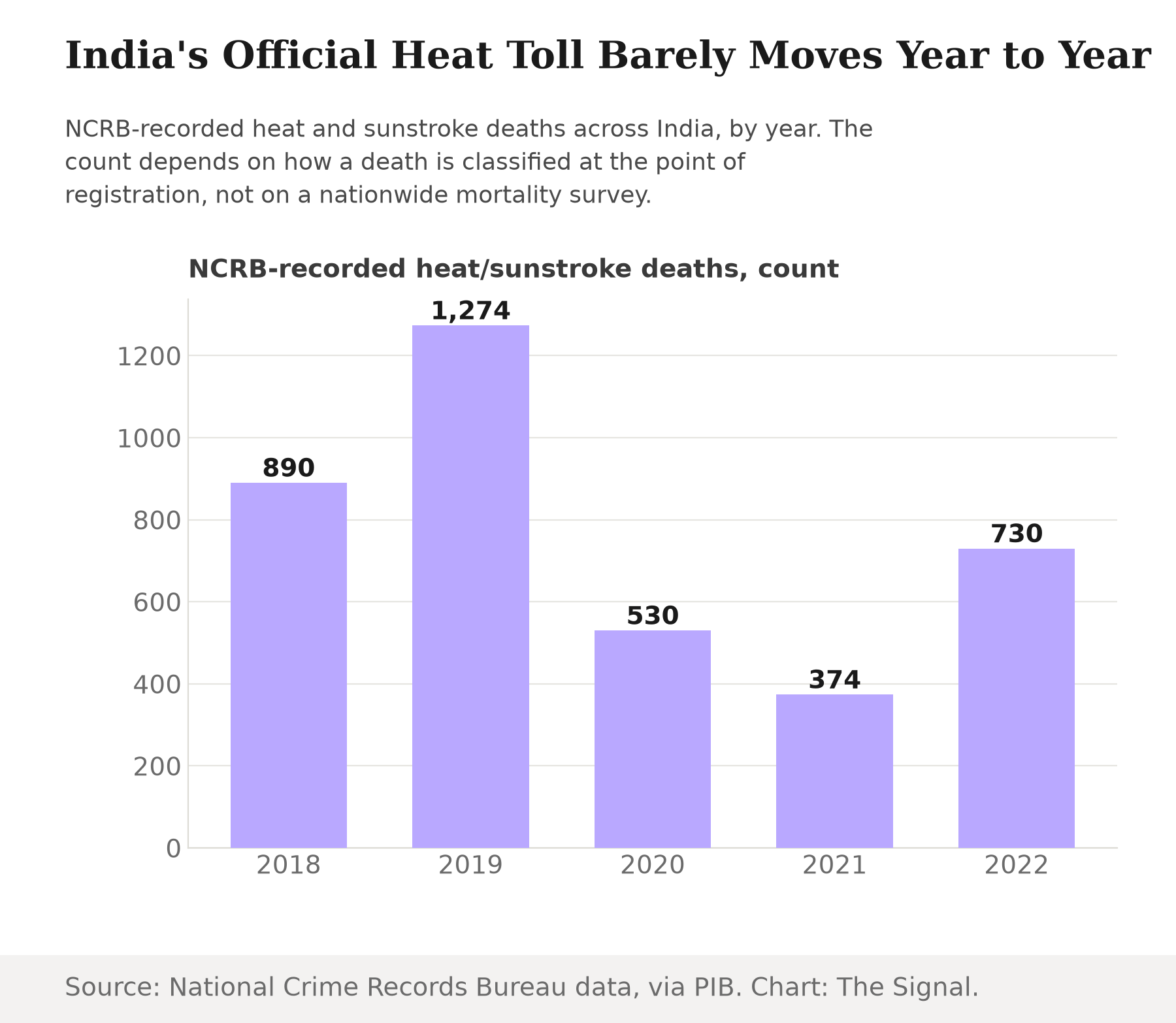
The NCRB's number is not wrong. It is narrow by design. It captures only deaths a doctor formally attributed to heatstroke or sunstroke at the point of registration, tabulated state by state and tabled in Parliament: 890 in 2018, 1,274 in 2019, 530 in 2020, 374 in 2021 and 730 in 2022. By that construction, the count misses nearly everything heat kills indirectly: the cardiac arrest three days into a heatwave, the kidney failure in a patient already living with chronic disease, the respiratory collapse a death certificate lists by its immediate cause even though extreme heat is what triggered it.
What India's own researchers find when they look harder
When Indian researchers apply an excess-mortality-style method instead of relying on cause-of-death registration alone, the number moves. A peer-reviewed study of ten major Indian cities between 2008 and 2019 found that a two-consecutive-day extreme heat event was associated with a 14.7 percent increase in daily mortality, equating to an estimated 1,116 excess deaths a year across those ten cities alone. That is more heat-attributable deaths, from ten cities using one methodology, than the NCRB recorded nationally in four of the five years shown in the chart above.
The undercount is not a uniquely Indian embarrassment; heat kills more than most cause-of-death systems anywhere are built to see. The World Health Organization estimates heat killed approximately 489,000 people a year worldwide between 2000 and 2019, with 45 percent of those deaths occurring in Asia. What is unusual about India's case is the size of the gap between what its own peer-reviewed science already estimates and what its official statistics report, sitting inside the same country, in the same years.
| Measure | Figure | What it actually captures |
|---|---|---|
| India, single extreme day, 2026 estimate | ~3,400 deaths | Modeled excess mortality, nationwide, one day above the 97th percentile |
| India, NCRB official count, 2018-2022 | 3,798 deaths total | Registered heatstroke/sunstroke cause of death, five full years |
| India, ten cities, annual average 2008-2019 | ~1,116 deaths a year | Modeled excess mortality, ten cities only |
| Worldwide, annual average 2000-2019 | ~489,000 deaths a year, 45% in Asia | WHO estimate across all reporting countries |
Sources: Frontiers in Environmental Health; PIB, Lok Sabha reply citing NCRB; Environment International; WHO.
The honest objection
The strongest case for India's narrower count is that it is not really a choice, it is a constraint. Running a EuroMOMO-style system requires a dense, reliable baseline of how many people die in an ordinary week, against which an unusual week can be measured. India's civil registration system's national death-registration completeness rose from 67 percent in 2011 to 79 percent in 2017, with wide variation between states. A system that was still missing roughly one in five deaths nationally as of 2017 cannot support continuous all-cause excess-mortality monitoring the way a near-complete European registration system can. Comparing India's heatstroke tally to Sciensano's excess-mortality tally, on this view, is not really comparing like for like; it is comparing a country still building the infrastructure to one that finished building it decades ago.
That case is real, but it does not explain the scale of what is being left out. Registration gaps of roughly one in five deaths as of 2017 cannot, on their own, account for a single day's modeled toll of 3,400 landing within a few hundred of five years of the official count: that is a difference of definition and method, not merely of missing paperwork. India's own scientists are already publishing the wider estimate, using data that exists today. The question is not whether the country can build a EuroMOMO-grade system overnight. It is why the heat action plans issued each summer are still sized against the narrower of the two numbers already sitting in the public record.
The Signal
Europe's 2026 heatwave season made a point that had nothing to do with exposure and everything to do with counting method: the same kind of event can be described as a few hundred deaths or a few thousand, depending only on whether cause of death is read narrowly off a certificate or measured against a baseline. India will keep having heatwaves larger than any single European country's, and its official number will keep landing far below what its own researchers calculate for the same kind of event. The figure worth watching next is not another state's monsoon-season heatstroke tally. It is whether any Indian authority starts publishing an excess-mortality baseline the way Sciensano and EuroMOMO already do. Until one does, every heat action plan in the country is being sized against a number that was never built to hold the true toll.
Reporting basis: the France figure is per Euronews, citing French national mortality surveillance data; the Belgium figure is per VRT NWS, citing Sciensano, Belgium's federal public health institute; the England and Wales figure is per RTE, reporting a joint analysis by Imperial College London, the UK Met Office and the London School of Hygiene and Tropical Medicine. The single-day national estimate for India is from a May 2026 peer-reviewed study in Frontiers in Environmental Health by Piyush Narang and Ashok Gadgil. The ten-city estimate is from a separate peer-reviewed study in Environment International. India's official heat/sunstroke death counts are National Crime Records Bureau data as tabled in a written Lok Sabha reply, via the Press Information Bureau. The worldwide heat-mortality estimate is the World Health Organization's own published figure. The civil registration completeness figures are from a peer-reviewed study using Registrar General of India Civil Registration System data. EuroMOMO's mission and country coverage are as stated on its own website. The comparison of the single-day and ten-city estimates against the NCRB's five-year and year-by-year totals is The Signal's juxtaposition of those independently published figures, not a single source's own claim.