On July 8, the World Health Organization and the International Agency for Research on Cancer released the Global Status Report on Cancer 2026, putting the disease at an estimated 20.6 million new cases and close to 10 million deaths worldwide in 2024, with annual cases projected to rise to nearly 35 million by 2050 without stronger action. India's own numbers, reported the same week by IARC's Global Cancer Observatory, are stark on their own terms: 1.56 million new cancer cases and 901,828 deaths in 2024, with an 11.2 percent cumulative risk of developing cancer, and a 6.8 percent risk of dying from it, before age 75. Read as a scale story, this looks like what a country of 1.4 billion looks like inside a growing global disease.
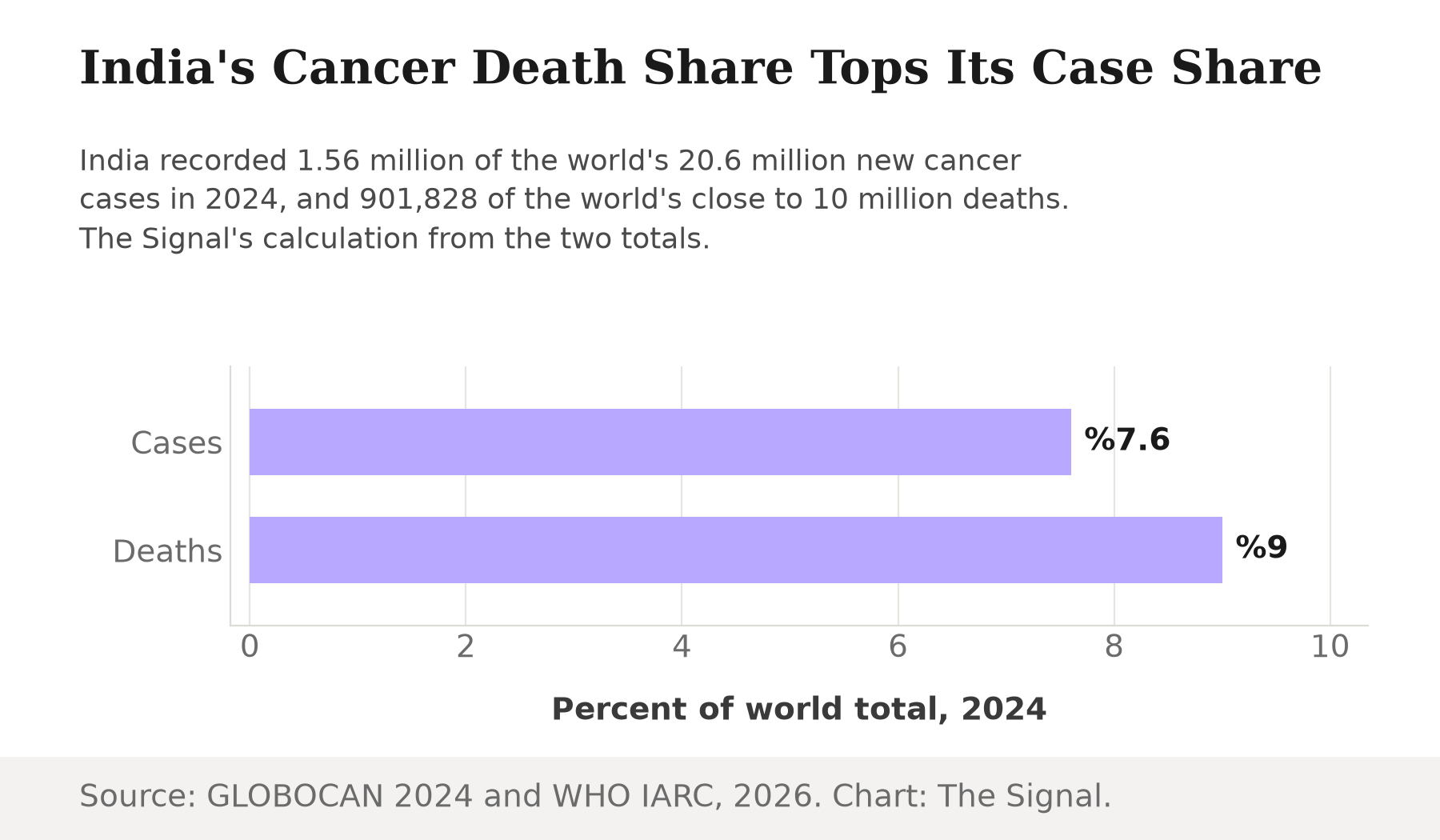
It is worth slowing down on that reading. India accounted for about 1.56 million of the world's 20.6 million new cancer cases in 2024, or roughly 7.6 percent, but its 901,828 deaths were about 9 percent of the world's close to 10 million, a calculation The Signal has made from those two totals. A country that carries a smaller share of the world's new diagnoses than of its deaths is not primarily a story about rising risk. It is a story about who survives what they are diagnosed with.
India's share of the world's cancer deaths is larger than its share of new cases.
Where the gap actually lives
The clearest single case study is breast cancer, India's leading cause of cancer illness and death among women, accounting for 13.5 percent of new cancer cases and 10.6 percent of all cancer deaths, in registry data through 2020. It is common enough, and tracked well enough by India's own registries, to show exactly where a scale story turns into a survival story.
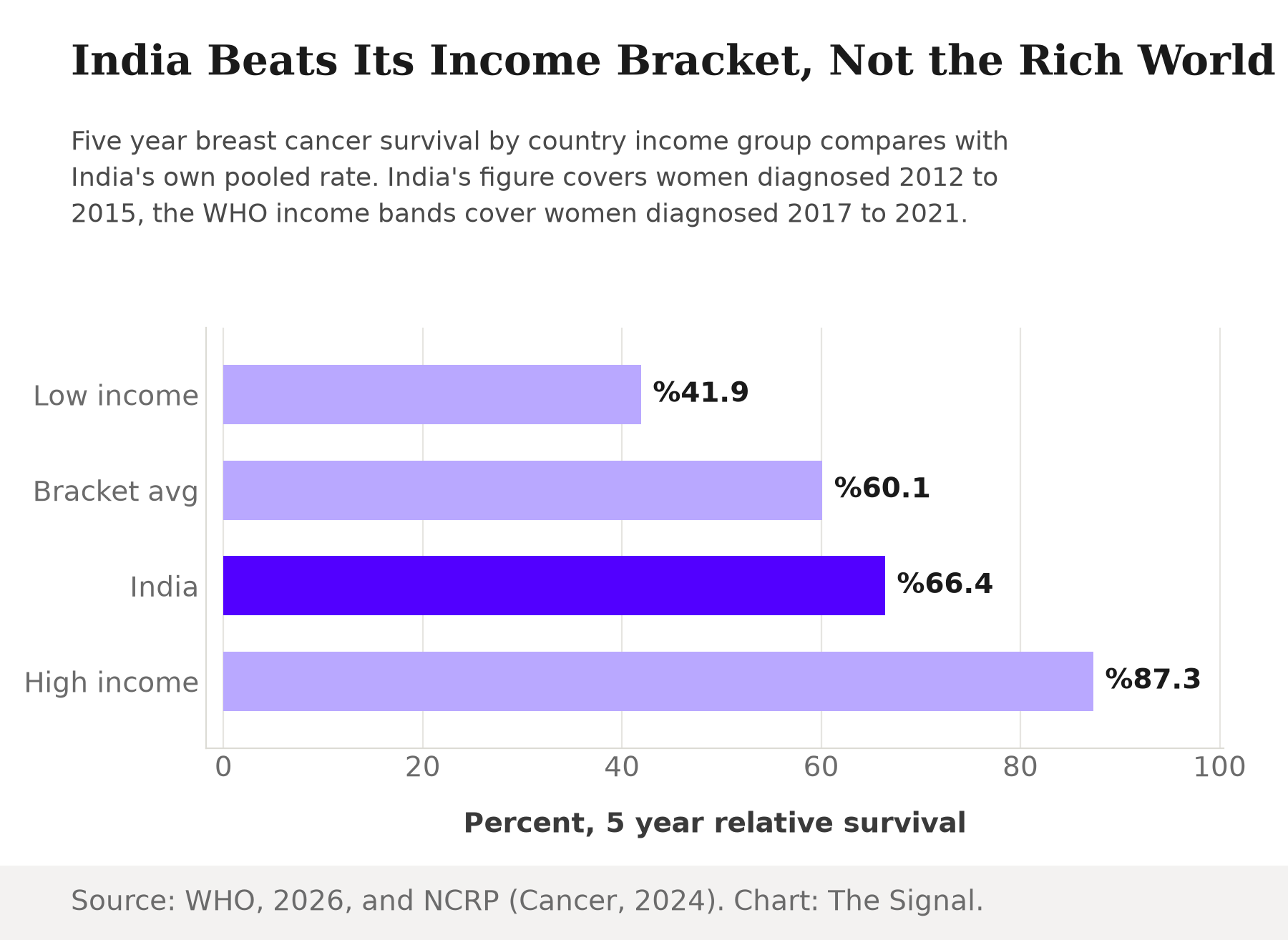
A 2024 study from India's National Cancer Registry Programme, pooling outcomes for women diagnosed with breast cancer between 2012 and 2015, put the five-year age-standardized relative survival rate at 66.4 percent, ranging from 41.9 percent in Pasighat to 74.9 percent in Mizoram. Roughly two in three Indian women diagnosed with breast cancer in that cohort were alive five years later.
India beats its income peers, not the rich world
The World Bank's current country classification, effective July 2026, places India among lower-middle-income economies, a bracket defined by a GNI per capita of $1,176 to $4,635. WHO's first global breast cancer survival estimates, covering women diagnosed between 2017 and 2021, put the median five-year survival for that same income bracket at 60.1 percent, against 87.3 percent in high-income countries and just 41.9 percent in low-income countries. Set against that ladder, India's own 66.4 percent looks like real outperformance, 6.3 points above the global median for its income bracket. The rich world is a harsher comparison: a 20.9-point gap that a decade of registry data has not closed.
Why the extra deaths accumulate
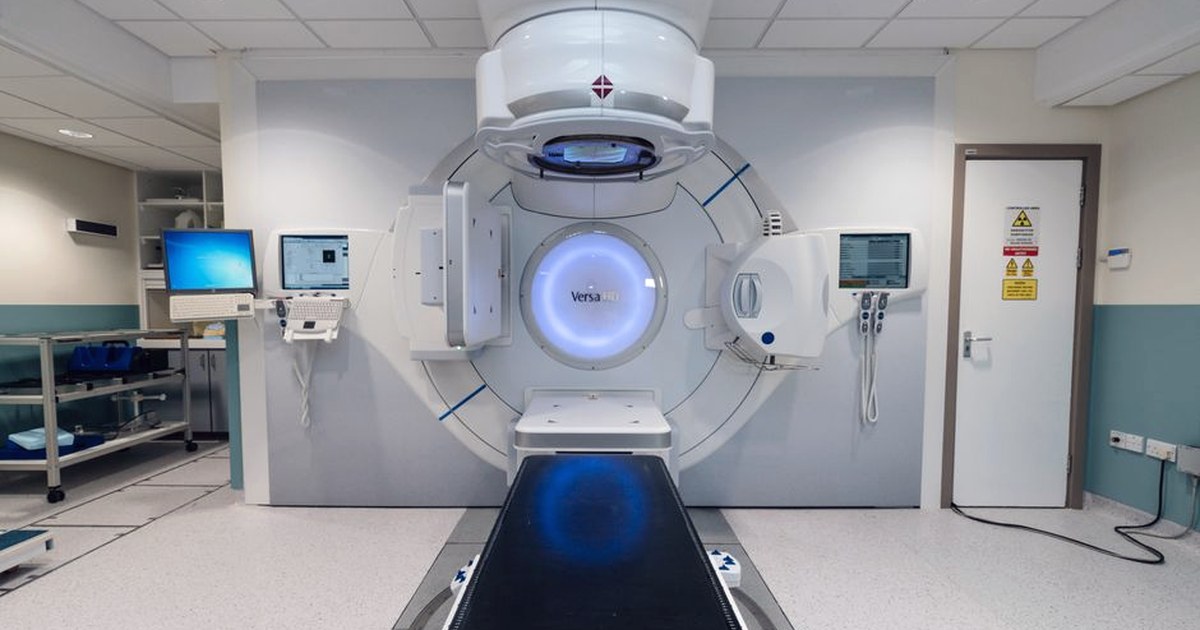
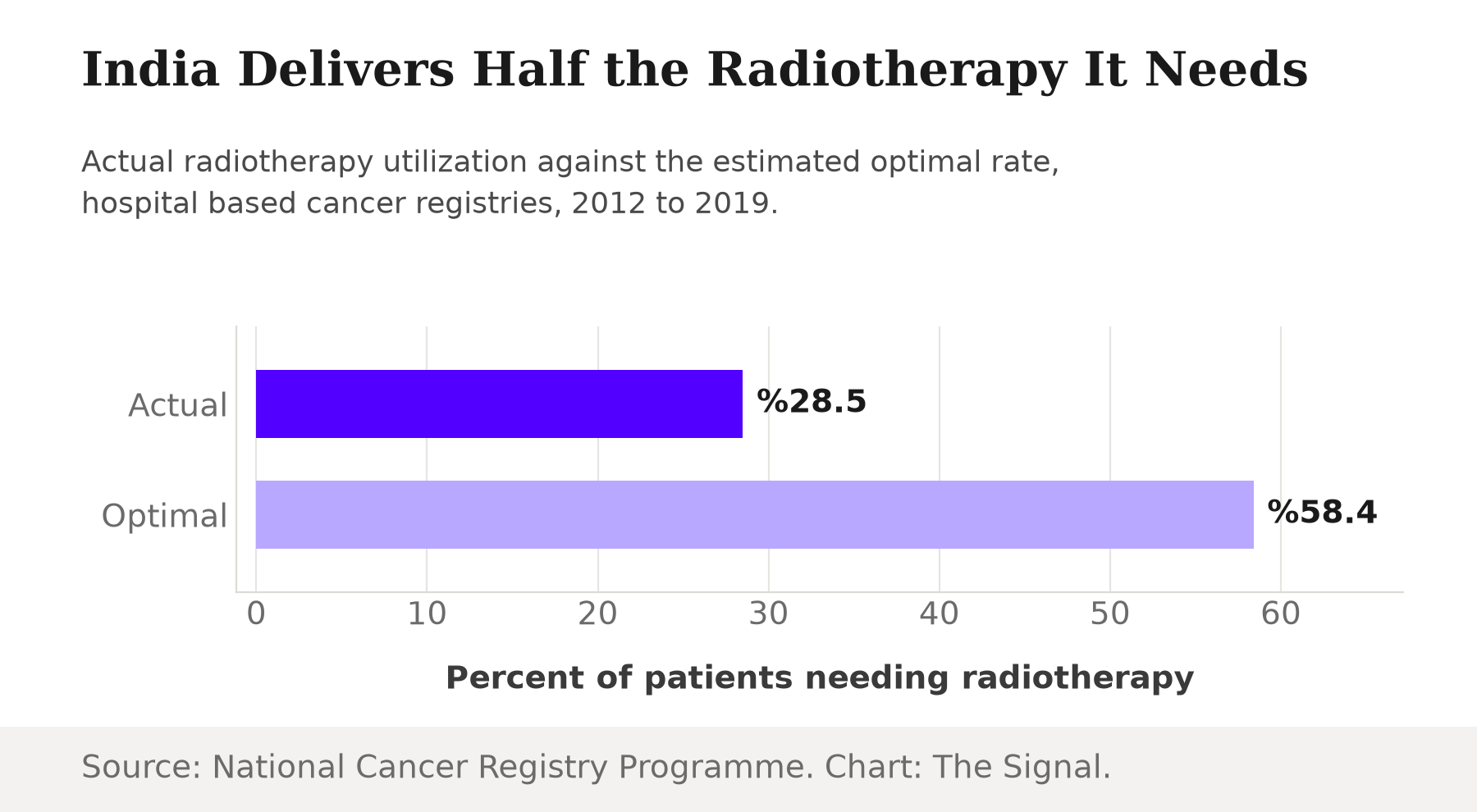
Cancer Statistics 2020, the National Cancer Registry Programme's last published staging breakdown, found that a majority of Indian breast cancer patients, 57.0 percent, presented at a locally advanced or locoregional stage rather than an early, more treatable one, in data covering diagnoses through 2016. Cancer caught late needs more treatment to control, and India's capacity to deliver it lags what its own patients need. A National Cancer Registry Programme analysis of hospital-based registries from 2012 to 2019 found actual radiotherapy utilization at 28.5 percent, against an estimated optimal rate of 58.4 percent: India delivers radiotherapy to roughly half the share of patients who need it.
Delayed diagnosis and rationed treatment are not free to the patients living through them. A 2021 systematic review and meta-analysis in the Asian Pacific Journal of Cancer Prevention put the pooled share of Indian cancer patients facing catastrophic health expenditure at 62.7 percent, meaning most families paying for cancer care in India are paying more than their household can readily absorb. Stage at diagnosis, treatment capacity, and financial ruin are the same story told three times.
The honest objection
The strongest case against reading this as a fixed structural gap is timing. India's own breast cancer survival figure covers women diagnosed between 2012 and 2015, the WHO income-bracket comparison covers women diagnosed between 2017 and 2021, and the staging and radiotherapy figures run through 2016 and 2019 respectively. None of these cohorts describe the India that just produced a 1.56-million-case, 901,828-death year in 2024. A health system can move in a decade, and India's has added hospitals, screening programs and oncology capacity since the oldest of these cohorts was diagnosed.
That case is real, but it does not explain away the shape of the gap, only its precise size. Every dataset available, spanning three separate cohorts and two separate registries, points the same direction: India's cancer survival tracks its own system's reach, not its income bracket alone, and even its best recent reading still leaves a fifth of the distance to the rich world uncrossed.
The trend line, where it can be seen at all, runs the same way. A 1997 population-based study from the Madras Metropolitan Tumour Registry, one of India's oldest cancer registries, found just 51 percent five-year relative survival for women diagnosed with breast cancer between 1982 and 1989. That single-registry figure from four decades ago is not directly comparable to the 66.4 percent pooled, 11-registry average for 2012-2015, but the direction is unmistakable: India's own survival odds have risen substantially from that earlier base. The gap to the rich world has narrowed with time, even if it has not closed.
The Signal
The 2026 numbers make it easy to write India's cancer story as a scale story, a large country producing a large slice of a growing global disease. The more useful story is a capacity one. India's cancer risk is not exceptional, and its outcomes already beat what its income bracket alone would predict, which means the remaining gap to the rich world is not something a richer India will close on its own. It is something its diagnosis pathways and its radiotherapy machines have to close directly. Watch two numbers going forward: the share of patients still presenting at a locally advanced stage, and the radiotherapy utilization rate against the guideline rate cited above. If both move toward the guideline, survival will follow. If they do not, the next GLOBOCAN update will show the same gap wearing a fresher year.
Reporting basis: India's 2024 cancer case and death counts, and its cumulative lifetime risk, are from IARC's Global Cancer Observatory GLOBOCAN 2024 country fact sheet. Global 2024 totals and the 2050 projection are from the WHO and IARC's jointly published Global Status Report on Cancer 2026. India's pooled breast cancer survival rate, for women diagnosed 2012 to 2015, is from a National Cancer Registry Programme study published in the journal Cancer. The income-bracket survival comparison, for women diagnosed 2017 to 2021, is from WHO's first global breast cancer survival estimates, and India's income classification is from the World Bank's country and lending groups list. The breast cancer incidence and mortality share is from a national registry burden study, the stage-at-diagnosis breakdown is from Cancer Statistics 2020, and the radiotherapy utilization figures are from a National Cancer Registry Programme analysis. The catastrophic health expenditure figure is from a systematic review and meta-analysis in the Asian Pacific Journal of Cancer Prevention. The earlier, 1982-1989 breast cancer survival figure is from a population-based study by the Madras Metropolitan Tumour Registry, published in the British Journal of Cancer. India's share of global cancer cases and deaths, and the point gaps between India's survival rate and its income bracket and high-income countries, are The Signal's calculations from those figures.