The received wisdom on lifestyle disease in India is that it is a city problem first: better incomes buy worse habits, and the countryside catches up later, if at all. Telangana's own numbers still back that reading, for now. Rural Telangana men run a lower rate of high or very high blood sugar than urban Telangana men, 16.6 percent against 21.4 percent, and a lower rate of elevated blood pressure, 28.9 percent against 36.8 percent, according to the National Family Health Survey-5 Telangana State Fact Sheet. Read only those two numbers and the consensus holds: the disease itself is still worse in the city.
It is worth slowing down on that reading. Strip out the disease markers and look instead at what drives them, and the direction reverses. Rural Telangana men consume alcohol at 49.0 percent, against 33.9 percent for urban Telangana men, and use some form of tobacco at 26.5 percent, against 15.2 percent in the cities, per the same fact sheet. On the two habits that cause the disease most directly, rural Telangana's men have already overtaken the men next door in Hyderabad and the state's other cities.
Rural Telangana men drink and smoke more than the state's own cities.
The gap runs widest on alcohol, where rural use is nearly half again the urban rate.
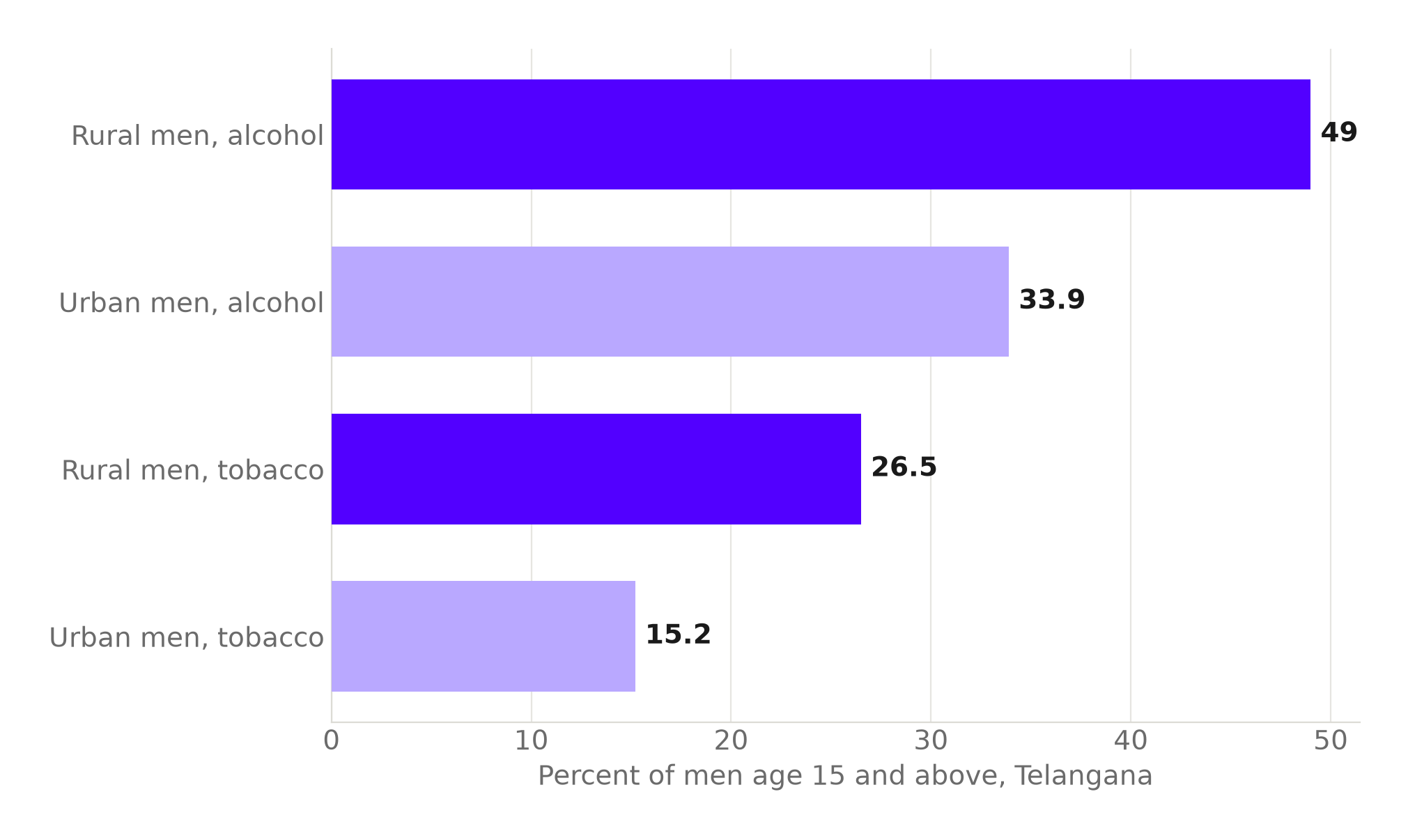
Source: National Family Health Survey-5, Telangana State Fact Sheet. Chart: The Signal.
That reversal is not a Telangana quirk against the rest of rural India either, at least on drinking. Nationally, 19.9 percent of rural Indian men consume alcohol and 42.7 percent use tobacco, per the National Family Health Survey-5 India National Fact Sheet. Rural Telangana's men drink at more than double the national rural rate, 49.0 against 19.9. Their tobacco rate of 26.5 percent, though, sits below the national rural figure of 42.7 percent. The reversal is concentrated in alcohol, not repeated across both habits.
The disease markers tell a similar story of a state already running hotter than the country's rural average, even short of its own cities. Nationally, 14.5 percent of rural Indian men have high or very high blood sugar and 22.7 percent have elevated blood pressure, against Telangana rural men's 16.6 percent and 28.9 percent. Telangana's villages sit above the national rural line on both counts, even as they still trail Telangana's own cities.
| Metric (men, age 15+) | Telangana, rural | Telangana, urban | India, rural |
|---|---|---|---|
| High or very high blood sugar, or on medicine (%) | 16.6 | 21.4 | 14.5 |
| Elevated blood pressure, or on medicine (%) | 28.9 | 36.8 | 22.7 |
| Consumes alcohol (%) | 49.0 | 33.9 | 19.9 |
| Uses any form of tobacco (%) | 26.5 | 15.2 | 42.7 |
Source: NFHS-5 Telangana State Fact Sheet (2019-20) and NFHS-5 India National Fact Sheet (2019-21).
The onset curve is shifting younger
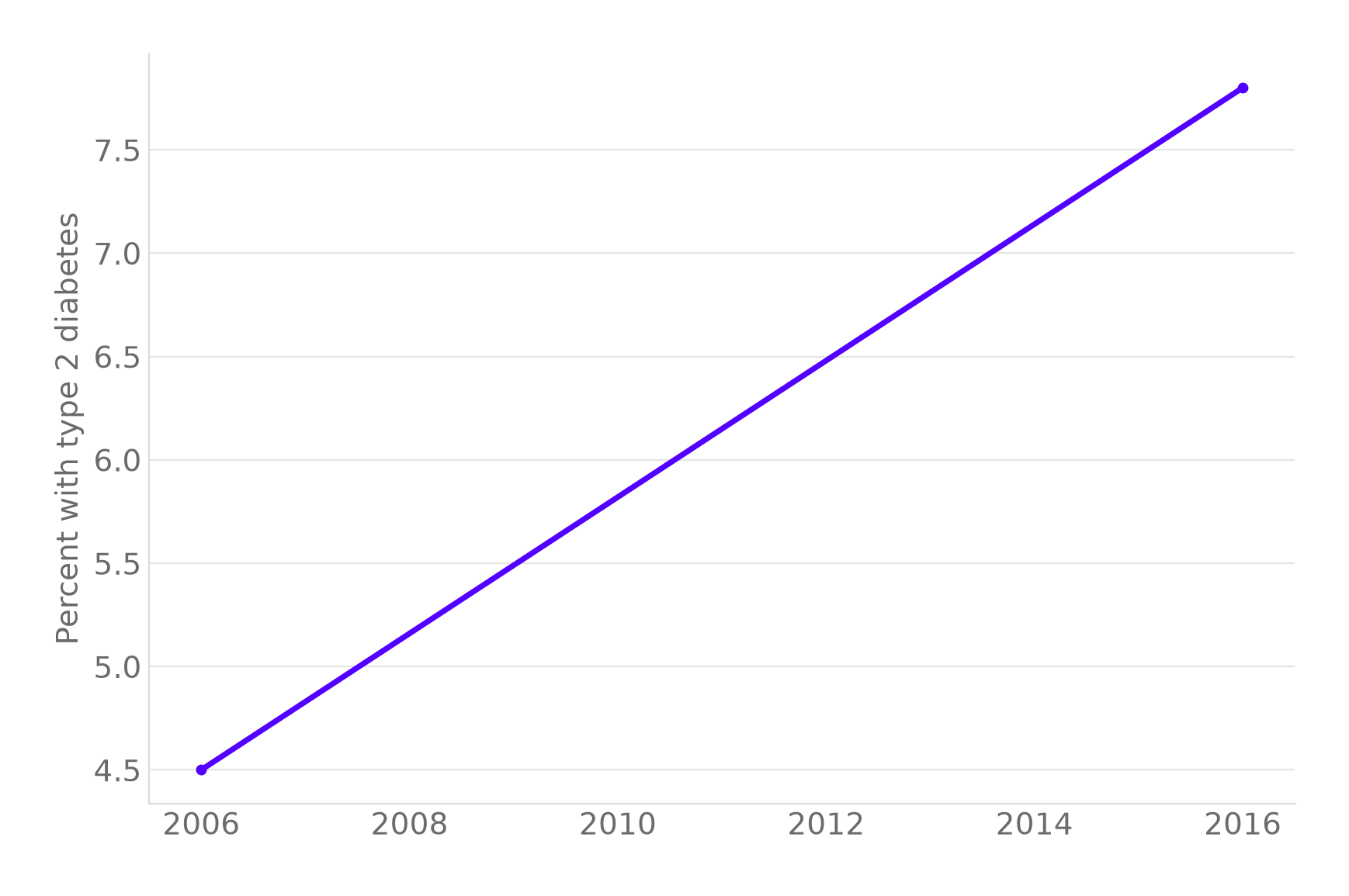
The bigger break from the urban-first consensus is not where the disease sits today. It is where it is arriving next. In southern India, type 2 diabetes prevalence among adults age 20 to 39 rose from 4.5 percent in 2006 to 7.8 percent in 2016, a steeper increase than in older adults over the same decade, per the Secular TRends in DiabEtes in India (STRiDE-I) study.
Type 2 diabetes in southern Indian adults under 40 nearly doubled between 2006 and 2016.
The rise in the youngest working-age adults outpaced the rise recorded in older age groups over the same decade.
Source: Secular TRends in DiabEtes in India (STRiDE-I) study. Chart: The Signal.
Nationally, the same shift shows up in the disease's own diagnosis registry. Of 5,546 cases enrolled in India's national registry of diabetes diagnosed at age 25 or younger, 25.3 percent were type 2 diabetes rather than the autoimmune type 1 form, per the ICMR Registry of Youth Onset Diabetes in India. A quarter of the country's earliest-onset diabetes is already the lifestyle-linked kind, not the kind a young patient is simply born with.
Blood pressure in young men is moving the same direction. Among Indian men age 15 to 24, hypertension prevalence rose from 5.2 percent in the 2015-16 survey to 6.2 percent in the 2019-21 survey, and prehypertension rose from 38.9 percent to 44.5 percent, per a nationally representative analysis of the two National Family Health Surveys. None of these three trends is Telangana-specific. All three describe the direction rural Telangana is already leaning on the inputs that cause the disease.
The diagnosis gap sits where the risk is rising
The reason the urban-first read has survived this long may be simpler than a genuine urban-rural gap in disease. It may be a gap in who gets tested. Nationally, 56 percent of diabetes cases in rural India go undiagnosed, and the southern states carry a significantly higher rate of undiagnosed diabetes than the rest of the country despite having near-universal access to healthcare, according to a study of National Family Health Survey-4 data published in BMJ Open Diabetes Research & Care. A number that reads as "the city has more diabetes" can just as easily read as "rural and southern India catches less of the diabetes it already has."
What the complications already show
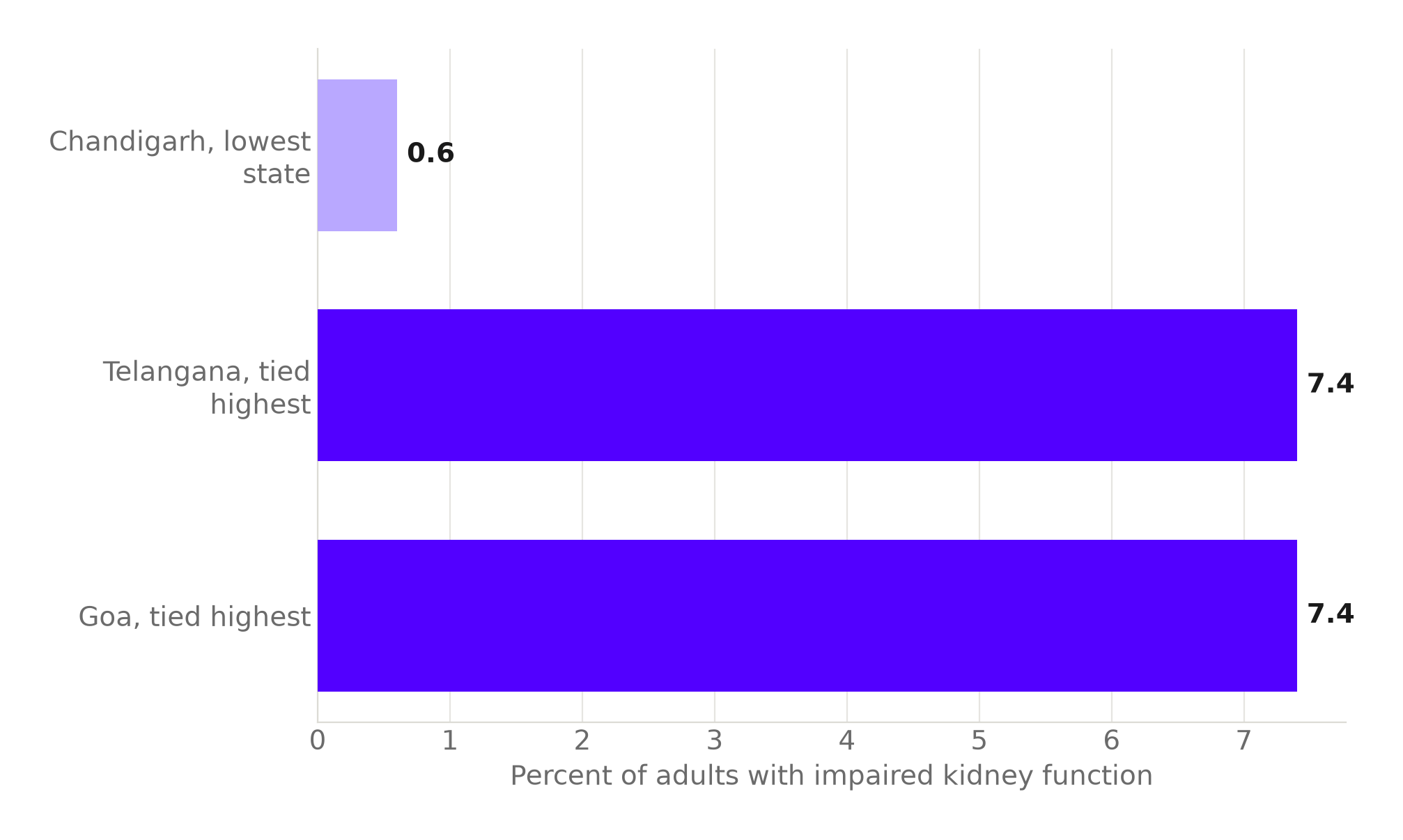
If Telangana's rural risk factors were merely catching up on paper, its complication data would still lag behind. It does not. Telangana ties with Goa for the highest state-level prevalence of impaired kidney function in India, at 7.4 percent, in a range that runs down to 0.6 percent in Chandigarh, per the ICMR-INDIAB-22 study published in the Indian Journal of Medical Research.
Telangana already ties for the highest rate of impaired kidney function of any Indian state.
Source: ICMR-INDIAB-22, Indian Journal of Medical Research. Chart: The Signal.
A state whose villages already out-drink and out-smoke its own cities is also the state, tied for first nationally on the kidney damage the disease leaves behind.
The honest objection
The strongest case for the older, urban-first read is that Telangana's own numbers still back it up today. Urban Telangana men run a higher rate of both high blood sugar, 21.4 percent, and elevated blood pressure, 36.8 percent, than rural men do. Nationally, India's overall weighted diabetes prevalence stands at 11.4 percent, with every metabolic non-communicable disease except prediabetes still more common in urban than rural areas, the ICMR-INDIAB-17 study found. On the disease itself, not just its inputs, cities are still worse, and that is not a small caveat.
That case is real, but it describes where the disease has landed, not where it is headed. Alcohol and tobacco are inputs, not outcomes, and rural Telangana already leads its own cities on both. The youngest adults nationally, and southern India's 20-to-39 group specifically, are gaining the disease faster than older cohorts are. And the same rural, southern geography that still tests lower for diabetes is also the geography testing least for it. An urban lead in diagnosed prevalence is consistent with a genuine urban lead in disease. It is equally consistent with an urban lead in who gets a blood sugar test.
The Signal
Telangana's villages are not catching up to its cities on lifestyle disease. On the two habits that cause it most directly, they have already passed them. The disease itself has not caught up, at least not on the numbers anyone has measured, but the state already carries, tied for first in the country, the kidney damage that disease leaves behind. Watch the diagnosis rate before the disease rate: if rural Telangana's tested prevalence of blood sugar and blood pressure starts closing the gap with its cities as fast as its drinking already has, the state was never behind. It was undercounted.
Reporting basis: Telangana's and India's rural and urban risk-factor and disease-marker figures are from the International Institute for Population Sciences' National Family Health Survey-5 Telangana and India fact sheets. The southern India young-adult diabetes trend is from the Madras Diabetes Research Foundation-led Secular TRends in DiabEtes in India (STRiDE-I) study. The national diabetes prevalence and urban-rural comparison across metabolic non-communicable diseases are from the Indian Council of Medical Research's ICMR-INDIAB-17 study, published in The Lancet Diabetes & Endocrinology. The youth-onset type 2 diabetes share is from ICMR's Registry of Youth Onset Diabetes in India. The undiagnosed-diabetes figures are from a study of National Family Health Survey-4 data, published in BMJ Open Diabetes Research & Care. The impaired-kidney-function figures are from the ICMR-INDIAB-22 study, published in the Indian Journal of Medical Research. The young men's hypertension and prehypertension trend is from a nationally representative analysis of National Family Health Survey-4 and National Family Health Survey-5 data, published in PLOS One. The alcohol and blood-sugar rate comparisons stated as multiples in the text are The Signal's calculations from those figures.