In 2020, India's Ministry of Agriculture and Farmers Welfare drafted an order to restrict 27 pesticides on health and environmental grounds, the fungicide Thiram among them. Ultimately, the proposed restrictions on Thiram were not implemented, allowing the chemical to remain on the market. Read only the first half of that, and it looks like the system working as designed: a regulator flags a chemical, drafts a rule, prepares to act.
It is worth slowing down on the second half. Six years after the draft order, Thiram remains legally sold and used in India because that restriction was never implemented, not because anyone found the original health and environmental concerns to be wrong.
The number that explains the gap is 40 to 50 billion rupees.
That is the rupee value the Pesticides Manufacturers & Formulators Association of India put on the market for the 27 generic pesticides named in the 2020 draft order, Thiram included, warning that replacement imports would cost Indian farmers far more. A rule that touches a market that size does not glide through unopposed, and this one did not.
What the 2020 order actually proposed, and what happened to it
The draft order was not a ban already in place that got rolled back. It was a proposal, one of 27 pesticides bundled together, that never crossed into an enforced restriction after the industry pushed back. PMFAI's own framing of the opposition is worth reading in full: its president argued that the generic products on the list had been used by Indian farmers for three to four decades without complaints, barring misuse, and that the category represented a market worth 40-50 billion rupees. That is an economic argument and a safety-record argument fused into one sentence, and it is the argument that won.
Thiram's case sits inside a wider pattern of Indian pesticide regulation moving in small, counted steps. India's Ministry of Agriculture and Farmers Welfare told the Rajya Sabha in February 2023 that it had, in total, banned or phased out 46 pesticides and 4 formulations, withdrawn 8 registrations, and placed 9 pesticides under restricted use, after a 2015 expert panel had reviewed 66 pesticides already banned or restricted abroad.
India's own tally of finished pesticide actions is short.
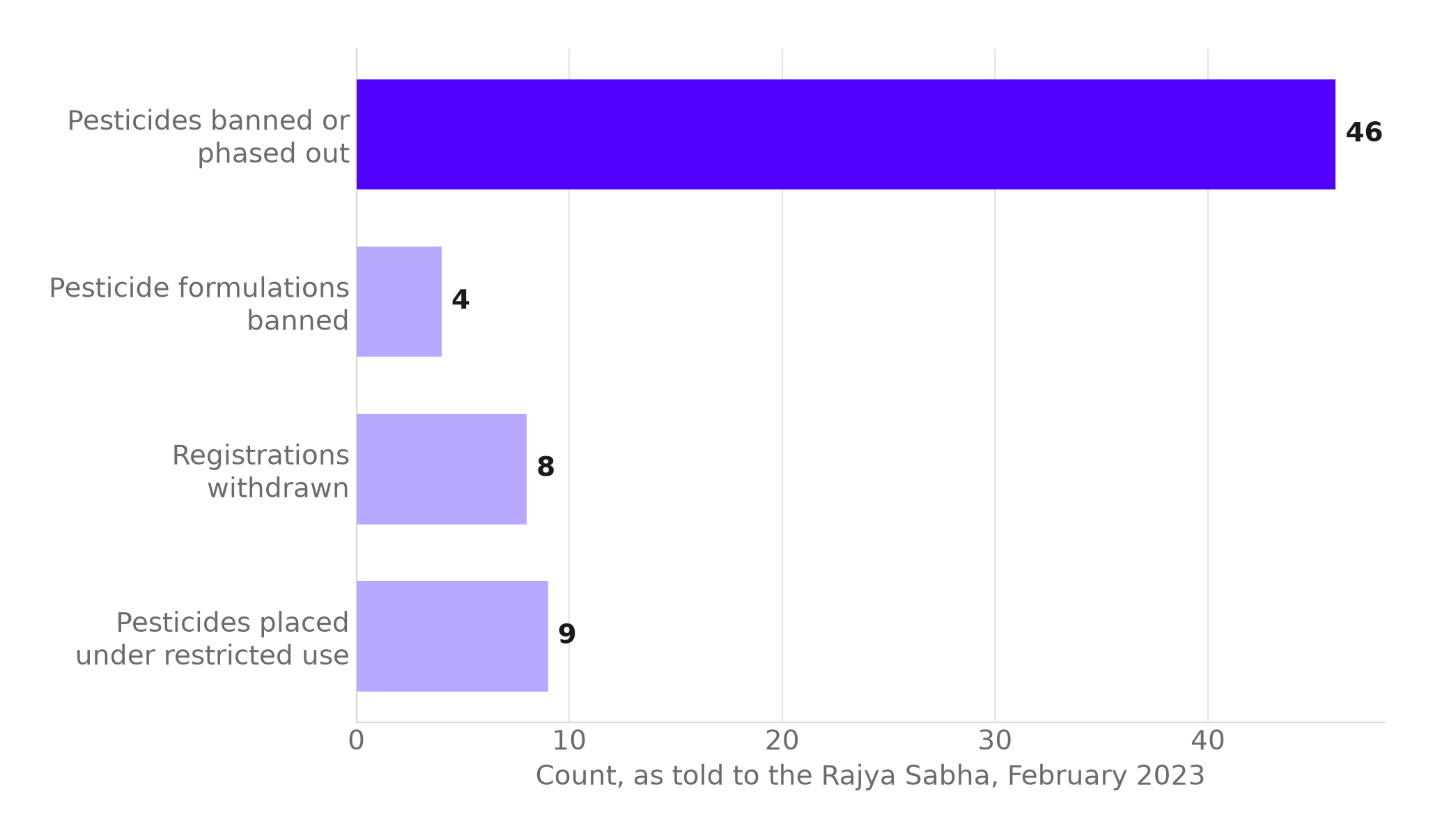
Source: Ministry of Agriculture & Farmers Welfare, via PIB. Chart: The Signal.
Thiram's 2020 draft restriction sits outside that tally entirely. It was proposed, not enacted, so it never added to any of these four counts. It is a fifth category the ministry's own numbers do not have a column for: rules that were written and then quietly did not happen.
The ministry did eventually finish that review, just not for Thiram. Three years after the 27-pesticide draft, the Insecticides (Prohibition) Order, 2023 banned four pesticides, Dicofol, Dinocap, Methomyl and Monocrotophos, a different, much shorter list. Thiram is not on it. The 2020 draft was not left in limbo because the ministry never got back to the underlying review; it got back to it, closed the file on four other chemicals, and Thiram was not among them.
A fungicide the European Union already walked away from
India's regulator drafted, then dropped, a restriction on Thiram in the same period that a different regulator finished the job. The European Commission's 2018 implementing regulation ended EU approval of thiram as a pesticide active substance and banned the sale and use of thiram-treated seeds from 31 January 2020, citing risks to consumers, workers, birds and mammals. That is not a proposal under review. It is a completed non-renewal, in force for more than six years, covering the same chemical.
The contrast is less about India being uniquely permissive toward risk than about two regulators reviewing the same substance around the same time and reaching opposite operational outcomes, one a completed ban, one a draft that stalled.
The classification the "carcinogenic" label skips
The word most often reached for around Thiram is "carcinogenic," and the actual science here needs the same slow-down as the regulatory history. The World Health Organization's International Agency for Research on Cancer classified thiram itself as Group 3, not classifiable as to its carcinogenicity to humans, citing inadequate evidence in both humans and experimental animals. That is IARC's most inconclusive category, not a finding of danger.
The carcinogen concern attaches to something else: what Thiram turns into. NDMA, a breakdown byproduct of thiram, is classified by the US Environmental Protection Agency as a probable human carcinogen, Group 2B, a distinct classification from thiram's own inconclusive one.
Thiram itself and its breakdown product carry two different classifications.
| Substance | Classifying body | Classification |
|---|---|---|
| Thiram (the fungicide itself) | International Agency for Research on Cancer, 1991 Monograph, Volume 53 | Group 3: not classifiable as to carcinogenicity to humans |
| NDMA (thiram's breakdown byproduct) | US Environmental Protection Agency, via CDC/ATSDR ToxFAQs | Group 2B: probable human carcinogen |
Source: IARC Monograph, Volume 53; CDC/ATSDR ToxFAQs on NDMA.
This distinction does not clear Thiram. The EU's 2018 non-renewal was framed around risks to consumers, workers, birds and mammals, not carcinogenicity alone. But it does mean the shorthand "banned carcinogen" compresses two separate scientific findings into one. That compression makes the chemical sound more settled than the underlying classifications actually are.
An industry with a growing stake in saying no
The economic backdrop to the 2020 draft order's failure to launch is a sector that has spent the years since getting larger, not smaller. India's agrochemical industry's trade surplus rose from Rs 8,030 crore in 2017-18 to Rs 28,908 crore in 2022-23, a nearly 3.6-fold increase in five years.
The industry that opposed the 2020 restriction has grown its export surplus almost fourfold since.
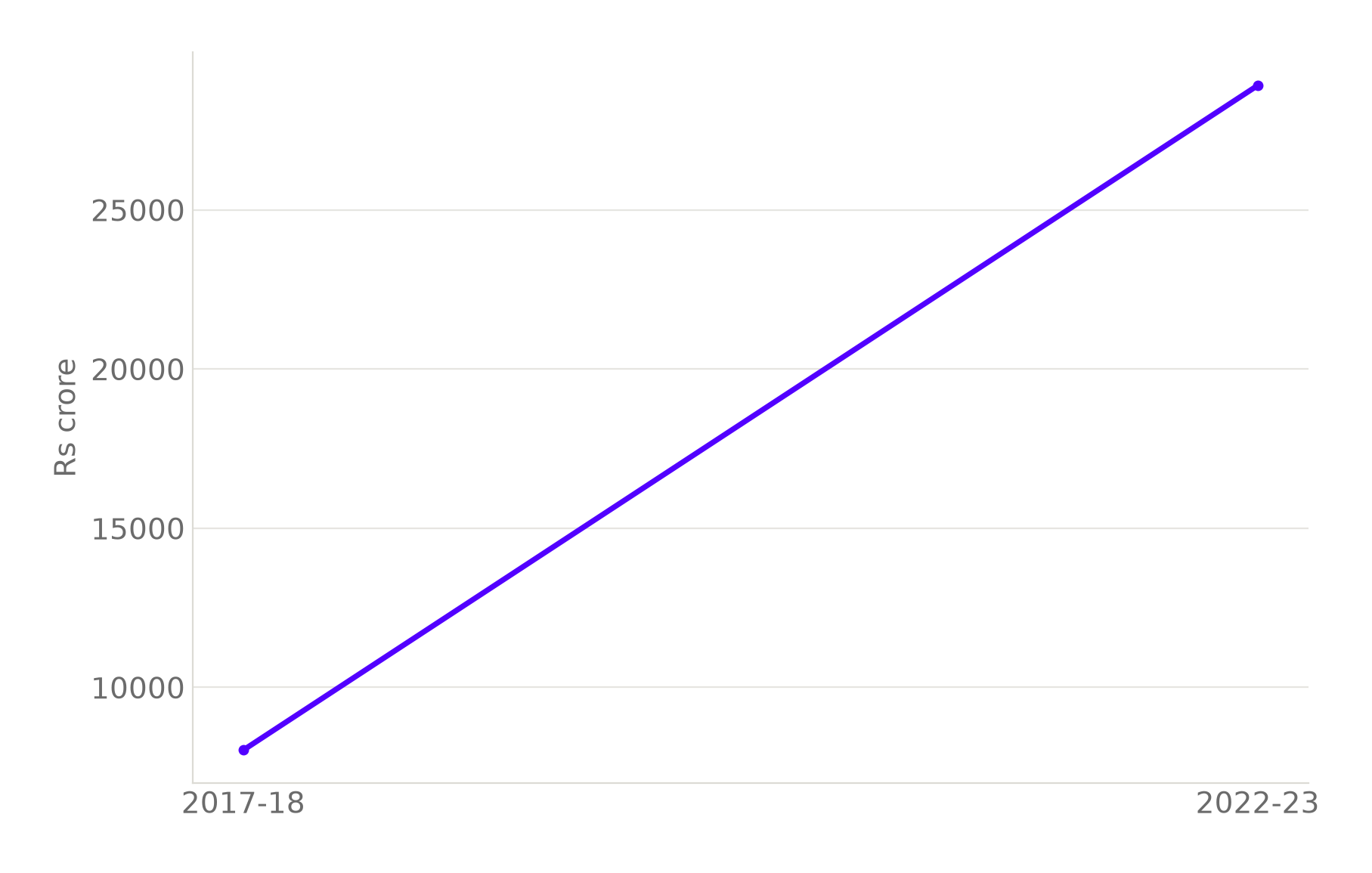
Source: Ministry of Commerce & Industry, via Indian Chemical News. Chart: The Signal.
A shrinking trade surplus would have handed the industry a weaker hand when it warned a regulator about the cost of a restriction. A sector whose surplus grew from Rs 8,030 crore to Rs 28,908 crore over five years has a stronger one, and it is the stronger hand that showed up when the 2020 draft order came up for a decision.
The honest objection
The strongest case against reading this as regulatory capture is PMFAI's own argument, taken at face value: these are generic products that Indian farmers have used for three to four decades without complaints, barring misuse, and the chemical itself carries no confirmed carcinogenicity finding from IARC. On that reading, the 2020 draft order was drafted broadly, caught a chemical with a genuinely ambiguous risk profile, and industry pushback simply corrected an overreach rather than blocking a needed restriction.
That case is real, but it does not explain why the European Union, working from the same underlying chemistry, still moved to end Thiram's approval and ban thiram-treated seed from 2020, citing risk to workers, birds and mammals well beyond the single question of human carcinogenicity. Nor does it explain why India's own ministry drafted the restriction in the first place, only to let it lapse rather than narrow or defend it. A decades-long absence of complaints is also not a monitoring dataset. It is the absence of a specific kind of report, from a farming population with uneven access to occupational health surveillance. That is a different claim than an absence of harm.
The Signal
The 2020 draft order was never repealed. It simply never turned into a rule, and when the ministry did finish that review, three years later, the resulting ban covered four other pesticides and not Thiram. "Still under review" has stopped being a credible description of its status. What killed it was not a finding that Thiram is safe. It was a market worth 40 to 50 billion rupees telling a regulator what enforcement would cost, made by an industry whose export surplus has since grown nearly fourfold. Watch what happens the next time an Indian ministry drafts a restriction on a chemical the EU has already moved against: whether the draft becomes a rule, or becomes another line in a tally of pesticides that were proposed but never counted.
Reporting basis: the 2020 draft order and its non-implementation are as reported by India Today, which is the sole source for that specific reporting. India's cumulative pesticide-action tally is from the Ministry of Agriculture & Farmers Welfare's February 2023 reply to the Rajya Sabha, via a Press Information Bureau release. The 2023 Insecticides (Prohibition) Order and the four pesticides it covers are as reported by ChemLinked. The European Union's non-renewal of thiram is from the European Commission's own implementing regulation, the primary legal text. Thiram's IARC classification is from the IARC Monograph itself; NDMA's EPA classification is as relayed by the US CDC/ATSDR's ToxFAQs sheet. PMFAI's market-size warning and quoted argument are as reported by Global Agriculture. India's agrochemical trade surplus figures are Ministry of Commerce & Industry data, as reported by Indian Chemical News. The five-year growth multiple on the trade surplus is The Signal's calculation from those two figures.