MoSPI's Women and Men in India 2023 report, citing Sample Registration System data, states that life expectancy during 2016-20 reached 71.4 years for women and 68.6 years for men, a 2.8-year gap favouring women. Read on its own, that is the ordinary story: women outlive men, as they do almost everywhere data is kept, and the vital-statistics scorecard says the Indian gender health gap runs in women's favour.
It is worth slowing down on that framing. A peer-reviewed study in Genus, using LASI Wave 1 (2017-18) and SRS 2016-20 data, finds that 98.4 percent of the mortality advantage women hold over men at age 60 is spent living with disability, nearly erasing any gain in disability-free years. Applying that share to the national 2.8-year gap works out to about 2.76 years spent unwell and only roughly 0.04 years of genuinely extra healthy life, our calculation from the two figures above. The years are real. The health inside them mostly is not.
Almost the entire longevity gap between Indian men and women is spent in poor health, not extra healthy life.
The chart below turns that mortality advantage into years, then shows how much of it survives contact with disability.
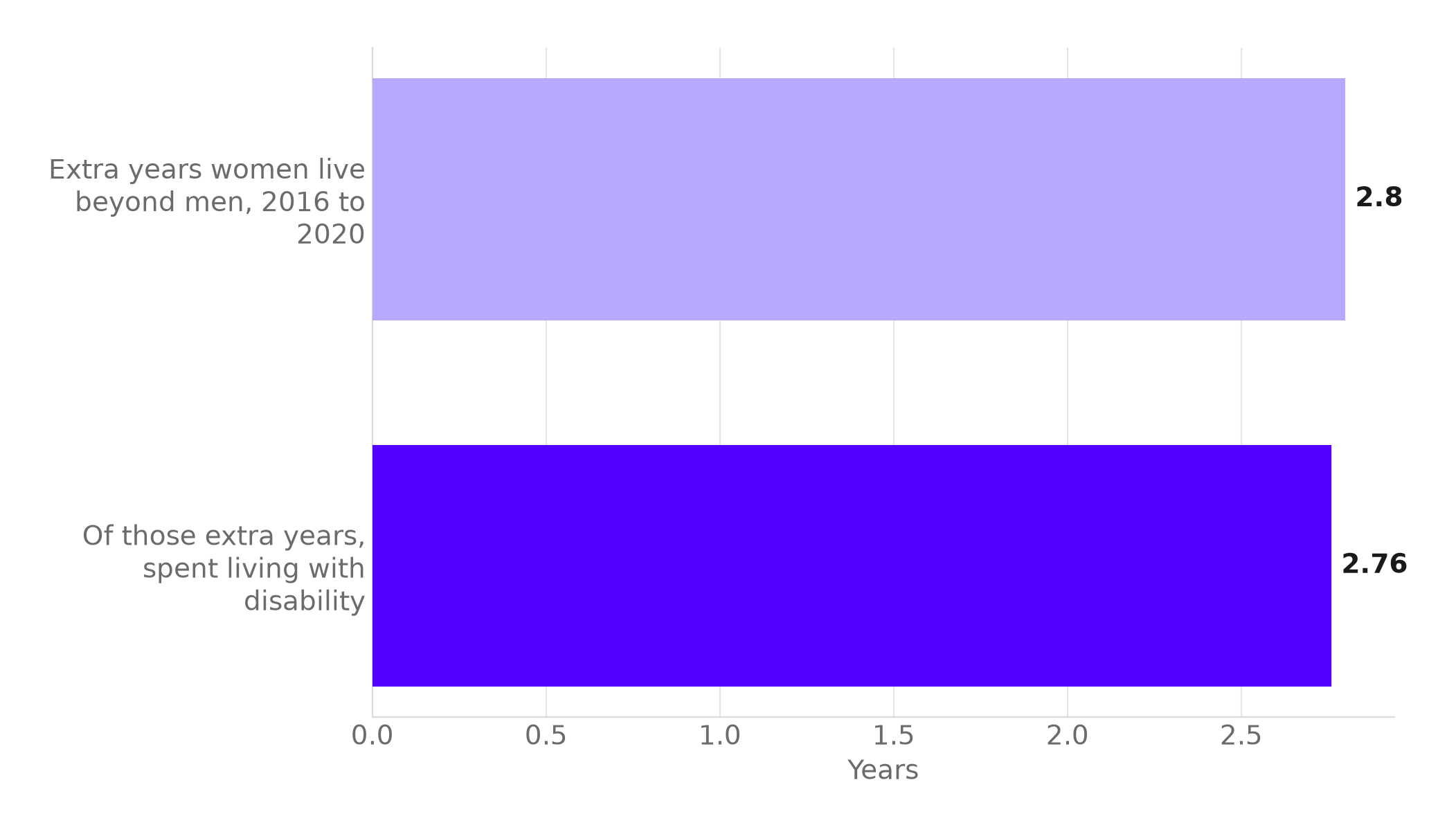
Source: MoSPI, Sample Registration System; Genus journal study. Chart: The Signal.
The body keeps the receipt
The paradox is not an artefact of national averages. A 2025 study in Frontiers in Public Health, using LASI data, finds that women aged 45 to 49 live with complex multimorbidity for 10.77 years on average, compared with 8.93 years for men of the same age, with a similar gap on simple multimorbidity: 6.09 years for women against 5.85 for men.
Women in midlife carry more years of chronic illness than men do, by every measure the same study tracked.
| Chronic illness burden by sex, ages 45 to 49 | Women | Men |
|---|---|---|
| Years lived with multimorbidity | 6.09 | 5.85 |
| Years lived with complex multimorbidity | 10.77 | 8.93 |
Source: Frontiers in Public Health, 2025. Table: The Signal.
The gap on complex multimorbidity, nearly two years, is wider than the gap on simple multimorbidity. Whatever is driving women's extra years of survival is not sparing them the accumulation of disease along the way; if anything, the two move together.
A sicker body, a thinner safety net
Some of that extra burden has a direct, treatable driver. The Union Health Ministry's PIB Research Unit brief, citing NFHS-5 (2019-21), reports that 57 percent of Indian women aged 15 to 49 are anaemic, more than double the 25 percent rate among men in the same age group.
Women are more than twice as likely as men to enter midlife anaemic.
Anaemia is inexpensive to screen for and to treat, which makes the response to it, not the condition itself, the more telling number.
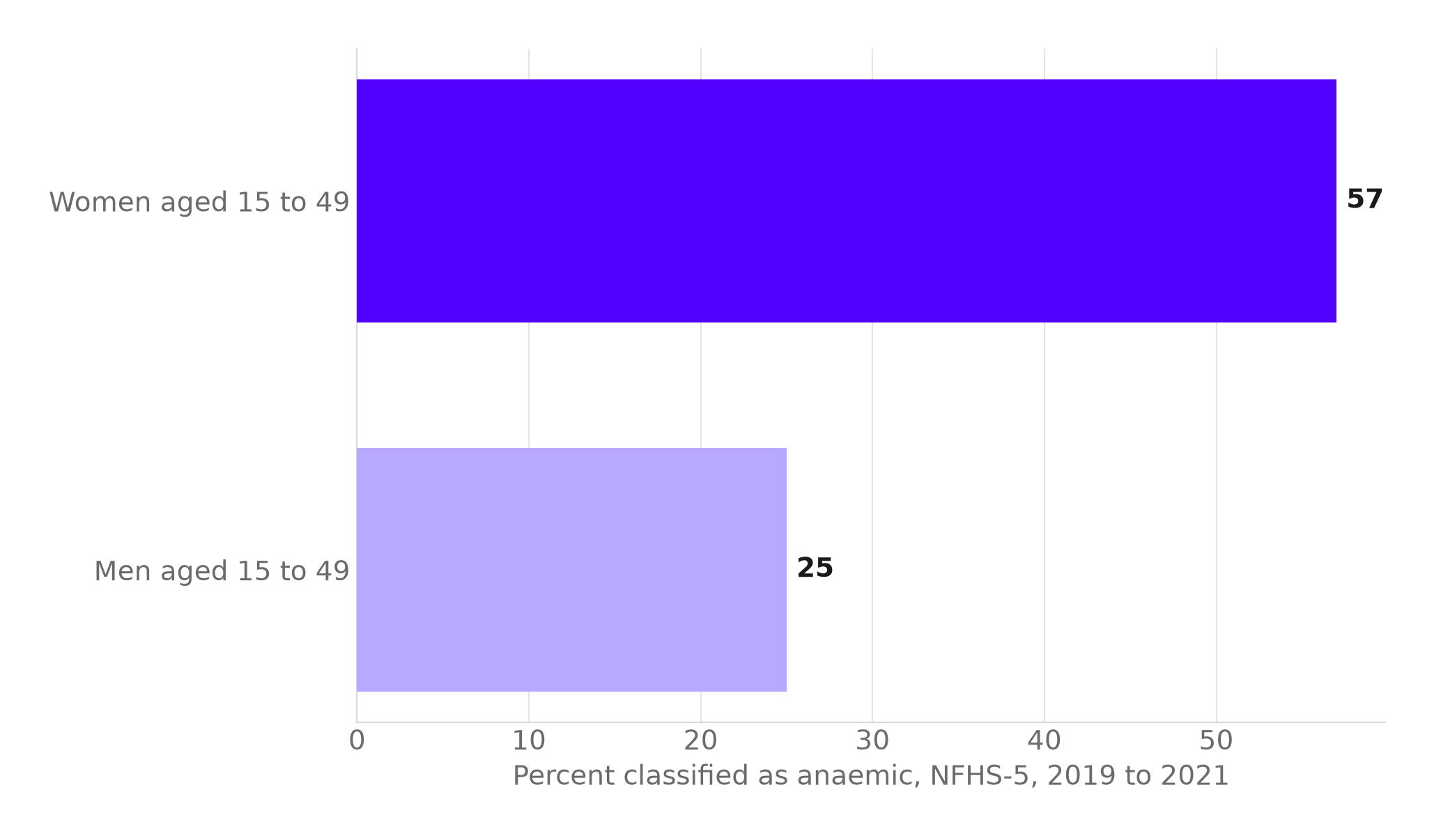
Source: PIB Research Unit brief, citing NFHS-5. Chart: The Signal.
The spending pattern behind conditions like this is where the paradox turns from biology into budgeting. A study using India Human Development Survey data, published via PMC, finds that households spend systematically less treating women's short-term illnesses than men's, and that the male-female gap in per-episode treatment spending widened from Rs 26 in 2004-05 to Rs 57 in 2011-12, after adjusting for inflation. Rs 57 is a bit more than double Rs 26: the underspending on women's care did not merely persist across those seven years between survey rounds, it grew.
The rupee gap in treating women's illness more than doubled in seven years.
| Survey round | Male-female gap in per-episode treatment spending (inflation-adjusted) |
|---|---|
| 2004-05 | Rs 26 |
| 2011-12 | Rs 57 |
Source: India Human Development Survey, via PMC. Table: The Signal.
The second shift
The households spending less on women's care are, disproportionately, run on women's unpaid labour. MoSPI's Time Use Survey 2024 release states that female participants in caregiving activities spent about 140 minutes a day on unpaid care for household members, compared with 74 minutes for male participants aged 15 to 59. 140 minutes is nearly double 74: the same women accumulating extra years of multimorbidity and anaemia are also the ones a household counts on to carry everyone else through theirs.
The honest objection
The strongest case against reading any of this as straightforward gender disadvantage is that men's health problem is, in a real sense, worse: it kills them sooner, before disability even has time to accumulate. The REACH-Rural India Study, a peer-reviewed cardiology cohort study, found that coronary artery calcification, a marker of the plaque buildup behind heart attacks, was present in 33.5 percent of men versus 18.5 percent of women in a rural Tamil Nadu cohort, with severe calcification threefold higher in men.
Men carry more of the silent heart disease that tends to kill before old age.
Coronary calcification builds for years before symptoms appear, so a rural Tamil Nadu cohort showing it in nearly twice the share of men as women is a real, measurable head start on fatal disease, not a subjective read.
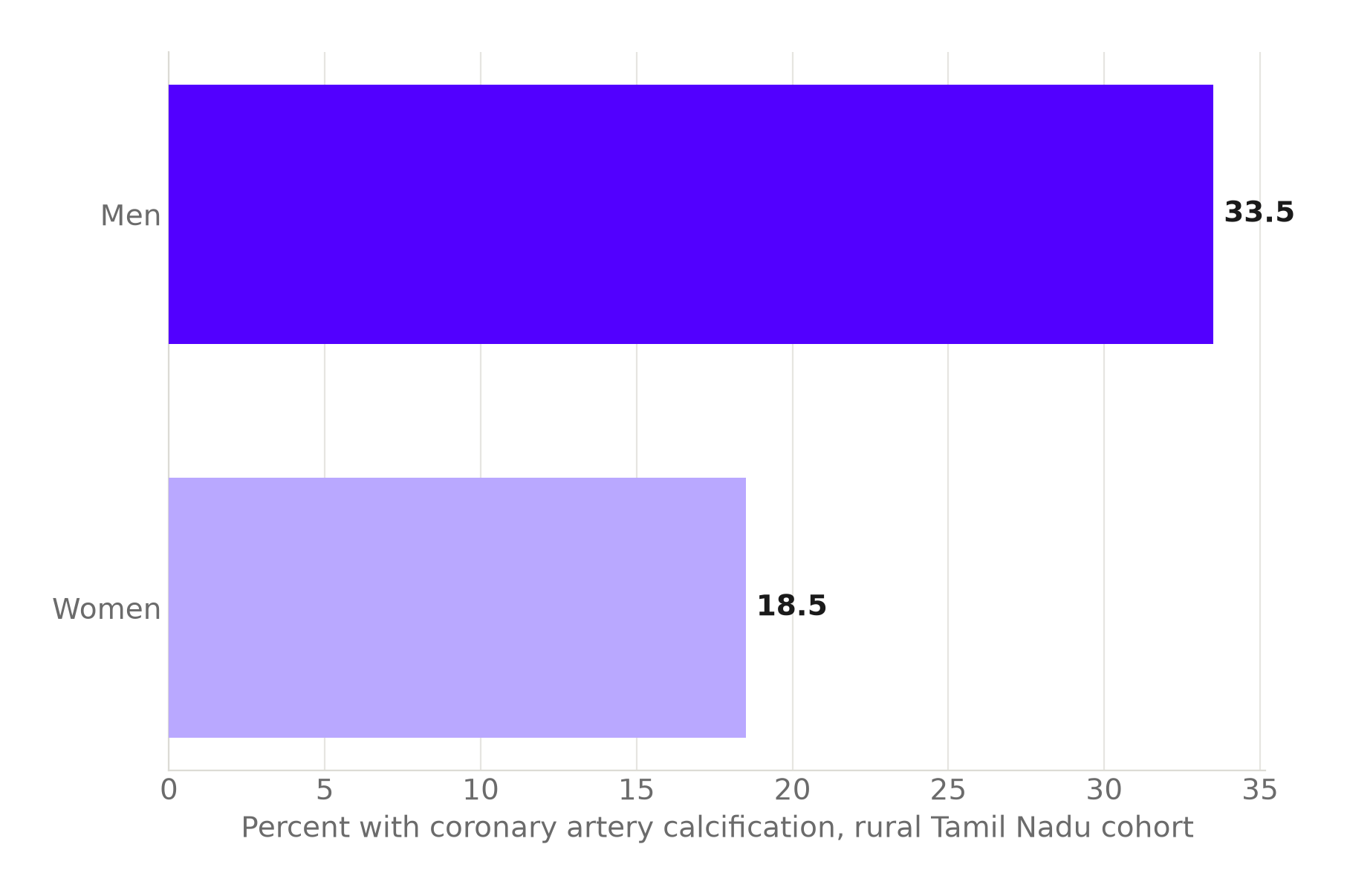
Source: REACH-Rural India Study. Chart: The Signal.
That case is real, and it is the likely reason men's raw life expectancy comes up short to begin with: a heart attack in his fifties erases decades that a woman's slower-failing body gets to spend instead. But a higher risk of dying does not cancel out a lower rate of being cared for while alive. Men's disadvantage shows up as an earlier death. Women's shows up as more years inside a body, and a household budget, that treats the extra time as less worth the expense.
The Signal
The 2.8-year edge in India's vital statistics measures which sex dies first, not which one stays well. Once complex multimorbidity, anaemia and treatment spending are counted, the extra years women live look less like a reward and more like a different set of bills: paid by the woman living them, rarely budgeted for by her own household, even as she is relied on for 140 minutes a day of unpaid care for everyone else. Men's disease kills faster, ending their lives sooner, while women live through more of theirs because the money to treat it arrives more slowly, if at all. A gap measured only in years of life, and never in years spent well, will always look like women are winning.
Reporting basis: life expectancy figures are from the Sample Registration System, compiled by the Office of the Registrar General of India and released via MoSPI's Women and Men in India 2023 report. The disability share of the female mortality advantage is from a Genus journal study built on the Longitudinal Ageing Study in India (LASI) Wave 1 and the same SRS series, and is the only source for that figure. The multimorbidity years at ages 45 to 49 are from a separate Frontiers in Public Health study, also built on LASI Wave 1 data. Anaemia prevalence is from the National Family Health Survey-5, as carried in a Press Information Bureau research brief from the Health Ministry. The unpaid-caregiving minutes are from the National Statistics Office's Time Use Survey 2024, released via PIB. The coronary artery calcification comparison is from the REACH-Rural India Study, a single cohort covering Coimbatore and Tirupur districts in Tamil Nadu, and is the only source for that figure. The household health-spending gap across the 2004-05 and 2011-12 rounds is from a study built on the India Human Development Survey, published via PMC. The 2.76-year disability estimate, the complex-multimorbidity gap comparison, the near-doubling of the coronary calcification share, and the doubling comparisons on spending and caregiving minutes are The Signal's calculations from those figures.