The Union Cabinet's new delimitation Bill reads like a peace treaty. The Cabinet on Friday, November 27, cleared a uniform 50 per cent rise in Lok Sabha seats in all states, taking the House from 543 seats to a maximum of 850, with a freeze on seats till 2051. Every state gains. No state loses ground to another. Southern leaders who spent the year warning that their states would be punished for controlling population have, on paper, got what they asked for.
That reading is correct about seats. It misses what the freeze does to people.
The seat fight the April Bill lost
The deal only makes sense against the version that failed. The earlier 131st Amendment Bill was defeated in the Lok Sabha in April. That Bill would have reallocated seats on the 2011 census. PRS Legislative Research projected that, at today's strength, Tamil Nadu would fall from 39 seats to 32 and Kerala from 20 to 15, while Uttar Pradesh rose from 80 to 89, Bihar from 40 to 46 and Rajasthan from 25 to 30.
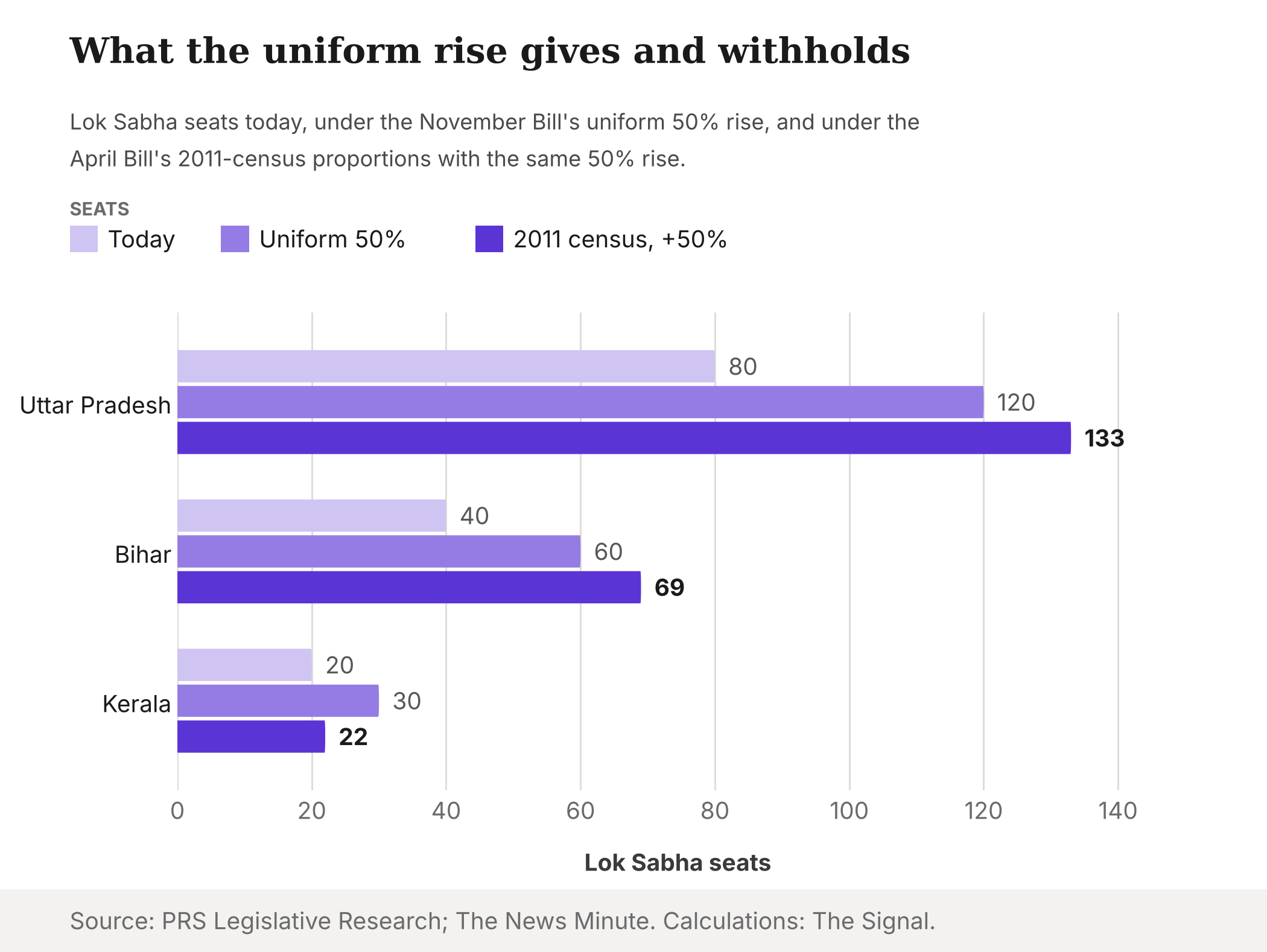
The November Bill takes a different route. All states get a 50 per cent increase in Lok Sabha and Assembly seats, and the maximum strength of the Lok Sabha rises from 550 to 850. Applied to today's allocation of 80 seats for Uttar Pradesh, 40 for Bihar and 20 for Kerala, a uniform rise gives 120, 60 and 30.
Set that against PRS's own scenario of a 50 per cent larger House drawn on 2011 population. On that basis Uttar Pradesh would have had 133 seats, Bihar 69 and Kerala 22. So the compromise hands Kerala eight seats more than its 2011 population would earn, and withholds 13 from Uttar Pradesh and nine from Bihar.
What a seat is worth
A seat count is a proxy. The thing it stands for is how many people one MP speaks for. Here the freeze has a long history. The 42nd Amendment in 1976 froze each state's Lok Sabha seats on the 1971 census, and the 84th Amendment in 2001 extended the freeze until the first census after 2026, as a motivational measure for population stabilisation. Freezing shares again to 2051 means the 1971 ratios govern the House for three quarters of a century.
Populations did not freeze. Bihar's population has grown roughly 215 percent since 1971, while Kerala's has grown 70 percent, according to Carnegie Endowment researchers. They conclude that roughly 8 percent of Lok Sabha representation is misallocated across states, and that a vote in a southern state carries more weight than one in a northern state.
The official projections let that weight be measured. The Health Ministry's Technical Group on Population Projections puts Bihar at 13.23 crore people on 1 March 2026 and Kerala at 3.62 crore. On Bihar's 40 seats and Kerala's 20, that is 3.31 million people per Bihar seat against 1.81 million per Kerala seat. A Bihar MP speaks for 1.83 times as many people.
The 50 per cent rise does not touch that ratio. Every state gets the same 50% increase, so every state's seats grow by the same factor, so every constituency shrinks by the same third. After the rise a Bihar seat would cover about 2.2 million people and a Kerala seat about 1.2 million. The gap in vote weight is exactly what it was.
The gap the freeze locks in
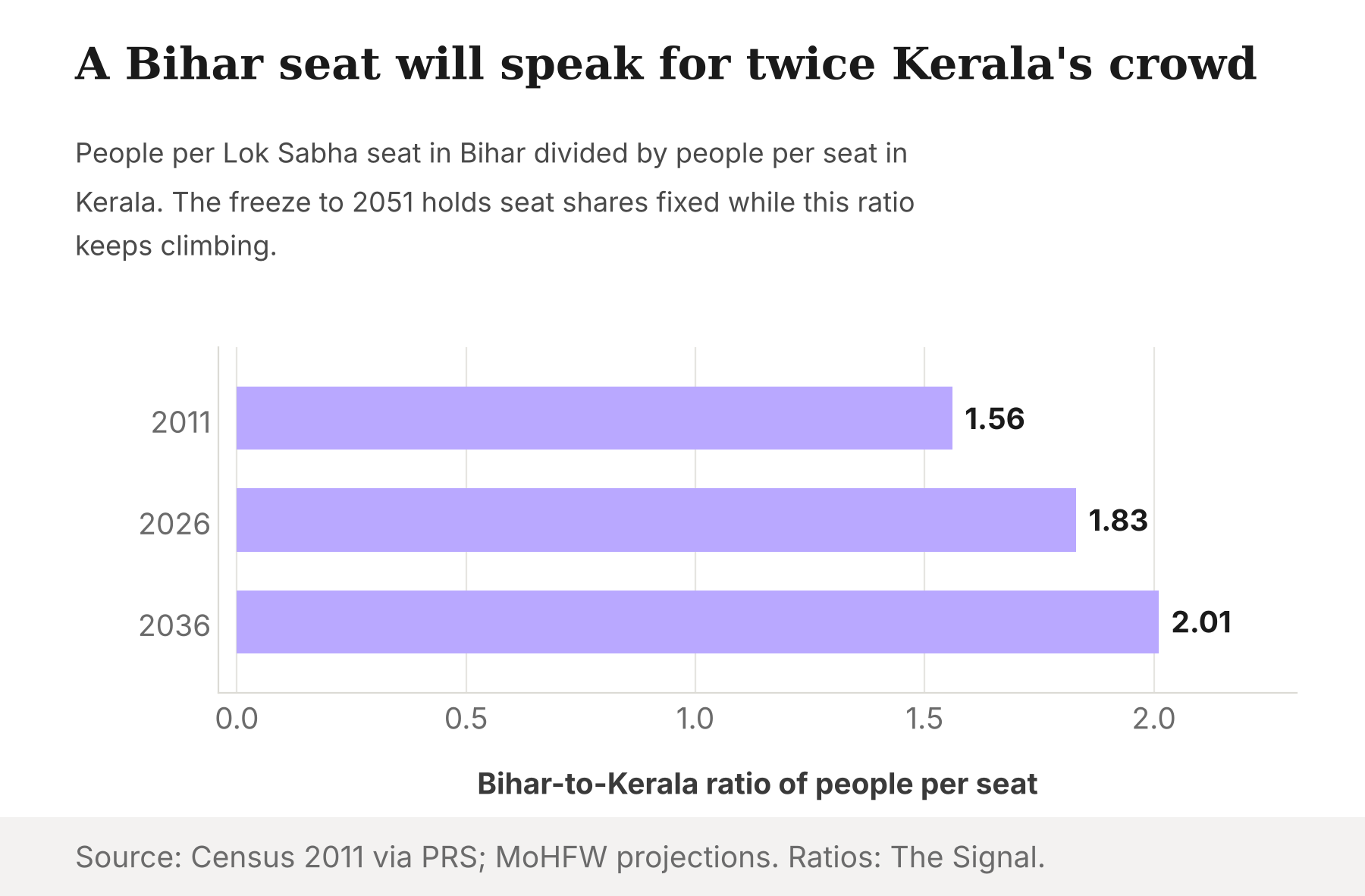
The more important number is where the ratio goes next. The same projections put Bihar at 14.86 crore and Kerala at 3.69 crore in 2036. With seat shares frozen, the Bihar-to-Kerala ratio of people per seat climbs from 1.56 on the 2011 census counts to 1.83 in 2026 and 2.01 in 2036. By then a vote in Bihar carries half the representational weight of a vote in Kerala, and the freeze still has 15 years to run.
Uttar Pradesh follows the same path less steeply. Its projected population rises from 24.29 crore in 2026 to 25.90 crore in 2036, so people per seat go from 3.04 million to 3.24 million at today's 80 seats. Tamil Nadu barely moves, from 1.99 million to 2.00 million, because its projected population edges from 7.75 crore to 7.81 crore.
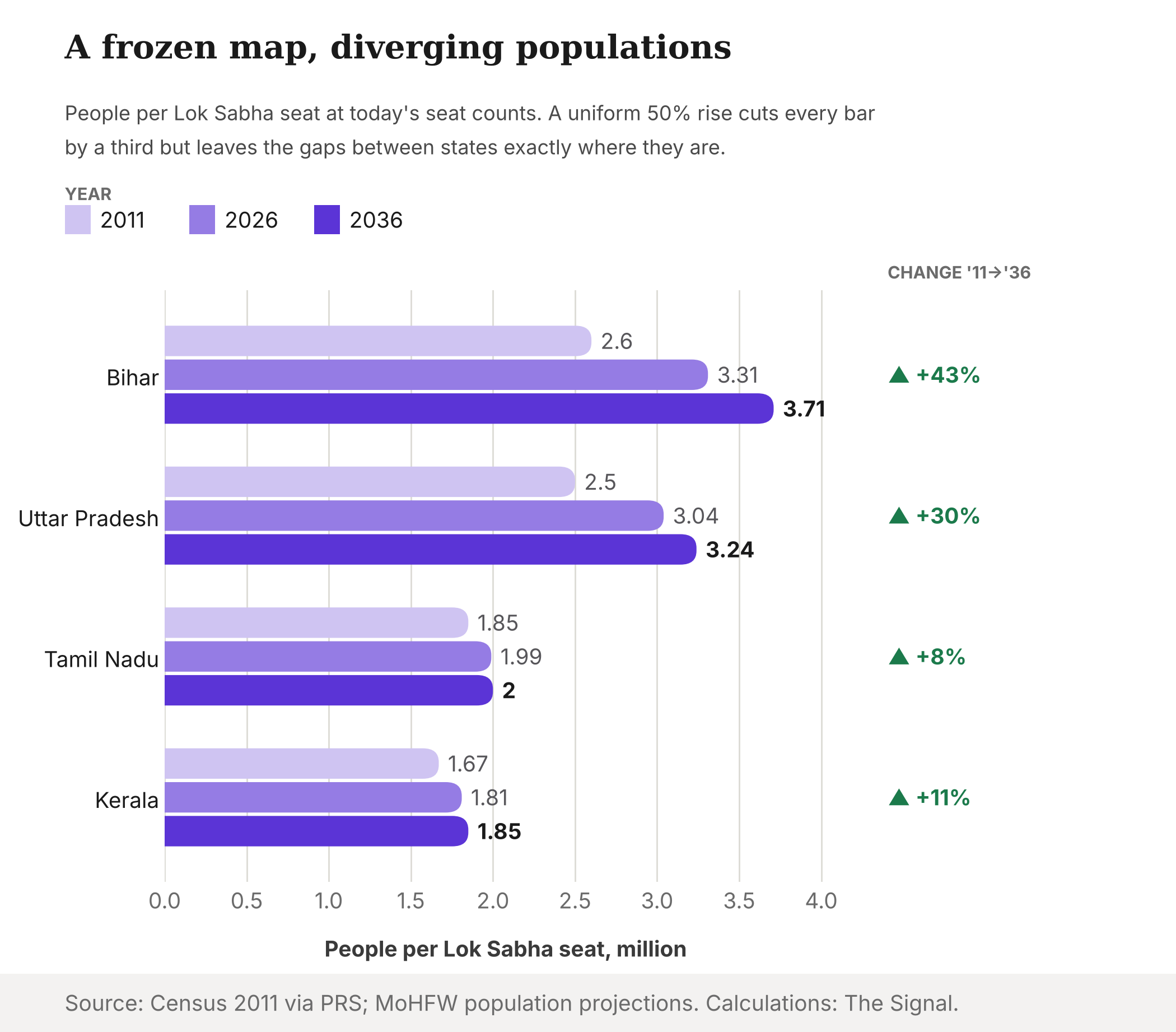
People per seat keeps rising in Bihar and Uttar Pradesh and barely moves in the South (million people per seat, at today's seat counts)
| State | Seats today | 2011 | 2026 | 2036 |
|---|---|---|---|---|
| Bihar | 40 | 2.60 | 3.31 | 3.71 |
| Uttar Pradesh | 80 | 2.50 | 3.04 | 3.24 |
| Tamil Nadu | 39 | 1.85 | 1.99 | 2.00 |
| Kerala | 20 | 1.67 | 1.81 | 1.85 |
Source: PRS Legislative Research for seats and 2011 census counts; MoHFW Technical Group projections for 2026 and 2036. Per-seat figures are The Signal's calculations.
The bigger House changes more than seat shares
A larger Lok Sabha also shifts power between institutions. PRS calculates that a 50 per cent rise from 543 to 815 seats would move the ratio of Lok Sabha to Rajya Sabha seats from 2.2:1 to 3.3:1, and raise the permissible size of the Council of Ministers from 81 to 122. The Rajya Sabha is where states sit as states. A House that grows while the upper house does not tilts joint sittings and presidential elections toward the chamber whose map is frozen.
The honest objection
The case for the freeze is serious. The 2001 extension was explicitly a reward: a motivational measure to enable state governments to pursue population stabilisation. Reallocating seats away from the states that delivered on that promise would punish compliance and reward delay. A federation is not only a count of heads. It is also a bargain between states.
That argument justifies protecting the South's share. It does not make the cost disappear. The same Constitution requires that seats in Lok Sabha be allocated to states in proportion to their population. The November Bill chooses the federal bargain over that principle for another 25 years. That is a legitimate choice. It should be described as one, rather than as a deal in which nobody gives anything up. The projections also carry uncertainty: they rest on the 2011 census, and the 2027 count will revise them.
The Signal
The delimitation fight was framed as seats, so the November Bill could end it by giving every state 50% more seats. What it actually settles is a different question: whether a vote should weigh the same everywhere in India. The answer, until 2051, is no, and the official projections say the imbalance grows every year the freeze holds. Watch the special sitting from November 30 for whether any party tries to attach a sunset review to the freeze. Without one, by 2036 one Bihar voter counts for half of one Kerala voter.
Reporting basis: the November 2026 Bill's terms (a uniform 50 per cent seat rise, an 850-seat ceiling and a freeze to 2051) are per The News Minute's reporting on the draft Bill, as also reported by The Hans India; the April Bill's defeat is per The News Minute. Current seat allocations, 2011 census populations, the 2011-census seat scenarios, the constitutional history of the freeze and the Rajya Sabha and Council of Ministers figures are from PRS Legislative Research's April 16, 2026 analysis, which itself compiles Census 2011 and the Representation of the People Act. State population projections for 2026 and 2036 are from the Health Ministry's Technical Group on Population Projections. Population growth since 1971 and the misallocation estimate are from a single Carnegie Endowment analysis. The uniform-rise seat counts, people per seat and the Bihar-to-Kerala ratios are The Signal's calculations from those figures.