Washington is about to publish the verdict of an investigation that has hung over Indian exporters since March. Reuters reported on November 25 that the findings were expected as soon as this week, with new duties to follow, though the rates and exemptions were still unclear. India is one of 16 economies the US Trade Representative named when it opened the probe, alongside China, the European Union, Japan, Korea, Vietnam, Bangladesh and Mexico. The charge is "structural excess capacity": factories kept alive by policy that pump surplus goods into world markets.
For China, the charge has an obvious shape. For India, it sits oddly. India's merchandise trade deficit was $333.19 billion in FY2025-26, up from $283.50 billion a year earlier. A country flooding the world with surplus goods does not usually import a third of a trillion dollars more than it sells.
The test that actually catches India
The answer is in how the notice defines its target. USTR says excess capacity can be evidenced by large or persistent goods surpluses, "including the nature and quality of an economy's trade balance with the United States", as well as by idle capacity or unprofitable firms. Those are two separate tests joined by "or". India fails the first one only bilaterally.
The notice's India paragraph opens with exactly that: in 2025, it says, India had a bilateral trade surplus with the United States of $42 billion. The Census Bureau's goods table puts the gap higher, at a US goods deficit with India of $58.4 billion in 2025, on $45.4 billion of US exports against $103.8 billion of imports. Either way, the number that puts India on the list is a surplus with one partner, inside a large deficit with everyone else.
That matters because the two diagnoses call for different cures. A genuine glut is fixed by closing capacity, while a bilateral surplus shrinks when India buys more from the US. Read that way, the excess-capacity label is the legal wrapper and the bilateral balance is the payload.
The surplus was already closing
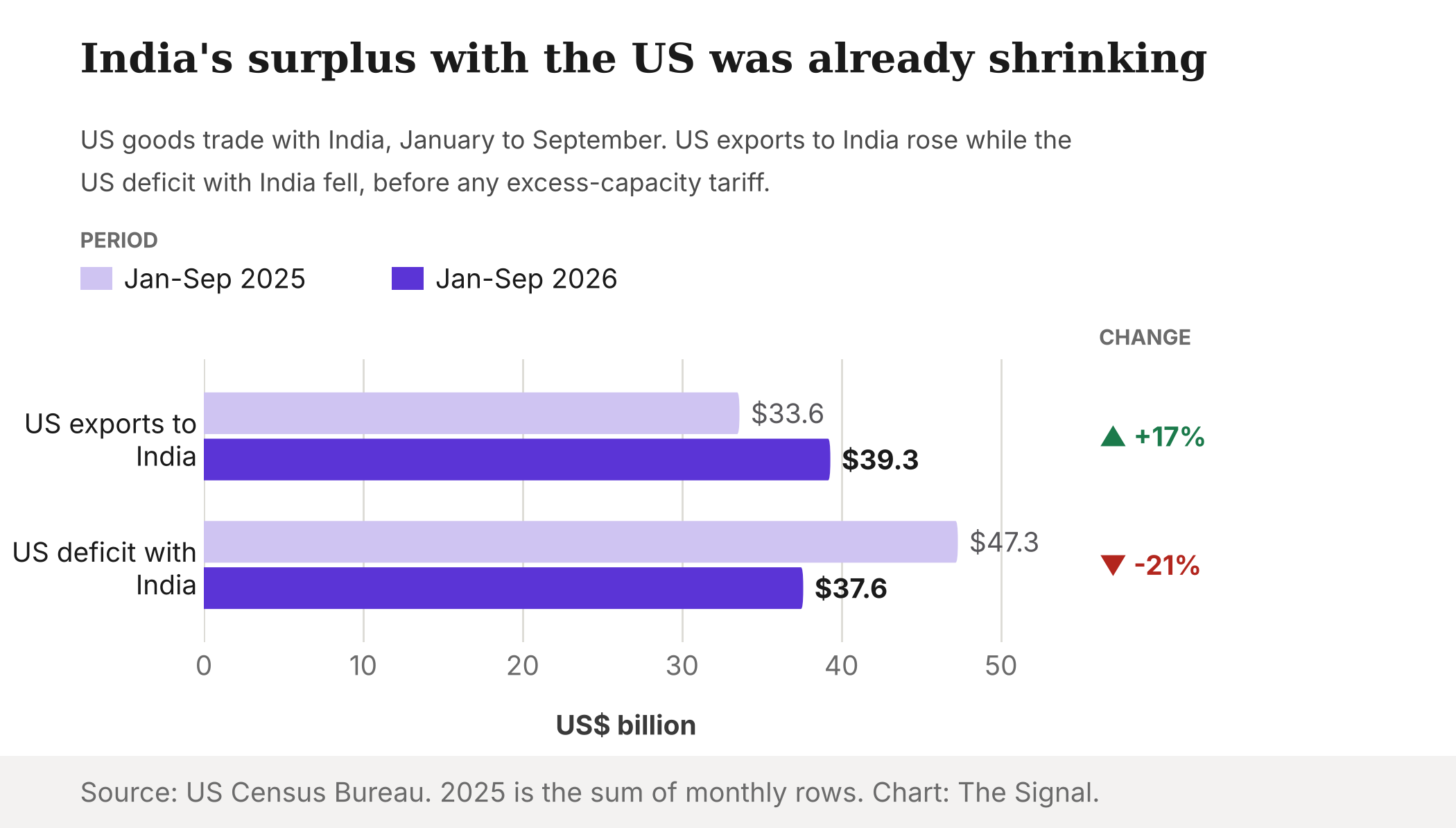
The bilateral number was also moving in Washington's direction before any new tariff. Census data show the US goods deficit with India was $37.6 billion from January to September 2026. The same nine months of 2025 add up to $47.3 billion, so the gap narrowed by about a fifth. US exports to India rose from $33.6 billion to $39.3 billion over those months, roughly 17 percent.
That shift happened while India already paid a tariff. Since July, India has sat in the 10 percent tier of a separate set of Section 301 duties from USTR's forced-labour investigations, the lower of two rates (the other is 12.5 percent). That 10 percent is the baseline any excess-capacity duty will be judged against.
Idle capacity is real, but it stays home
The second test, idle capacity, is where the notice reaches for India's factories directly. It says India "has created significant excess capacity in petrochemicals, steel, and other industries".
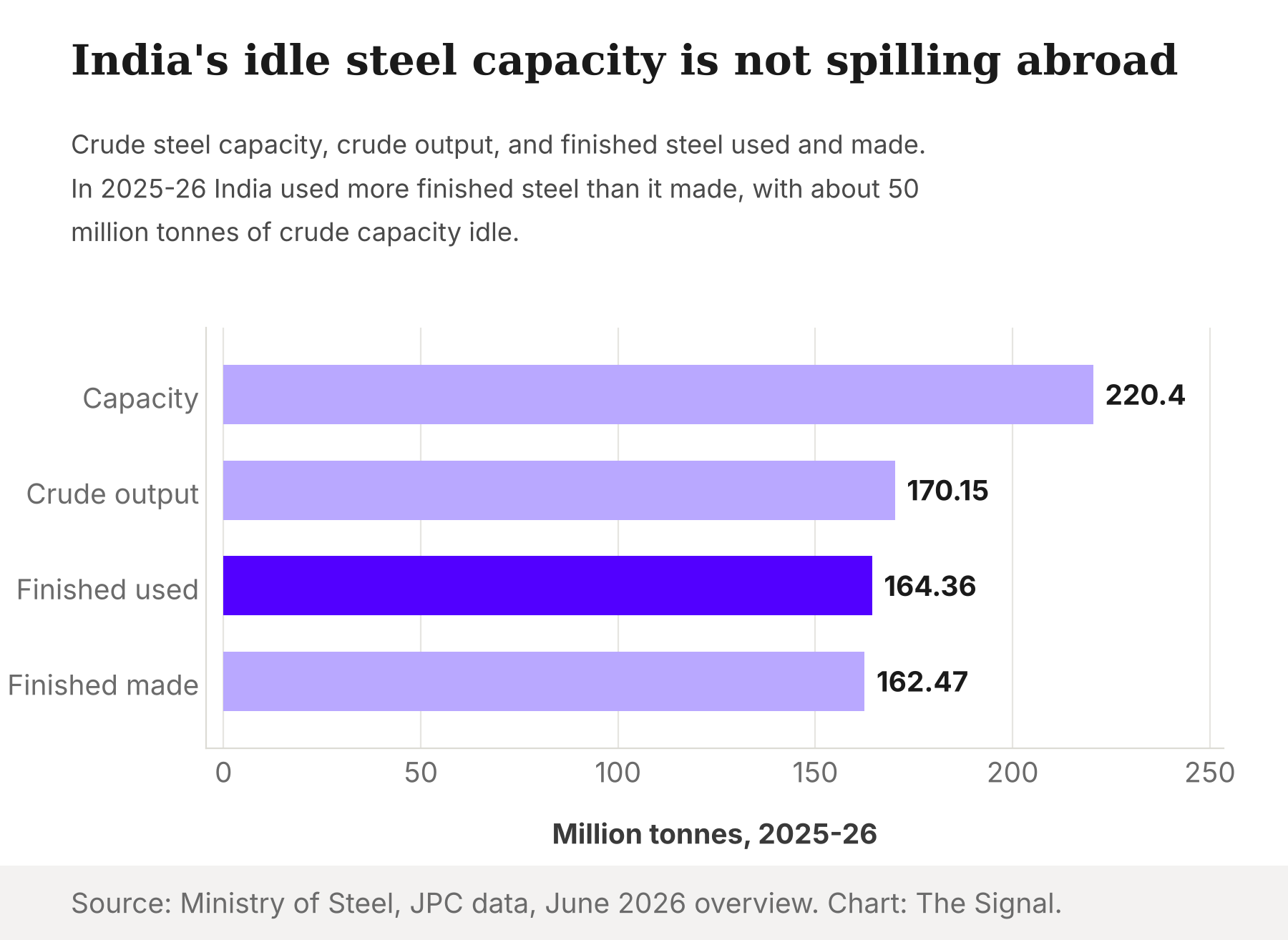
Indian plants do run below full capacity. The RBI's survey put manufacturing capacity utilisation at 74.6 percent in April to June 2026, or 76.3 percent seasonally adjusted. Steel shows the same gap. The Ministry of Steel reports crude steel capacity of 220.4 million tonnes in 2025-26 against output of 170.15 million tonnes, which leaves about 50 million tonnes unused and a utilisation rate near 77 percent.
But idle capacity is only a trade problem if its output leaks abroad at below-market prices. India's does not. The same Joint Plant Committee figures show India consumed 164.36 million tonnes of finished steel in 2025-26 and made 162.47 million tonnes. It used more than it produced.
The trade line says the same. India was a net importer of finished steel in 2023-24 and 2024-25, a net exporter by just 77 thousand tonnes in 2025-26, and a net importer again in April to June 2026, with 2,064 thousand tonnes in against 1,593 thousand tonnes out. China's steel problem is a surplus looking for buyers. India's idle mills sit beside a home market that still imports.
| Indicator | Figure | Period |
|---|---|---|
| Crude steel capacity | 220.4 million tonnes | 2025-26 |
| Crude steel output | 170.15 million tonnes | 2025-26 |
| Finished steel consumed | 164.36 million tonnes | 2025-26 |
| Finished steel made | 162.47 million tonnes | 2025-26 |
| Finished steel imports vs exports | 2,064 vs 1,593 thousand tonnes | Apr to Jun 2026 |
Source: Ministry of Steel, Overview of Steel Sector, June 2026, using Joint Plant Committee data.
The honest objection
The strongest case for Washington is solar, and it is a real case. USTR's notice says India's module manufacturing is "nearly triple annual domestic demand". India's own numbers support it. The Ministry of New and Renewable Energy put cumulative module capacity at about 172 GW at the end of FY2025-26, with about 98 GW added in FY2025-26, while the country installed a record 44.61 GW of solar. That is close to four record years of installations from one year of factory capacity.
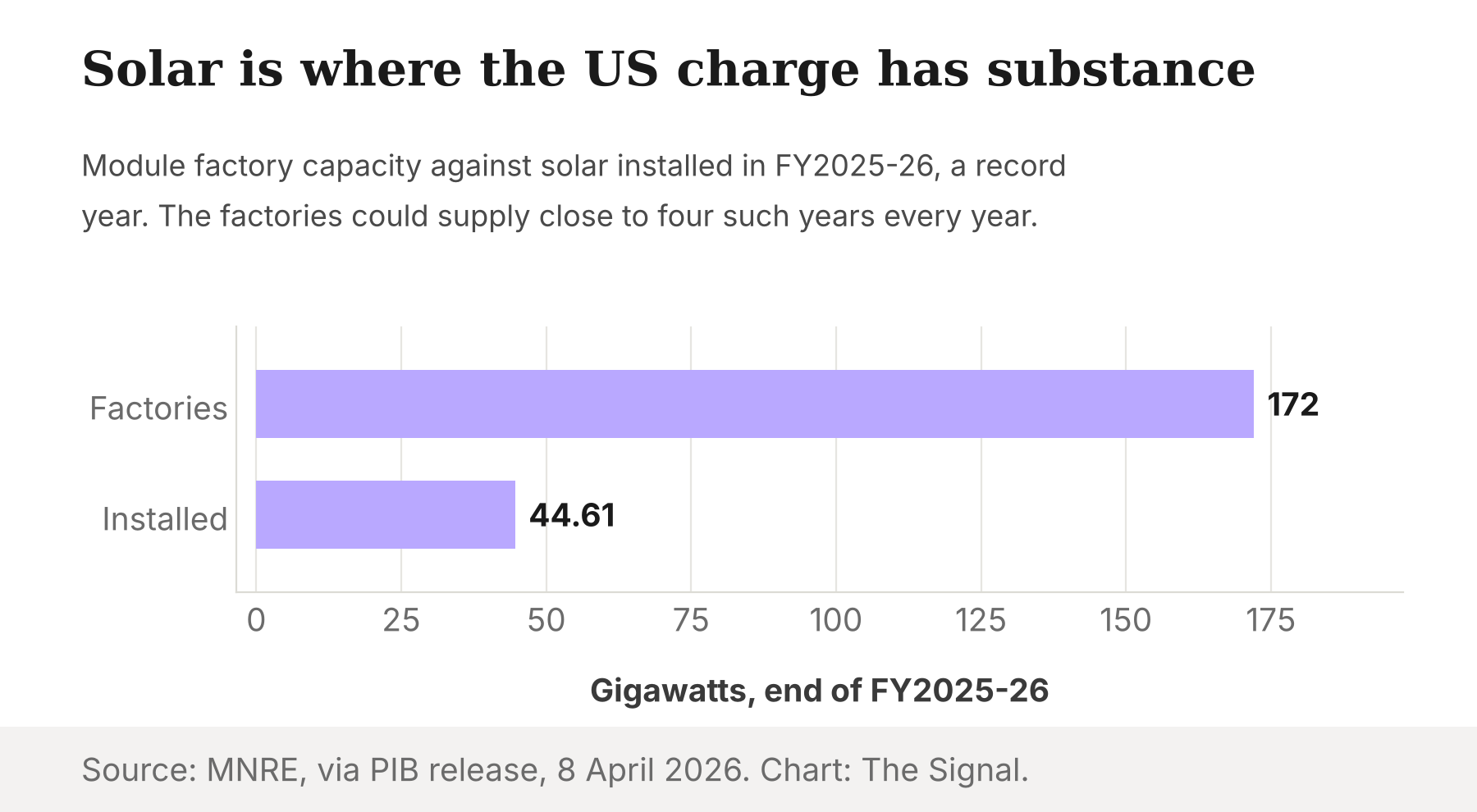
That capacity was built with policy help: production-linked incentives and an approved-manufacturer list that steers buyers to domestic modules. If anything in India fits the notice's definition of capacity "sustained through governmental interventions", it is this. On solar, Washington has a point and India should concede it.
But solar is one sector, and it does not explain the country listing. A sector-specific remedy, a duty on Indian modules, would address it. Folding India into a 16-economy action next to China treats one subsidised industry as proof of an economy-wide glut that the steel and trade data do not show.
The Signal
The excess-capacity probe gives Washington a fresh legal route to tariffs. For India the useful reading is that the binding test is the bilateral balance, not the factory floor. That points New Delhi's negotiators at the lever that actually moves the outcome. Buying more American goods narrows the number USTR quotes first, and Census data show it was already narrowing in 2026 at a pace of about a fifth.
Watch two things when the findings land. If India's rate sits near the forced-labour tier and solar is singled out, Washington is treating India as a sector problem. If India is stacked near China, the capacity language is cover for a surplus tariff. India is not being judged on how much it makes. It is being judged on how much it sells to one customer.
Reporting basis: the list of investigated economies, the excess-capacity indicators, the $42 billion bilateral surplus and the solar and steel allegations are from USTR's Federal Register notice of March 17, 2026, via govinfo.gov, and India's 10 percent forced-labour tier is from USTR's July 23, 2026 announcement. US-India goods trade for 2025 and January to September 2026 is from the US Census Bureau. India's FY2025-26 merchandise deficit is from the Ministry of Commerce and Industry. Capacity utilisation is from the RBI's OBICUS survey. Steel capacity, production, consumption and trade are Joint Plant Committee data, via the Ministry of Steel. Solar module capacity and installations are from the Ministry of New and Renewable Energy, via the Press Information Bureau. The expected timing of the findings rests on a single Reuters report, carried by The Korea Times. The January to September 2025 totals, the percentage changes, the unused steel capacity and utilisation rate, and the module-to-installation multiple are The Signal's calculations from those figures.