Six years after the split, the Shiromani Akali Dal and the BJP are back together. On 24 November 2026, the two parties announced a tie-up for the coming Punjab Assembly polls, with the Akali Dal as the senior partner and the chief minister's post reserved for it. The quick read writes itself. Add the two parties' 2024 votes together and they come out ahead of everyone else in the state. On paper, a party that was finished in 2022 is suddenly the front-runner.
It is worth slowing down on that. The combined number is real, but it is not new. It is smaller than the vote the same two parties polled together in 2019, when they lost.
The number that carries the story
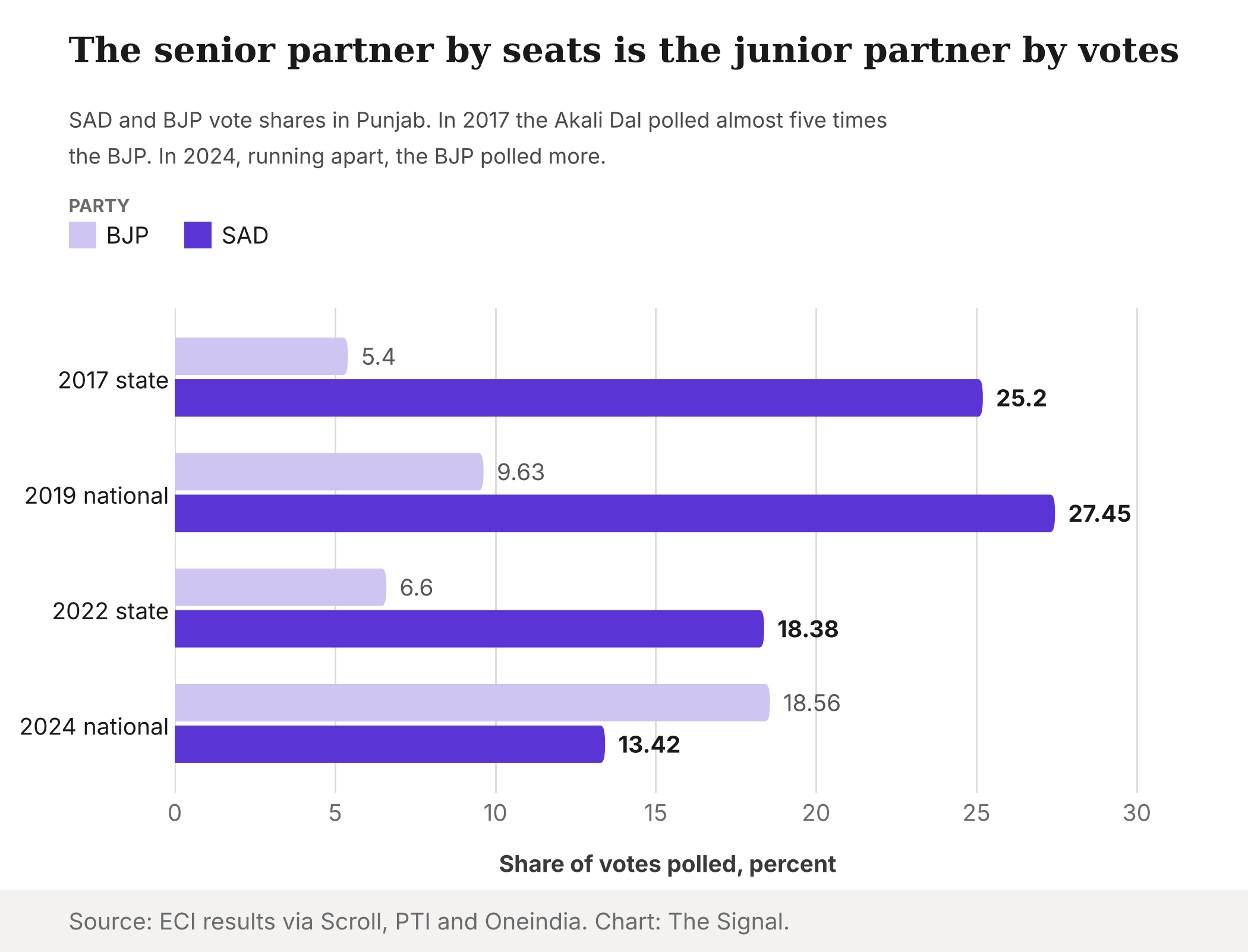
In the 2024 Lok Sabha election, the BJP polled 18.56 percent in Punjab and the Akali Dal 13.42 percent, according to Election Commission data reported by PTI. Added together, that is 31.98 percent. The same report puts the alliance's 2019 vote, when the parties still fought as partners, at 27.45 percent for the Akali Dal and 9.63 percent for the BJP: 37.08 percent between them. That larger total lost Punjab to a Congress that polled 40.12 percent in 2019.
So the alliance re-enters the contest about five points lighter than the version that lost the last national vote it fought together. What changed is the field around it. In 2024, Congress polled 26.30 percent and AAP 26.02 percent. No single rival came within six points of the alliance's combined total.
The alliance has never been a 40 percent force
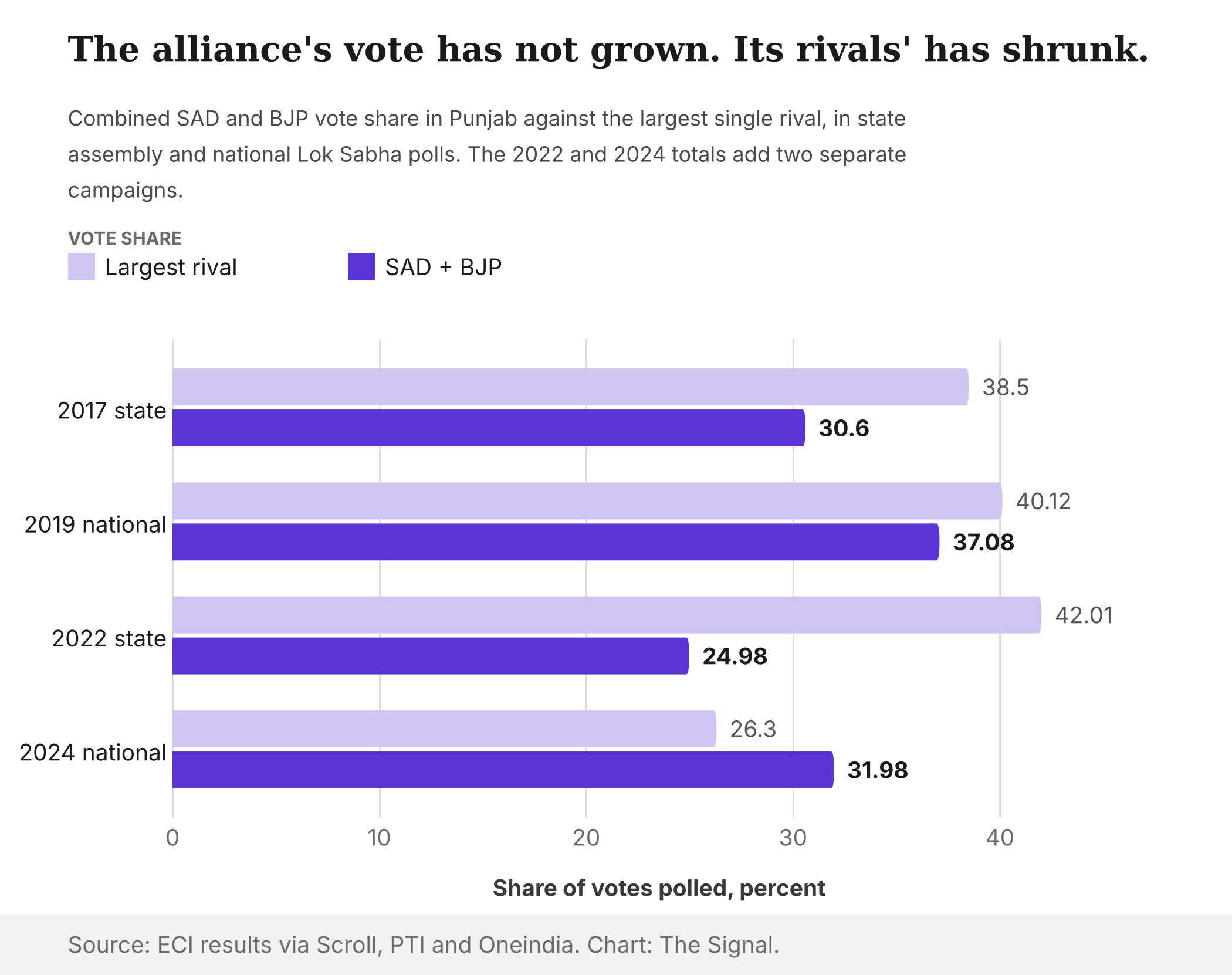
Go back to the last state election the two fought together. In 2017, Congress polled 38.5 percent, the Akali Dal 25.2 percent, the BJP 5.4 percent and AAP 23.7 percent, and the ruling alliance won 18 seats, per Scroll's analysis of the results. Of those, 15 went to the Akali Dal and 3 to the BJP, according to the Association for Democratic Reforms. A combined 30.6 percent, in other words, bought 18 of 117 seats.
Then came the separate runs. In the 2022 Assembly election, AAP took 42.01 percent, Congress 22.98 percent, the Akali Dal 18.38 percent and the BJP 6.60 percent. The two former partners together polled 24.98 percent, 17 points behind AAP. The Akali Dal won three seats and the BJP two.
| Election | SAD + BJP vote share | Largest rival | Rival's share | Gap |
|---|---|---|---|---|
| 2017 Assembly (allied) | 30.6% | Congress | 38.5% | 7.9 points behind |
| 2019 Lok Sabha (allied) | 37.08% | Congress | 40.12% | 3.04 points behind |
| 2022 Assembly (separate) | 24.98% | AAP | 42.01% | 17.03 points behind |
| 2024 Lok Sabha (separate) | 31.98% | Congress | 26.30% | 5.68 points ahead |
Source: Scroll (2017), PTI via The Week (2019, 2024), Oneindia (2022). Combined shares and gaps are sums and differences of the reported figures.
Across four statewide votes, the combined total has moved between 25 and 37 percent. The only time it led was 2024, when no rival cleared 27 percent. The alliance does not win by growing. It wins when the opposition splits.
The senior partner polled less
The second thing the 2024 numbers show is who brings the votes. Under the old pact, the BJP contested 23 of the 117 seats and the Akali Dal 94. That split matched the 2017 vote, when the Akali Dal polled almost five times the BJP's share.
By 2024 the order had flipped. Running alone, the BJP polled 18.56 percent against the Akali Dal's 13.42 percent, per the PTI report. The BJP also led in 23 assembly segments to the Akali Dal's nine, while Congress led in 37 and AAP in 33. Yet the new deal hands the Akali Dal the chief minister's post. The party with fewer recent votes gets the chair, a deal that prices the Akali Dal's standing as Punjab's oldest regional party above its recent vote count.
That bet carries a cost. The Akali Dal broke the 24-year alliance in September 2020 over the three farm laws, since repealed. Its vote then fell in every election that followed. Whether that slide came from the farm-law years, from AAP, or from the party's own leadership, the alliance now has to make the transfer run toward a partner whose voters drifted away.
The honest objection
The strongest case against this reading is that Lok Sabha votes are a weak guide to an Assembly race. Voters split tickets. A national poll rewards the BJP's national brand, which can inflate its 18.56 percent Punjab share in 2024 and say little about a state contest. On that view, the 2024 sum overstates the BJP and understates the Akali Dal, and the 2019 comparison says nothing about 2027.
That case is real, and it cuts both ways. If national polls flatter the BJP, the alliance's true state-level base sits below 32 percent, not above it, and the 2022 Assembly figure of 24.98 percent is the better floor. Either way, the alliance's path runs through its rivals' weakness. In 2024, AAP and Congress finished within about 30,000 votes of each other, with AAP at 35.20 lakh votes, Chief Minister Bhagwant Mann told The Tribune. A near-tie between the two big parties is exactly what lets a third bloc in the low thirties win seats.
Seats also turn on concentration, not just share. In 2022, AAP converted its 42.01 percent into 92 seats, up from 20 in 2017, according to PRS Legislative Research. A bloc at 32 percent can win very few seats or a great many depending on how the rest of the vote breaks.
The Signal
The revived alliance is not a stronger version of the old one. On the 2024 numbers it is a weaker one, about five points short of the 2019 partnership that lost, now led by the partner that polled less. What makes it competitive is a four-way field in which AAP and Congress each sat near 26 percent in 2024. The thing to watch is not the alliance's seat-sharing formula. It is whether AAP or Congress pulls clear of the other. If one does, a 32 percent bloc is back to 2017, holding 18 seats. If neither does, 32 percent may be the largest number in the room.
Reporting basis: the 24 November 2026 alliance announcement and the chief minister arrangement are per IANS, as carried by The Hans India; the old 94 and 23 seat split and the September 2020 break are per PTI, as carried by ThePrint. The 2019 and 2024 Lok Sabha vote shares are Election Commission figures as reported by PTI and carried by The Week, and the 2024 assembly-segment leads are per PTI, as carried by DT Next. The ThePrint, The Week and DT Next items are all PTI copy and count as one wire origin. The 2017 vote shares and the alliance's 18 seats are from Scroll's analysis of the results, and the 2017 party-wise seat split is from the Association for Democratic Reforms. The 2022 vote shares are per Oneindia, the only source for the SAD and BJP 2022 shares, and the 2022 seat counts are per Scroll and PRS Legislative Research. The 2024 AAP vote total is Chief Minister Bhagwant Mann's figure as reported by The Tribune. The combined SAD and BJP shares, the gaps to the largest rival and the AAP-Congress vote margin are The Signal's calculations from those figures.