Nepal's new prime minister came to Delhi three months after the Bhotekoshi floods and left with a large number. The joint press release on Balendra Shah's state visit, issued on 23 November 2026, says India will extend development assistance of INR 15,000 crore (NPR 24,000 crore). Read as flood relief, Delhi has answered a disaster in its closest neighbour with a cheque sized to match.
It is worth slowing down on that. The same sentence of the release splits the money in two: a grant of INR 3,500 crore for post-disaster reconstruction and new infrastructure, and a rupee-denominated line of credit of INR 11,500 crore for energy sector projects. That is 23 percent grant and 77 percent loan. Most of what was headlined as flood relief is credit, and it is earmarked for power.
The money that does not have to be repaid
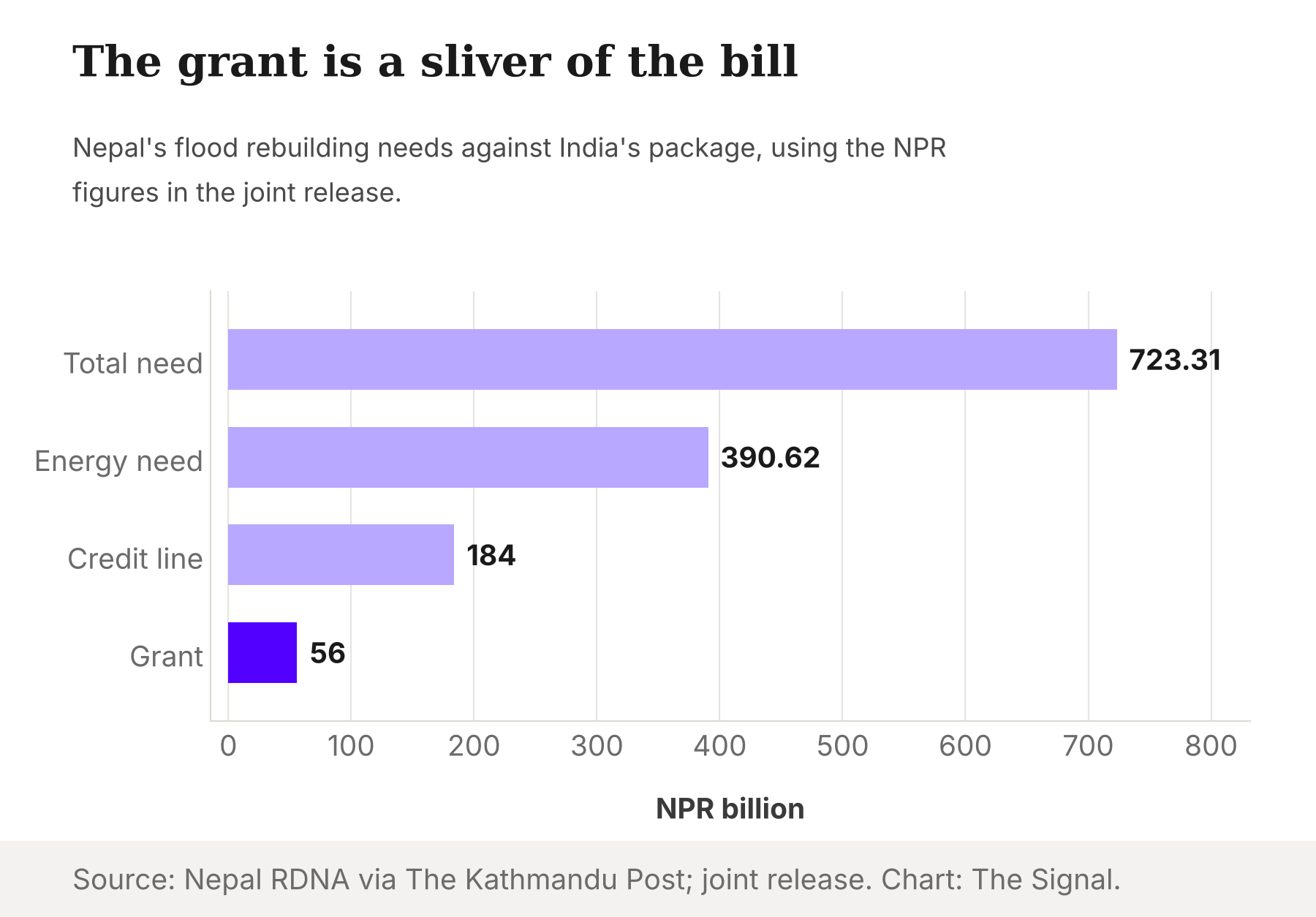
Start with the scale of the damage. Nepal's Rapid Damage and Needs Assessment, led by the National Planning Commission and the disaster authority, puts the cost of rebuilding infrastructure hit by the 26 August Bhotekoshi floods at NPR 723.31 billion. The Pioneer, citing the same government-led assessment, put the recovery and reconstruction needs at an estimated $4.7 billion. As of 10 September, 1,370 deaths had been confirmed and 5,130 people were unaccounted for.
Against that bill, the Indian grant is NPR 5,600 crore, or NPR 56 billion. Set beside the NPR 723.31 billion rebuilding estimate, the grant covers 7.7 percent. Even the whole NPR 24,000 crore package, loan included, reaches about a third. And the grant is not ring-fenced for the flood: the release lists it for reconstruction and new infrastructure projects.
Big against India's own aid budget
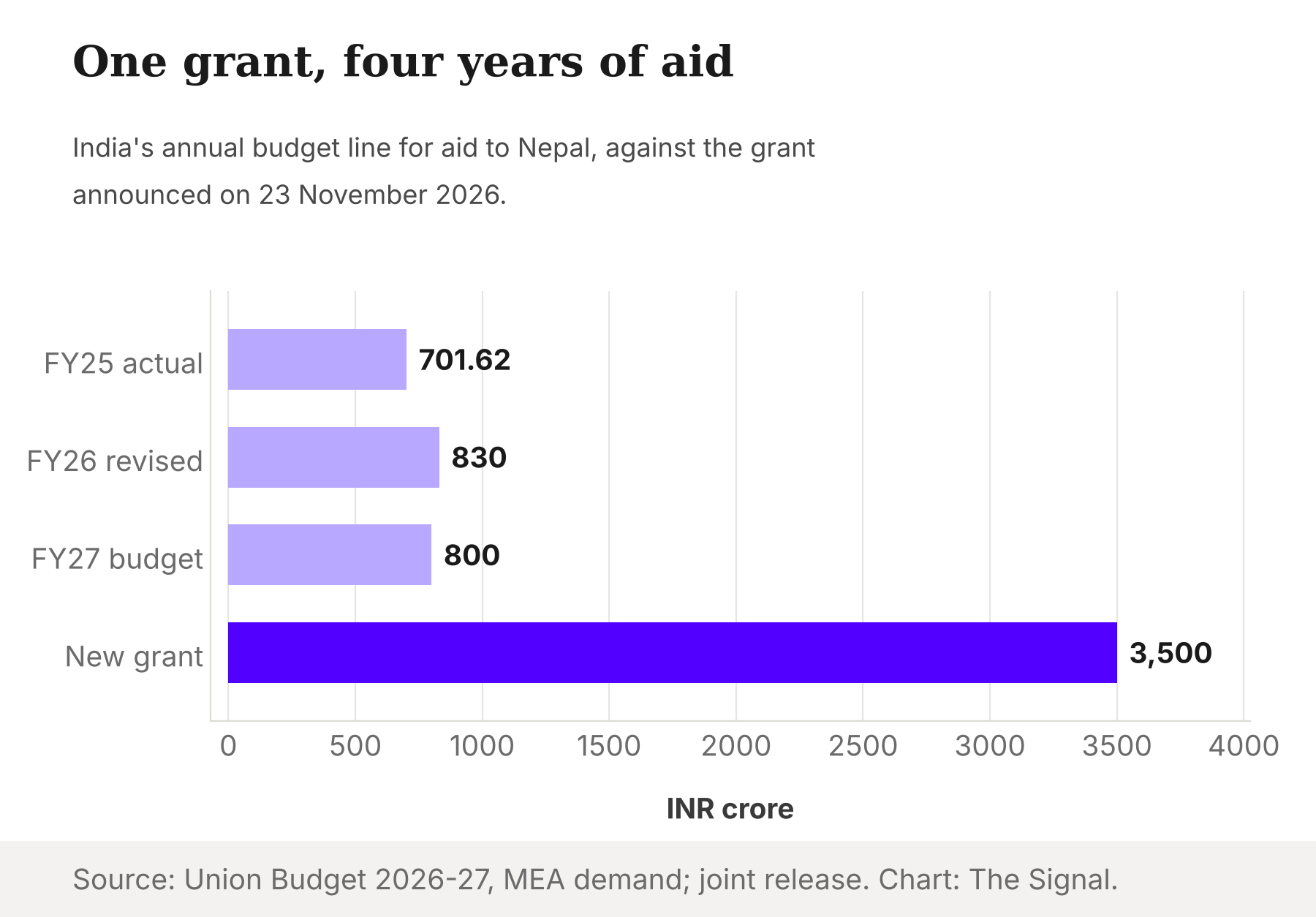
None of this makes the grant small by Indian standards. The Ministry of External Affairs' demand for grants in the Union Budget allocates INR 800 crore as aid to Nepal for 2026-27, against INR 830 crore revised for 2025-26 and INR 701.62 crore actually spent in 2024-25. A single INR 3,500 crore grant is more than four years of that line at once.
The whole package is bigger still. India's total budgeted aid to all countries for 2026-27 is INR 5,685.56 crore, with Bhutan the largest recipient at INR 2,288.56 crore. The Nepal package is about 2.6 times that. The comparison flatters the headline, though, because the credit line does not come out of the aid budget the way a grant does. It is a loan, and the borrower pays it back.
What Nepal asked for
Kathmandu came with a different mix in mind. Before the visit, The Kathmandu Post reported that Nepal was seeking more than $1 billion in lines of credit, another $500 million in grants for the Siddhartha Highway, and a further $500 million, most likely as a grant, for flood reconstruction. On that wish list, roughly half the money would have been grant. What India offered is less than a quarter grant.
The credit line does line up with one real need. The assessment found that restoring Nepal's energy and grid system alone is expected to cost NPR 390.62 billion. The NPR 18,400 crore credit line for energy projects would cover about 47 percent of that, if it is drawn. Delhi's priorities also show in the rest of the release, where the two leaders laid the foundation stone for the 669 MW Lower Arun hydro project.
The 2015 formula, repeated
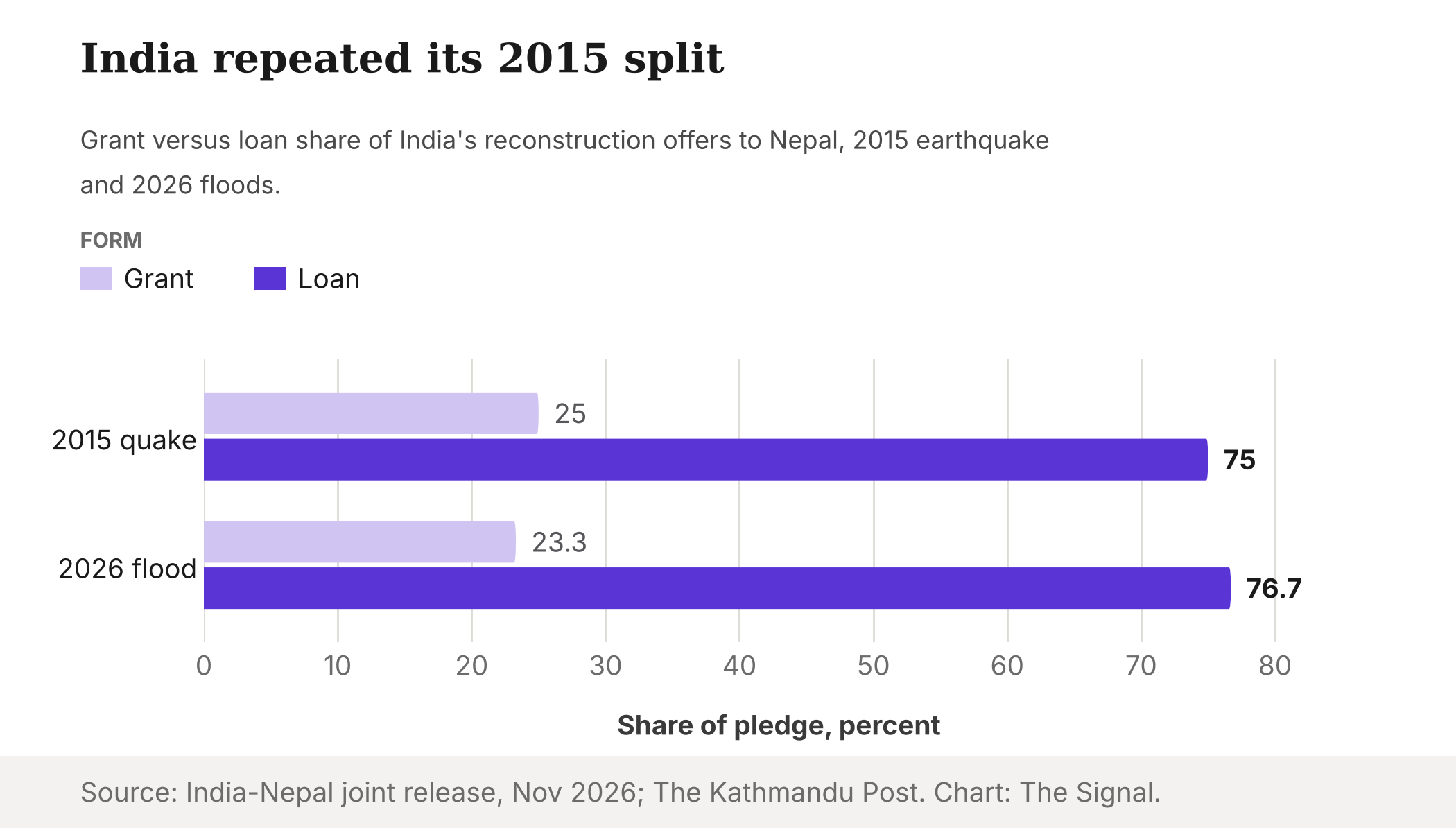
This split has a precedent. After the 2015 earthquake, India pledged Rs100 billion for reconstruction, of which Rs25 billion was a grant and Rs75 billion a soft loan through the Export-Import Bank of India. The ratio then was 25 to 75. The ratio now is 23 to 77.
The earlier loans did not flow easily. The same report says Nepal was unable to fully utilise either line of credit because of stringent conditions imposed by India, with a former ambassador citing local-content requirements on raw materials, technicians, engineers and machinery. India's lending to Nepal is not new. The Embassy of India in Kathmandu put its four earlier lines of credit at US$1.65 billion, financing more than 40 road projects and six hydropower and transmission projects, as of its August 2023 review meeting. The question was never how much was offered. It was how much got spent.
The honest objection
The strongest case for Delhi is that a loan for energy is the right tool for an energy problem. Power plants and transmission lines earn revenue, so they can carry debt in a way that a rebuilt school cannot. Some of that revenue already crosses the border: the Indian embassy said in August 2023 that up to 452 MW of Nepali power exports were running over the India-financed Dhalkebar-Bhittamod 400 kV line. A grant budget that runs at INR 800 crore a year for Nepal could never fund a rebuild of this size, and lending stretches each rupee further. On this view, the split is prudent, not stingy.
That case is real, and it explains why the loan exists. It does not explain the grant share. Households, roads and bridges in the flood districts do not earn revenue, and that is where grant money matters. The release also leaves the hard parts open: it says the specific projects and modalities will be finalised through mutual consultations. In 2015, too, the headline came first, and the conditions that held the loan back came with the detail.
The Signal
India has made a large gesture by the measure of its own Nepal aid budget, and it has made it in the same shape as last time. The INR 3,500 crore grant is generous by the standard of India's own aid line and thin by the standard of Nepal's flood bill. The INR 11,500 crore credit line is large on paper and conditional in practice. Watch three things over the next year: whether the grant gets tied to named flood projects, whether the credit line carries the local-content rules Nepal has complained about, and whether a disbursement figure ever appears beside the pledge. A pledge is not aid until it is drawn.
Reporting basis: the size and split of the package, its NPR equivalents and the Lower Arun foundation stone are from the India-Nepal joint press release of 23 November 2026, as published by Nepal's Ministry of Foreign Affairs. India's aid-to-Nepal and total aid-to-countries figures are from the Ministry of External Affairs' Notes on Demands for Grants in the Union Budget 2026-27. Flood rebuilding needs, the energy and grid estimate and the toll are from Nepal's Rapid Damage and Needs Assessment, led by the National Planning Commission and the disaster authority, via The Kathmandu Post; the $4.7 billion figure is from the same assessment, as reported by The Pioneer, and is not a second origin. Nepal's pre-visit request, the 2015 grant and loan split and the utilisation problems with earlier loans rest on a single source, The Kathmandu Post's own reporting. The total of India's earlier lines of credit and the 452 MW power export figure are from the Embassy of India in Kathmandu, as of August 2023. The grant and loan shares, the grant's share of rebuilding needs, the credit line's share of energy needs and the multiples of India's aid budget are The Signal's calculations from those figures.