The headline from Sydney in November 2026 was a comfortable one for New Delhi. The Lowy Institute's 2026 Asia Power Index ranks India 3rd of 27 countries, with a score of 40.5 out of 100, up 0.5 points, and classes it a major power. Lowy's own summary calls it consolidation: India's score rose from 40.0 to 40.5, while the gap between the United States and China narrowed to 5.3 points from 6.8. Japan sits 4th at 38.6, so India's third place looks safe.
It is worth slowing down on that. The same index also asks a harder question: given what a country has, how much influence should it have? On that test, India ranks 22nd of 27, one of the weakest performers in Asia.
The number that carries the story
Lowy's 2026 Power Yield table shows India's resources predict a comprehensive power score of 43.9, but it actually scores 40.5, a yield of minus 3.3 that places it 22nd of 27. Lowy defines yield as the difference between a country's overall power and what its resources would lead you to expect. Japan tops that table, scoring 38.6 against an expected 27.7, a yield of plus 10.9.
Put the two side by side. India has far more raw material than Japan and only 1.9 points more power. Japan turns a smaller base into almost as much influence. India leaves 3.3 points on the table.
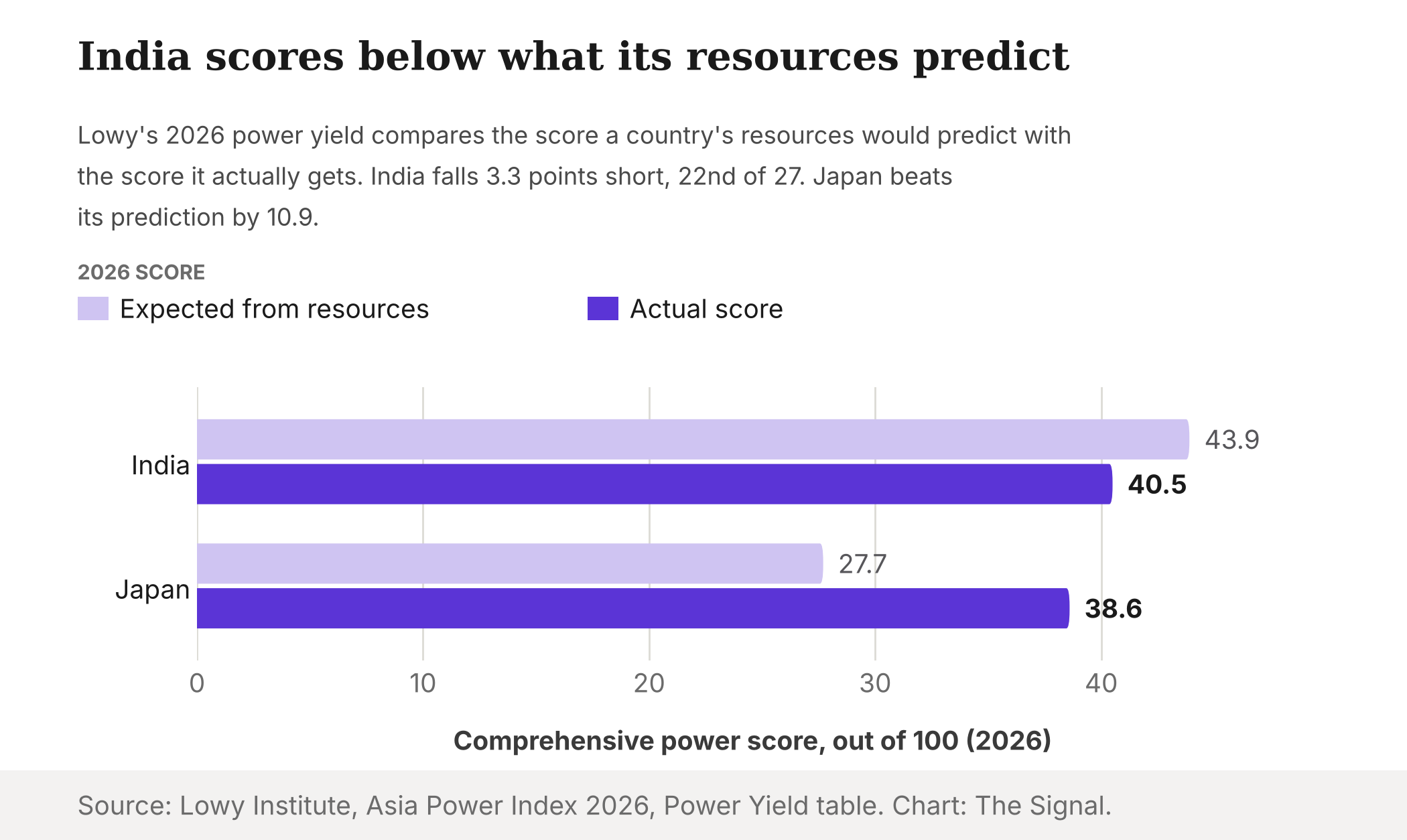
The finding is not new, and that is the point. A year earlier, Lowy's 2025 release said India had passed the index's threshold for major power status, yet the growth in its influence through diplomacy and economic relationships had not been commensurate with its expanding resources. The 2026 edition shows the shape of that gap clearly.
Where the shortfall sits
Lowy builds its index from eight measures. India's scores split into two groups. The first is weight: what India owns. India ranks 3rd on future resources with 56.2, far ahead of 4th-placed Russia at 20.4. It ranks 3rd on economic capability with 26.4 and 4th on military capability with 48.5. Diplomatic influence is its best score, 70.3, good for 4th. The two measures not shown in the chart below fit the same pattern: India ranks 4th on resilience with 55.4 and 4th on cultural influence with 43.8. Six of India's eight measures rank in the top four.
The second group is networks: how much other countries depend on India. Here, on the remaining two measures, it drops out of the top tier. India ranks 7th on economic relationships with a score of 19.9. It ranks 9th on defence networks with 18.6, its weakest-ranked measure.
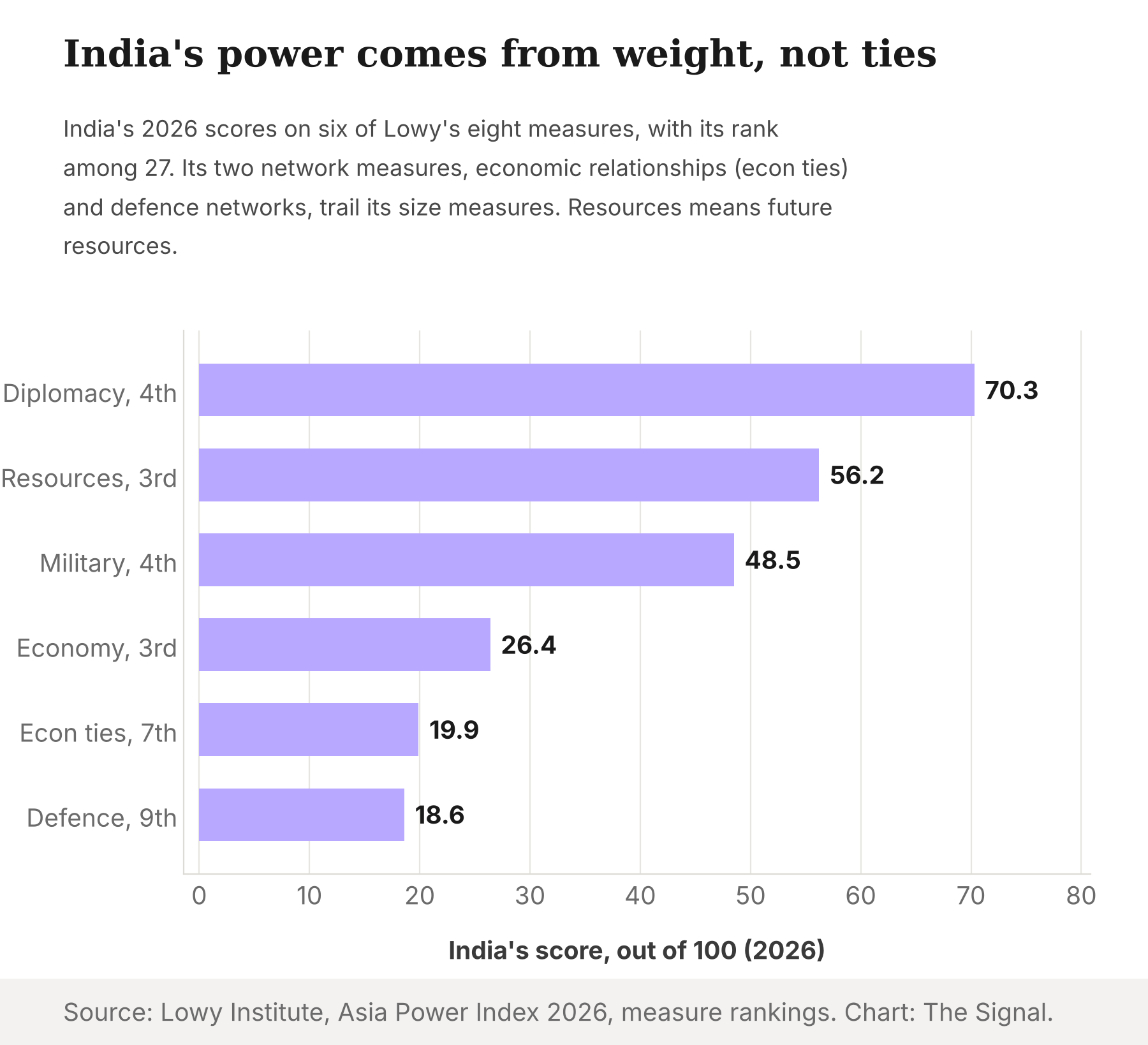
That split explains India's minus 3.3 yield. Resources are things a country holds. Relationships are things other countries feel. India has built the first much faster than the second.
Economic ties are the costlier gap
Of the two network measures, economic relationships matters more for the headline score. Lowy gives economic relationships a 15% weight in comprehensive power, and on it China leads at 91.8, with the United States second at 58.0. India's 19.9 is about a fifth of China's score.
Compare that with size. On economic capability, India's 26.4 sits behind the US at 86.7 and China at 86.1. So India's economy scores roughly 31% of China's on Lowy's size measure, but its economic relationships score only about 22% of China's. The economy is small relative to China. The web of dependence around it is smaller still.
Inside the measure, the picture is uneven, and the unevenness is instructive.
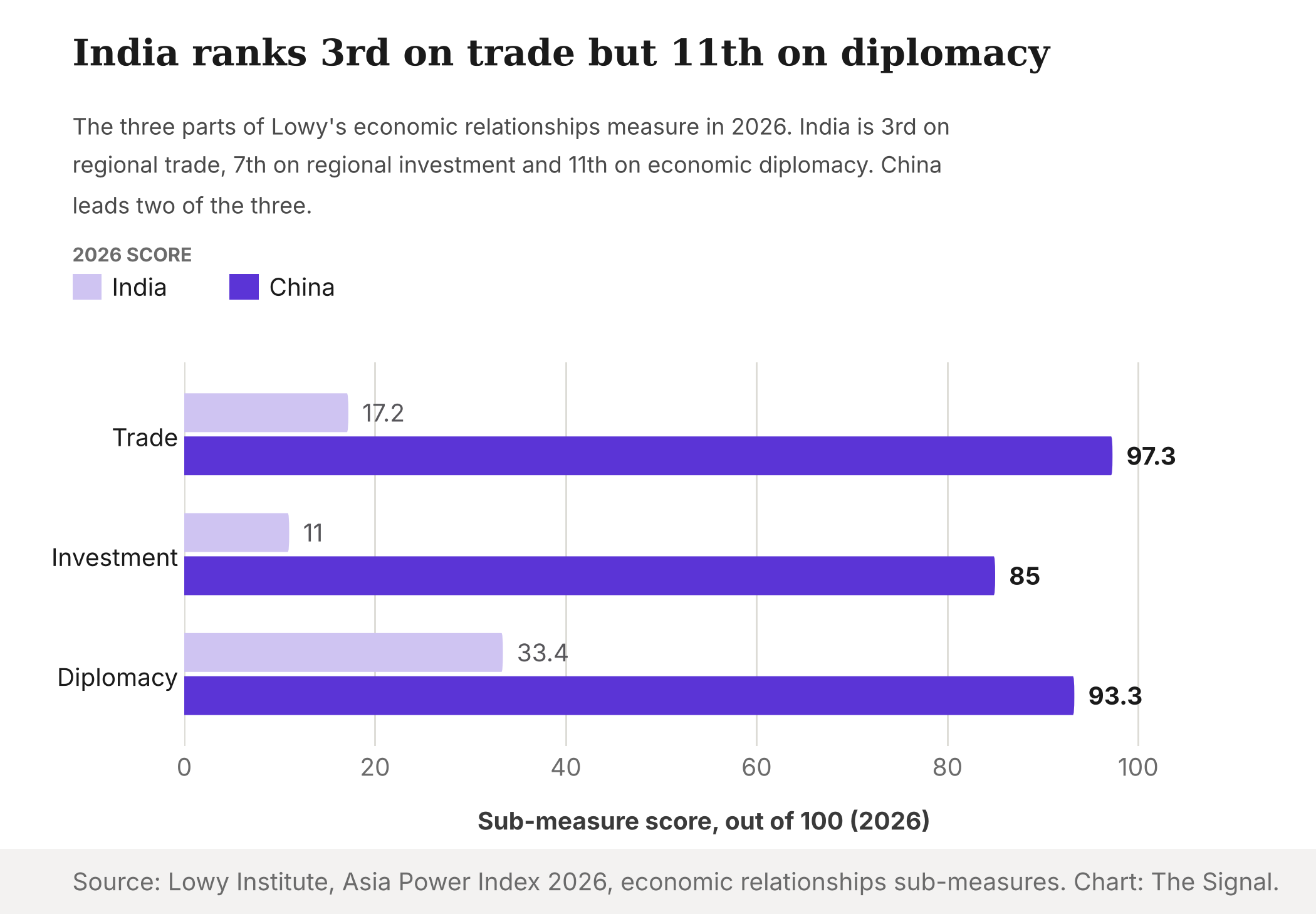
India is a top-three trading partner in Asia but a mid-table investor and economic diplomat.
| Economic relationships sub-measure (2026) | India's rank | India's score | China's score | Leader's score |
|---|---|---|---|---|
| Regional trade relations | 3rd | 17.2 | 97.3 | 97.3 (China) |
| Regional investment ties | 7th | 11.0 | 85.0 | 86.5 (United States) |
| Economic diplomacy | 11th | 33.4 | 93.3 | 93.3 (China) |
Source: Lowy Institute regional trade relations, regional investment ties and economic diplomacy sub-measures, 2026. Scores out of 100.
On regional trade relations India ranks 3rd with 17.2, against China's 97.3 and the US's 34.5. On regional investment ties it ranks 7th with 11.0, behind the US at 86.5 and China at 85.0. On economic diplomacy it ranks 11th with 33.4, while China leads at 93.3. India sells into Asia. It does not yet own stakes across Asia, or use economic tools to shape it.
Stuck, not sliding
Decline is the wrong word. India rose from 9th to 7th on economic relationships in 2026, and it climbed two places to 9th on defence networks. The trouble is the longer view. In the first Asia Power Index in 2018, a Lowy Interpreter analysis by Alyssa Ayres reported India ranked seventh for economic relationships and tenth on defence networks. Eight years on, India holds the same economic-relationships rank it started with.
Meanwhile the leader pulls away on overall power. China ranks 2nd at 73.6, 33.1 points above India, and economic relationships is China's strongest measure. China's lead over India is built largely on exactly the dimension where India has stood still.
India's biggest new trade deal points west
New Delhi's biggest trade move of 2026 is with Europe. The European Commission said the EU and India concluded free trade negotiations on 27 January 2026, that the two already trade over €180 billion in goods and services a year, and that the deal removes or reduces tariffs on 96.6% of EU goods exports to India. India's side of the ledger is just as broad: the commerce ministry says the deal secures preferential access for more than 99% of Indian exports to the EU by trade value. India's commerce ministry put bilateral goods trade with the EU at USD 136.54 billion in 2024-25, with exports of USD 75.85 billion. A Council of the EU document shows the Commission sent a proposal for a decision on signing the agreement on 11 September 2026.
The signing date is not settled. Press Trust of India reported, citing a single unnamed official, that the two sides are likely to sign on 16 December. Treat that as a working date, not a fixed one.
Here is the mismatch. Lowy's methodology builds its regional trade sub-measure from indicators such as trade with the region and a country's importance as an importer, exporter and primary trade partner for other countries. The deal is not invisible to the index: Lowy's economic diplomacy sub-measure tracks free trade agreements, with separate indicators for global and regional FTAs, so a signed EU pact can count there. But that is one indicator inside one sub-measure. A pact with Brussels may be good economics for India. It does not build the Asian trade and investment dependencies that hold India's yield down.
The honest objection
The strongest case against this reading is that the yield is a model, and models punish fast growers. If resources rise faster than relationships can follow, any country will look underpowered for a while. India's trajectory supports patience: its overall score rose 0.5 points in 2026, and it gained two places on both network measures in a single year. Japan, the yield champion, is not a model of momentum either, since Lowy says Japan's economic relationships fell to a record low in 2026.
That case is real, and it rules out any story of India falling. But it explains a lag, not a rank that has returned to its 2018 position. Eight years of catch-up should look like steady climbing, and India's path looks more like a round trip. And a trade agenda tilted toward Europe does little for sub-measures built on ties within the region.
The Signal
India's power in Asia rests on what it owns: people, an army, a diplomatic corps, an economy third in size. Its influence lags because fewer neighbours are tied to it by investment and economic statecraft, and that gap has barely moved since the index began. The EU deal, if it is signed in December as one official expects, will deepen India's links with Europe. Watch instead whether India's regional investment rank, 7th in 2026, rises in the 2027 edition. Size makes a country a major power. Dependence makes it a powerful one.
Reporting basis: all index rankings, scores, weights and the power-yield figures are from the Lowy Institute's 2026 Asia Power Index pages (country profiles for India, China and Japan, the Power Index overview, the Power Yield table and the individual measure and sub-measure tables); the 2025 assessment is from Lowy's 2025 release, and the 2018 ranks are from a 2018 Lowy Interpreter analysis by Alyssa Ayres, so every index figure traces to one origin, the Lowy Institute. India-EU goods trade figures are from India's Ministry of Commerce and Industry, via PIB. The conclusion of negotiations, the €180 billion trade figure and the 96.6% tariff coverage are from the European Commission, and the signing proposal is from a Council of the EU document. The 16 December signing date rests on a single unnamed official quoted by Press Trust of India, via Business Standard, and is not confirmed by either government. Resilience and cultural influence ranks are from Lowy's measure tables, and the description of how the trade and economic diplomacy sub-measures are built is from Lowy's methodology page. The more-than-99% preferential access figure for Indian exports is the Indian commerce ministry's own framing, by trade value. India's economic scores as shares of China's (about 31% and 22%) and the comparison of India's and Japan's expected and actual scores are The Signal's calculations from those figures.