The headline out of Tokyo on Thursday read like a friendship milestone. At the fourth India-Japan 2+2, held in Tokyo on 18 and 19 November 2026 according to India's Ministry of Defence, the two governments agreed to let Japanese troops conduct live-fire missile training at Indian firing ranges in future joint drills, the Associated Press reported. The easy read is symbolism: two Quad partners deepening trust, Japanese missiles on Indian soil, another line in a long communiqué.
It is worth slowing down on that. The agreement is less about trust than about geography. Japan has been buying missiles that fly far, and it does not own enough empty sea to fire them safely.
A 1,000 km missile and a 40 km range
Start with 40. Shizunai, off Hokkaido, is Japan's largest restricted water training area, a fan-shaped zone 40 kilometers in radius covering 1,256 square kilometres, Naval News reported. The missile Japan is now fielding is the upgraded Type 12, which has a range of about 1,000 kilometers, 10 times that of the roughly 100 km Type 88, according to the AP. That is 1,000 km of reach against 40 km of home water: the new missile outranges Japan's biggest sea range 25 times over.
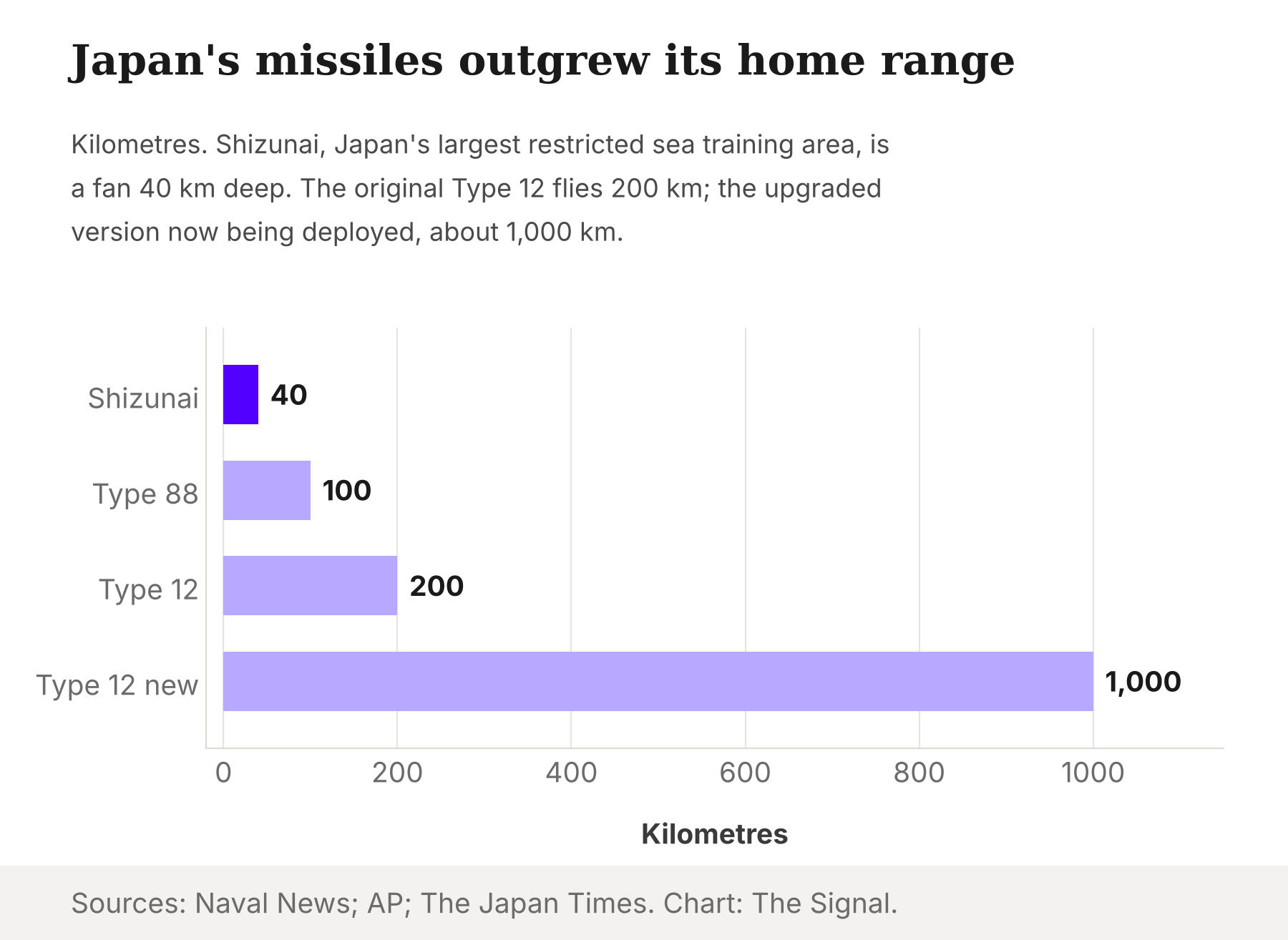
This is not a paper gap. Japan only managed its first missile test on its own territory on 24 June 2025, firing a training round at an uncrewed boat about 40 km off Hokkaido. The AP noted that because of space limitations and safety concerns, Japan had held its past missile tests in the United States and Australia. Japan's then defence minister was candid about the ceiling. "While there will be range limitations, we aim to ensure more units can train with advanced equipment," Gen Nakatani said in 2025, as Naval News reported.
The AP spelled out the mechanism in its 2+2 report. As an island nation with limited space to safely conduct missile tests and training, Japan needs partners that can provide live-fire facilities.
The money moved faster than the map
The pressure is rising because the arsenal is growing on a budget timetable, not a geographic one. Japan's Cabinet approved a record defence budget plan exceeding 9 trillion yen ($58 billion) for the fiscal year that began in April 2026, the AP reported. That plan includes a 177 billion yen purchase of upgraded Type-12 missiles with a range of about 1,000 km. It also set aside more than 970 billion yen for "standoff" missile capability. In 2026 Japan started deploying long-range missiles, including Type-12s mobilized in Kumamoto.
A missile a crew has never fired at full distance is a missile with an untested crew. So Japan has been renting distance, one partner at a time.
Japan's firing map, so far
Japan's recent anti-ship missile firings have mostly happened on other countries' ranges.
| Year | Where | What Japan fired | Distance reported |
|---|---|---|---|
| 2023 | Beecroft range, Australia | Type 12, first firing in Australia | 200 km-range missile |
| 2025 (June) | Shizunai, Hokkaido, Japan | Type 88 training round, first test on home soil | Target about 40 km out |
| 2025 (July) | Beecroft range, Australia | Two Type 12s | Hit a target about 19 miles offshore |
| 2026 (May) | Luzon, Philippines | Two Type 88s | Ship target 75 km away |
| 2026 (Nov) | India | Live-fire missile training agreed | Not yet announced |
Sources: The Japan Times; AP; Defense News; Naval News; AP.
In July 2023 the Ground Self-Defense Force test-fired its 200-kilometer-range Type-12 for the first time in Australia, The Japan Times reported. In July 2025 it launched two Type 12s from the same Beecroft range that hit a floating target around 19 miles off the Australian coast, per Defense News. In May 2026, in the Philippines, a Japanese launcher fired a pair of missiles at a ship target 75km away, Japan's first deployment of combat troops onto Philippine soil since the Second World War, Naval News reported.
Australia shows what a range host gets
Australia is the template, and it shows that range space is a scarce asset partners queue for. In August 2026 Australia's defence minister Richard Marles described an enhanced arrangement for Japan's use of Australian missile ranges over the course of the next decade, AFP reported. Japan's defence minister Shinjiro Koizumi called it second only to similar cooperation with the United States. The same report said waiting times to use the Woomera site are growing as partner nations seek it out.
Woomera covers 122,188 square kilometres of the South Australian outback, per Australian Defence Magazine. Set against Shizunai's 1,256 square kilometres, that is about 97 times the room.
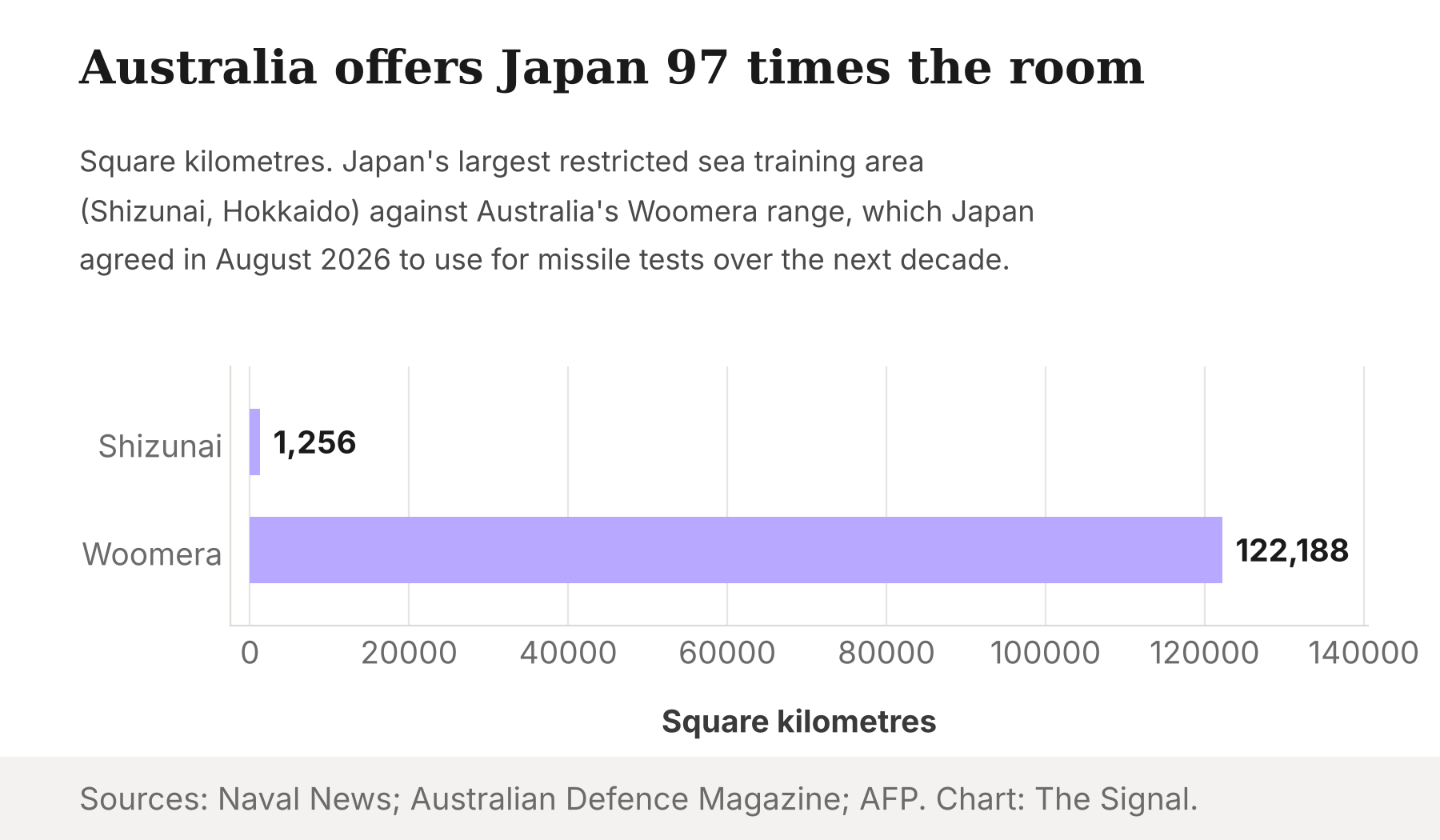
A host with that much room is not a junior partner. It sells something that money cannot manufacture in Japan, and it sets the calendar.
Where India fits
India comes to this as a supplier, not a client. Japan's ground force chief Gen Masayoshi Arai confirmed in October 2026 that "We had dispatched personnel to coordinate various matters with India," WION reported, a month before the ministers signed off. The Tokyo meeting also tied the range deal to industry: Rajnath Singh said defence industrial cooperation will proceed under the framework of "design with Japan, make in India".
That pairing matters. The industrial side of the relationship has usually been framed as Japanese technology flowing to India. Now Japan needs something from India that it cannot build at home, and that gives New Delhi a bargaining chip in the industrial talks running alongside it. The groundwork is already there. In August 2026 the two defence ministers signed a maritime security memorandum and welcomed the steady expansion of the army exercise Dharma Guardian and the naval exercise JAIMEX, All India Radio reported.
The honest objection
The strongest case against this reading is that Japan is fixing the problem at home and India is a stopgap. Japan plans a new missile firing range on Minamitori Island for training from fiscal 2026, Naval News reported, and once it opens, the argument goes, the leverage evaporates. There is also a political reading: the drills are a signal to Beijing, and range space is incidental.
Both points are real. But a new island range does not change the arithmetic of a 1,000 km missile in a crowded archipelago, and Japan's own minister has already conceded "range limitations" at home. Nor did Tokyo pick India alone: it agreed a decade-long range arrangement with Australia and fired from the Philippines within the same year. A country that only wanted a signal would not be lining up three hosts. A country short of room would.
The Signal
Japan's missile build-up has outrun its coastline, and that turns India's empty sea and long test corridors into a strategic export. The cooperation is real, but so is the dependency: Japan's newest weapons need partners' ranges to prove they work. Watch two things. First, whether the first Japanese live fire in India uses the long-range Type 12 rather than an older missile, which would show India is being asked for distance, not ceremony. Second, whether the "make in India" side of the deal produces contracts on the same timeline as the range access. The scarcest thing in Japan's arsenal is not a missile. It is room.
Reporting basis: the 2+2 agreement, Japan's space constraint, its Kumamoto deployment and the "design with Japan, make in India" line are per the Associated Press report of 19 November 2026; the meeting dates are from India's Ministry of Defence, via PIB. Japan's first domestic missile test and the Type 88 and upgraded Type 12 ranges are per a separate AP report of June 2025, and the Shizunai dimensions, the Minamitori plan and Gen Nakatani's remark are per Naval News, citing Japan's Ground Staff Office. The FY2026 budget figures are per the AP, as carried by Defense News. Japan's 2023 Australian firing is per The Japan Times, the 2025 firing per Defense News, and the 2026 Philippine firing per Naval News. The Australian range arrangement is per AFP, Koizumi's remark and the Woomera waiting times per The Nightly (the latter resting on unnamed military sources), and Woomera's area per Australian Defence Magazine. Gen Arai's statement is per WION, relaying his press conference, and the August 2026 ministerial memorandum and exercises are per All India Radio's report of the joint statement. The 25-fold reach gap and the 97-fold area gap are The Signal's calculations from those figures.