
The Open Doors report released on November 16 gave Indian newspapers a tidy headline. India is still the largest source of foreign students in the United States, for the third year running, and its count slipped 6 percent to 339,435 in the 2025/26 academic year. After the visa interview freezes and the social-media vetting of 2025, a single-digit dip reads like resilience.
That reading depends on what counts as a student. Open Doors counts graduates working in the US on Optional Practical Training, or OPT, the post-study work permit attached to the F-1 visa. Those people have finished their degrees. They are employees on a student status. And for Indians, they are now the majority.
The number that carries the story
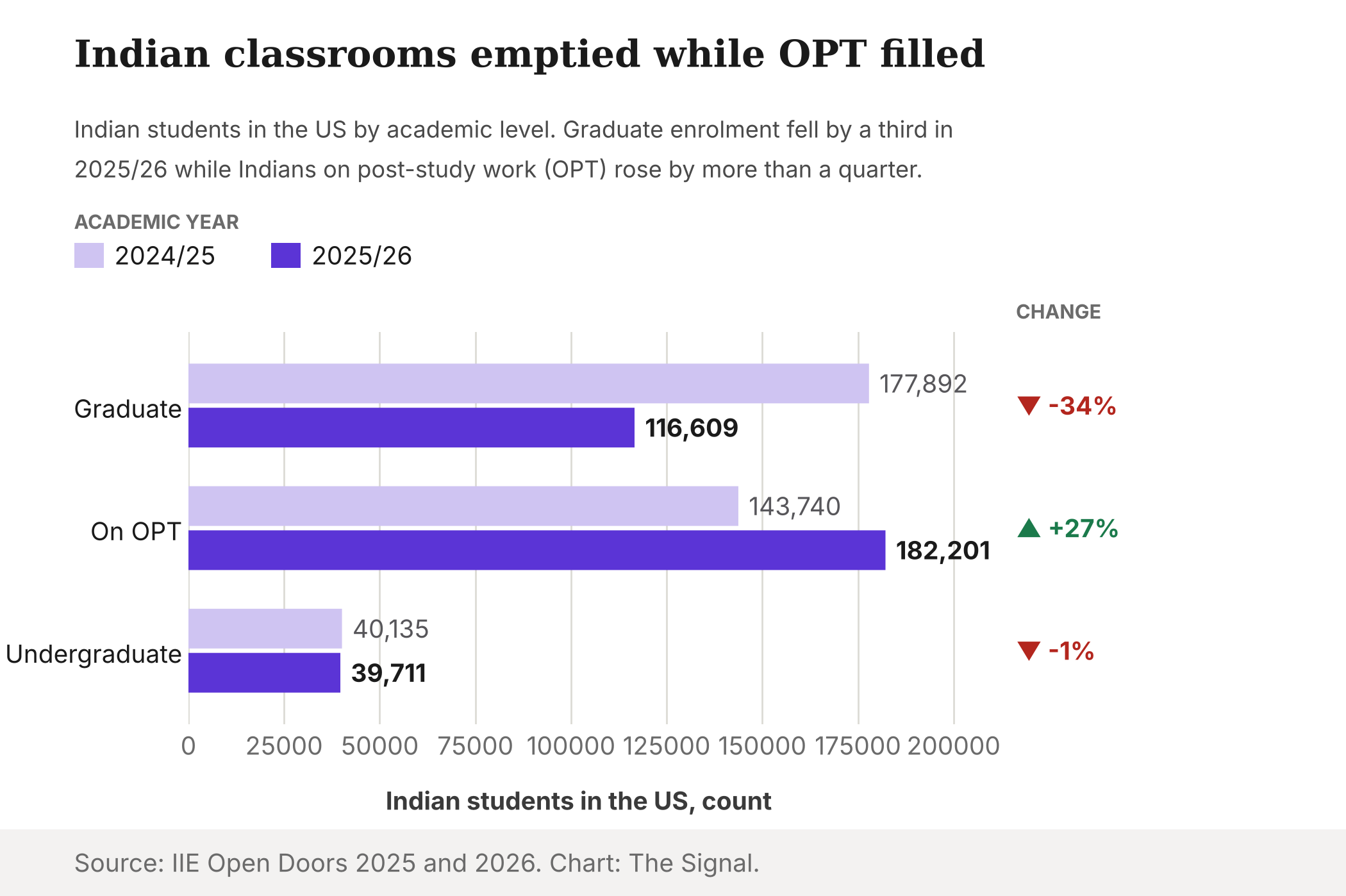
The Institute of International Education's own breakdown is blunt. Indian graduate students fell 34 percent to 116,609, Indian undergraduates fell 1 percent to 39,711, and 182,201 Indians were on OPT, up 27 percent. OPT holders are 54 percent of the Indian total.
One year earlier the picture was different. In 2024/25, Indian graduate students numbered 177,892 and Indians on OPT numbered 143,740, with 40,135 undergraduates. Subtract OPT from the total in both years and the count of Indians actually enrolled in US programmes falls from 219,279 to 157,234. That is a 28 percent drop, not 6.
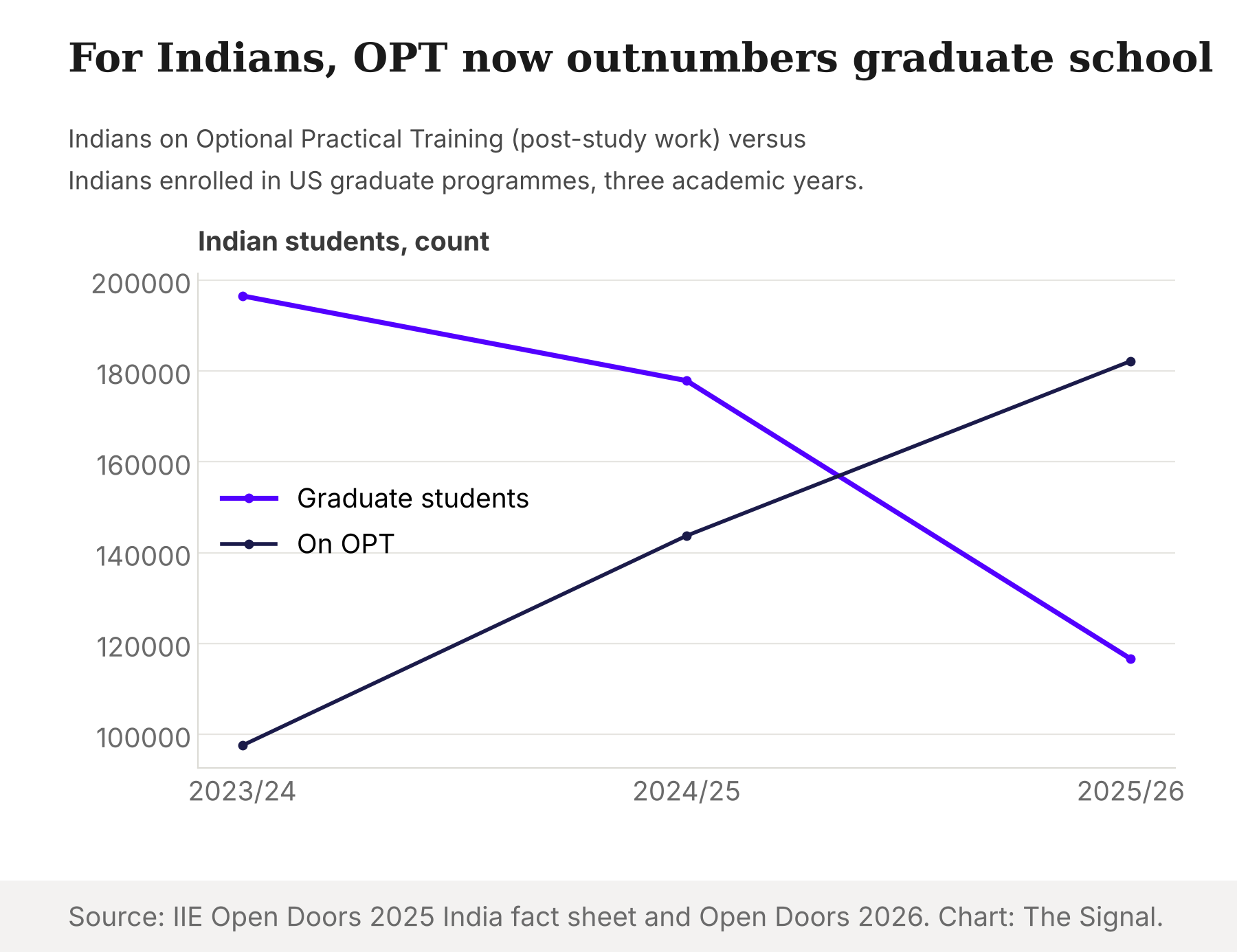
The two-year view is sharper still. The same fact sheet shows Indian graduate enrolment at 196,567 in 2023/24 and OPT at 97,556. Graduate numbers have since fallen 41 percent. OPT has nearly doubled. The lines crossed in 2025/26.
Why the total is a lagging indicator
OPT is a stock of past admissions. A student who started a two-year master's in 2023 graduated in 2025 and now sits in the OPT count. STEM graduates can extend it further. So the 2025/26 OPT number mostly reflects earlier intakes; IIE says OPT grew due to strong international graduate student growth in recent years. It says nothing about who is arriving now.
The arrivals are the part that broke. F-1 visa issuance to Indian students fell 76 percent between 2023 and 2025, according to The PIE News's analysis of US State Department figures. Across all countries, new international enrolments fell 18 percent to 228,123 in 2025/26, and the graduate decline was driven by master's students, down 22 percent. Indians dominate exactly that master's pipeline.
India's own government saw a gentler version earlier in the year. Minister of State for External Affairs Kirti Vardhan Singh told the Rajya Sabha, citing US Department of Homeland Security SEVIS data, that Indian students in the US numbered 378,787 in February 2025 and 352,644 in February 2026. That 6.9 percent fall also includes OPT holders, so it carries the same cushion.
India is the US graduate decline
The story is not only about India's exposure to America. It is about America's exposure to India. Open Doors Fast Facts show international graduate students in the US fell from 488,481 to 423,078 between 2024/25 and 2025/26, a loss of 65,403. Indian graduate students fell by 61,283 over the same year. India alone accounts for 94 percent of the drop.
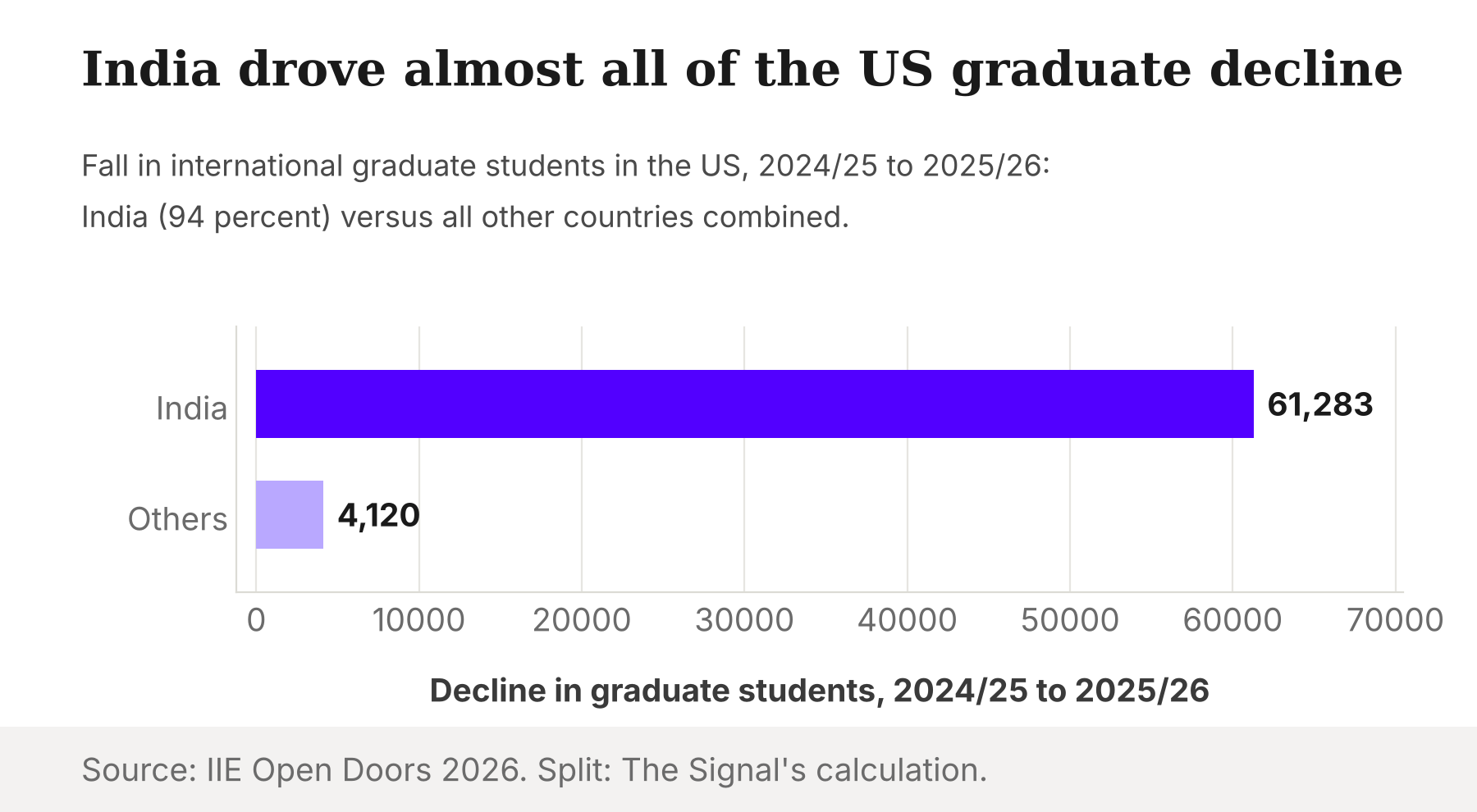
China, the usual comparison, barely moved. Its total fell 4.3 percent to 254,458. The US graduate market did not shrink across the board. It shrank where Indian master's students used to fill seats.
Indian students in the US by level, 2024/25 to 2025/26
| Level | 2024/25 | 2025/26 | Change |
|---|---|---|---|
| Graduate | 177,892 | 116,609 | down 34% |
| On OPT (post-study work) | 143,740 | 182,201 | up 27% |
| Undergraduate | 40,135 | 39,711 | down 1% |
| Total (all levels) | 363,019 | 339,435 | down 6.5% |
Source: IIE Open Doors 2025 India fact sheet and Open Doors 2026. Totals include a small non-degree group.
The pipeline arrives next year
The early read on 2026/27 points the same way. IIE's Fall 2026 Snapshot of 809 institutions reports that international numbers declined across undergraduate (down 3 percent), graduate (down 15 percent) and OPT (down 6 percent) levels. OPT is now falling too. That is the arithmetic of a thinner graduating class working its way through.
When it does, the Indian total loses its cushion. The 61,283 graduate seats lost in 2025/26 are next year's missing OPT workers. The headline number will then catch up with the classroom number, a year late.
There is a second risk built into the same structure. OPT exists by regulation, not statute. Senator Rick Scott's Prioritizing American Talent Act, introduced in June 2026, would permanently prohibit the Department of Homeland Security from funding the Optional Practical Training Program. A rival bill, H.R. 8683, introduced in May 2026, would amend the Immigration and Nationality Act to codify the Optional Practical Training program. Neither has passed. But with 182,201 Indians on OPT, more than half of all Indian "students" in the US now depend on a programme that one side of Congress wants to end. US institutions see the risk too: 95 percent of Snapshot respondents say international students would likely consider other countries if OPT options were limited.
The honest objection
The strongest case against this reading is that OPT growth is a sign of success, not a mask. Indians went to the US to get jobs, and a rising OPT count means more of them are getting exactly that. IIE itself attributes OPT growth to strong international graduate student growth in recent years. On this view the classroom drop is a one-off shock from the 2025 visa freeze, and intake will recover once processing normalises.
That case is real for the OPT holders themselves. It does not rescue the total. The graduate fall came after a 76 percent collapse in F-1 issuance to Indians between 2023 and 2025, and the Fall 2026 Snapshot shows graduate numbers still falling 15 percent across all nationalities this autumn. Among institutions reporting declines, 88 percent cite the visa application process. A recovery would have to show up in new visas first. It has not.
Meanwhile the students are going somewhere. Indian enrolments at German universities rose 17.5 percent to a record 69,816 in the winter semester 2025/26, according to The PIE News citing DAAD India.
The Signal
The US is still India's largest study destination, and the 6 percent headline makes it easy to treat 2025 as turbulence. The composition says otherwise. Indian enrolment in actual US programmes fell 28 percent in one year, and India supplied almost the entire decline in America's graduate schools, on IIE's own figures. The total held up only because it counts people who have already left the classroom.
For India's families, banks lending for education and the agents who sell the US route, the useful number is the classroom count, not the total. For American universities, which IIE says drew nearly $56 billion into the US economy through international students in 2025, per the US Department of Commerce, the exposure is concentrated in a single country's master's students. Watch Open Doors 2027's OPT line. When it falls, the 6 percent headline becomes a double-digit one, and the drop everyone thought had passed arrives on paper.
Reporting basis: enrolment counts by level for 2023/24, 2024/25 and 2025/26, the US-wide graduate, new-enrolment and OPT totals, the China figures, and the Fall 2026 Snapshot results all come from a single origin, the Institute of International Education's Open Doors census and its Fall 2026 Snapshot, published by IIE. The $56 billion economic figure is the US Department of Commerce's, as relayed by IIE. The F-1 visa decline is from US State Department figures, as analysed by The PIE News. The February 2025 and February 2026 SEVIS counts are from a Ministry of External Affairs reply to the Rajya Sabha, as reported by Deccan Chronicle. The Germany figure is DAAD India's, as reported by The PIE News. The two OPT bills are cited from Senator Rick Scott's office and the bill text on GovInfo. The enrolled-excluding-OPT counts and their 28 percent fall, the OPT share of the Indian total, the two-year graduate and OPT changes, and India's 94 percent share of the US graduate decline are The Signal's calculations from those figures.