
On 13 November 2026, India voted against a United Nations draft calling for a pause in executions. Open magazine reports that the draft cleared the General Assembly's human rights committee by 133 votes to 33, with 16 abstentions. The surface read writes itself: India stands with a small club of holdouts defending capital punishment in a chamber that has moved on.
India's delegation made its case plainly. ANI, carried by The Tribune, reports that First Secretary Bhavika Mangalanandan told the committee there is "no international consensus against capital punishment" and that Article 6 of the International Covenant on Civil and Political Rights permits its use with restrictions. In India, she said, the death penalty is "exercised exclusively in the rarest of rare cases", with mandatory confirmation of death sentences by a higher court and extensive mitigation consideration.
It is worth slowing down on that last clause. The higher court is where nearly every Indian death sentence now ends. The BBC reported that four men convicted of the 2012 Delhi gang rape and murder were hanged in Tihar jail on 20 March 2020, the first executions in India since 2015. They remain India's last. As of November 2026, that is nearly six years and eight months without a hanging.
The number that carries the story
Start with 106. Bar & Bench, reporting the Square Circle Clinic's annual statistics, says that of the 1,085 death sentences India's High Courts decided between 2016 and 2025, only 106, or 9.77%, were confirmed. The same courts acquitted 376 people (34.65%) and commuted 515 sentences (47.46%). Acquittals outnumbered confirmations by more than three to one. Over that decade, a person sentenced to death in India was likelier to be acquitted outright than to see the sentence upheld.
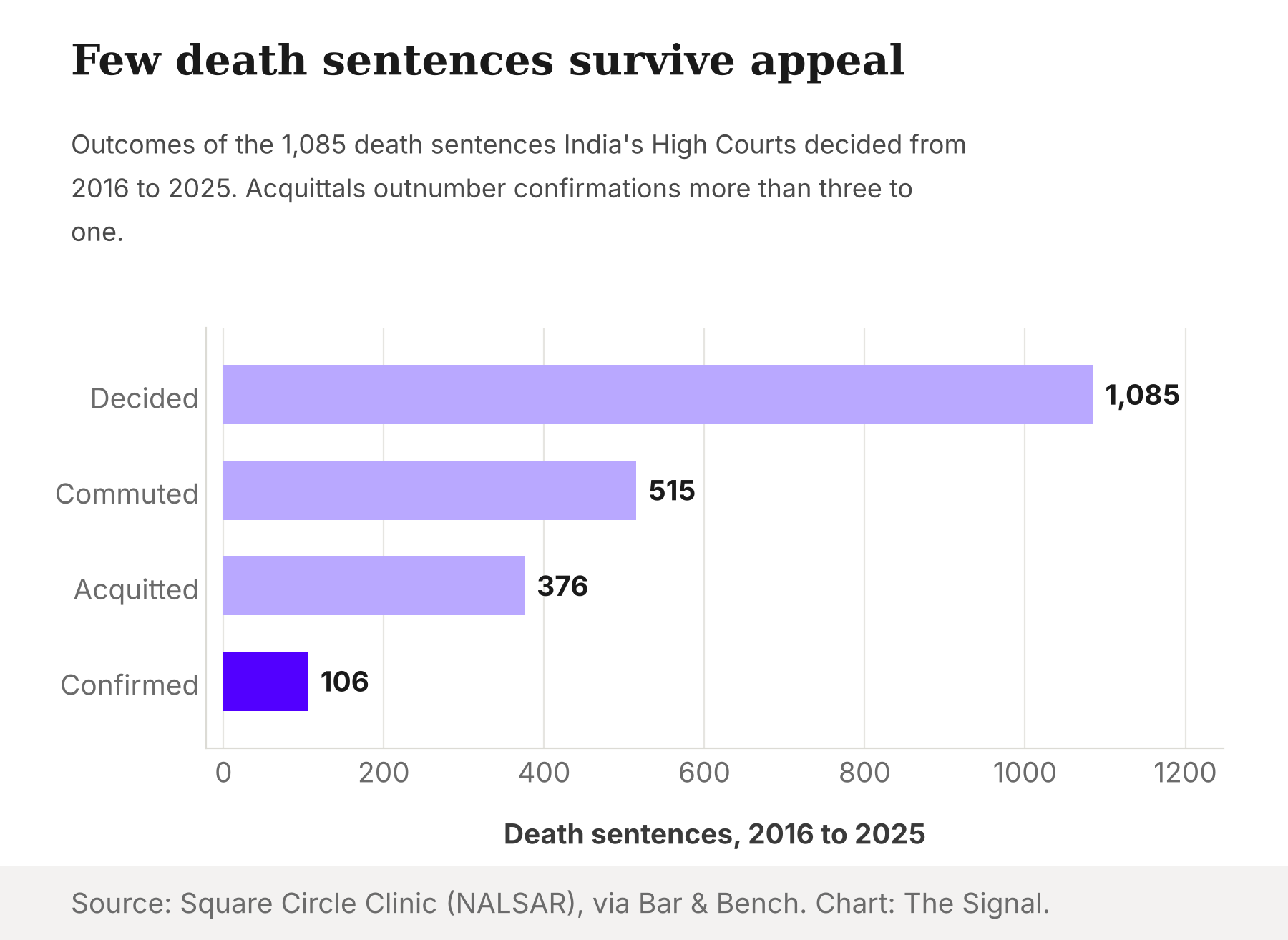
Source: Bar & Bench, reporting the Square Circle Clinic's annual statistics. Chart: The Signal.
The Supreme Court's filter is tighter still. ThePrint, reporting the Square Circle Clinic's annual statistics, says that 2025 was the third year in a row in which the Supreme Court did not confirm a single death sentence. The intake did not slow. Sessions courts sentenced 118 men and 10 women to death in 2025, and the 10 women were the most since 2016, by the same count.
A death row that keeps filling
Pair a busy front door with a nearly shut back door and the waiting room fills. LiveLaw, reporting the Square Circle Clinic's annual statistics, says that 400 persons were on death row in 2016 and 574 on 31 December 2025, a 45% increase. Supreme Court Observer, reporting the same statistics, says the end-2025 figure is the highest since 2016, with Uttar Pradesh holding the largest share, followed by Gujarat and Haryana.
Much of that population is simply waiting for its first appeal. Scroll, reporting the Square Circle Clinic's annual statistics, says that 312 cases involving 478 persons were pending before High Courts on 31 December 2025, and that the average gap between a sessions-court death sentence and a High Court hearing was 2.99 years, nearly 36 months. In Jammu and Kashmir the average was 11.53 years.
The government's own prison data point the same way, on an older date. Factly, citing NCRB Prison Statistics India 2023, reports that 545 convicts facing capital punishment were lodged in jails on 31 December 2023, 0.4% of all convicts, including 145 sentenced during 2023. The NCRB and the Square Circle Clinic count differently, so the two series should not be spliced year by year. Both put India's death row above 500.
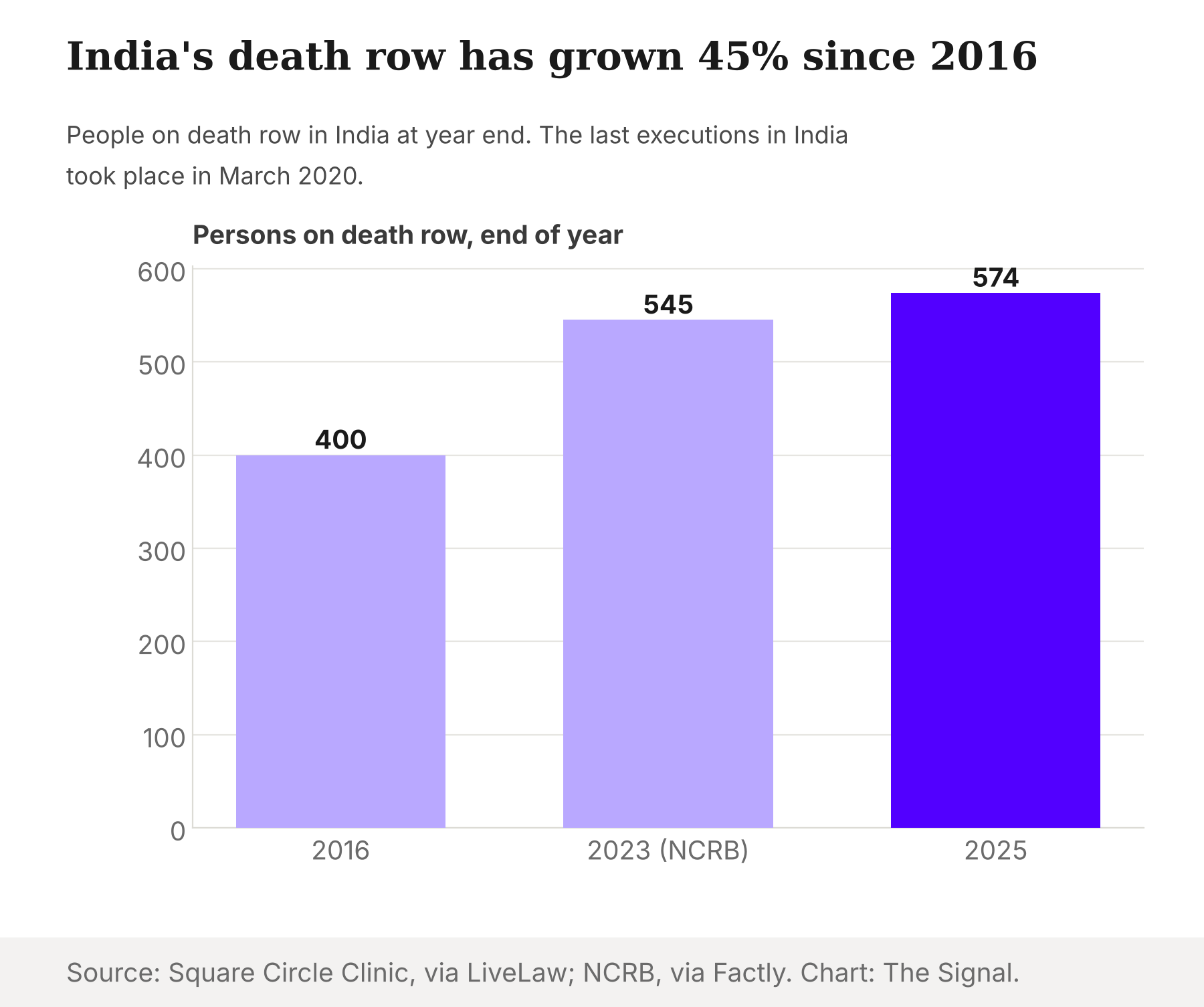
Sources: LiveLaw, reporting the Square Circle Clinic's annual statistics, for 2016 and 2025; Factly, citing NCRB Prison Statistics India 2023, for 2023. Chart: The Signal.
India's death penalty, stage by stage
| Stage | Figure | Period |
|---|---|---|
| Death sentences imposed by trial courts | 128 | 2025 |
| Trial-court cases not meeting constitutional sentencing requirements | 79 of 83 (95.18%) | 2025 |
| Death sentences confirmed by High Courts | 106 of 1,085 (9.77%) | 2016 to 2025 |
| Death sentences confirmed by the Supreme Court | 0 | 2025, third straight year |
| Persons on death row | 574 | 31 December 2025 |
| Executions | 0 | since 20 March 2020 |
Sources: ThePrint, LiveLaw and Bar & Bench, each reporting the Square Circle Clinic's annual statistics; BBC News for the last executions.
Two readings of one record
The government and its critics look at the same pipeline and see opposite things.
The government's reading is that the pipeline is the safeguard. As India told the UN committee, capital punishment is "meted out after rigorous and due legal process", under a framework of multi-tier procedural safeguards that includes the presumption of innocence. On this view, a High Court acquittal rate above one in three is the system working: review catches mistakes before anything irreversible happens. Keeping the penalty on the statute book for the gravest crimes, while applying it sparingly, is the design rather than a contradiction. And with no international consensus to bind it, India sees no reason to trade that design for a UN resolution.
Critics read the same figures as an indictment of the front door. LiveLaw, reporting the Square Circle Clinic's annual statistics, says that in 79 of 83 cases decided by trial courts in 2025, or 95.18%, sentencing did not adhere to constitutional requirements. India's own law reform body went further in August 2015: the Law Commission of India's 262nd Report recommends that the death penalty be abolished for all crimes other than terrorism-related offences and waging war. On this reading, India already runs a moratorium in practice while refusing to sign one, and the cost of that gap falls on the people waiting on death row, nearly three years on average before a High Court even hears their case.
Where India sits in the world
India's vote was no surprise. Amnesty International's 2024 global death penalty report records India among the 32 states that voted against the General Assembly's moratorium resolution in December 2024. Amnesty International reported that the full General Assembly adopted that resolution on 17 December 2024 by 130 votes to 32, with 22 abstentions. The 2026 committee tally of 133 to 33 comes from a different stage of the process, so the two are not a like-for-like comparison. Even so, the bloc voting against has held at a little over 30 states. In Amnesty's count, India's new death sentences rose from 120 in 2023 to 139 in 2024, one of the most notable increases it recorded anywhere.
Globally, the picture splits. Amnesty International's annual count shows 2,707 people executed across 17 countries in 2025, the highest figure Amnesty has recorded since 1981, even as 113 countries have abolished the death penalty and more than two-thirds are abolitionist in law or practice. The UN Secretary-General's report on the moratorium (A/79/276) states that some 170 states have abolished the death penalty, introduced a moratorium in law or practice, or suspended executions for more than 10 years.
That last test makes India's position measurable. Counting from the Tihar hangings of 20 March 2020, reported by the BBC, India would cross the 10-year line only in March 2030. Until then it sits in neither camp: a country that has not executed anyone in over six years, and that votes at the UN to keep the option open.
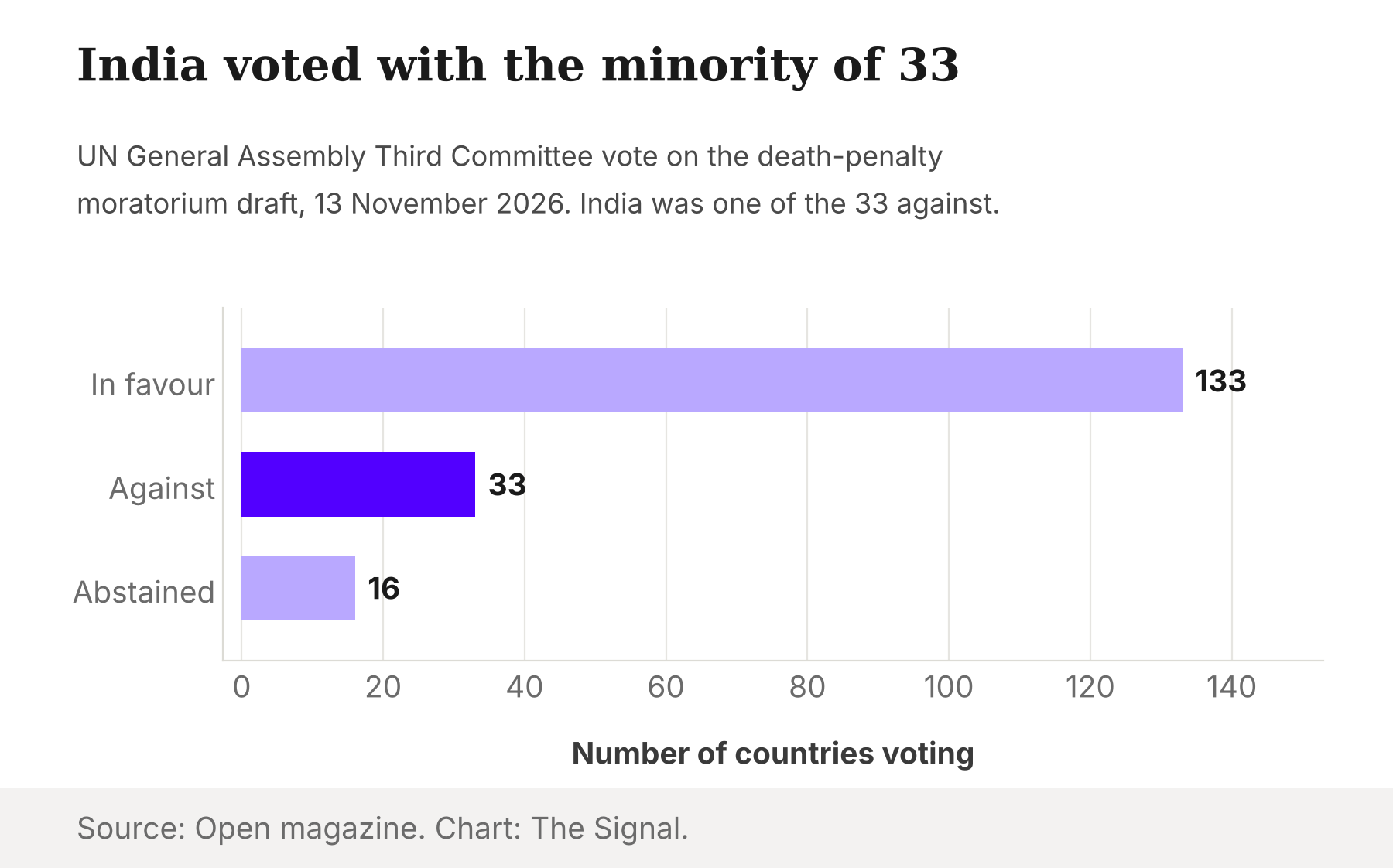
Source: Open magazine. Chart: The Signal.
The honest objection
The strongest case against reading India's unused gallows as a quiet moratorium is that executions stall for procedural reasons, not policy ones. A death sentence must clear High Court confirmation, a possible Supreme Court appeal, further petitions and finally a plea for executive mercy. That sequence takes years, and the BBC's account of the 2020 hangings, the first since 2015, shows the machinery still runs to the end once every step is exhausted. The last step does real work too: Scroll, reporting the Square Circle Clinic's annual statistics, says the President rejected 19 mercy petitions and accepted 5 between 2016 and 2025. On this view, three straight years of zero Supreme Court confirmations describe a slow pipeline, not a closed one, and a policy choice that belongs to Parliament should not be outsourced to a General Assembly vote.
That case is serious, and the data cannot settle it. A slow pipeline and an unannounced moratorium produce the same numbers for years at a stretch. What separates them is what happens next: confirmations that resume and lead to executions, or a death row that keeps growing while the appeals courts keep unwinding it.
The Signal
India's vote in New York and its record at home are closer than the 133 to 33 tally suggests. The committee result reported by Open magazine puts India with the minority, but the standard it defended there is one its own courts apply so strictly that High Courts confirmed fewer than one in ten death sentences between 2016 and 2025. Watch three things: whether the full General Assembly repeats the committee vote, whether the Supreme Court confirms any death sentence in 2026, and where the next Square Circle Clinic count puts death row against its end-2025 level of 574. The statute says rarest of rare. The appeals courts are reading rare as almost never.
Reporting basis: the 13 November 2026 committee tally rests on a single outlet, Open magazine, and India's statement to the committee is per ANI, as carried by The Tribune. The 2020 executions are per the BBC. Death-row, sentencing, High Court and Supreme Court figures for 2016 to 2025 all come from one origin, the Square Circle Clinic's annual statistics report at NALSAR, as reported by Supreme Court Observer, ThePrint, LiveLaw, Bar & Bench and Scroll (which also carries the report's High Court pendency and mercy-petition figures); those five outlets are relays of the same report, not independent confirmations. The end-2023 prison count is from the NCRB's Prison Statistics India 2023, via Factly. India's 2023 and 2024 sentencing figures, its December 2024 vote, the 130-32-22 plenary tally and the 2025 global execution count are Amnesty International's figures, from three Amnesty publications. The 170-state figure is from the UN Secretary-General's report A/79/276, and the 2015 abolition recommendation is from the Law Commission of India's 262nd Report. The acquittal-to-confirmation ratio, the time elapsed since the last execution and the March 2030 date are The Signal's calculations from those figures.