The headline from this week's OECD migration report reads like good news for anyone worried about India's talent leaving. Rich countries are tightening their doors, and the flow is shrinking. Migration from India to the OECD fell by 19% in 2024, to fewer than five lakh people, largely because arrivals in the UK halved to 66,000, according to Scroll's reading of the OECD International Migration Outlook 2026. Across the bloc, permanent migration fell 1.6% in 2025, a second straight annual decline, and international student inflows dropped from 1.9 million in 2024 to 1.6 million in 2025, as summarised by India Blooms News Service.
The easy read follows: fewer Indians are leaving, so India will lose fewer of them.
That read confuses two clocks. One clock measures who arrives. The other measures who stops being Indian. They are years apart, and the second one is still running high: nearly 2.3 lakh Indians took OECD passports in 2024.
The number that matters is not the flow
The same report carries the other figure. About 9.2 lakh Indians acquired the citizenship of an OECD country between 2020 and 2024, up 41% from 6.5 lakh in 2015 to 2019. In 2024 alone, nearly 2.3 lakh Indians received passports in these countries.
For India, that number has a direct domestic twin. India does not permit dual citizenship. An Indian who naturalises abroad stops being an Indian citizen, and the Ministry of External Affairs records the renunciation. The MEA told the Rajya Sabha in December 2025 that renunciations ran at 85,256 in 2020, 1,63,370 in 2021, 2,25,620 in 2022, 2,16,219 in 2023 and 2,06,378 in 2024, as reported by The Free Press Journal. Those five years add to 8,96,843.
Set the two series side by side and they move almost in lockstep. Renunciations recorded by the MEA over 2020 to 2024 equal about 97% of the naturalisations the OECD counted. In the previous five years, the MEA's figures were 1,31,489 in 2015, 1,41,603 in 2016, 1,33,049 in 2017, 1,34,561 in 2018 and 1,44,017 in 2019, or 6,84,719 in total, close to the 6.5 lakh OECD count.
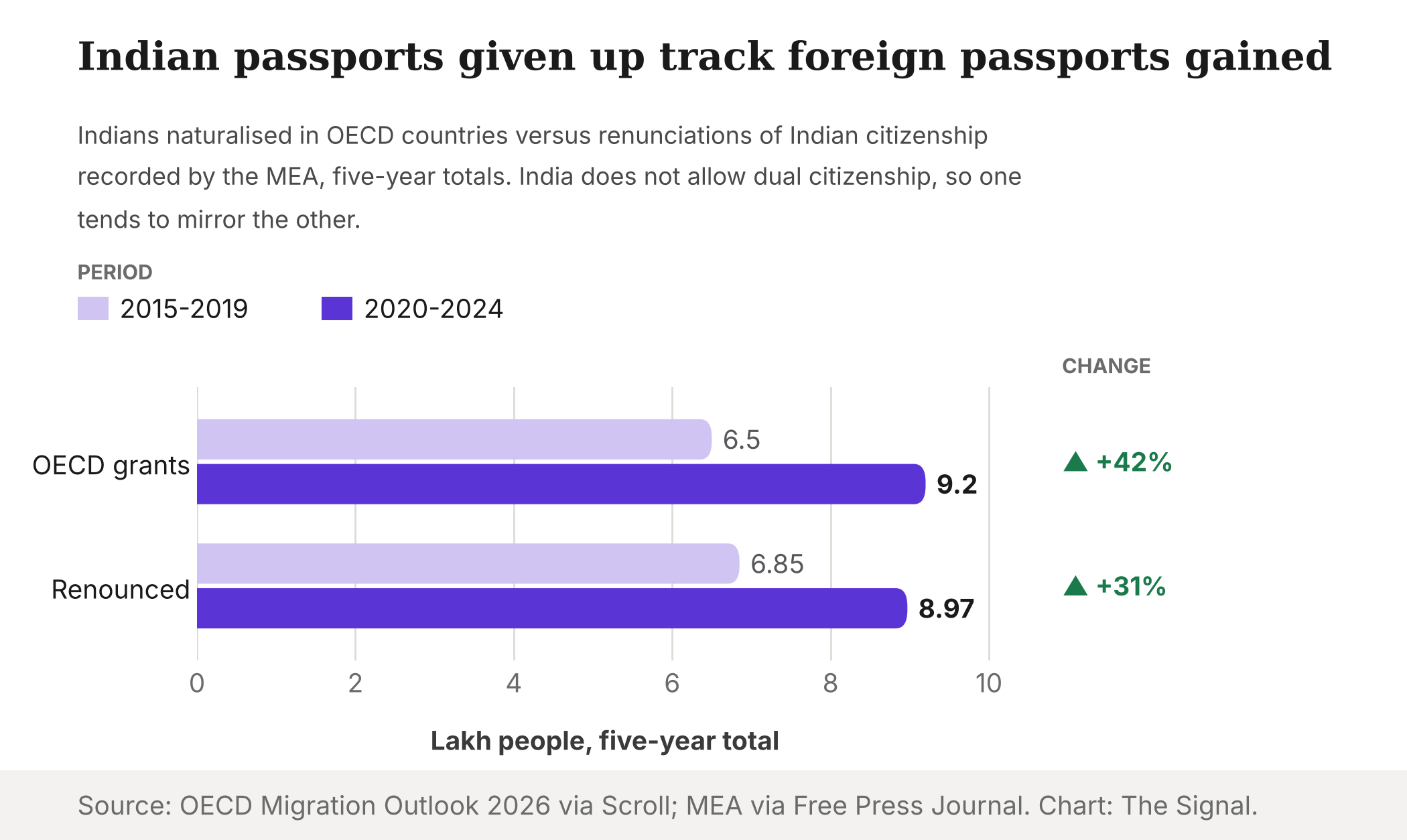
So the citizenship count is not an abstract diaspora statistic. It is, almost one for one, the number of Indian passports the state cancels.
Why the second clock runs late
Citizenship is the last step of a migration, not the first. Canada shows the delay clearly. Applicants must have been physically in Canada for at least 1,095 days during a five-year eligibility period, per Immigration, Refugees and Citizenship Canada, and that clock only starts after a student or worker has secured permanent residence.
The OECD's country tables show the result. Canada granted citizenship to 31,207 Indians in 2019 and 78,487 in 2023, out of 2,50,557 and 3,79,991 total grants. Between 2019 and 2023, Indians went from about one in eight new Canadian citizens to about one in five. Over the full period, Canada accounted for 2.6 lakh Indian naturalisations between 2020 and 2024, 150% more than in 2015 to 2019.
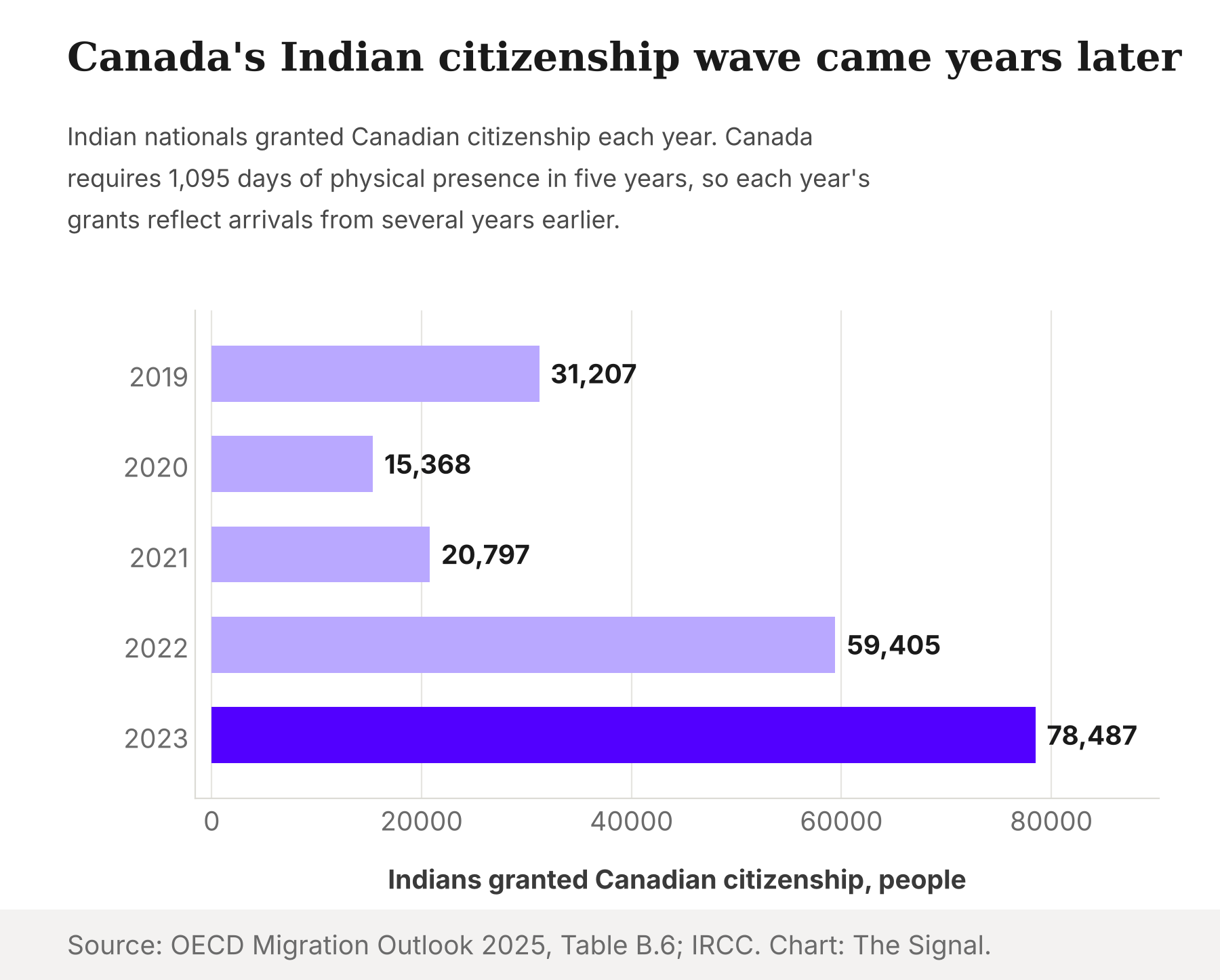
Those 2023 citizens are mostly people who arrived years earlier. The arrivals that will become the citizens of 2027 and 2028 have already landed. The OECD's own flow data say how many: about 6 lakh Indians immigrated into OECD countries in 2023, 8% more than in 2022, including 1,44,000 to the UK and 1,40,000 to Canada. The 2024 drop shrinks the cohort behind it, not the one already in the queue.
The UK queue is already visible
Britain offers the clearest view of what is coming, because it publishes the step before citizenship. Indian nationals were the largest group granted settlement in the year ending June 2026, with 35,384 grants, up 51%, per the Home Office. Settlement, or indefinite leave to remain, is the gate to a British passport.
British passports are already following. Indian nationals, at 24,851, were the largest group among 2,45,520 grants of British citizenship in the same period. A 51% jump in settlement today is a larger citizenship cohort a year or more from now.
| Measure | What it shows | Direction |
|---|---|---|
| Indian migration to the OECD, 2024 | New arrivals, down 19% | Falling |
| OECD student inflows, 2025 | Future workers, 1.9 million to 1.6 million | Falling |
| UK settlement grants to Indians, year to June 2026 | Next citizenship cohort, up 51% to 35,384 | Rising |
| OECD citizenships to Indians, 2024 | Nearly 2.3 lakh | High |
Sources: OECD International Migration Outlook 2026 via Scroll and IBNS; UK Home Office.
What follows for India
The policy debate in India treats the falling outflow as the signal. The renunciation count is the one Parliament actually hears, and it will not respond to the visa squeeze for years. Through the rest of this decade, the number of Indians giving up citizenship is set mostly by who left in 2019 to 2023, not by who is refused a visa in 2026.
That matters for three reasons. Each naturalisation moves a person out of the NRI category and out of the electorate, since only citizens vote. It shifts the financial relationship from a citizen abroad to a foreign national with Indian ties. And it keeps the dual-citizenship question alive, because the scale is now roughly two lakh renunciations a year.
The honest objection
The match between the two series could be partly coincidence. The MEA count covers every country, including non-OECD destinations, while the OECD count covers only its members. Renunciations are also recorded when a passport is surrendered, which can lag the foreign grant by months. A near-equal five-year total does not prove a one-for-one mapping year by year, even though India has been the top former nationality of new OECD citizens since 2019.
That is fair, and the year-by-year paths do diverge: the MEA figure dipped from 2,25,620 in 2022 to 2,06,378 in 2024 even as OECD grants stayed high. But the argument here does not depend on the exact ratio. It depends on the direction and the lag, and both are visible in sources that do not rely on each other: Canada's residence rule, the OECD's country tables and the Home Office's settlement data all say the queue to citizenship is long and already full.
The Signal
Rich countries closing the door changes who arrives in 2026. It does not change who becomes a citizen in 2027 or 2028, when today's settlement grants turn into passports. The visible test is next year's MEA reply to Parliament and the Home Office's citizenship count for Indians: if visa curbs were really shrinking India's losses, those would fall first, and the evidence says they will rise. India's passport losses are set by a door that closed years ago.
Reporting basis: the 2020 to 2024 citizenship totals (Scroll), the 2024 figure, the Canada share and the 2024 fall in Indian migration are from the OECD International Migration Outlook 2026 as reported by Scroll; the 2025 permanent-migration and student-inflow figures are from the same OECD report as summarised by India Blooms News Service, so these rest on one origin, the OECD, relayed by two outlets. The 2019 to 2023 Canadian naturalisation counts, the 2023 Indian migration flows and the 2023 nationality figures are from the OECD International Migration Outlook 2025, checked directly. Year-wise renunciation figures are from the Ministry of External Affairs' written reply in the Rajya Sabha in December 2025, as reported by The Free Press Journal; the reply itself was not checked. Canada's residence rule is from Immigration, Refugees and Citizenship Canada, and the British settlement and citizenship figures are from the UK Home Office's immigration statistics for the year ending June 2026. The five-year renunciation totals, the 97% ratio and the Canadian shares are The Signal's calculations from those figures.