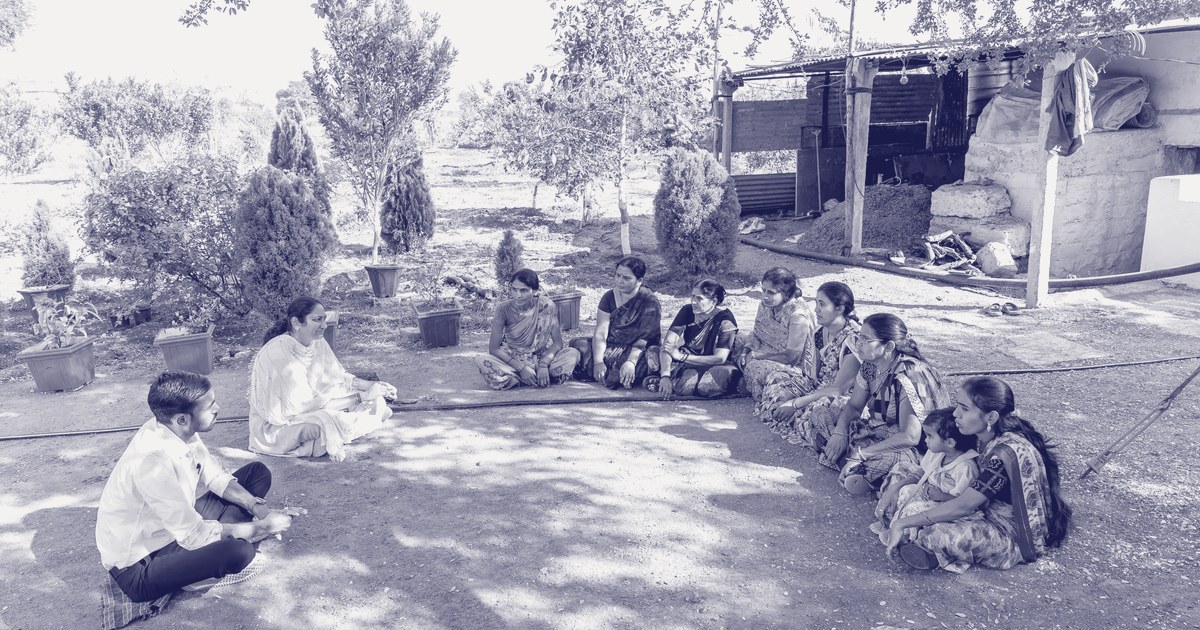
On 4 November 2026 the Supreme Court set aside the disqualification of Mangala Bhimrao Ingle, a former Maharashtra sarpanch who lost office after her third child was born. A bench of Justices PS Narasimha and Alok Aradhe said laws penalising more than two children have lost their relevance, noting that India's fertility rate has fallen from 3 in 2003 to 1.9 now, below the replacement level of 2.1. The court also said the fear of overpopulation behind such laws "has crumbled". The easy read is demographic: fertility fell, so the rule is stale.
That read is true and incomplete. The more useful question is where the penalty still exists, and what the fertility numbers look like there.
The laws survive where the problem has gone
The national picture first. The Registrar General's Sample Registration System put India's total fertility rate at 1.9 in 2024, below the 2.1 replacement level, with rural women at 2.1 and urban women at 1.5. The total fertility rate is the average number of children a woman would have over her lifetime at current age-specific birth rates. The World Bank's series shows the same slide: 3.12 in 2003, the year of the ruling that upheld such laws, and 1.96 in 2024. That is a fall of more than a third in 21 years.
Now the map. Per the amicus compilation before the court, the states that continue to have the two-child norm include Assam, Goa, Gujarat, Maharashtra, Odisha and Uttarakhand, while seven states have repealed it and fifteen never had one. Set that list against the 2024 fertility figures.
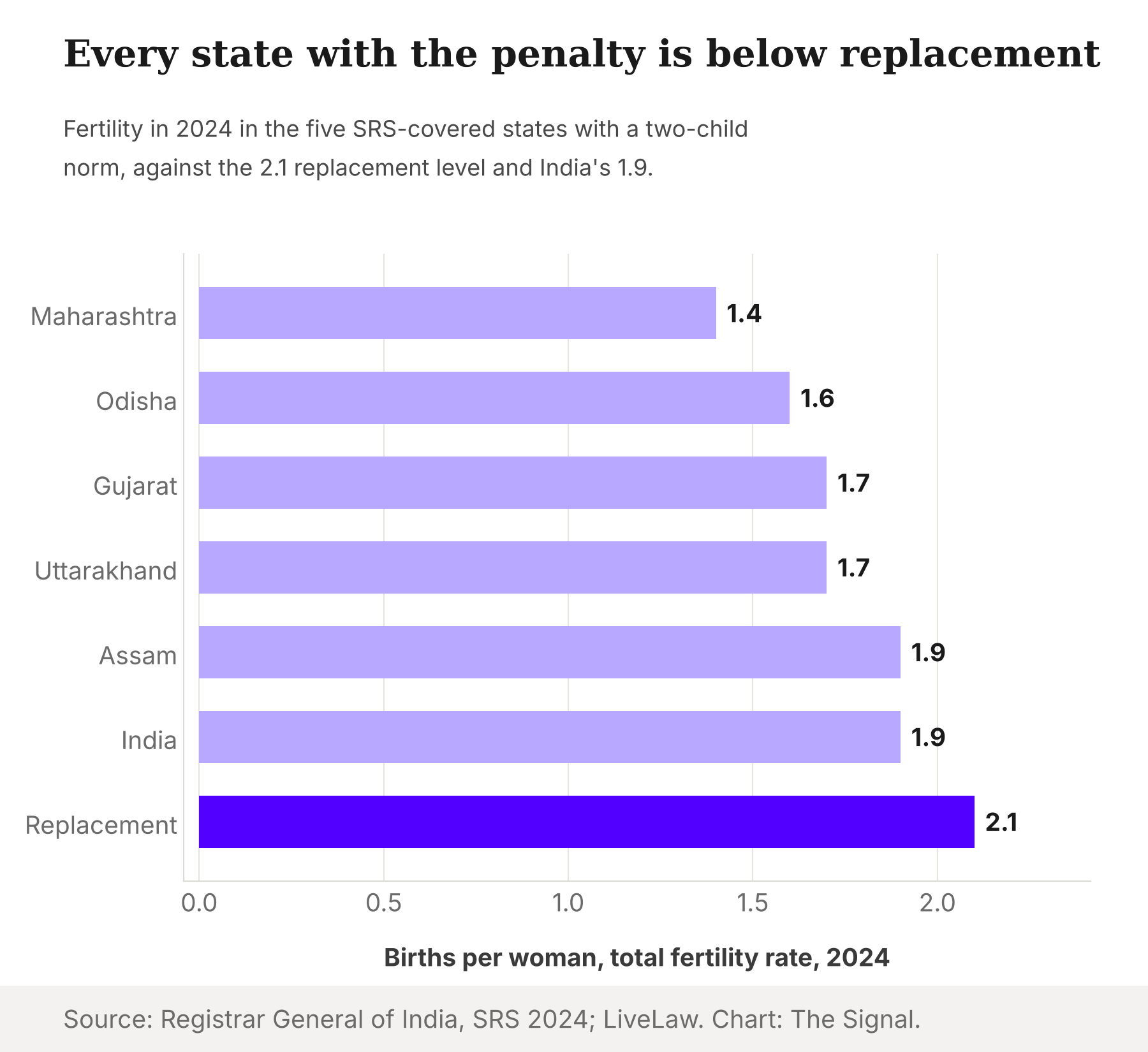
In the SRS state table, Maharashtra stood at 1.4, Odisha at 1.6, Gujarat and Uttarakhand at 1.7, and Assam at 1.9. All five are below replacement. Goa does not appear in the report's bigger-state table, so it is left out here rather than guessed at. The same table shows the states that are above replacement: Bihar at 2.9, Uttar Pradesh at 2.6, Madhya Pradesh at 2.4, Rajasthan at 2.3, and Chhattisgarh and Jharkhand at 2.2. None of those six is on the amicus list of states with the norm.
Read plainly, that is the thesis. A law meant to hold down family size is on the books in states where 2024 fertility was already below replacement, and absent from most of the states where it was not.
Who is left to be penalised
An average can hide a tail, so look inside the averages. A penalty on a third child bites hardest on whoever is still having three or more. Nationally, the 2024 fertility rate was 3.2 for illiterate women and 1.8 for literate women. The gap is about schooling far more than about the law.
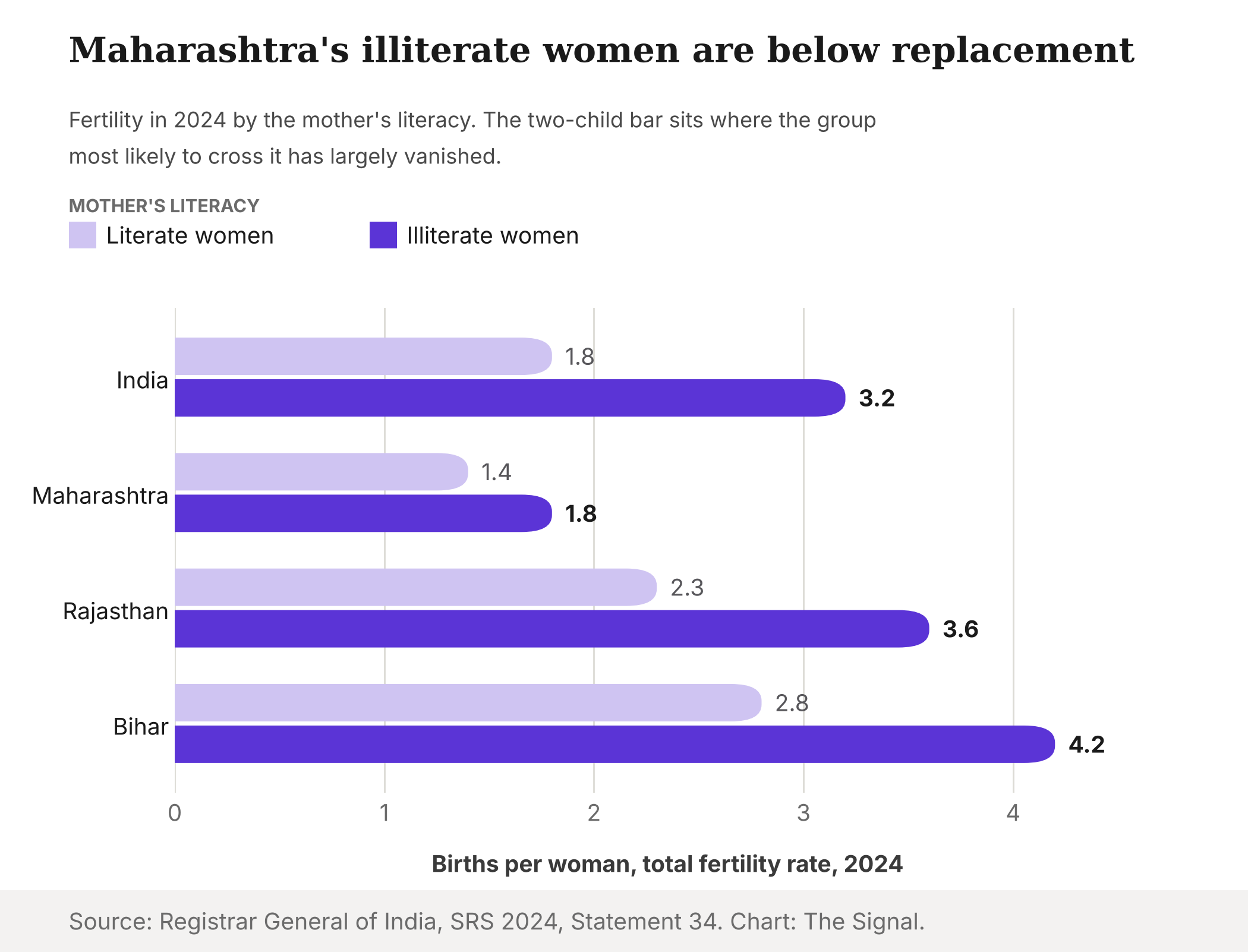
In the state at the centre of this case, Maharashtra's illiterate women averaged 1.8 children and its literate women 1.4. Even Maharashtra's highest-fertility group is below replacement, and it matches the national figure for literate women. Compare Bihar, where illiterate women averaged 4.2, more than twice the Maharashtra figure.
So the people a two-child bar can still catch in Maharashtra are a thin slice, and by the numbers they are disproportionately the least schooled. A rule justified as population policy has become, in effect, a rule that bars a shrinking group from local office. The court put the cost in constitutional terms: such laws exclude "an entire class of citizens from political representation" and force "an unconscionable choice between bearing children and democratic participation".
The honest objection
The strongest case for the laws runs the other way. Fertility in the six above-replacement states was still 2.2 to 2.9 in 2024. An average of 1.4 in Maharashtra tells you nothing about the third births that do occur, and a rule can matter at the margin even when the mean has fallen. Fertility also reflects choices people make for reasons unrelated to a candidacy bar, so the falling rate cannot be credited to these laws or blamed on them.
All of that is fair, and none of it rescues the rule as population policy. If the target is high fertility, the targeting is backwards: the penalty sits mostly in low-fertility states. And the high-fertility states are not free of such rules. In February 2024 the Supreme Court upheld a Rajasthan rule barring government appointment for candidates with more than two children after 1 June 2002, relying on the 2003 Javed ruling. In Rajasthan the penalty is attached to jobs rather than elections.
There is also a limit on what the court did. It referred the 2003 Javed v State of Haryana judgment, which upheld the Haryana rule, to a larger bench. Until that bench rules, Javed is still the precedent behind the Rajasthan decision and the other states' laws.
The Signal
The court framed this as a question about time: the country changed and the law did not. The data adds a question about place. Five of the six states that keep a third-child penalty are already below replacement, and the six states that are above it are mostly not where the penalty lives.
Watch two things. The first is the larger bench: if it overturns Javed, the Rajasthan-style job rules lose the precedent the 2024 ruling relied on, along with the election bars. The second is whether the states repeal on their own. Seven already have. A rule that no longer touches the average family tends to end up touching the family with the least schooling and the least say.
Reporting basis: fertility rates by state, residence and literacy are from the Registrar General of India's Sample Registration System Statistical Report 2024, which is the primary source verified for those figures and is rounded to one decimal place. The 2003 and 2024 national comparison is from the World Bank's fertility series, an independent origin. The Supreme Court's 4 November 2026 judgment is reported by LiveLaw and Bar & Bench, which are two outlets relaying one origin, the judgment itself, which was not read directly; the list of states with the norm comes from the amicus compilation as reported by LiveLaw and rests on that single secondary account. The February 2024 Rajasthan ruling is per LiveLaw's report. The fall of more than a third since 2003 and the Maharashtra-to-Bihar comparison are The Signal's calculations from those figures.