India has spent the autumn doing something it usually avoids: putting its name to a concrete plan inside the Russia-Ukraine war. On 31 October 2026, External Affairs Minister S Jaishankar described three pieces India is working on with Russia, Ukraine and Europe: not attacking civilian shipping, restoring grain exports from both Russia and Ukraine, and a non-attack on energy. The coverage has filed this under Global South diplomacy, a large democracy lending its weight to keep Ukrainian wheat moving to Africa and West Asia.
That reading is not wrong. It is incomplete, and the missing part sits in Indian kitchens.
Look at the shape of the proposal. Ukrainian President Volodymyr Zelenskyy, describing the plan India drafted with Turkey and Egypt, put it this way to Bloomberg: "One ship heading to our port, and the other to Russian and we accept agreements not to strike either of these vessels". The plan protects Russian ports as much as Ukrainian ones. For India, that is the half that matters more, because Russia, not Ukraine, is where most of its sunflower oil comes from.
India grows almost none of the sunflower oil it eats
Start with the dependence. India produced 36 thousand tonnes of sunflower oil in 2024/25 and imported 2,905 thousand tonnes, according to the US Department of Agriculture's New Delhi post. Domestic output covers roughly 1 percent of supply. Across all cooking oils, the same report says India will rely on imports for about two-thirds of its vegetable oil needs. Sunflower oil is the extreme case of a general exposure.
Then look at where the imports come from. UkrAgroConsult, a Kyiv-based agricultural consultancy, reports that India's sunflower oil imports held at 2.91 million tons in marketing year 2025/26, with shipments from Russia slipping from 1.54 million tons to 1.46 million tons and imports from Ukraine falling from 725 thousand tons to 443 thousand tons.
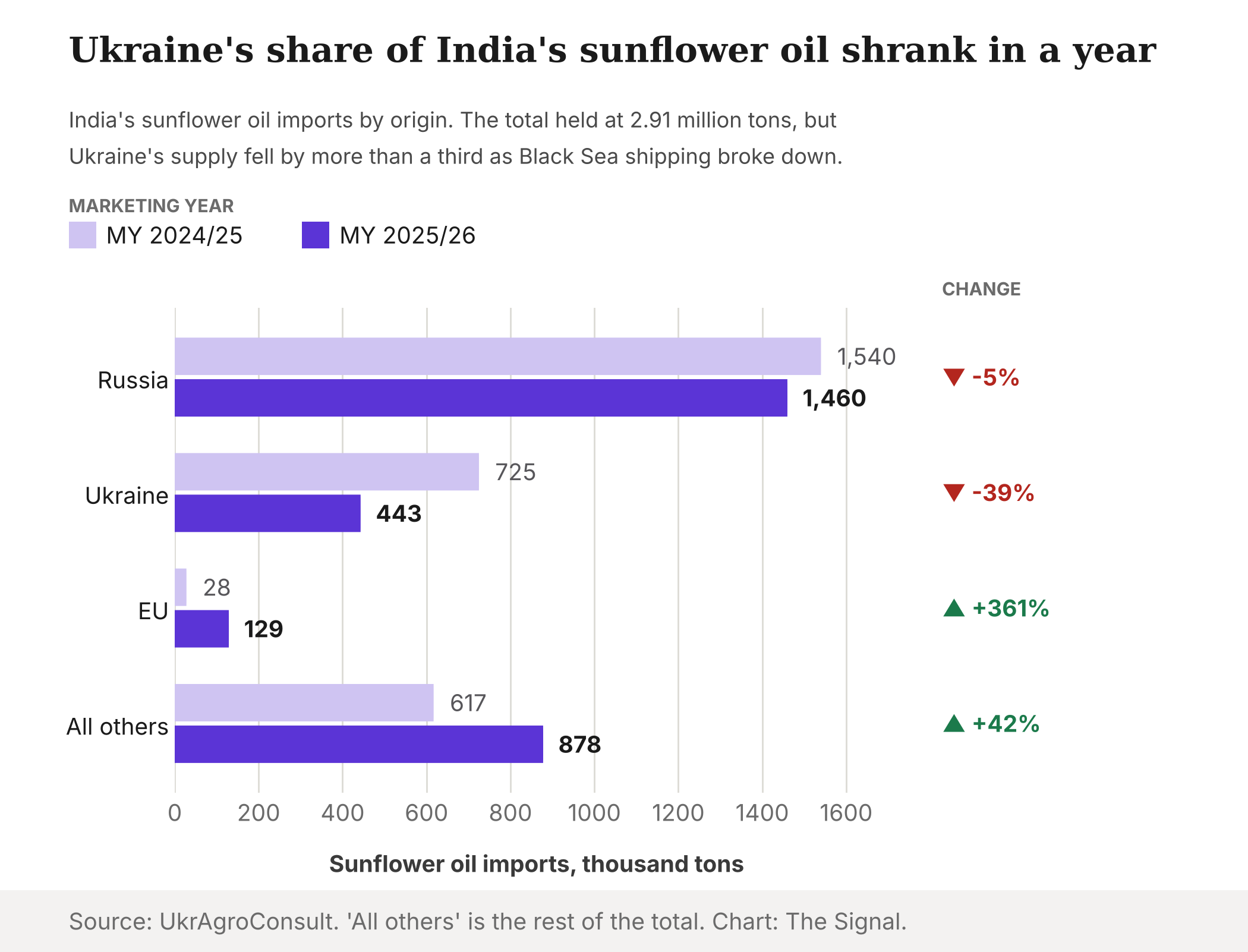
Between 2024/25 and 2025/26, the two warring countries together went from about 78 percent of India's sunflower oil to about 65 percent. Ukraine's own share dropped from roughly a quarter to roughly 15 percent. Russia's held near half. The EU expanded shipments from 28 thousand tons to 129 thousand tons, but that is a tenth of what Russia sends.
The Black Sea closed for Russia too
The common assumption is that Black Sea disruption hurts Ukraine and spares Russia. For vegetable oil, the evidence points the other way in 2026. UkrAgroConsult reports that more than half of Russia's vegetable oil exports had previously been shipped through the Azov and Black Sea ports. Rosstat data, as reported by UkrAgroConsult, show Russia's sunflower oil production fell by almost a third year-on-year in August 2026 to 0.3 million tons, with the main reason the effective halt of vegetable oil exports through the Azov-Black Sea basin.
Ukraine's ports are in worse shape. Zelenskyy says the country can export only 38% of its regular volumes, with shipments halted since August. But Ukraine supplies a much smaller slice of India's oil. When both sides' ports seize up, the bigger hole opens on the Russian side of India's ledger.
September 2026 shows it. UkrAgroConsult puts India's sunflower oil purchases at 109 thousand tons in September 2026 against 252 thousand tons a year earlier, with Ukraine and Russia each supplying 42 thousand tons and the EU 21 thousand tons. Industry data from the Solvent Extractors' Association, as reported by PTI, tell the same story for crude oil: crude sunflower oil imports plunged to nearly 1.05 lakh tonnes in September from 2.72 lakh tonnes a year earlier.
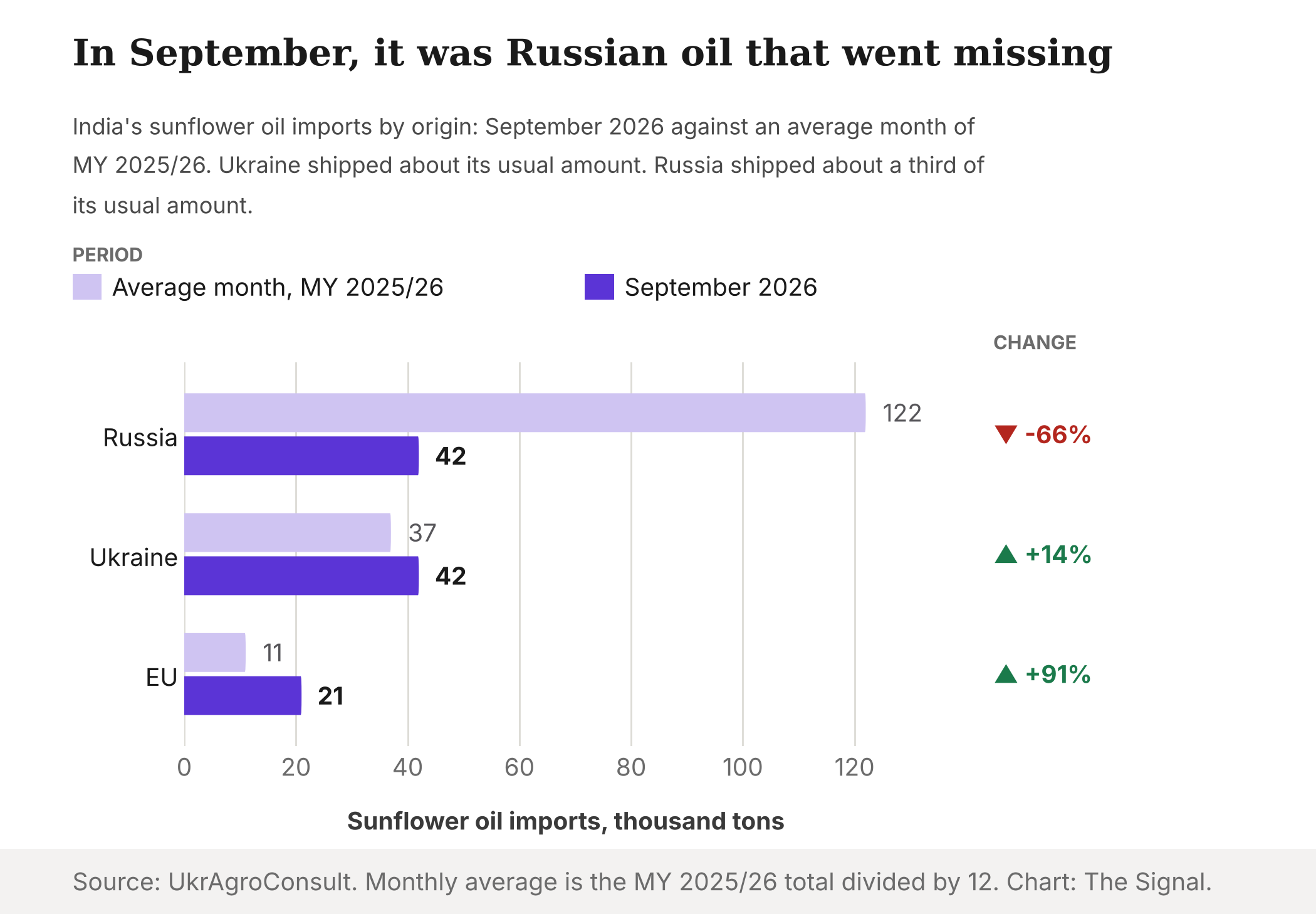
Divide Russia's 1.46 million tons for 2025/26 by twelve and an average month is about 122 thousand tons. September's 42 thousand tons is about a third of that. Ukraine's 42 thousand tons was slightly above its own monthly average.
New Delhi's other lever was the tariff
India reached for the domestic tool first. On 24 September 2026 the government cut the basic customs duty on crude sunflower oil from 10% to nil, while crude soybean and palm oil went from 10% to 5%. Sunflower oil got the deepest cut of the three. That is the revealed preference: the oil most exposed to the Black Sea got the most help at the border.
The cut coincided with a rebound. Dealers' estimates compiled by Reuters show that in October 2026, sunflower oil shipments doubled from the previous month's more than four-year low to 223,000 tons. A duty cut makes oil cheaper to land. It cannot move a tanker that will not load. October's recovery depended on cargoes finding a way out, and the corridor India is drafting is the plan for keeping that way open.
The stakes are not only commercial. Attacks on merchant ships in the Black Sea left at least five Indian seafarers dead, and Jaishankar called such attacks by any party absolutely unacceptable. "Any party" is the operative phrase. India needs both navies to hold fire, because its oil and its crews sail to both coasts.
The honest objection
The strongest case against this reading is that Russian oil is finding other routes, so India's stake in the Black Sea is smaller than September suggests. It has some evidence behind it. Industry executives quoted by S&P Global Commodity Insights expect Russia to ship 150,000-170,000 mt of sunflower oil through Baltic ports, with rail exports to China at 50,000-70,000 mt a month. The same executives forecast Russian shipments to India of 2 million-2.5 million mt in MY 2026-27, which would be more than in 2025/26.
That case is real, and it shows Russian supply is adaptable. But the forecast is a bet on routes that are not yet carrying that load. A Baltic outlet of 150,000-170,000 mt is a small fraction of a 2 million ton India trade. It also does not change the arithmetic of September 2026, when India received a third of its usual Russian oil. The forecast measures how much Russia wants to sell to India; how much arrives on time still depends on the Black Sea.
There is a second objection: that India's plan is mostly about standing, not supply. Russia has rejected the proposal and no agreement has yet been reached. If the plan fails, India still earns credit as a broker trusted by both sides. That is true, and the two motives do not compete. A plan that protects ships bound for Russian ports is the rare diplomatic move whose credit and payoff point the same way.
The Signal
India's Black Sea diplomacy reads as altruism toward Ukraine. Its design reads as insurance on Russia. The proposal guards ships calling at both coasts. Jaishankar's version restores grain from both countries. The duty cut favoured the oil that crosses that sea. All three point at a supply line where Russia supplies half of India's sunflower oil and India grows about one percent of what it uses.
Watch two things. First, whether India's November and December sunflower oil arrivals from Russia return toward 120 thousand tons a month, against 42 thousand tons in September, without a corridor. If they do, the Baltic and rail routes are working, and India's stake shrinks. Second, whether Moscow's rejection softens on the half of the plan that protects its own ports. India's cooking oil runs through the Black Sea, and most of it starts on the Russian shore.
Reporting basis: India's sunflower oil imports by origin for marketing years 2024/25 and 2025/26, and for September 2026, are per UkrAgroConsult, a Kyiv-based market consultancy, and rest on that single compiler. The September crude sunflower oil figure is Solvent Extractors' Association of India data as reported by PTI in the Free Press Journal. The October volume is a dealers' estimate compiled by Reuters, as carried by The Edge Malaysia, not official data. The duty cut is from the consumer affairs ministry's release via the Press Information Bureau. India's sunflower oil production and its two-thirds import reliance are from the USDA Foreign Agricultural Service's New Delhi annual report. The share of Russia's vegetable oil exports moving through Azov and Black Sea ports is per UkrAgroConsult, and the August production fall is Rosstat data as reported by UkrAgroConsult. The Baltic, rail and 2026-27 forecasts are industry executives' estimates reported by S&P Global Commodity Insights via Hellenic Shipping News. Zelenskyy's description of the plan is from his Bloomberg interview as reported by Business Today, Russia's rejection is per Global Agriculture, Jaishankar's three-part plan is from PTI as carried by Telangana Today, and the seafarer deaths and his statement are per The Wire. The origin shares, Russia's and Ukraine's monthly averages, and India's domestic share of sunflower oil supply are The Signal's calculations from those figures.