On October 20, Delhi's Chief Minister laid out the city's winter pollution plan. Vehicles coming from outside Delhi that do not comply with BS-VI emission standards would be barred from entering the national capital from November 1 to January 31, The Hans India reported. The rule starts in six days. The reading most people will take from it is simple: Delhi's smog comes from tailpipes, so keep the dirtiest tailpipes out.
That reading is partly right. It is also much smaller than it sounds.
A ladder, not a single rule
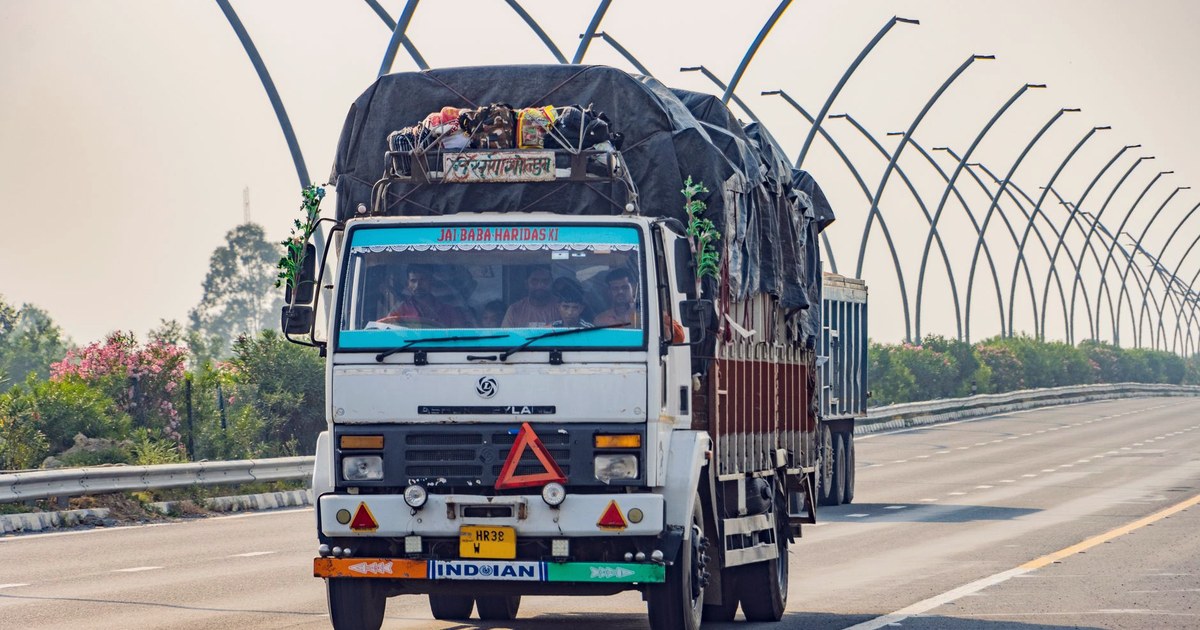
The November 1 restriction is the latest step in a ratchet. A year ago, all commercial goods vehicles registered outside Delhi and not compliant with BS-VI norms were prohibited from entering the capital, with one carve-out. BS-IV commercial goods vehicles were allowed in until October 31, 2026, as a transitional measure, according to a Delhi Transport Department notice. That window closes on Saturday.
Buses are next on the same calendar. The Commission for Air Quality Management (CAQM), the statutory regulator for the region, mandated that buses entering Delhi, including those on All India Tourist Permits, run on BS-VI diesel, CNG or electricity from November 1, 2026, according to a Press Information Bureau release. Delhi-registered buses are exempt.
And the emergency tier already exists. CAQM's revised pollution-response schedule, dated September 29, 2026, lists a bar on entry for outside-registered goods vehicles at the Stage III level, which is triggered when Delhi's air quality index reaches 401 to 450. The direction tells the Delhi government "to not permit diesel operated BS-IV and below standard MGVs, registered outside Delhi, to enter Delhi". MGV stands for medium goods vehicle.
One caveat on scope. The October 20 report does not say whether private cars are covered, and the official notice for the new rule was not among the documents verified for this piece. The goods-vehicle and bus rules above are documented. The wider one is, for now, a reported announcement.
What transport actually supplies
The most-cited measurement of who produces Delhi's fine particles is the ARAI and TERI source apportionment, published in August 2018. In its dispersion modelling, transport accounted for about 28 percent of Delhi's PM2.5 in winter and about 17 percent in summer. PM2.5 means particles finer than 2.5 micrometres, the kind that reach deep into the lungs.
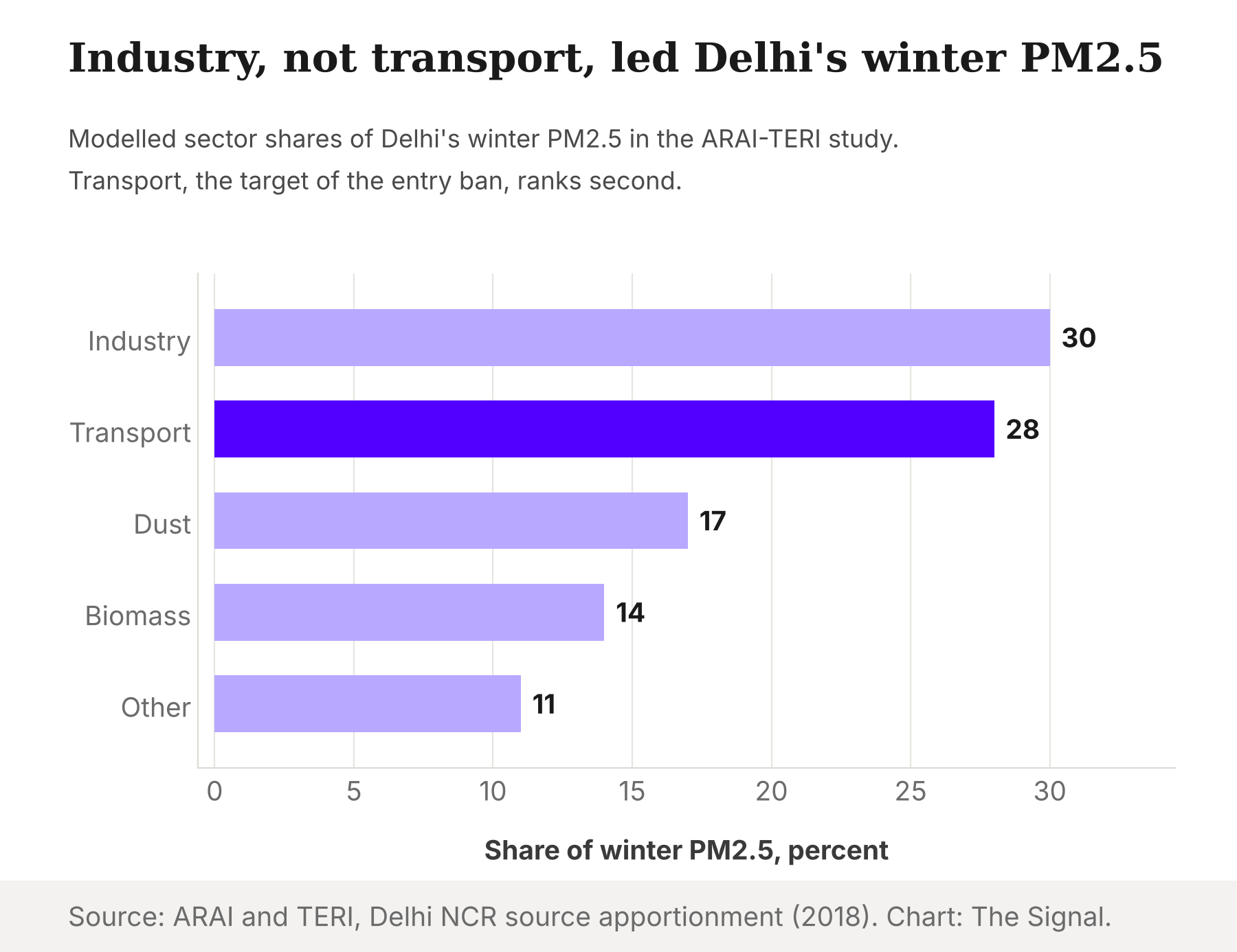
In the same study, industry contributed 30 percent in winter, dust 17 percent, biomass burning 14 percent and other sources 11 percent. So transport is a large winter source, the second largest in that model, 2 points behind industry. It is not the dominant one.
The seasonal swing is where the policy logic shows. Transport's share rises 11 points from summer to winter, about 1.6 times its summer level, while dust, which held 38 percent in summer, falls to 17 percent.
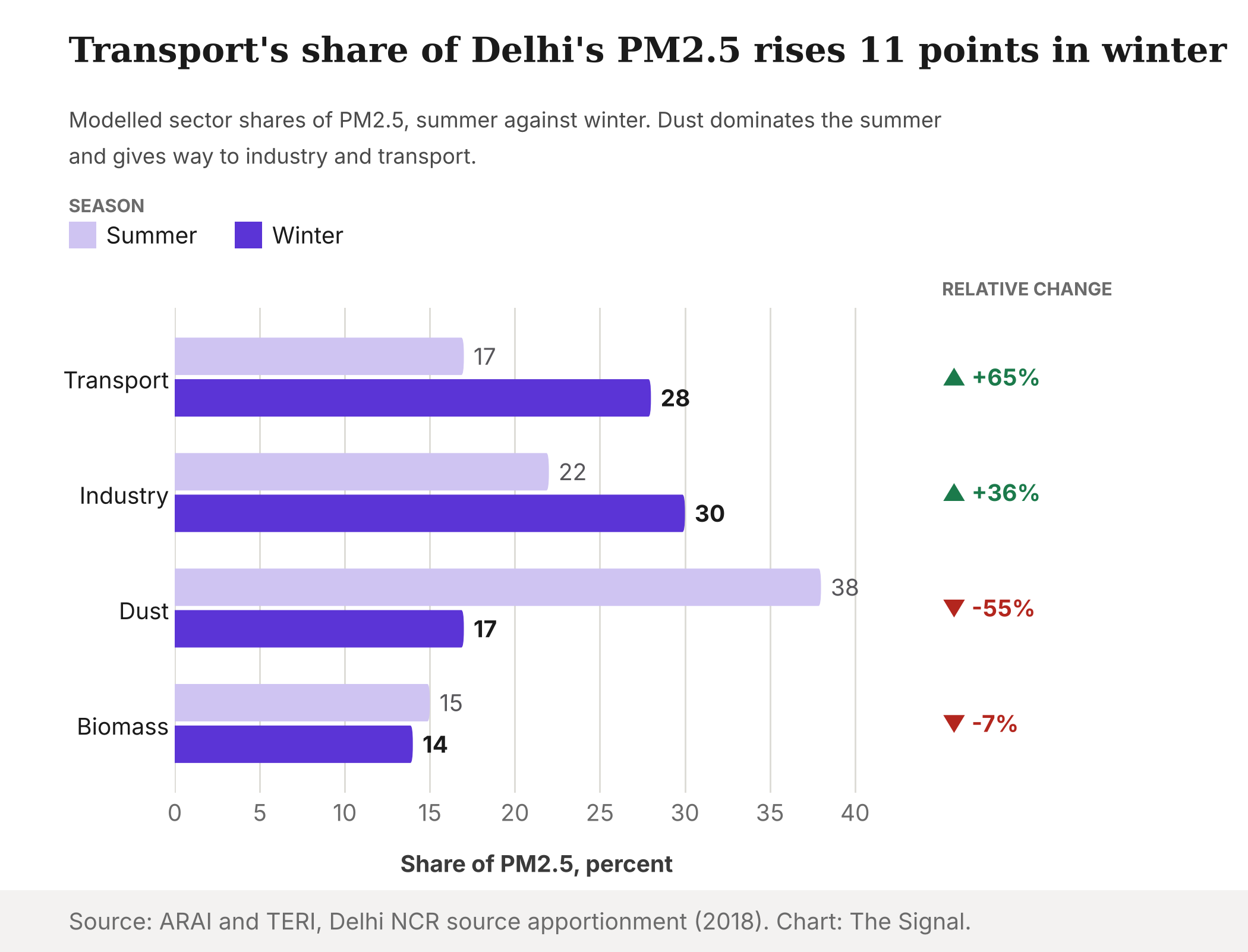
That is the strongest case for acting on vehicles in winter. The sector's share is at its annual peak just when the plan starts.
The part an entry ban cannot reach
Now narrow the lens. The ban covers vehicles registered outside Delhi that fail BS-VI. It does not touch Delhi-registered vehicles, BS-VI vehicles, or anything already on the road inside the city. None of the sources checked for this piece splits transport emissions by where a vehicle is registered, so the size of the targeted slice cannot be stated. It is some fraction of the 28 percent transport share, and a smaller fraction of the whole.
Then there is the air itself. A Scientific Reports study of the Indo-Gangetic Basin, published in March 2026, used trajectory analysis to trace where winter pollution arrives from. It found that north-westerly transport contributes 55 to 65 percent of wintertime PM2.5 in Delhi, Kanpur and Lucknow. The ARAI and TERI study points the same way qualitatively, noting that contributions from sources outside Delhi are likely due to winds carrying pollution with the incoming air.
These two numbers measure different things, so they cannot be added or subtracted. One splits Delhi's particles by the kind of source. The other splits them by the direction the air came from. A truck's exhaust inside the city counts as transport in the first and may count as local or regional in the second. What the pair does show is scale: the share of winter smog that arrives on the wind is larger than the share any single sector, including transport, supplies.
The honest objection
The strongest defence of the ban is that tailpipe emissions are the one source a city can switch off at a checkpoint, as its own rules for goods vehicles already do. Farm fires and regional industry sit outside Delhi's jurisdiction. A ban on dirty outside vehicles is enforceable, visible, and aimed at the oldest part of the fleet, where emissions per vehicle are worst. Averages hide that. A rule that removes the dirtiest 5 percent of vehicles can cut more than 5 percent of the sector's emissions.
There is a second point in its favour. The ARAI and TERI study draws on measurements and inventories from before the current BS-VI fleet, and it is eight years old. The vehicle mix has changed, so the 28 percent is a snapshot of an older fleet and a rule written for BS-VI can fairly claim to be aimed at a moving target.
Both points are fair. Neither changes the arithmetic of the ceiling. Even a perfect ban on outside non-BS-VI vehicles can remove only part of one sector's share.
The Signal
Delhi's rules keep escalating at the border because the border is where a government can enforce something. The Chief Minister's announcement, the goods-vehicle ban, the bus mandate and the emergency schedule all act on vehicles at a gate. The plume that settles over the city in December is not stopped by a gate.
Watch two things from November 1. First, whether the official notice defines the rule as goods vehicles only or all non-BS-VI vehicles, since that decides how many drivers it reaches. Second, whether winter readings improve relative to last year on days when the wind is the same. If they do not, the ban was a border rule for a regional problem. A checkpoint can count the trucks. It cannot count the wind.
Reporting basis: the November 1 entry rule and its dates are per the Delhi government's announcement of October 20, 2026 as reported by The Hans India, and the October 31, 2026 BS-IV window is per a Delhi Transport Department notice as reported by The Tribune; neither rests on the notice text itself, which was not verified. The bus mandate is from CAQM, via a PIB release, and the Stage III provision is from CAQM's Direction No. 104, read directly. Sector shares are from the ARAI and TERI executive summary (August 2018), based on 2016 to 2017 modelling and monitoring, and the wind-transport range is from a single Scientific Reports study (March 2026). The 11-point seasonal rise and the 1.6 times figure are The Signal's calculations from those figures.