
The story most outlets are running this autumn is one of redirection. The Global Enrolment Benchmark Survey by NAFSA, Oxford Test of English and Studyportals reports that half of the 254 universities it polled across 36 countries saw fewer new international students in the January to March 2026 intake. The US, UK, Canada and Australia were hit hardest, while European and Asia-Pacific countries other than Australia reported growth. Times Higher Education, reporting the same survey, says the US took the biggest hit, with postgraduate enrolments down 24 percent on average. Germany supplies the poster child. The PIE News, citing figures highlighted by DAAD India, reports that Indian enrolments at German universities rose 17.5 percent to a record 69,816 in winter semester 2025/26. The tidy conclusion: the Anglosphere closed a door and Indian students walked through another.
It is worth slowing down on that. Rerouting has a testable signature: the total number of Indians leaving to study should hold roughly steady while the destinations shuffle. India's own exit count does not show that.
The count that settles it
Times Higher Education, reporting the Education Ministry's Rajya Sabha reply based on Bureau of Immigration data, says that about 908,000 Indians went abroad to study in 2023, 770,000 in 2024 and just over 626,000 in 2025. That is roughly 282,000 fewer departures in two years, a fall of about 31 percent.
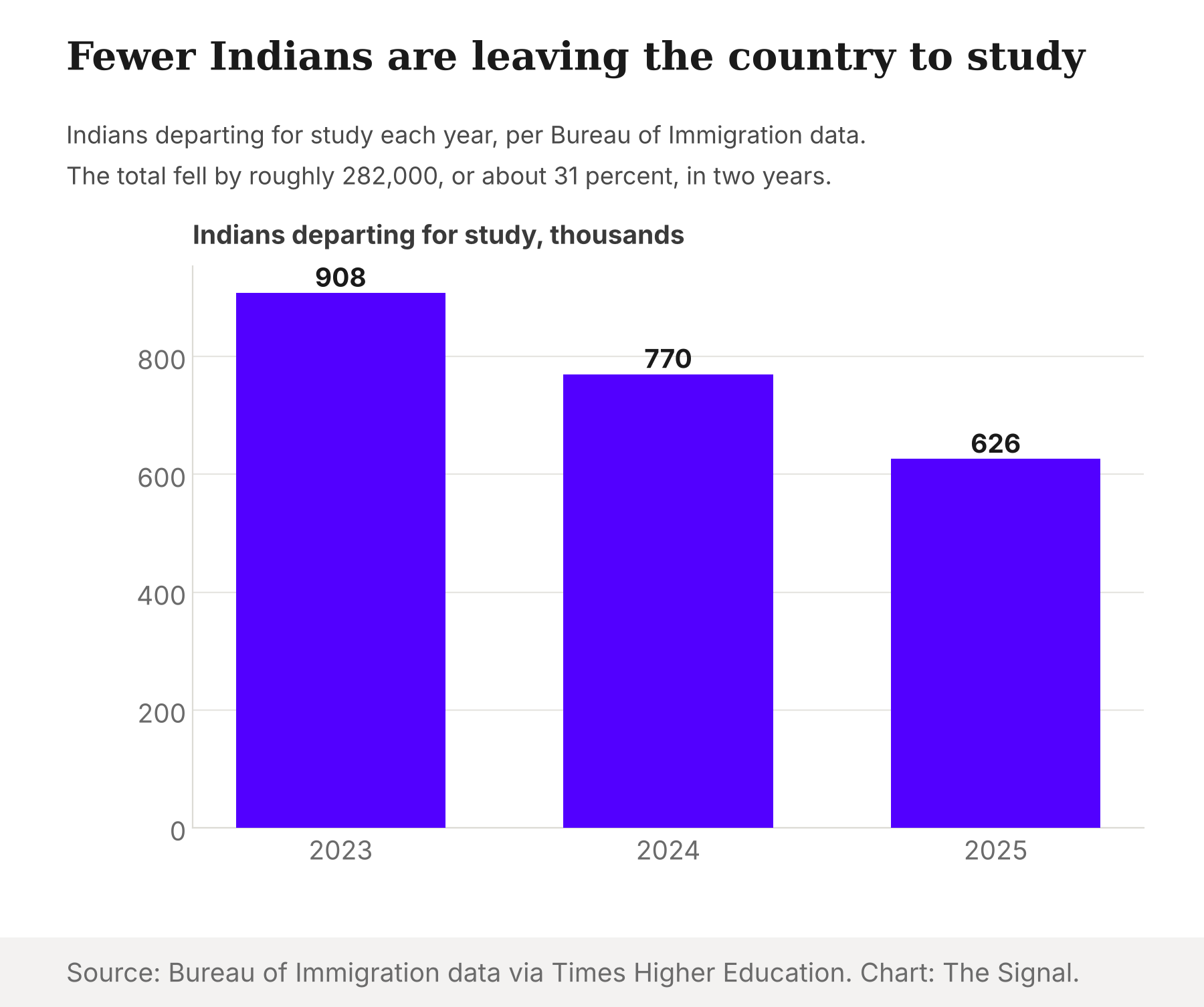
This number beats any destination's tally because it does not care where a student lands. A student who swapped Texas for Berlin still leaves India and still counts, so the drop is already net of every rerouting. Whatever moved to Europe or Asia, the outbound total in 2025 was still about 144,000 below its 2024 level, on the Bureau of Immigration figures relayed by Times Higher Education.
A second, separate count points the same way. ICEF Monitor, reporting Ministry of External Affairs data, says the number of Indian students enrolled abroad fell from about 1.33 million in 2024 to a little over 1.2 million in 2025, 5.7 percent fewer. That is a stock of everyone already studying overseas, so it moves more slowly than departures, but it is falling too.
Germany is real, and small
None of this makes Germany's gain imaginary. The DAAD's Wissenschaft weltoffen release (with DZHW) reports that India became Germany's largest country of origin in winter semester 2024/25, with just under 59,000 students, up 20 percent in a year and well ahead of China's roughly 38,600. The PIE News puts the 2025/26 figure at 69,816, almost 10,400 more in one year.
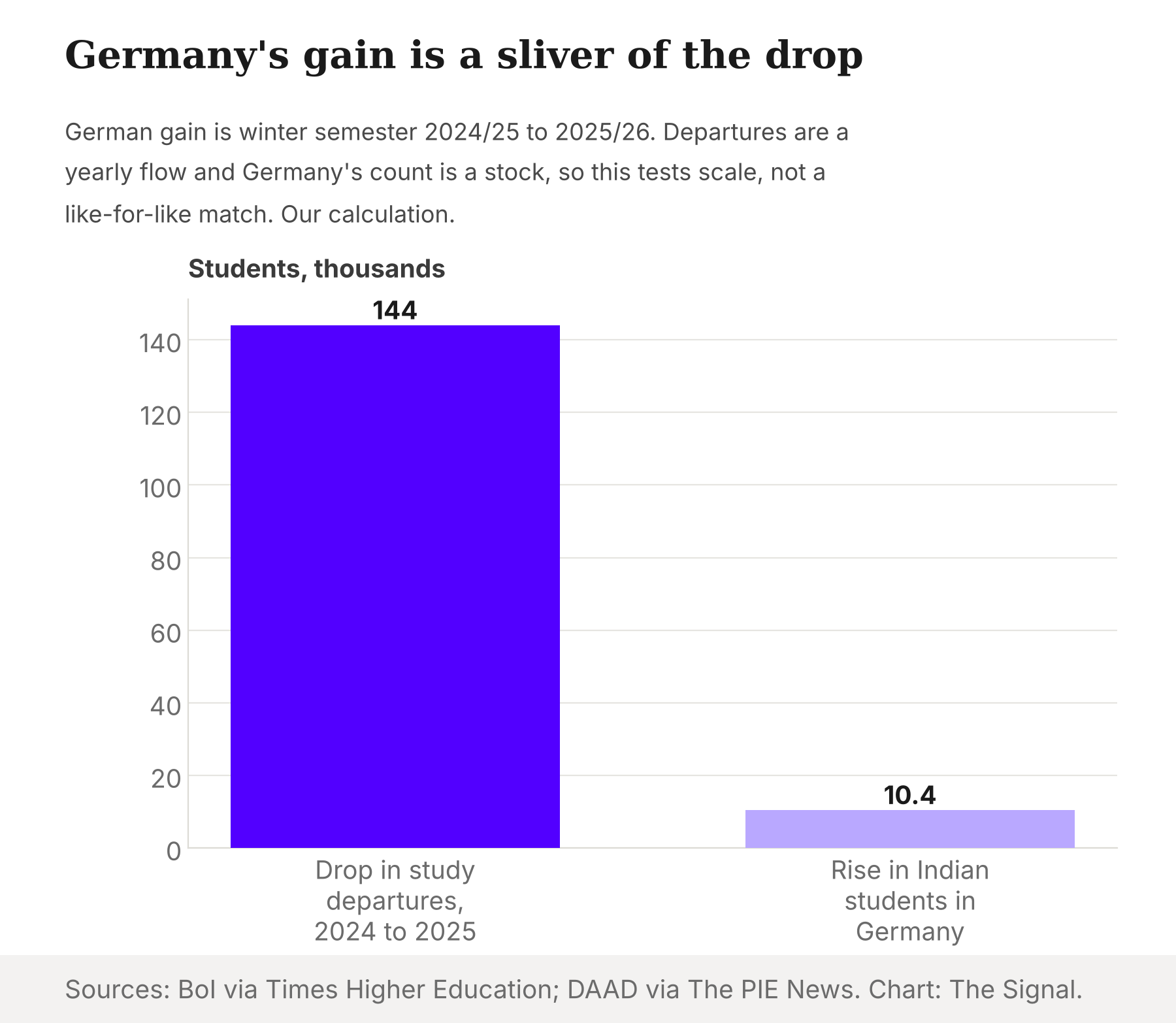
Now set that beside the exit count. Germany added about 10,400 Indian students between winter semesters 2024/25 and 2025/26, while India's study departures fell by about 144,000 from 2024 to 2025. The German gain is about 7 percent of that drop. Departures are a yearly flow and Germany's figure is a stock of everyone enrolled, so this tests scale, not a like-for-like match. The gap is too wide for that caveat to close.
Where the drop shows up
The Anglosphere numbers almost all point the same way, though each measures something different.
Nearly every Anglosphere indicator for Indian students points down; Germany is the clear riser, and Australian new grants the one small uptick.
| Indicator | Period | Change |
|---|---|---|
| US student visas issued to Indians | 2025 vs 2024 | -57% |
| Common App first-year applicants from India | 2026-27 cycle, to March 1, 2026 | -14% |
| Indian students in the US (SEVIS count) | Feb 2026 vs Feb 2025 | -6.9% |
| UK sponsored study visas granted to Indians | Year ending June 2026 | -16% |
| Canadian study permits held by Indians | 2025 vs 2024 | -50% |
| Indian student visa holders in Australia | Dec 31, 2025 vs Dec 31, 2024 | -13.5% |
| Australian student visas granted to Indians | Jul-Dec 2025 vs Jul-Dec 2024 | +5.3% |
| Indian students at German universities | Winter semester 2025/26 | +17.5% |
Sources: ICEF Monitor on State Department data; Common App; Deccan Chronicle on a Rajya Sabha reply; UK Home Office; IRCC annual reports for 2024 and 2025; Australian Department of Home Affairs; The PIE News.
The US is the sharpest case. The Open Doors 2025 report shows India was the largest source of international students in America in 2024/25, with 363,019 students, up 10 percent. Then the pipeline broke. ICEF Monitor's analysis of State Department data shows US student visas issued to Indians fell 57 percent in 2025, against a 23 percent fall in new F, M and J student visas overall. Indians lost visas at more than twice the overall rate.
The stock has barely moved by comparison. Deccan Chronicle, reporting a written reply by Minister of State Kirti Vardhan Singh in the Rajya Sabha, says Indian students in the US fell from 378,787 in February 2025 to 352,644 in February 2026, down about 6.9 percent. That gap between a 57 percent visa fall and a 6.9 percent stock fall is a lag, not a recovery: students already enrolled stay until they graduate, while the new cohorts behind them are thinner.
The 2026 signals say the thinning continues. Common App's March 2026 deadline update shows first-year applicants from India down 14 percent for the 2026-27 cycle. ICEF Monitor, reporting IIE's Spring 2026 Snapshot survey, says 61 percent of 585 responding US institutions reported declining application volumes from India.
Britain shows a milder version. UK Home Office immigration statistics show 82,523 sponsored study visas granted to Indian main applicants in the year ending June 2026, down 16 percent, against an 11 percent fall for all nationalities. The freshest UK series, Home Office monthly entry clearance statistics, shows sponsored study applications from all nationalities at 349,900 in the year ending October 2026, 20 percent lower than a year earlier.
Canada has fallen furthest. IRCC's 2025 Annual Report to Parliament shows 188,465 Indians holding Canadian study permits in 2024, 36.5 percent of the total. Its 2026 report shows 94,025 Indians with a study permit in effect in 2025, including extensions, still the largest group at 24.6 percent. The two reports word the measure slightly differently, but the Indian count roughly halved between 2024 and 2025.
Australia is the mixed case, and the only Anglosphere data here that ticks up. The Department of Home Affairs' December 2025 student visa report shows 23,665 student visas granted to Indians from July to December 2025, up 5.3 percent on the same months of 2024. The same report shows Indian student visa holders in Australia down 13.5 percent, from 102,093 at the end of 2024 to 88,306 at the end of 2025. A small rise in new grants has not stopped the overall Indian student population there from shrinking.
The money cannot answer the question yet
The obvious cross-check is rupees: if families kept paying for foreign degrees, demand had moved rather than vanished. The RBI data looks at first as if it gives a clean answer. RBI Bulletin data from May 2026 show Liberalised Remittance Scheme (LRS) outflows under "Studies Abroad" of $2,918.91 million in 2024-25. The October 2026 Bulletin shows that line fell to $2,309.74 million in 2025-26, about 21 percent lower, and to $191.84 million in August 2026 from $319.17 million in August 2025.
That fall cannot be read as shrinking spending. The July 2026 Bulletin shows that from March 2026 the RBI reports a separate "Travel for education" line, covering fees and hostel costs for students who travel abroad, and now defines "Studies Abroad" as education taken remotely without travelling. March 2026 sits inside 2025-26, so even the annual comparison straddles the change. In July 2026, per the September Bulletin, Travel for education was $665.76 million against $148.54 million for Studies Abroad, about four and a half times larger.
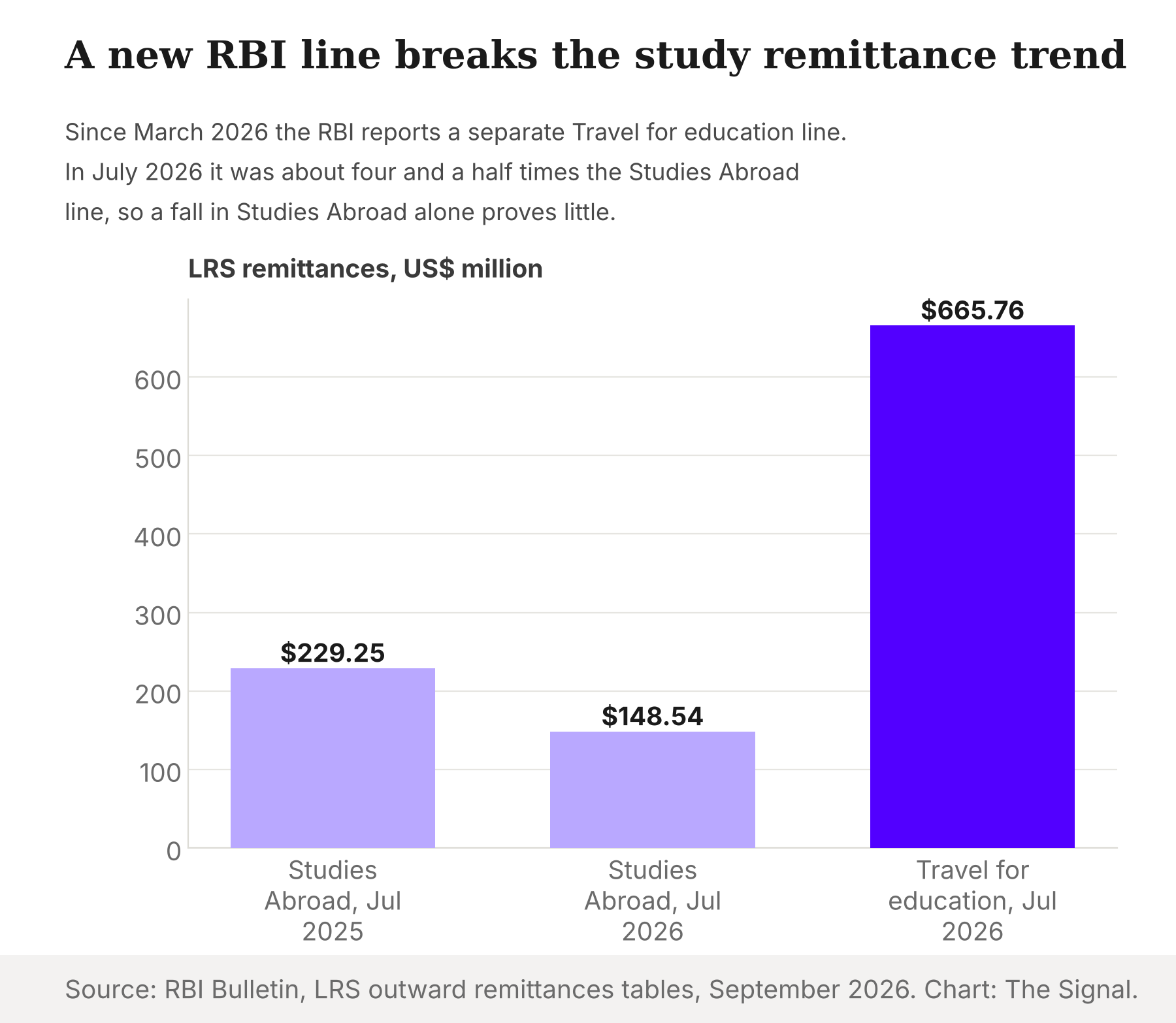
The remittance series has a break in it. Neither "education outflows shrank" nor "they held up" follows from RBI data alone until the new line has a year of history to compare against itself.
The honest objection
The strongest case for rerouting runs like this. The global survey itself found growth outside the big four, and Germany is only one of many non-Anglo destinations. France is growing too: ICEF Monitor reports Indian enrolments at French universities up 17 percent to 9,100 in 2024/25. Ireland, the Gulf and East Asia are absent from this data. Spending on education abroad, once the new RBI line is counted, is clearly large. And any exit count could miss students who leave on other papers.
That case is right that Germany is not the whole map. But it cannot get around the departures total. Every student who went to Paris or Seoul instead of Boston is inside the Bureau of Immigration count reported by Times Higher Education, and that count still fell by about 144,000 between 2024 and 2025. Rerouting happened at the margin. It did not replace the students who stopped leaving.
The Signal
Some Indian demand did move, and Germany is the clearest beneficiary. But the headline effect is subtraction. India sent about 282,000 fewer students abroad in 2025 than in 2023, on Bureau of Immigration data via Times Higher Education, and the leading 2026 indicators in the US and UK still point down. Two numbers will decide whether this is a pause or a reset: the Bureau of Immigration's 2026 departures count, and a full year of RBI's Travel for education line, which becomes comparable with itself from March 2027. Until then, anyone claiming the money simply moved is reading a broken series. The students who did not leave are the story the rerouting narrative misses.
Reporting basis: the departures series is Bureau of Immigration data from the Education Ministry's Rajya Sabha reply, as reported by Times Higher Education, and rests on that single relay. The global enrolment survey is per the NAFSA, Oxford Test of English and Studyportals release, with the US postgraduate figure as reported by Times Higher Education. US figures come from three separate origins: the IIE and State Department's Open Doors report, State Department visa data as analysed by ICEF Monitor, and the SEVIS count in a Rajya Sabha reply as reported by Deccan Chronicle; IIE's Spring 2026 Snapshot is per ICEF Monitor, and application counts are from Common App. UK figures are from the Home Office. Canadian figures are from IRCC's 2025 and 2026 Annual Reports to Parliament, and Australian figures from the Department of Home Affairs. The total of Indian students abroad is Ministry of External Affairs data and the French enrolment figure is as reported by ICEF Monitor. German figures are from the DAAD and DZHW for 2024/25 and from DAAD India via The PIE News for 2025/26. Remittance figures are from RBI Bulletin LRS tables. The two-year and one-year changes in departures, the roughly 50 percent fall in Canadian permits, the 21 percent annual fall in Studies Abroad remittances, Germany's share of the one-year drop, and the ratio of the two RBI education lines are The Signal's calculations from those figures.