
The headline that travelled fastest from Pew Research Center's new religion projections was global. Pew projects that Muslims will outnumber Christians worldwide by 2035. In India, the coverage narrowed to one line: Hindus will grow more slowly than other groups, and Muslims will rise as a share of the country. Both readings are accurate. Both miss where the projection's real weight sits.
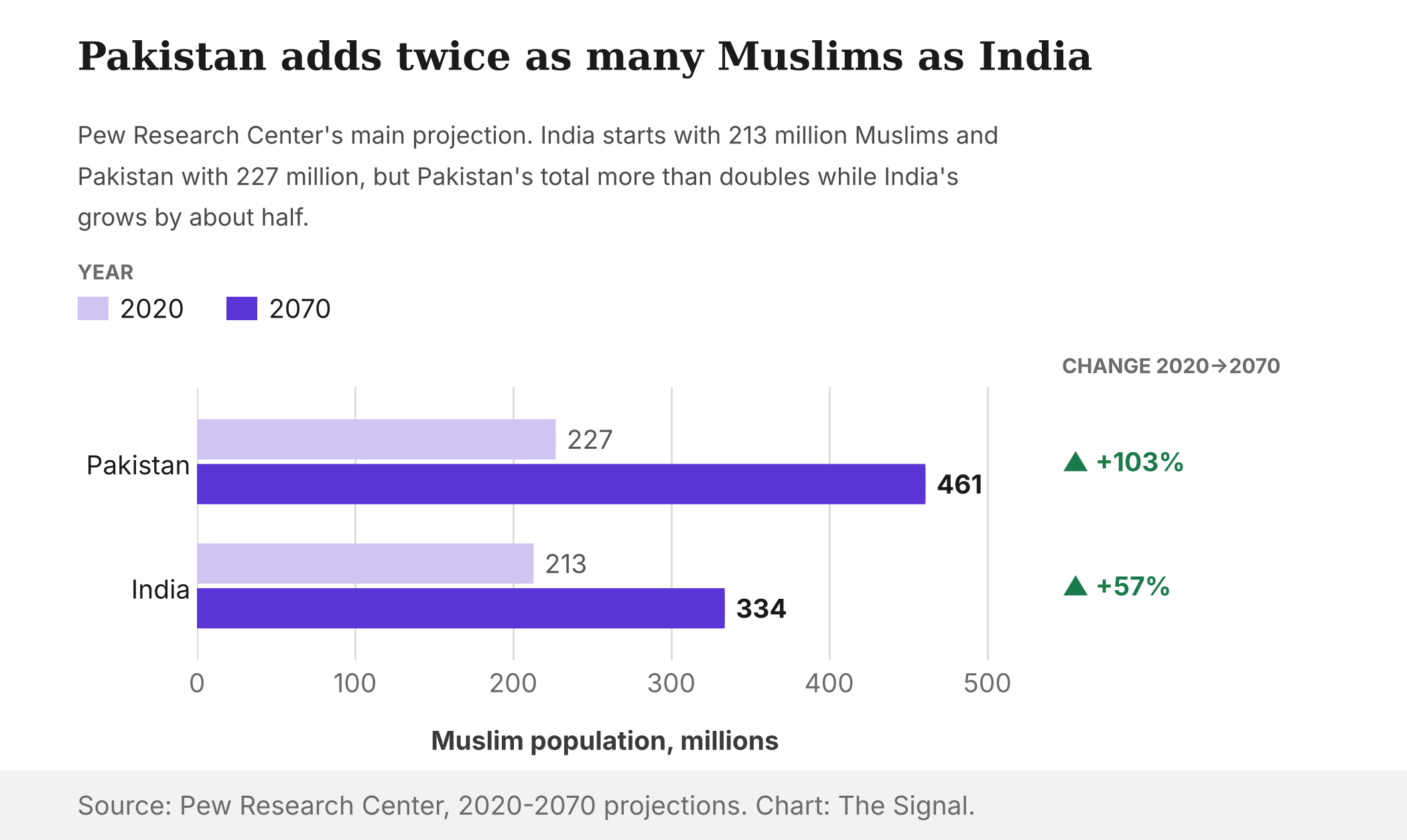
Look at South Asia as a whole and the largest Muslim growth is not in India. Pew projects Pakistan's Muslim population will reach 461 million by 2070, overtaking Indonesia as the largest in the world. Pakistan started from 227 million in 2020, and India from 213 million, with India reaching 334 million by 2070. Two countries began within 14 million of each other. Over fifty years, Pakistan adds about 234 million Muslims and India about 121 million. That is nearly twice as many, from a starting base only slightly larger.
The gap India argues about has been closing for thirty years
Pew's own explanation for India's shift is a fertility gap plus Muslims' younger age profile. The gap is real. Its size is the part the debate tends to skip.
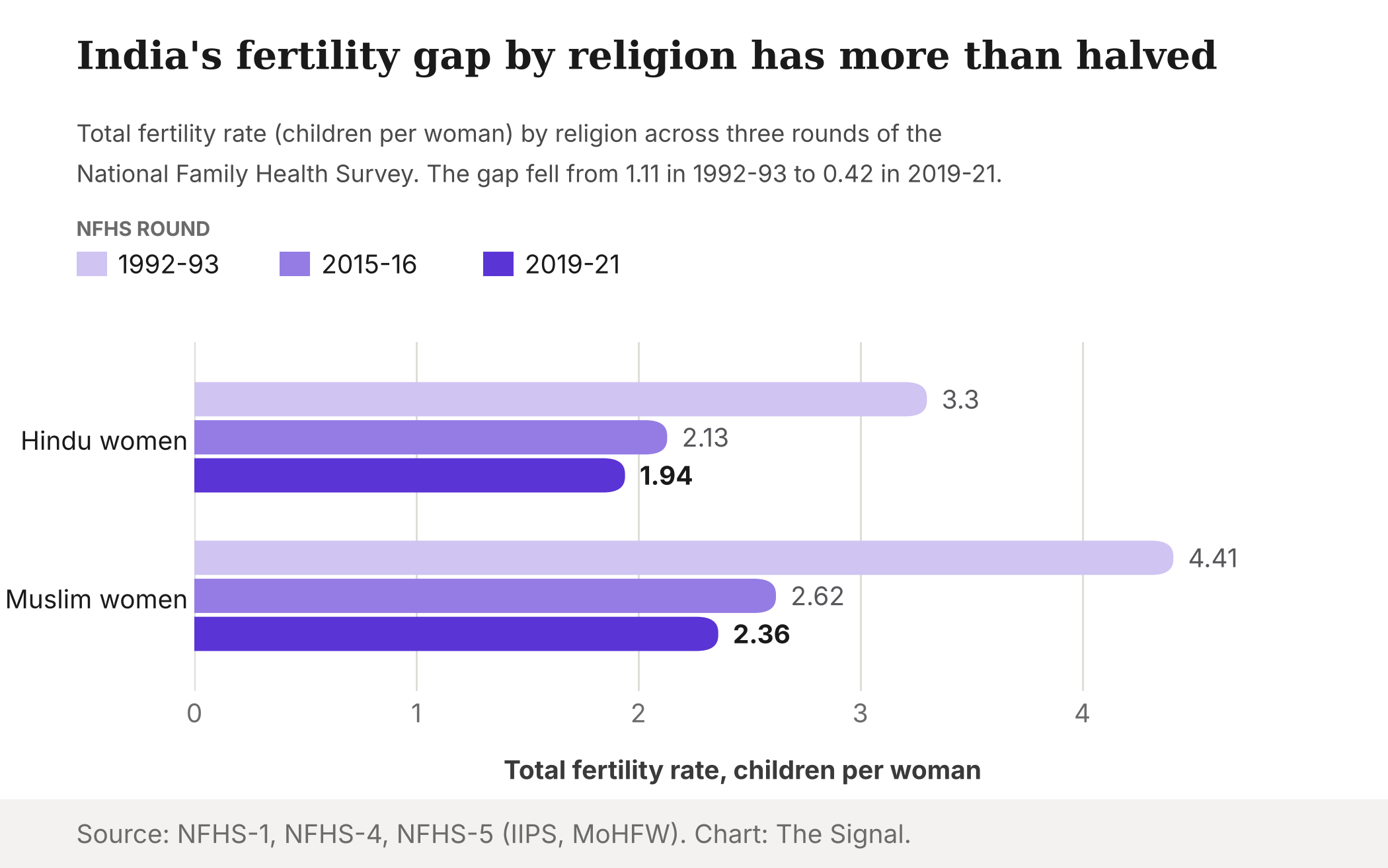
The first National Family Health Survey, in 1992-93, measured a total fertility rate of 3.30 for Hindu women and 4.41 for Muslim women. The total fertility rate is the number of children a woman would have over her lifetime at current birth rates. That was a gap of 1.11 children. By NFHS-4 in 2015-16, the rates were 2.13 and 2.62. By NFHS-5 in 2019-21, they were 1.94 and 2.36. The gap is now 0.42 children, about 62 percent smaller than in 1992-93.
The fall was steepest among Muslim women: 2.05 children per woman across the three surveys, against 1.36 for Hindu women. Pew's estimate for Indian Hindus over 2020-2025 is 1.9 children per woman, down from as high as 3.3 three decades ago. Both groups have travelled the same road. Muslims started further back and are moving faster.
Schooling tracks the same pattern. NFHS-5 recorded a fertility rate of 2.82 for women with no schooling and 1.78 for women with 12 or more years of schooling. The schooling spread of 1.04 children is more than twice the religious spread of 0.42. Pew's modellers assume the same mechanism: fertility differences between religious groups within a country are expected to converge by 2100 as educational differences narrow.
Pakistan is the outlier, not India's Muslims
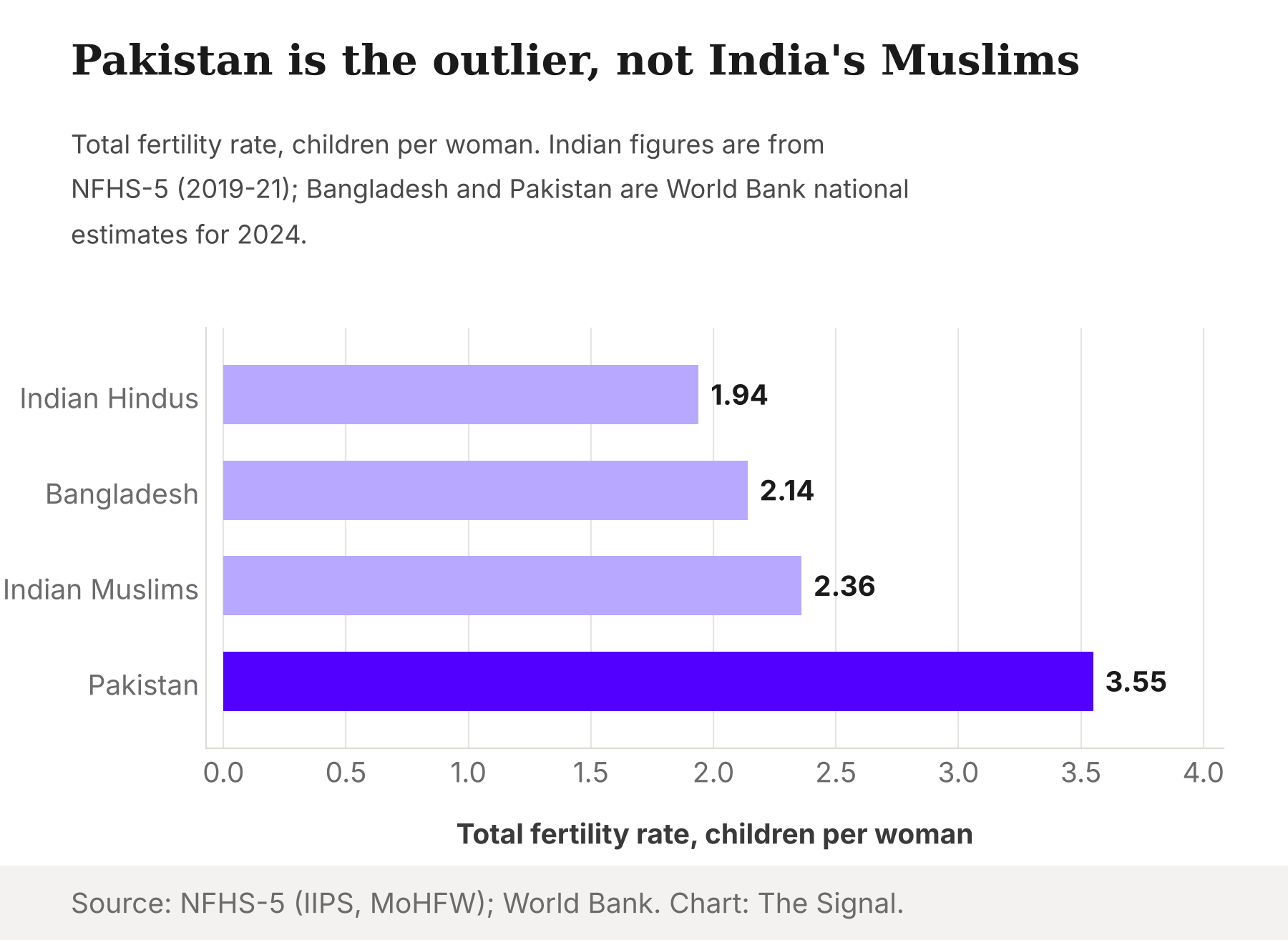
Set those figures beside India's neighbours. World Bank data put Pakistan's total fertility rate at 3.547 births per woman in 2024. The same series shows India at 1.962 and Bangladesh at 2.138. Pakistan's own household survey is consistent with that level: the Pakistan Demographic and Health Survey 2017-18 measured a total fertility rate of 3.6.
The dates differ, so read the comparison as an order of magnitude rather than a precise subtraction. Still, the shape is clear. Indian Muslim women, at 2.36 in NFHS-5, sit 0.42 above Indian Hindu women at 1.94. They sit about 1.2 below Pakistan's national rate of 3.547 in 2024. Indian Muslim fertility is nearly three times closer to that of Indian Hindus than to Pakistan's. Muslim-majority Bangladesh, at 2.14 in 2024, sits between the two Indian groups.
A narrow gap inside India, a wide one across the border.
| Group | Total fertility rate | Period | Source |
|---|---|---|---|
| Indian Hindu women | 1.94 | 2019-21 | NFHS-5 |
| Bangladesh, national | 2.14 | 2024 | World Bank |
| Indian Muslim women | 2.36 | 2019-21 | NFHS-5 |
| Pakistan, national | 3.55 | 2024 | World Bank |
Sources: NFHS-5 (IIPS, Ministry of Health and Family Welfare); World Bank fertility rate series.
That is why Pew's projection puts Pakistan, not India, at the top of the world's Muslim populations by 2070. Religion is the label on the table. The fertility level behind it, which tracks schooling, does the work.
The honest objection
The strongest case against this reading is that a gap of 0.42 children still compounds over fifty years. Pew also points to Muslims' younger age profile in India alongside the fertility gap, which means more women entering their childbearing years. A younger population keeps growing faster for decades even after its fertility converges. And Pew's main scenario already assumes that religious fertility differences narrow by 2100, yet it still has Muslims rising as a share of India. That case is right on the direction, and nothing here disputes it.
The answer concerns scale. Pew projects India's Hindu population will grow by 176 million between 2020 and 2070, and that Hindus will remain more than three-quarters of the country. India had 1.1 billion Hindus in 2020. The shift is a gradual change in shares within a country where both groups' fertility is falling. It is not a reversal of majorities. People who stress the rising Muslim share and people who stress convergence are describing the same numbers. Where they differ is which half of the trend they watch.
There is also a measurement caveat that cuts both ways. Pew built India's 2020 baseline by projecting forward from the 2011 census, because the 2021 count was delayed and still under way. Every India figure in the projection rests on a starting point that is nine years older than its base year.
The Signal
Pew's projections tell two stories about Muslim population growth in South Asia, and India's debate hears only one of them. Inside India, the fertility gap between Hindus and Muslims has fallen from 1.11 children in 1992-93 to 0.42 in 2019-21. Across the border, Pakistan's national rate was still above 3.5 in 2024, and that is where Pew places most of the region's added Muslims. For India the practical stakes are next door. A neighbour whose Muslim population alone is projected to grow by about 234 million will need jobs and schools on a scale that India's own demographic quarrel barely registers.
The number to watch is Census 2027. House-to-house enumeration in most states runs from January 25 to February 28, 2027, and its religion tables will replace the 2011 base under every Indian figure in Pew's model. If the count differs from Pew's back-projected 2020 baseline, every India figure in the model moves with it. The gap India argues about is the one that keeps shrinking.
Reporting basis: the 2020 and 2070 population projections for Muslims in India and Pakistan, for Hindus in India, and the global Muslim-Christian crossover come from Pew Research Center's The Future of World Religions: Population Growth Projections, 2020-2070, published November 18, 2026, which is also the source for its India baseline method, its Hindu fertility estimate and its fertility-convergence assumption; Pew is a single origin for all of these and the projections are its model, not counts. Fertility rates by religion and by schooling in India are from three rounds of the National Family Health Survey (1992-93, 2015-16 and 2019-21), conducted by the International Institute for Population Sciences for the Ministry of Health and Family Welfare, read in the national reports hosted by The DHS Program. Pakistan's 2017-18 fertility rate is from the Pakistan Demographic and Health Survey run by the National Institute of Population Studies, and the 2024 fertility rates for Pakistan, India and Bangladesh are from World Bank data. Census 2027 enumeration dates are from the Ministry of Home Affairs, via the Press Information Bureau. The population increases, the fertility gaps, the percentage narrowing and the relative-distance comparison are The Signal's calculations from those figures.