Six weeks from now, Indians will most likely need a visa to visit Malaysia again. As of 19 November 2026, Malaysia's Immigration Department lists Indian citizens as visa-exempt only until 31 December 2026, and no extension has been announced. The obvious read is that Malaysia is shutting the door on one of its fastest-growing markets. The timing makes it look worse. This is Malaysia's own tourism showcase year, and Malaysia had set a target of 2.1 million visitors from India for 2026 under Visit Malaysia Year.
The arrival data do not fit that story. The waiver stopped adding Indian visitors well before its end date. Over the same months, the waiver Malaysia gave China, designed differently from the start, kept working.
The number that moved first
Tourism Malaysia's January to September 2026 figures show visitor arrivals from India fell 8.8 percent to 1,076,568. Overnight tourists from India fell faster, down 11.3 percent to 828,548. Over the same nine months, Chinese visitor arrivals rose 13.5 percent to 4,092,405. Malaysia's total arrivals grew, from 31,520,332 to 32,264,989. Indians and Chinese could both enter visa-free for all nine months. Only one market shrank.
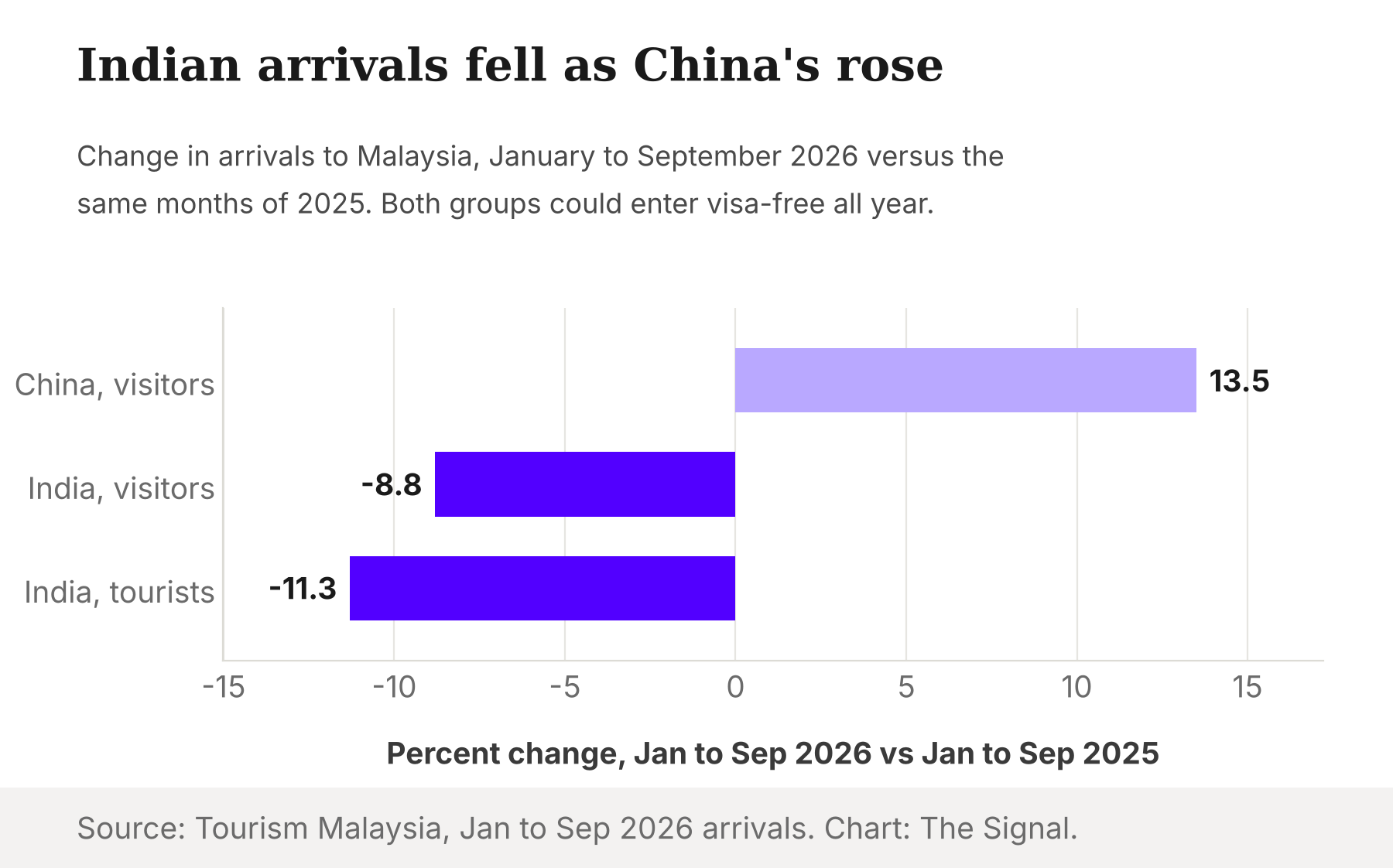
Set that against the target. With three quarters of 2026 counted, arrivals from India stood at about 51 percent of the 2.1 million goal. And they were running below 2025's pace, not above it. Tourism Malaysia's monthly table puts January to September 2025 arrivals from India at 1,180,600. That makes the 2026 figure about 104,000 visitors lower.
What the waiver actually did
The waiver did work, but once rather than every year. Prime Minister Anwar Ibrahim announced in November 2023 that Indian and Chinese citizens could stay up to 30 days visa-free from the beginning of December, to boost tourism. The response was immediate. Tourism Malaysia's monthly series records 99,112 visitors from India in December 2023, against 49,792 in December 2022, and 773,221 for all of 2023.
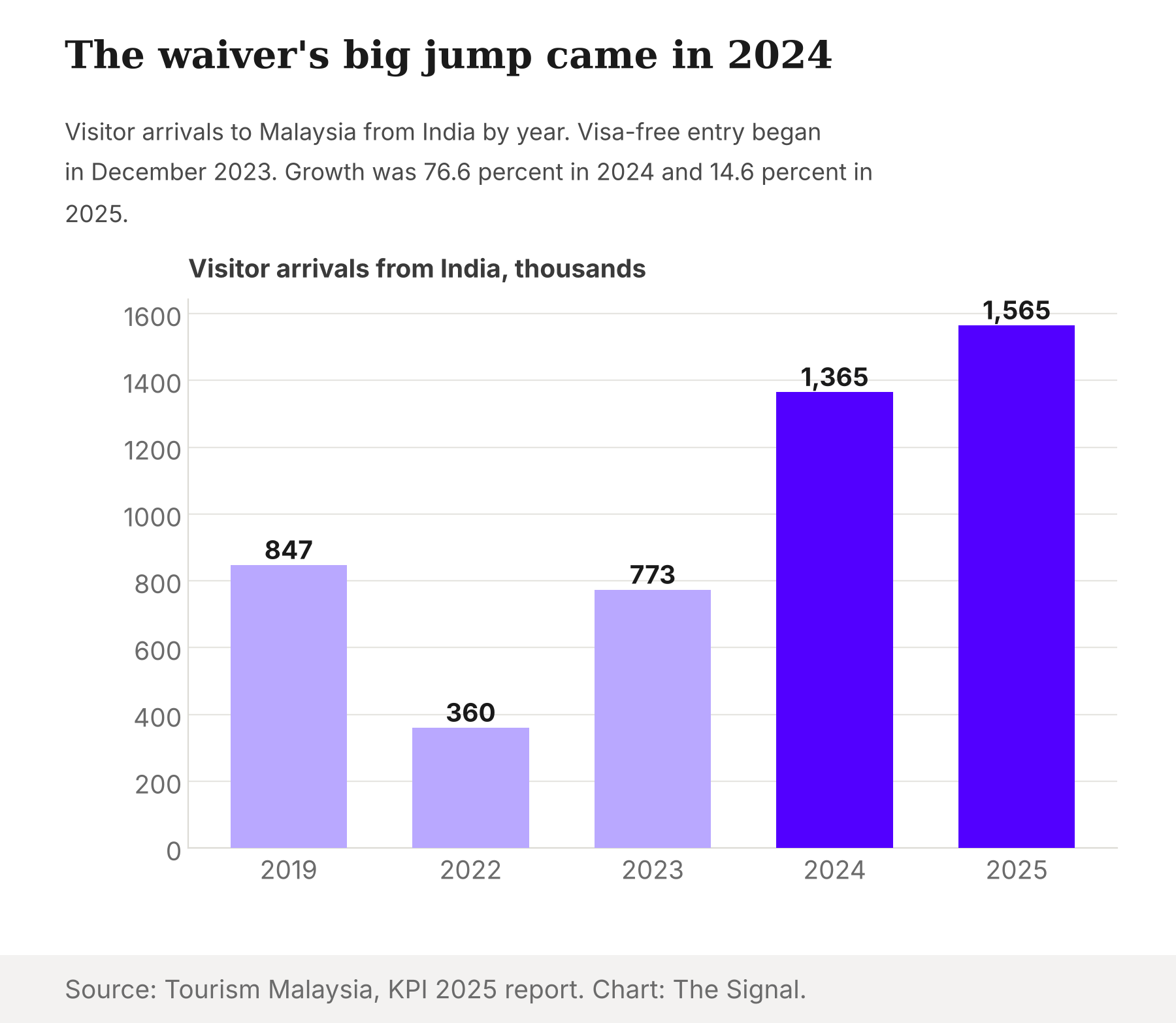
The first full visa-free year was the big one. Tourism Malaysia counts 1,365,387 visitors from India in 2024 and 1,565,194 in 2025, against 846,874 in pre-pandemic 2019. That works out to growth of 76.6 percent in 2024, 14.6 percent in 2025, and then a decline in 2026. Removing a visa requirement brings in the travellers who were put off by paperwork. Once they have come, it has nothing more to offer. The waiver lifted India to a higher level, and by 2026 that level had stopped rising.
Two waivers, two designs
Malaysia announced the two waivers together. They then went down different paths.
China's waiver was traded and India's was granted, with an end date written into its reasons.
| China | India | |
|---|---|---|
| Visa-free entry began | December 2023 | December 2023 |
| Legal basis now | Mutual agreement, in force since 17 July 2025 | Unilateral exemption, extended in December 2024 |
| Terms | 30 days per visit, 90 days in any 180 | 30 days per visit |
| Stated rationale for current term | Reciprocity with China | 2025 ASEAN chairmanship and Visit Malaysia Year 2026 |
| Status on 19 November 2026 | In force | Exempt only until 31 December 2026 |
Sources: The Star; Free Malaysia Today; Immigration Department of Malaysia.
The China-Malaysia mutual visa exemption took effect on 17 July 2025, allowing stays of up to 30 days per visit and 90 days in any 180-day period. Each side holds the other to it. The Indian arrangement was justified differently. When Malaysia's home ministry extended the Indian exemption to 31 December 2026, it cited Malaysia's 2025 ASEAN chairmanship and preparations for Visit Malaysia Year 2026. The same report noted that Putrajaya had extended the Chinese exemption in reciprocation of China's, and that India's gesture in return was narrower: a 30-day e-Tourist visa fee exemption for Malaysians, for one year from 1 July 2024.
Both events Malaysia gave as reasons are over by the end of 2026. Seen this way, the expiry is less a reversal than the end of an arrangement whose stated reasons run out with it.
The honest objection
The strongest case against this reading is that the 2026 slump is about India, not Malaysia. A weaker rupee and a difficult year for travel abroad could have hit every destination. If Indians were travelling less everywhere, Malaysia's 8.8 percent fall in Indian arrivals in January to September 2026 says nothing about the waiver running out of steam.
That case deserves weight, and the data here cannot fully settle it. But the best available measure of Indian travel spending does not show a collapse. RBI data show Indians remitted $1,463.11 million for overseas travel under the Liberalised Remittance Scheme in July 2026, against $1,445.34 million in July 2025, roughly 1 percent more. That series measures money, not trips, and runs only to July, so it cannot rule out a later or destination-specific shock. What it does show is that Indian travel budgets as a whole were holding up in mid-2026, while arrivals in Malaysia were falling. Thailand offers a second check. Indian arrivals to Thailand fell 2.5 percent in the first nine months of 2026, according to the University of the Thai Chamber of Commerce as reported by Nation Thailand. So Indian travel to the region did soften. But Malaysia's 8.8 percent fall was more than three times as deep. An India-wide shock explains part of the decline, but not the gap between the two destinations.
The Signal
Malaysia's Indian market grew when the paperwork came off. Its 2026 slide shows how little a waiver does after that. The waiver that survives is the one tied to reciprocity, and only China secured that, through a mutual agreement in force since 17 July 2025. Two numbers matter next. The October to December 2026 arrivals will show whether Indians rushed to travel before the visa returned, and the early 2027 figures how much demand a visa requirement actually removes. For India, the lesson matters beyond Malaysia: visa-free access granted for a showcase year runs out when the year does, and access secured through a mutual agreement does not.
Reporting basis: the end date of India's exemption is from the Immigration Department of Malaysia's own visa-requirement page. All arrival figures for India and China, including the monthly series and the January to September 2026 results, are Tourism Malaysia data compiled with the Immigration Department, from its 2025 indicators report and its January to September 2026 release. The 2.1 million target is Tourism Malaysia's, as reported by VnExpress International, which is the only source used for it. The November 2023 announcement is per The National. The December 2024 extension, its stated reasons and India's e-visa fee waiver are per Free Malaysia Today, reporting a home ministry statement and an Indian high commission announcement, so that origin carries those three facts alone. The China agreement's terms are per The Star. Travel remittances are from the Reserve Bank of India's Bulletin. The Thailand comparison is the University of the Thai Chamber of Commerce's figure, as reported by Nation Thailand, and rests on that single report. The 51 percent share of target, the 2024 growth rate, the shortfall against 2025, the change in travel remittances and the Malaysia-to-Thailand ratio are The Signal's calculations from those figures.