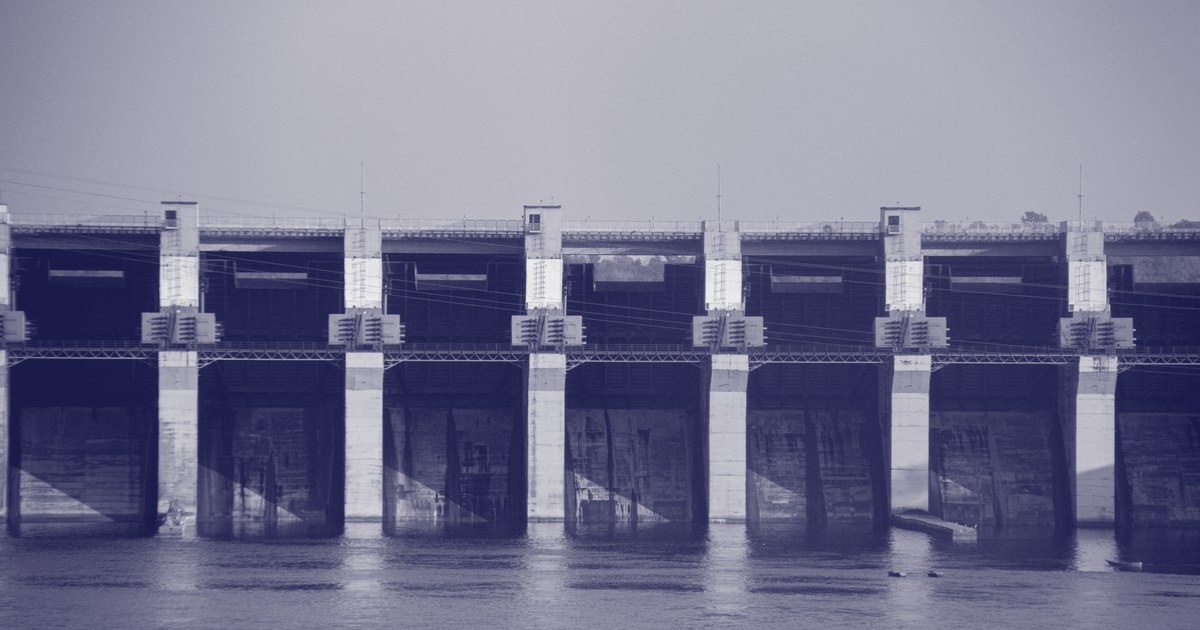
On Saturday, November 21, Union Home Minister Amit Shah went to Arunachal Pradesh and tried to calm a valley that has turned against a dam. Speaking to residents of the Siang region, Shah promised that "we will move forward without compromising the traditions, culture and religion of this place", PTI reports. He spoke of the proposed 11,200 MW Siang Upper Multipurpose Project and offered affected families a resettlement package he called among the country's best. The usual reading follows the headline number. India is building a giant hydro plant in a fragile valley, and the fight is power against people.
That reading gets the project's purpose wrong. The number that matters is not the megawatts, and Arunachal's own government has said as much.
The government has already said power is secondary
In early October, Arunachal's Deputy Chief Minister Chowna Mein set out the design. He said the project is proposed with a dam height of around 280 to 300 metres and about 9.2 billion cubic metres of live storage, and that "in the case of SUMP, power generation is secondary", according to PTI's October 5, 2026 report.
That is an unusual thing for a government to say about a plant Shah describes as 11,200 MW. It is a revealed preference. A state that wanted electricity would not build an oversized reservoir and call the turbines a side benefit. It would build a smaller dam faster, in a less contested spot.
The policy frame points the same way. The Ministry of Power lists "budgetary support for Flood Moderation/Storage hydroelectric projects" among its measures to promote hydropower. The flood-moderation and storage share of a dam can draw on budgetary support instead of being recovered entirely from electricity buyers. A dam justified by storage does not have to clear the tariff test that a pure power project faces.
The planning history fits too. An MP-IDSA issue brief from November 2025 notes the project "was initially conceived in 2017 when NITI Aayog proposed a 10,000 MW multipurpose storage-type dam on the Siang River". It was a storage dam from the start.
What the reservoir is meant to answer
The reason sits across the border. China began building its lower Yarlung Tsangpo project in July 2025 at an estimated cost of 1.2 trillion yuan ($167.1 billion), with five hydropower stations, Al Jazeera reports, citing Xinhua. The Jamestown Foundation's China Brief describes a 60-gigawatt project near the river's Great Bend in Medog County, with "anticipated annual production of nearly 300 billion kilowatt-hours of electricity".
On megawatts, India is not in the same contest. Medog's planned 60 GW is more than five times Siang's 11,200 MW.
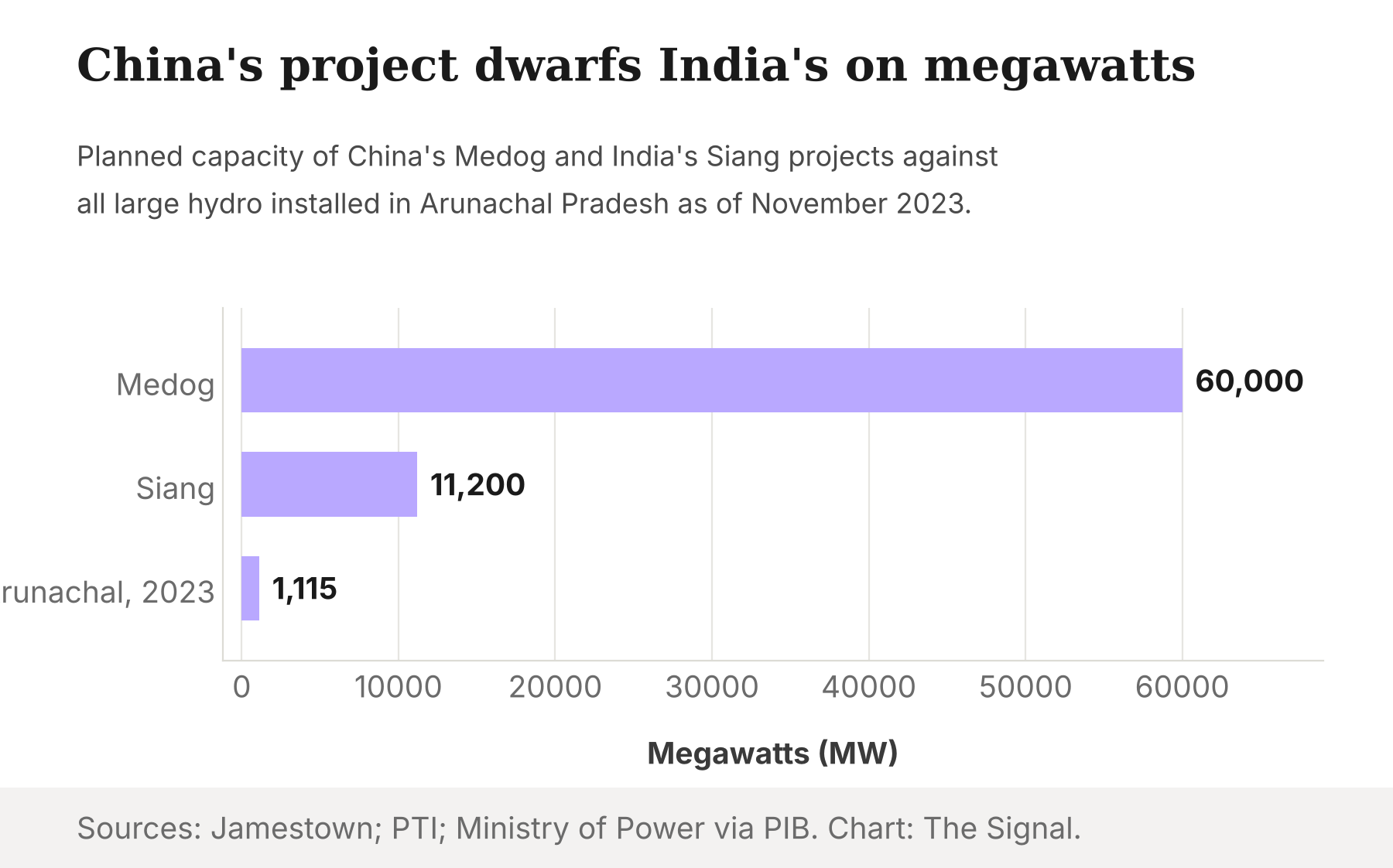
India's own baseline makes the gap plainer. Arunachal Pradesh had 1,115 MW of large hydro installed as of November 30, 2023, the Ministry of Power told Parliament. Siang alone would be about ten times that. CEA's 2017 to 2023 reassessment puts India's exploitable large hydro potential at 1,33,410 MW, with 50,394 MW of it in Arunachal Pradesh. So Siang would use roughly a fifth of the state's potential in one project.
India's strategic community reads the dam as a counter to Medog rather than a rival to it. MP-IDSA argues that "the Indian government has likely aimed to establish prior-use rights, enhance downstream flood control and assert hydrological sovereignty". Every item on that list is about controlling water.
The number that carries the argument
If storage is the point, storage has to be judged against the river. ORF researchers Nilanjan Ghosh and Sayanangshu Modak estimate the Yarlung Tsangpo carries about 31.2 BCM a year at Nuxia in Tibet, "swelling to an estimated 135.9 BCM as it passes through the Great Bend and exits China," and about 526 BCM at Pandu near Guwahati.
Set the reservoir against those flows and the design comes into focus.
| Measure | Volume | Siang storage as a share |
|---|---|---|
| Siang planned live storage | 9.2 BCM | 100% |
| Annual flow leaving China (estimate) | 135.9 BCM | about 7% |
| Annual flow at Pandu, Guwahati | 526 BCM | about 1.7% |
Sources: PTI via The Pioneer for storage; Ghosh and Modak via Mongabay India for flows. Shares are The Signal's calculations.
At an average rate, 135.9 BCM a year is about 0.37 BCM a day. A 9.2 BCM reservoir could absorb roughly 25 days of the flow that leaves China (our calculation).
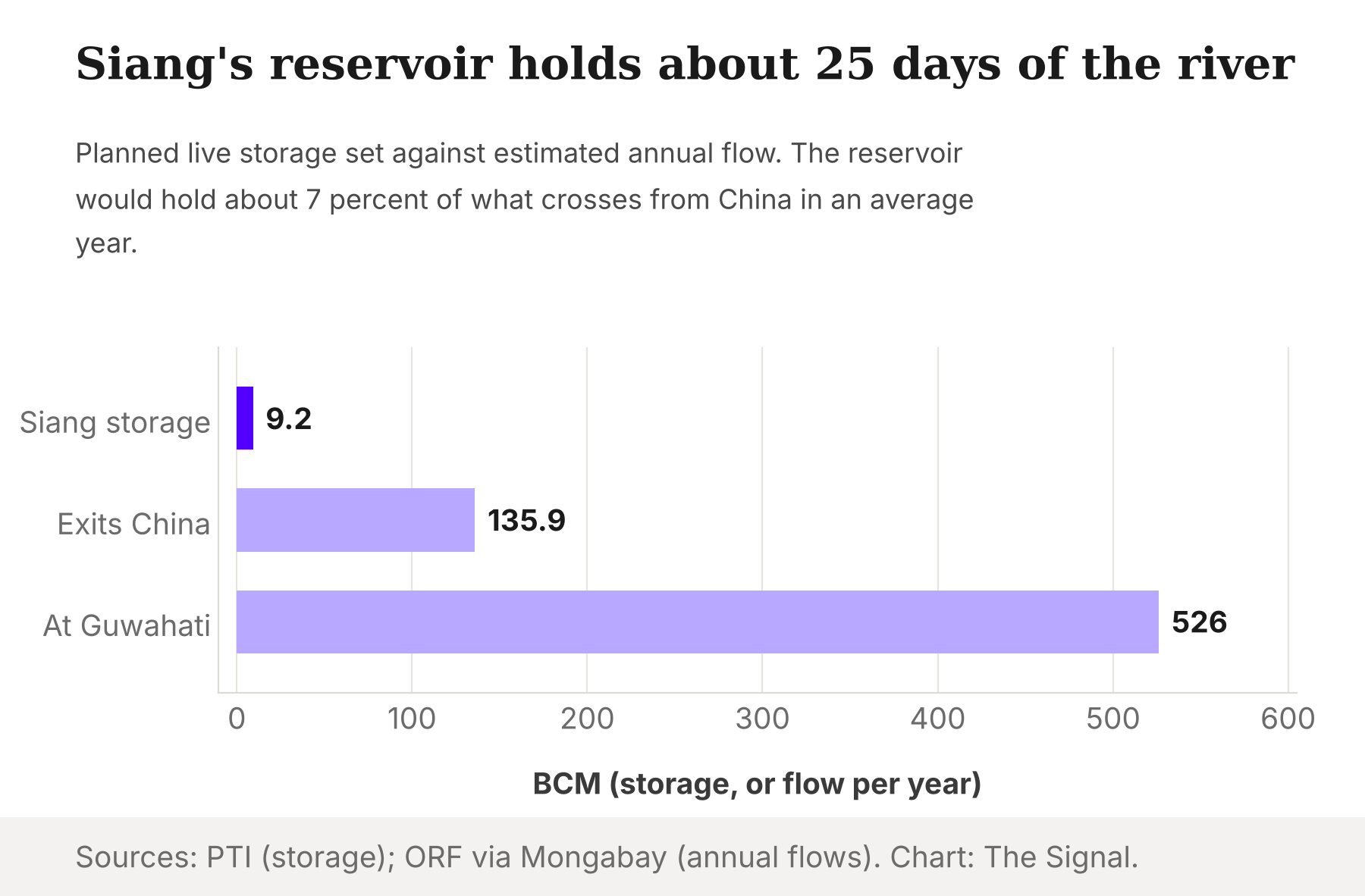
That figure explains what the reservoir can do and what it cannot. It could not make up for a whole season of reduced flow. It can catch a sudden release, or cover a short cut in flow, for a few weeks. That is the size of a shock absorber.
The honest objection
The strongest case against this framing is China's. China's embassy in India says the project "does not consume water but only uses the potential energy of water to generate electricity", and that it has no negative impact on the lower reaches. A power project that passes water through its turbines returns that water to the river. On that view, India is building a costly hedge against a threat that does not exist.
The hydrology partly backs Beijing. By the ORF estimates, most of the Brahmaputra's volume joins inside India. The 526 BCM at Guwahati is nearly four times the 135.9 BCM that crosses the border. India's long-run water supply does not depend on Medog's goodwill.
There is also a cost inside India that a storage frame does not erase. A 280 to 300 metre dam with a reservoir this size means submerging part of the valley where people now live and farm. That is the concern Shah was answering on Saturday.
But the objection answers the wrong question, and the size of the reservoir shows it. Siang is not insurance against China drying the river up. It is insurance against timing: a sudden release from upstream, or a run of days when flow drops and India does not know why. A cascade of five stations is run on a schedule set upstream, in China. A 25-day buffer suits that risk. And a dam that exists also strengthens India's claim to the river's use, a point MP-IDSA makes explicitly.
The Signal
Judge the Siang project by its 9.2 BCM of storage, not by its 11,200 MW. On megawatts, India loses a race it is not really running. On storage, it is buying weeks of control over a river that rises in China. The real test for the Union government is whether it can win consent in the Siang valley for a reservoir whose main purpose is strategic. Shah's promise of the country's best resettlement package is the first price quote. Watch whether the pre-feasibility work continues with the valley's consent or without it. A buffer against China that India builds over its own citizens' objections would be a strange kind of security.
Reporting basis: Two separate PTI wire stories underpin the Indian statements, counted here as one origin. Amit Shah's remarks of November 21, 2026 come from PTI, as carried by Siasat. The 9.2 BCM storage, the dam height and the statement that power is secondary come from Arunachal Deputy Chief Minister Chowna Mein, per PTI as carried by The Pioneer. The 2017 NITI Aayog origin of the project and the prior-use-rights reading are from an MP-IDSA issue brief. India's hydro potential, Arunachal's share and the budgetary support for flood moderation come from CEA and Ministry of Power data released through PIB, and Arunachal's 1,115 MW of installed large hydro comes from a separate Ministry of Power reply via PIB. Medog's cost and five-station design are Xinhua's figures as reported by Al Jazeera; its 60 GW capacity and output come from the Jamestown Foundation's China Brief. River flow estimates are from ORF researchers Nilanjan Ghosh and Sayanangshu Modak, published by Mongabay India, and are a single estimate, not an official gauge series. China's position is its embassy's own statement, published by the PRC foreign ministry. The comparison of Medog's and Siang's capacity, Siang's multiple of Arunachal's installed hydro, its share of the state's potential, the storage shares and the 25-day figure are The Signal's calculations from those figures.