On Friday, 20 November 2026, the Supreme Court dismissed two applications from Tamil Nadu seeking a direction to Karnataka to release 11 TMC of Cauvery water. Tamil Nadu had claimed a shortfall of 11.719 TMC at Billigundulu, the measuring point on the inter-state border, up to 6 October. Karnataka answered that this was a rain-deficit year and that several of its areas had been declared drought-affected. The usual reading is a scorecard: Karnataka won this round and Tamil Nadu lost.
That reading misses why there was a round at all. The argument in court was not mainly about whether Karnataka released water. It was about how much water a dry year actually owes. On that question, Tamil Nadu argued, the system set up in 2018 has never written down an answer.
The rule that exists, and the one that does not
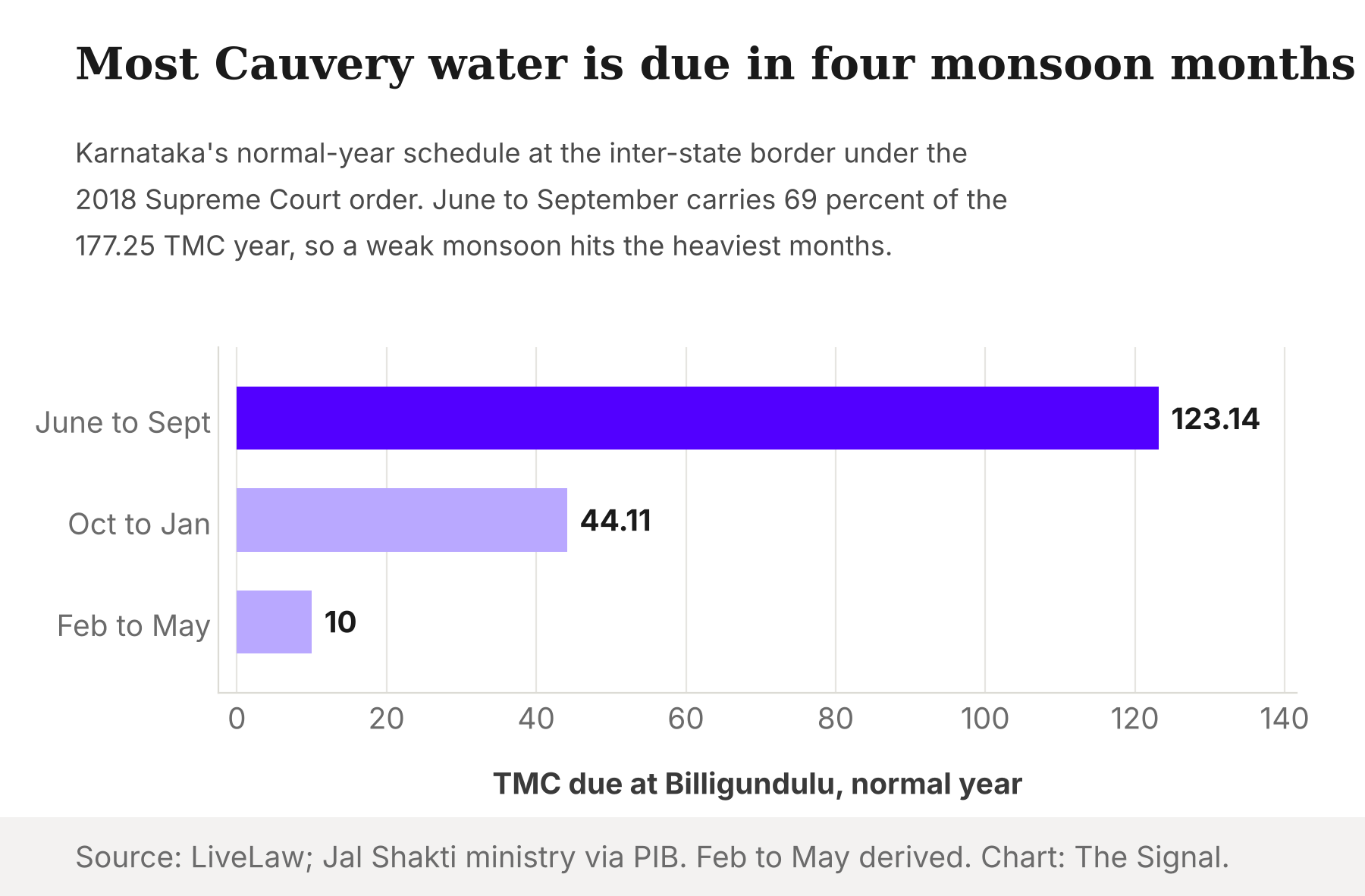
The 2018 settlement is precise about normal years. Under the Supreme Court's February 2018 verdict, Karnataka's normal-year delivery to Tamil Nadu at Billigundulu was cut from 192 TMC to 177.25 TMC, the Ministry of Jal Shakti told the Rajya Sabha. The award breaks that down by month. According to a DMK application described by LiveLaw, Karnataka must ensure 123.14 TMC from June to September and 44.11 TMC from October to January, or 167.25 TMC between June and January.
That puts about seven-tenths of the year's 177.25 TMC in the four monsoon months alone. Those are the same four months a weak monsoon hits hardest.
The rules for a dry year are much looser. The charter of the Cauvery Water Management Authority (CWMA), the body created in 2018 to run the award, puts it in one sentence: distress from reduced flows "will be shared by the party States after the distress conditions and their extent is determined by the Authority", keeping the allotted shares in view. That is a principle, proportional sharing, with no arithmetic attached. Every dry year, the Authority has to decide afresh how short is short and who gives up what.
Tamil Nadu put exactly this complaint before the court. It argued that its share in a distress year must be decided pro rata, and that the CWMA, "even after eight years since its constitution, has failed to formulate the distress formula", PTI reported. Karnataka's counsel described the same gap from the other side: "Every distress year, this has been the problem."
A good year cannot be banked
The obvious reply is that in wet years Karnataka gives far more than it owes. The official record bears that out. In 2019-20, observed flows at Billigundulu totalled 275.401 TMC against the 177.25 TMC due, 55 percent above the normal-year figure. The following year, 2020-21, came in at 211.315 TMC, about 19 percent above.
The same table shows the problem. In June 2019, according to the ministry's figures, only 2.062 TMC reached the border against 9.19 TMC due. July 2019 delivered 7.443 TMC against 31.24 TMC. Then August brought 92.325 TMC, double the 45.95 TMC due. The year's surplus arrived after the window that matters most for the first crop. The 2020 season followed the same pattern, with June at 6.204 TMC and July at 11.346 TMC, both well short of schedule.
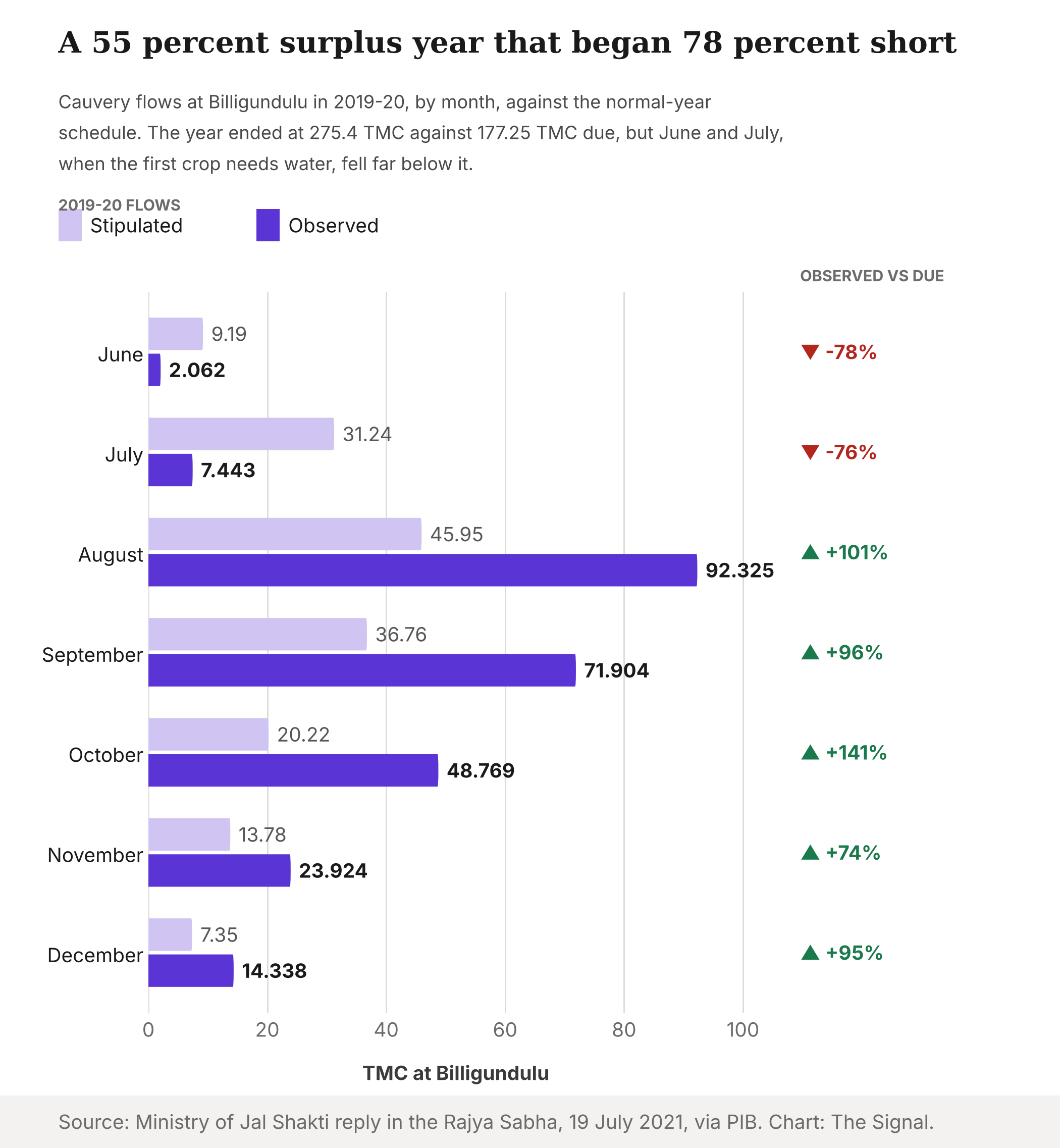
A flood-year surplus does not carry forward. Water that crossed the border in August 2019 does not count as credit in a dry 2026. Each water year starts from zero, and the monthly schedule is only binding for a normal year. So a surplus does nothing to settle a later deficit, and the fight starts again whenever rain fails.
2026 is the kind of year the formula was meant for
The 2026 monsoon was exactly that kind of year. The India Meteorological Department reports that the South Peninsula received 542.0 mm in the June to September season, the 4th lowest since 1901, against a long period average of 716.2 mm. Both states were dry. Using IMD data to 29 September, Down To Earth reports that Karnataka received 30 percent less rain than normal and Tamil Nadu 20 percent less.
In a year like this, distress sharing should have settled the matter. Instead, the dispute turned on competing calculations. As the season went on, a DMK application estimated the backlog at Biligundlu at 9.46 TMC on 26 July, already on a distress-adjusted basis. Tamil Nadu later told the court that the Cauvery Water Regulation Committee (CWRC), working from the percentage deficit, found that flows at Billigundulu should have been 52.935 TMC. It said the committee then cut releases from 6,000 cusecs to 4,000 cusecs anyway. Karnataka pointed to the Authority's 59th meeting on 8 October, which directed 3,000 cusecs at Billigundulu for 15 days, as proof that the system had worked.
Both states were citing the same bodies. They disagreed on what those bodies' numbers obliged Karnataka to do. That is what an unwritten formula produces.
The honest objection
The strongest case against this reading is that a fixed formula might be the wrong tool. Rain over the Cauvery basin is erratic within a season, not just between seasons. A rigid percentage written in advance could force releases from reservoirs Karnataka needs for drinking water in a genuine drought, which is exactly the argument its counsel made in court. Case-by-case judgment by an expert body may be the only workable approach. The Supreme Court has leaned that way before. In September 2023, the last major distress year, it refused to intervene for either state and relied on the combined expertise of the CWRC and the CWMA. Friday's dismissal, for which no written reasons have been published, leaves that approach in place.
That objection is serious, but it argues about what kind of formula to write, not about whether to write one. Discretion and a published method can sit together. A formula can set how the deficit percentage is computed and leave the Authority room to protect drinking water. What exists now is discretion with no published method. That is why both states can read the same committee minutes and reach opposite totals. The court can defer to the experts. It cannot defer to a calculation the experts have not published.
The Signal
Friday's order settles the 2026 claim. It does not settle the 2027 one. The 2018 order made the Cauvery predictable in every year that does not need managing: about seven-tenths of the water due in four monsoon months, and surpluses that are large but cannot be carried forward. In the years that do need managing, the Authority has still not written down the rule it was set up to apply. Without that rule, each weak monsoon will end in another application at the Supreme Court, and the court has now twice declined to step in. The thing to watch is not the next cusec order. It is whether the CWMA ever publishes the formula. Until it does, the award governs the Cauvery only in years when the monsoon behaves.
Reporting basis: the 20 November 2026 dismissal and Tamil Nadu's 11.719 TMC shortfall claim are as reported by ETV Bharat. The parties' arguments, including Tamil Nadu's account of the CWRC's 52.935 TMC finding and the CWMA's 59th-meeting direction, are per PTI as carried by ThePrint, and rest on the states' own submissions rather than a published order. The monthly delivery schedule and the July 2026 backlog estimate are per a DMK application in the Supreme Court as reported by LiveLaw, and the 2018 reduction to 177.25 TMC and the 2019-20 and 2020-21 monthly flows come from the Ministry of Jal Shakti's Rajya Sabha reply of 19 July 2021, via PIB. The distress-sharing principle is from the CWMA's own charter. Seasonal rainfall is from the India Meteorological Department's 2026 monsoon summary, with state deficits from IMD data as compiled by Down To Earth. The 2023 refusal to intervene is per All India Radio. The share of the annual obligation due in June to September, the February to May remainder and the percentage surpluses are The Signal's calculations from those figures.