On November 23, 2026, a coalition of South Asian women's rights groups published a comparative report on the marital rape exception in eight countries, from Afghanistan to the Maldives. Four days earlier, a Supreme Court bench led by Chief Justice Surya Kant said it would hear the petitions challenging India's exception on December 9 or 10. The case has been waiting since the Delhi High Court split on it on May 11, 2022.
The usual framing treats this as a question about the edge of the law. Rape is a grave crime. Marriage is a special relationship. The exception, on this reading, is a narrow carve-out for one hard category of cases, and the argument is about whether that carve-out is justified.
The numbers do not support that framing. The exception is not at the edge of the problem. It sits on top of most of it.
The figure that carries the argument
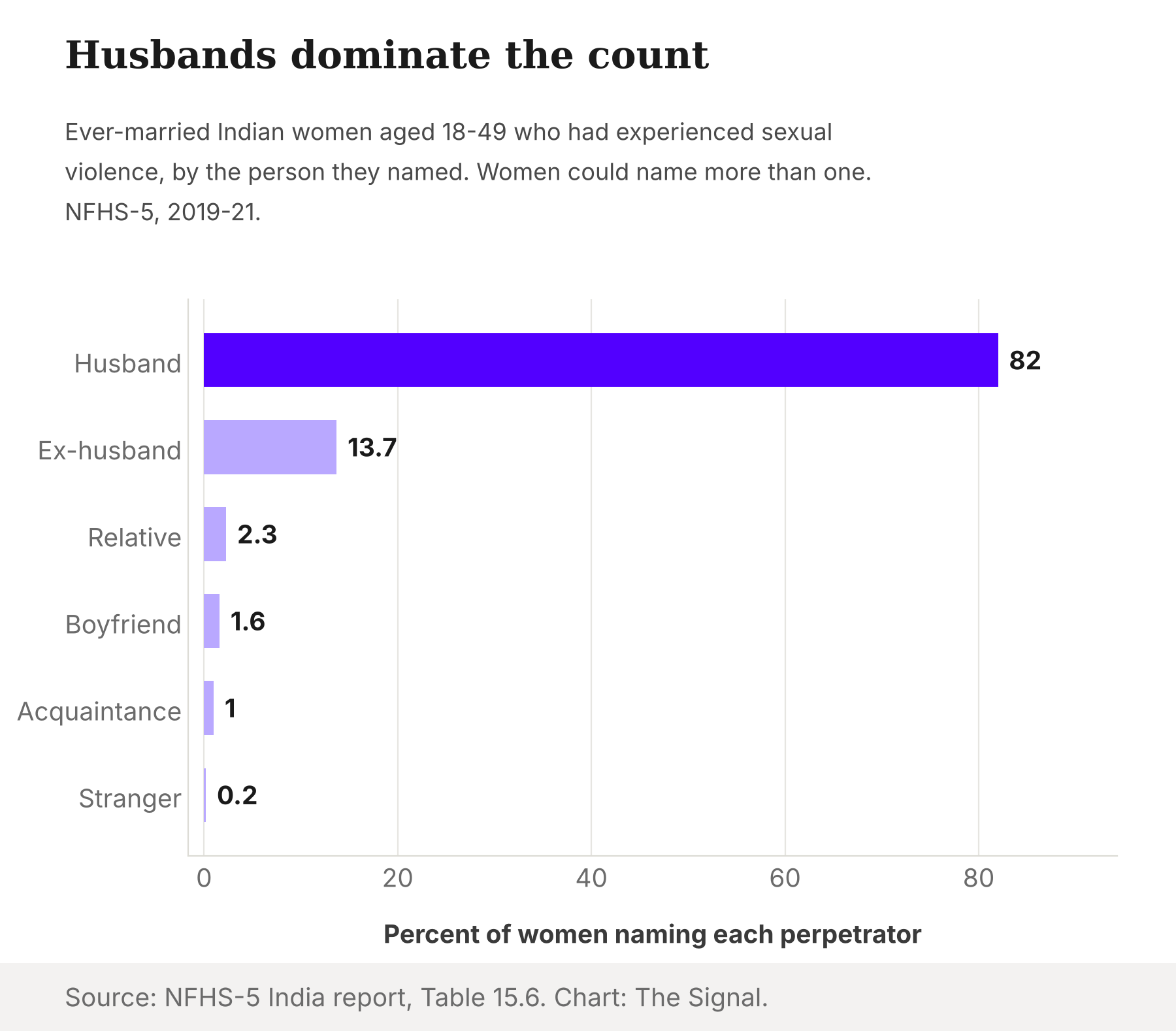
India's own health survey asks the question directly. Among ever-married women aged 18 to 49 who had ever experienced sexual violence, 82 percent named their current husband and 14 percent a former husband, according to the National Family Health Survey (NFHS-5, 2019-21). The same survey's table of perpetrators shows strangers at 0.2 percent for the same group. For a married woman in India, a husband is roughly 400 times more likely than a stranger to be the person named.
Now set that against the statute. Under Section 63 of the Bharatiya Nyaya Sanhita, the SAMAJ India brief notes, sexual intercourse or sexual acts by a man with his wife aged 18 or above do not constitute rape. The one marital case the rape chapter reaches is a couple living apart: Section 67 punishes non-consensual sex with a separated wife with a maximum of seven years' imprisonment.
Put the two together. The rape law covers the stranger who accounts for 0.2 percent of what married women report. It exempts the current husband who accounts for 82 percent. Whatever one thinks of the exception, it decides which part of the harm the rape law addresses at all.
Scale, and what does not get counted
The prevalence figure is not small either. Six percent of ever-married women aged 18 to 49 reported spousal sexual violence, and 5 percent in the past 12 months, per NFHS-5 (2019-21). Those are self-reports to a household survey, which is why they exist at all.
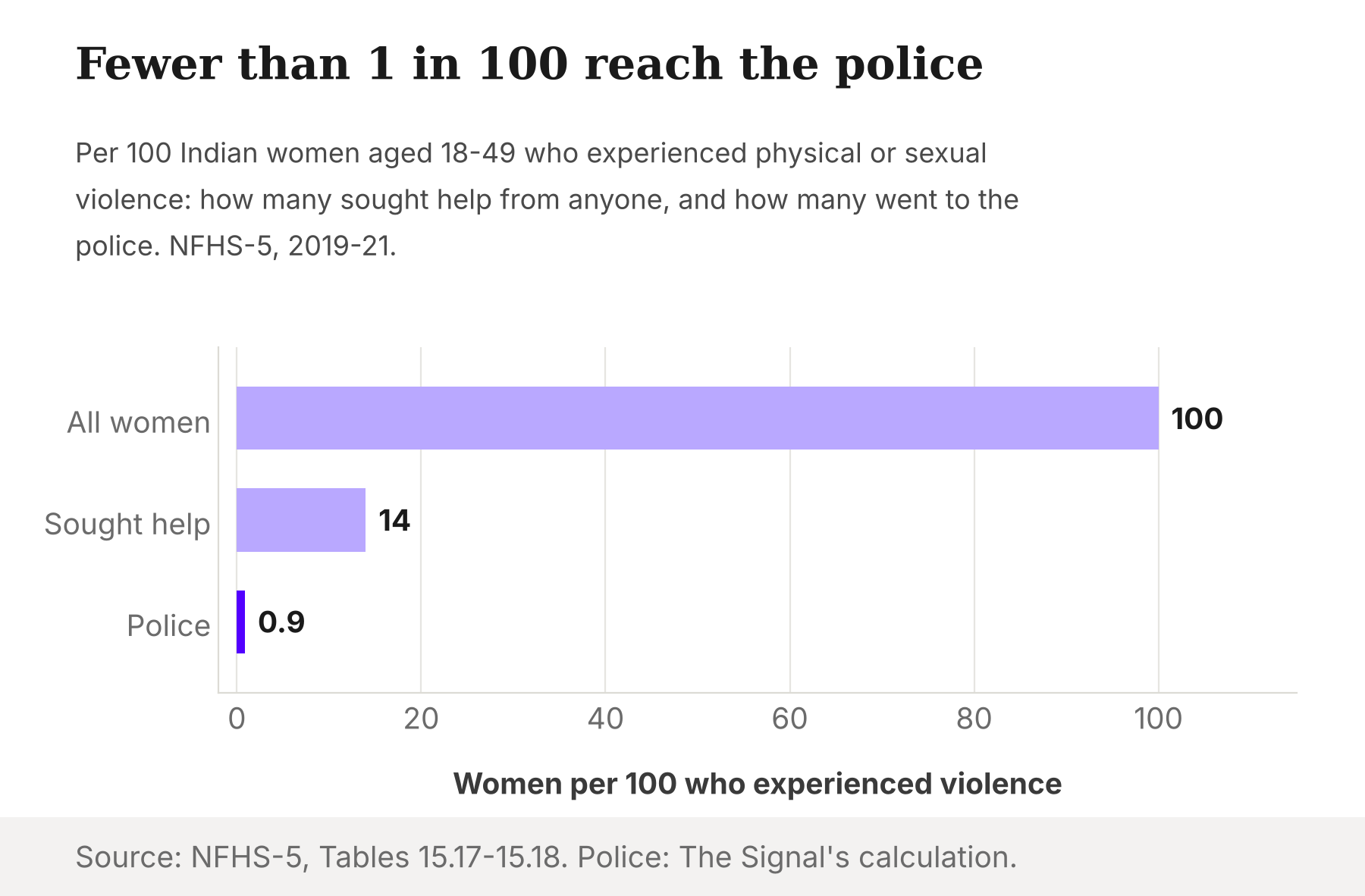
Very little of it reaches an institution. In the same 2019-21 survey, only 14 percent of women who experienced physical or sexual violence by anyone sought help to stop it. Among those who did, 60.9 percent turned to their own family and 6.3 percent to the police. That works out to fewer than one woman in 100 going to the police. The gap is widest inside a marriage: help-seeking was 11 percent among women abused only by a current husband, against 24 percent among women abused only by a previous husband.
This matters for a reason both sides should accept. Police and court data measure what the law already recognises. For marital rape, the law recognises almost nothing, so official crime statistics will show almost nothing. The survey is the only window, and it points at husbands.
How the neighbours drew the line
The SAMAJ report is useful mainly as a map. South Asia shares a colonial penal inheritance, and the countries have since split in different directions.
India sits with the stricter holdouts, not the reformers.
| Country | Position on marital rape (per SAMAJ, November 2026) |
|---|---|
| Maldives | Fully criminalised under the same framework as other rape, since a 2021 amendment |
| Pakistan | Exception removed from the rape definition in 2006; no superior-court ruling yet applying it to a husband |
| Nepal | A crime under the 2017 Penal Code, up to 5 years, versus 6 to 20 years for other rape |
| Bhutan | A crime, but a petty misdemeanour: one month to one year |
| India | Exempt where the wife is 18 or older; covered only if the couple is separated |
| Bangladesh | Exempt where the wife is above 13 |
Source: SAMAJ report country table, with detail on Nepal, Pakistan, Bhutan and Bangladesh.
The table also shows that removing the exception is not the end of the story. The SAMAJ report notes that Nepal punishes marital rape with up to five years, against six to 20 years for rape generally. In Pakistan, no reported judgement from the superior courts has confirmed that Section 375 applies to marital rape, two decades after the definition changed. Criminalising on paper and prosecuting in practice are separate steps.
The honest objection
The government's case deserves to be heard at full strength, because it is not a defence of marital rape. In its October 2024 counter-affidavit, the Union government told the Supreme Court that the act colloquially called marital rape "ought to be illegal and criminalized", and that existing provisions, including cruelty under Section 498A and the Domestic Violence Act, 2005, already carry penal consequences. Its objection is to the label and the sentence: the affidavit says a husband has no fundamental right to violate his wife's consent, but that applying the crime of rape to marriage "can be arguably considered to be excessively harsh and therefore, disproportionate". It also argues the question is one for Parliament and the states, not the courts.
The government is not alone. The affidavit quotes the National Commission for Women's 2022 report, which recommended that the exception be retained. The commission's reasoning was practical: prosecuting a husband may leave a wife and children destitute where support systems are weak.
The case against retention starts from the legislative record. The Justice Verma Committee recommended in 2013 that the marital rape exception be removed, and the 2023 rewrite of the penal code retained it anyway. The same survey bears on the alternative remedies the government cites: fewer than 1 in 100 women who experience violence go to the police at all.
Both arguments rest on the same fact. The government says other laws cover the conduct. Petitioners say the rape law should. Neither side disputes that the conduct is mostly committed by husbands. That is the variable the bench will in effect be ruling on.
The Signal
The exception is usually debated as a principle: marriage versus consent. The survey reframes it as a matter of coverage. A rape law that exempts the current husband sets aside the perpetrator 82 percent of married survivors name, and keeps the one they name 0.2 percent of the time. India's neighbours show the choices on the table, from the Maldives' full parity to Nepal's lighter sentence to Pakistan's change that courts have yet to test. Watch two things after December 9: whether the bench treats this as a definitional question or a sentencing one, and whether any ruling comes with a way to count the cases it creates. A law can only count what it is allowed to see.
Reporting basis: the perpetrator shares, prevalence of spousal sexual violence and help-seeking rates are from the National Family Health Survey (NFHS-5, 2019-21) India report published by IIPS for the Ministry of Health and Family Welfare, via the DHS Program; this is the latest national round, and its figures predate the Bharatiya Nyaya Sanhita. The country-by-country legal positions are from the SAMAJ coalition's November 2026 report and India brief, published by Equality Now as its secretariat, an advocacy body; its statutory summaries were not checked against each country's code separately. The Union government's position and the National Commission for Women's recommendation are from the government's October 2024 counter-affidavit in the Supreme Court, as hosted by Supreme Court Observer. The Verma Committee recommendation is per PRS Legislative Research's brief on the BNS. The hearing date and the Delhi High Court verdict date are per Outlook's report of the November 19 proceedings and rest on that single source. The husband-to-stranger multiple and the share of women reaching the police (14 percent multiplied by 6.3 percent) are The Signal's calculations from those figures.