In a letter dated November 27, 2026, former Chief Justice of India B.R. Gavai wrote to President Droupadi Murmu that recent Collegium recommendations disregard merit, diversity and inclusivity, and favour one community, The Pioneer reports. He opened by saying he did not write "lightly, nor write in anger." Bar & Bench, quoting the letter, reports that he described the favoured community as making up "less than 5 per cent of the country's population." That community, unnamed in the letter, has had "over 40 per cent representation in the Supreme Court," Gavai wrote, Bar & Bench reports in a separate account of the letter. He added that its share has risen manifold in the recent past. The surface read writes itself: a former head of the judiciary has turned on the system he once ran.
It is worth slowing down on that. The letter is an argument. The checkable record sits elsewhere, in numbers the Law Ministry has already tabled in Parliament about the High Courts, the tier directly below the Supreme Court. Those numbers neither prove nor refute Gavai. They do show how narrow the intake has been, and they point to where the narrowing may begin.
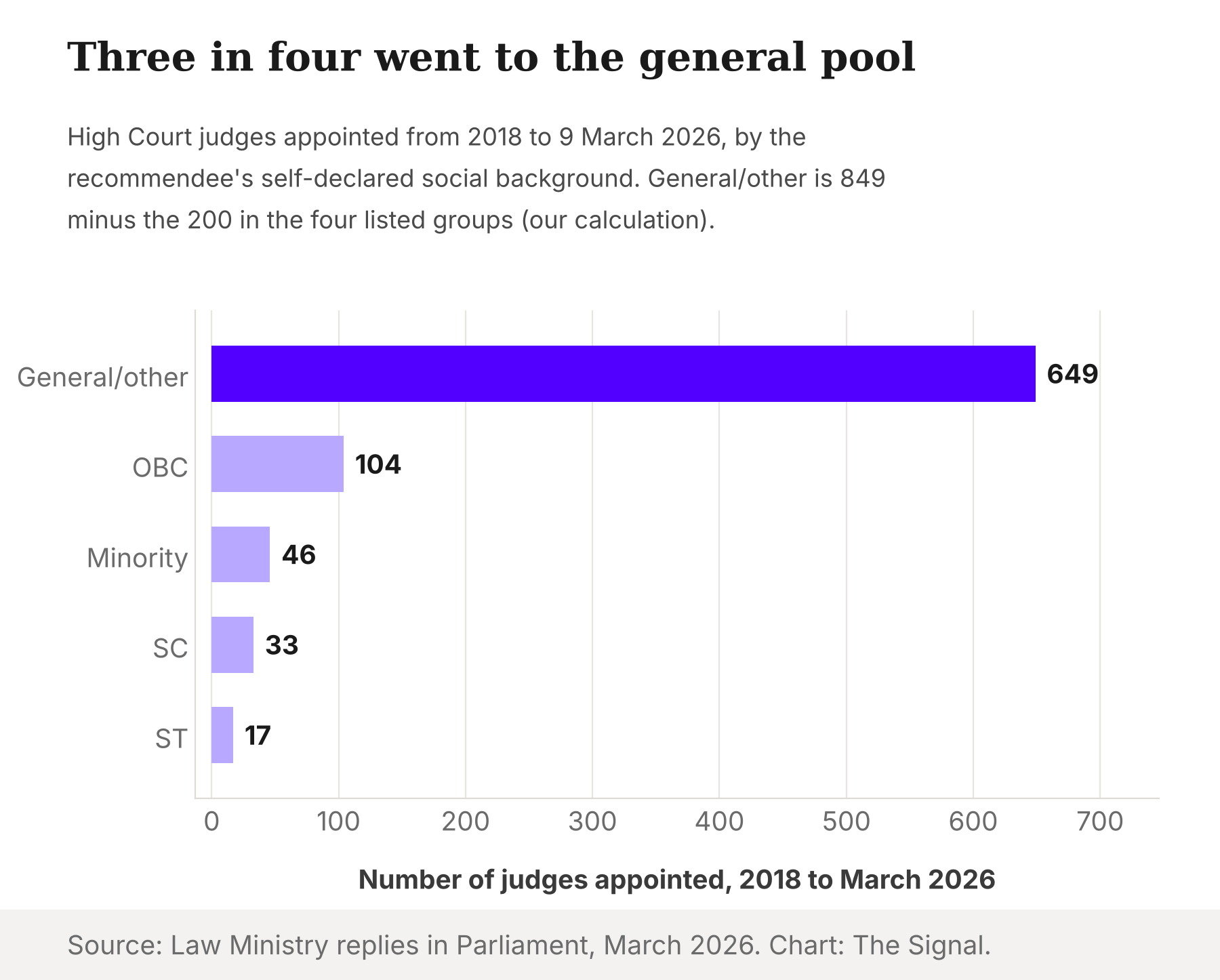
The figure that carries the argument is 200. Of 849 High Court judges appointed from 2018 to 9 March 2026, 33 were Scheduled Castes, 17 Scheduled Tribes, 104 Other Backward Classes and 46 from minority communities, the Law Ministry told the Lok Sabha. That is 200 judges, or 23.6 percent. The other 649, about three in four, fall outside all four groups.
What the government has already put on record
The categories come from the social background that recommendees declare about themselves, and the Ministry has reported them only for appointments since 2018. The same SC, ST and OBC counts appear in a separate answer, where the Law Ministry told the Rajya Sabha that 154 of the 849 belonged to those three categories, or 18.1 percent before minorities are counted.
Three separate replies, cut over different windows, tell a consistent story.
Every window the Ministry has reported shows roughly three in four appointees outside SC, ST, OBC and minority groups.
| Reply (window of appointments) | Judges appointed | SC | ST | OBC | Minority | Share from the four groups |
|---|---|---|---|---|---|---|
| March 2025 (2018 to March 2025) | 715 | 22 | 16 | 89 | 37 | 22.9% |
| February 2026 (January 2021 to January 2026) | 593 | 26 | 14 | 80 | 37 | 26.5% |
| March 2026 (2018 to March 2026) | 849 | 33 | 17 | 104 | 46 | 23.6% |
Sources: Law Ministry replies in Parliament, via LiveLaw (2025), LiveLaw (2026) and the Department of Justice. Shares are The Signal's calculations.
LiveLaw's reading of the 2025 reply put the upper-caste share of the 715 at 77.06 percent, citing a Law Ministry written reply in the Rajya Sabha. For the 593 judges appointed from January 2021 to January 2026, LiveLaw reports, citing a Law Ministry reply, the upper-caste share was about 73.5 percent, and 96 of those appointees were women.
The newest batch moved, a little
Subtracting the 2025 reply from the 2026 one isolates the 134 judges added in between. Of those, 36 came from the four groups: 11 SC, 1 ST, 15 OBC and 9 minority, per the 2025 and 2026 counts. That is 26.9 percent, against 22.9 percent for the first 715 (our calculation, since the two replies use slightly different cut-off dates).
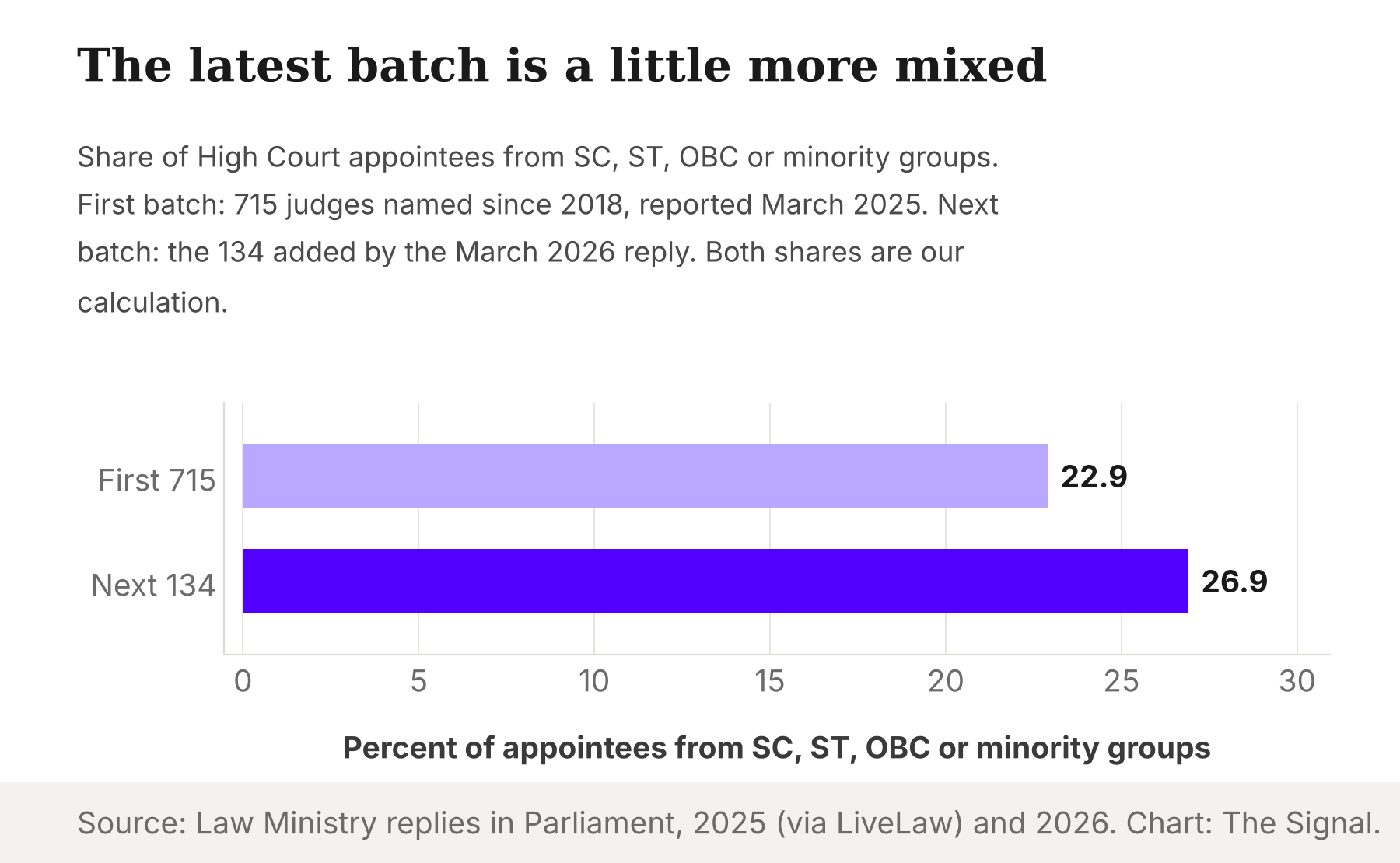
A rise of four percentage points on a batch of 134 judges is movement, not a trend. Only one of those 134 judges was from a Scheduled Tribe, based on the same two replies to Parliament.
The gender record is kept separately. As on 17 March 2026, there was one woman judge in the Supreme Court and 113 in the High Courts, the Law Ministry told the Lok Sabha. Women were 113 of 803 working High Court judges, or 14.1 percent, and Manipur, Tripura and Uttarakhand had none, Law Ministry data tabled in the Lok Sabha show.
Names start in the High Courts, not in Delhi
The Supreme Court Collegium does not originate most names. Each High Court's own collegium proposes them first. As on 6 March 2026, 132 proposals were at various stages of processing between the government and the Supreme Court Collegium, while recommendations against 180 of 312 vacancies had not yet been sent by High Court collegiums, the Law Ministry told the Rajya Sabha.
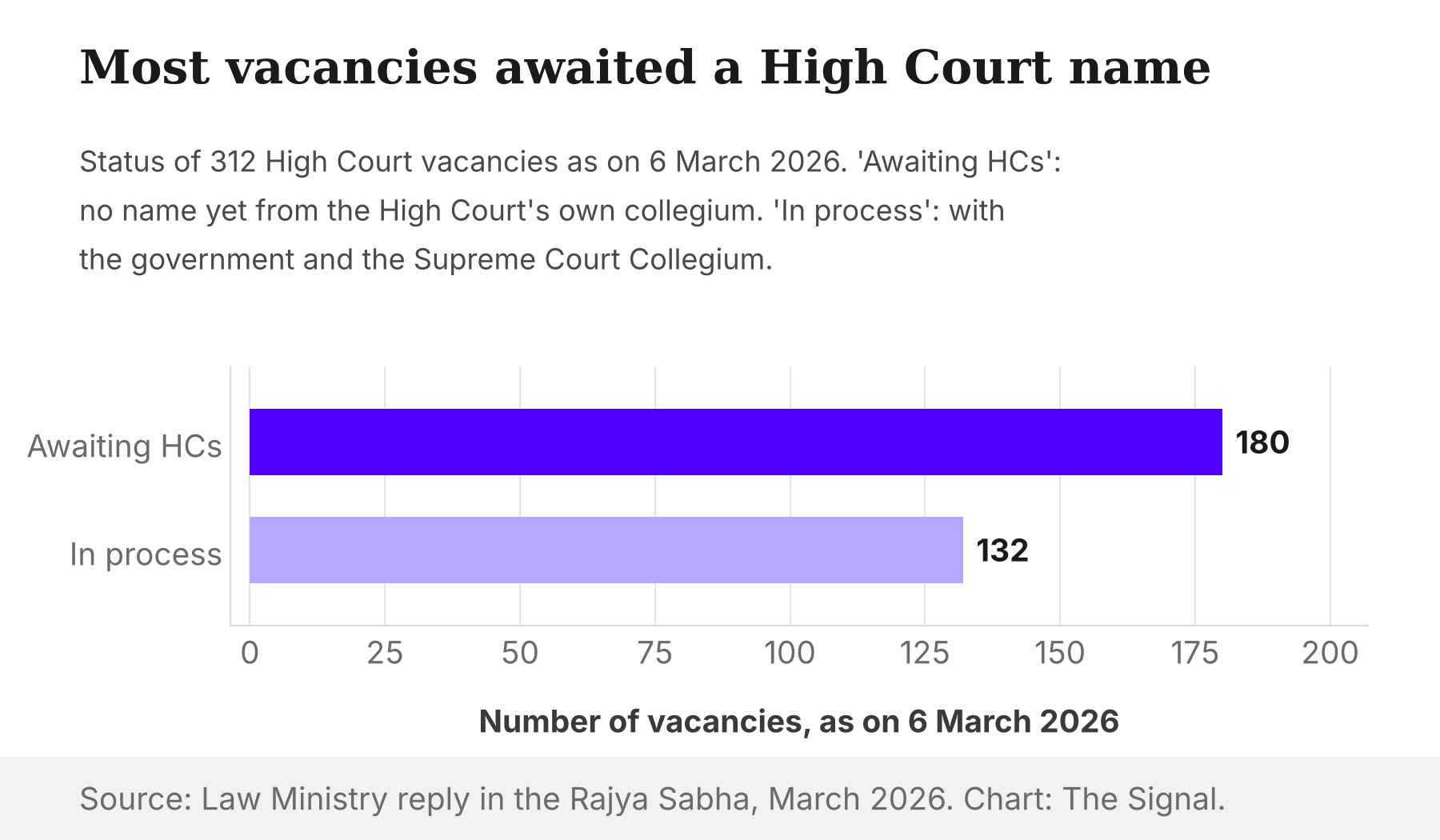
Under the 1998 Memorandum of Procedure, High Courts must recommend names at least six months before a vacancy arises, a time limit that "is rarely observed," the Law Ministry told the Lok Sabha. The vacancy gap is still large. As on 6 October 2026, High Courts had 830 judges working against a sanctioned strength of 1,122, with 292 posts vacant, the Department of Justice's vacancy statement shows. That is 26.0 percent of posts empty, down from 316 vacancies on 13 March 2026, per the earlier statement.
The honest objection
The strongest case for the Collegium is that it can only choose from the people in front of it. High Court judges come from two streams: senior advocates at the Bar and promoted district judges. If those two pools are themselves skewed by social background, then a Collegium choosing purely on seniority and reputation would reproduce the skew without any bias of its own. On this view, the 649 of 849 appointees since 2018 are a picture of who rose through the Bar and the subordinate courts, and the fix lies upstream, in who enters law and who gets briefed.
That case is real, and the data here cannot rule it out. The Ministry's replies count who was appointed, not who was eligible. No row in the public record used here measures the social composition of the senior Bar or the district judiciary. So the 23.6 percent cannot, on these numbers alone, be pinned on Collegium choice rather than on the pool.
The critics' answer is that the Collegium is not a passive filter. It decides which names travel and which do not, and a body that can pick from the top of a pool can also choose to reach deeper into it. Gavai's letter goes further, alleging that recent recommendations disregard merit, diversity and inclusivity, The Pioneer reports. His sharpest number, a community of under 5 percent of the population holding over 40 percent of Supreme Court representation, is his own figure about the top court, as Bar & Bench reports it, and is not measured by the High Court data used here. Both readings fit the same 200 of 849. This piece does not adjudicate between them.
A rulebook that was never finished
There is a mechanism both sides could use, and by the government's last public account it was still unfinished. The Supreme Court's December 2015 order directed the government to supplement the Memorandum of Procedure. A draft went to the Chief Justice in March 2016, and the government's stand was conveyed in July 2017. By March 2022, the government said, "The MoP is under finalization by the Government in consultation with the Supreme Court Collegium," the Law Ministry told the Rajya Sabha.
A finished MoP is where any written diversity criterion would live. It is also where a reform that reached upstream, into how High Court collegiums build their shortlists, would have to be written.
The Signal
Gavai's letter moves the diversity argument inside the judiciary, from one of its own former chiefs. The government's own figures give it a measurable base: 200 of 849 High Court appointees since 2018 from SC, ST, OBC or minority groups, per the Law Ministry's March 2026 reply. What those figures cannot do is say whether the narrowing happens at the Collegium's table or long before a name reaches it.
Watch three things. Whether the next parliamentary reply shows the newest batch holding above one in four. Whether High Court collegiums start sending names six months ahead, as the MoP already requires. And whether the MoP itself, last described by the government as under finalization in March 2022, is ever finished, and whether it says anything about diversity. A shortlist is decided before anyone signs a warrant.
Reporting basis: the letter's contents rest on two outlets' accounts, The Pioneer and Bar & Bench (in two reports), each reporting the letter dated November 27, 2026; the letter text itself was not independently checked, and only the phrases quoted here are drawn from those accounts. The appointment counts by social category for 2018 to March 2026, the women-judge counts, the pending-proposal figures and the Memorandum of Procedure's six-month rule are from Department of Justice compilations of the Law Ministry's Budget Session 2026 replies in the Lok Sabha and Rajya Sabha. The 2025 count of 715 appointees and the 2021 to 2026 count of 593 appointees are per LiveLaw, reporting Law Ministry written replies in the Rajya Sabha, and rest on that single outlet's reading. The vacancy figures are from the Department of Justice's statements as on 13 March and 6 October 2026, and the 2022 MoP position is from the Law Ministry's Rajya Sabha reply, via PIB. The shares from the four groups, the SC, ST and OBC share of 18.1 percent, the women's share of 14.1 percent, the split of appointees into the first 715 and the next 134, and the vacancy rate are The Signal's calculations from those figures.