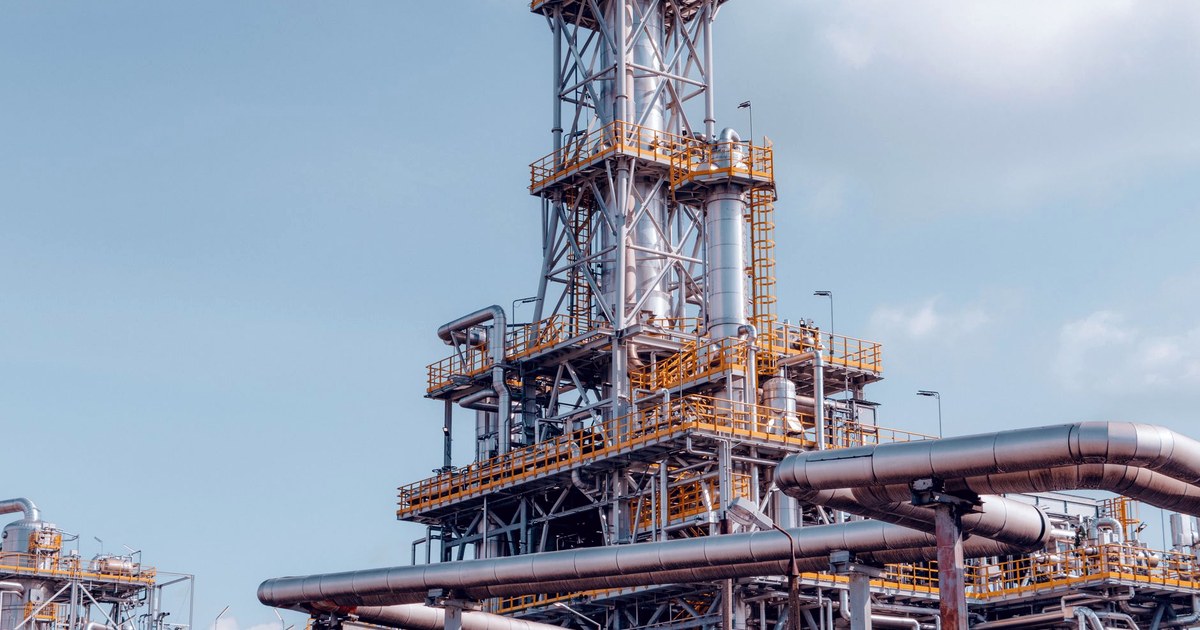
On October 21, US Secretary of State Marco Rubio flew to Jamnagar in Gujarat to tour Reliance Industries' refinery. The easy reading is a courtesy call attached to a stalled trade negotiation. But Rubio was specific about why this plant. He said Reliance "has the capability to refine the heavy crude that's produced in the Western Hemisphere, including from Venezuela", and he gave no volume target. A visit with no number attached invites the reading that nothing concrete is at stake.
It is worth slowing down on that. The number already exists, and it is large.
The figure that carries the story
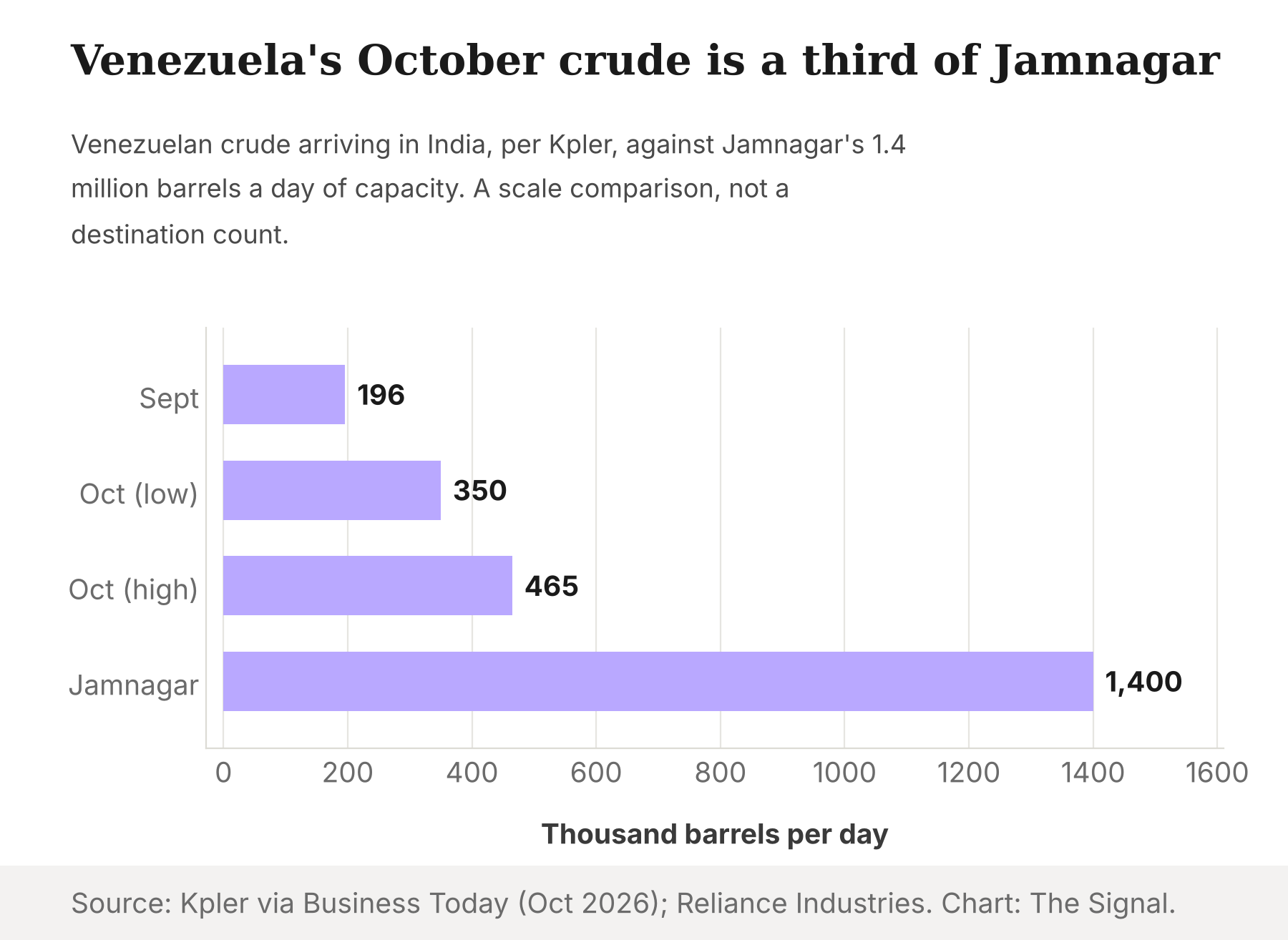
Kpler projects Venezuelan crude deliveries to India at about 465,000 barrels per day in October 2026, up from 196,000 in September. One Kpler analyst expects the month to average closer to 350,000 because some tankers may not discharge before October ends. Either way, on-time arrivals would make it the highest month since December 2019.
Set that against the plant. Reliance says Jamnagar has 1.4 million barrels per day of crude processing capacity. Venezuelan crude at 350,000 to 465,000 barrels a day is 25 to 33 percent of that. This is a comparison of scale, not a claim that every barrel goes to Jamnagar. But the Kpler report names Sikka, the port that serves Jamnagar, as the arrival point for at least two tankers due on October 31.
Why it has to be this plant
Venezuelan crude is heavy and sour, which makes it cheap to buy and hard to refine. Reliance describes Jamnagar's complexity index as 21.1, which it calls the highest in the world, a company claim about its own plant. The practical point comes from the tracker: Kpler's Sumit Ritolia said "not every Indian refinery can process them continuously or in large proportions". India has many refineries, and not every one can take this crude in bulk.
Washington is not short of places to send it. The US Energy Information Administration says Gulf Coast refineries are well suited to the heavy crude Venezuela produces. In February, it reported that oil previously bound for China was going to Caribbean storage, with the likely destination US Gulf Coast refineries. So Jamnagar is not a necessity for the United States. It is an outlet in a second market, one that keeps Venezuelan barrels flowing to a buyer that is not China.
The trade that is really on the table
The Venezuelan volumes arrive inside a larger bargain. Reliance received a US general license in February to buy Venezuelan oil directly, a license that, as the same report notes, followed a US trade deal demanding that India stop importing discounted Russian oil. The US tariff on Indian goods fell from 50 percent to 18 percent under a February framework, and a new sanctions law could impose tariffs of up to 100 percent on goods from the five largest importers of Russian oil or gas.
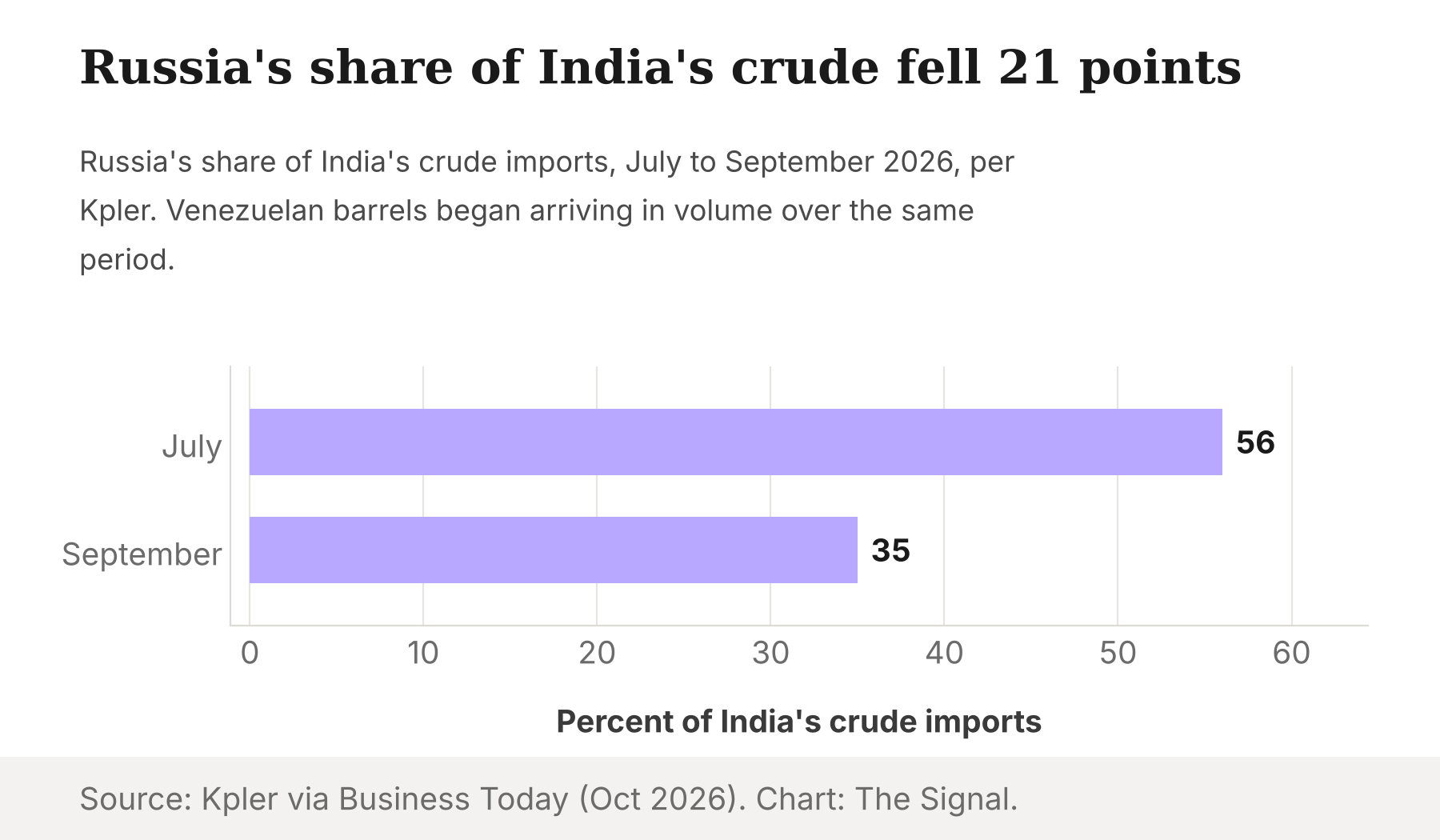
India's refiners need replacement barrels at a discount if they are to cut Russian supply. Russia's share of India's crude imports fell to around 35 percent in September from as high as 56 percent in July, and Venezuela's Merey grade is trading at a discount to Russian Urals. Venezuelan crude is a heavy grade that lets a refinery like Jamnagar replace Russian barrels without giving up the discount. The share fell 21 points in two months.
The honest objection
The strongest case against a geopolitical reading is that this is commerce. Reliance buys what pays. Merey trades below Urals, the plant is built for it, and a Secretary of State touring a refinery is stagecraft that follows the barrels rather than steering them. There is history to support this: Reliance had a 2012 term deal for as much as 400,000 barrels a day from PDVSA and took about 25 percent of Venezuela's exports in 2019, long before this diplomacy. Today's range of 350,000 to 465,000 is back near that old scale.
That case is real, and nothing here requires a hidden motive. But it answers a different question. Whatever drives Reliance, Russia's share of India's crude fell to around 35 percent in September from as high as 56 percent in July, and Reliance is the biggest buyer of Venezuelan crude outside the United States, per Business Standard. One private company now carries a large share of that shift.
The Signal
Concentration cuts both ways. For Reliance, it is leverage: the company that can run these barrels is the one Washington has to talk to. For India, it is exposure. The permission rests on a US Treasury license, and Reliance's earlier 2024 license expired and was not renewed. The supply is also fragile: EIA said the US oil blockade halted a large portion of Venezuela's exports in December 2025, and a policy change in either capital could halt the flow again, as the December blockade did.
Watch three things: whether Washington or Reliance puts a volume on the table, whether any second Indian refiner starts taking Venezuelan crude in bulk, and whether Russia's share, at around 35 percent in September, keeps falling or rebounds. A refinery that is the answer to two governments' problems is also the first place either one will look when the arrangement changes.
Reporting basis: Secretary Rubio's remarks are per The Tribune, reporting his comments to reporters. Venezuelan delivery projections, the Russian share of India's imports and the analyst's comments are Kpler data as reported by Business Today. Jamnagar's capacity and complexity index are Reliance's own description of its plant. The license, the 2012 term deal and the 2019 export share are per Bloomberg reporting carried by Transport Topics. Tariff rates and the sanctions law are per Al Jazeera. The December 2025 export halt and the destination of rerouted oil are from the US Energy Information Administration's February 2026 outlook. The 25 to 33 percent comparison and the 21-point drop in Russia's share are The Signal's calculations from those figures.