
On Tuesday, HSBC's group chief executive told the bank's Future Forum in Dubai that the Strait of Hormuz "could become 'redundant' in probably five years" as Gulf states build alternative routes. The logic is easy to follow. Pipelines run from oil fields to ports outside the strait, tankers load there instead, and the chokepoint stops mattering. For a country that imports most of its crude, it is a comforting thought.
It is worth checking against the numbers. Hormuz is large, and the pipes that exist are small by comparison.
The size of the gap
Before the conflict, oil and liquids through the strait averaged 21.6 million barrels per day in the fourth quarter of 2025, according to the US Energy Information Administration. The IEA, as relayed by Engineering News-Record in March, puts the current bypass ceiling at 3.5 to 5.5 million barrels per day across both pipelines. Set 5.5 against 21.6 and the best case covers about a quarter of the strait's flow. The low end covers about one barrel in six.
Even at its ceiling, the bypass fits about a quarter of what Hormuz carried.
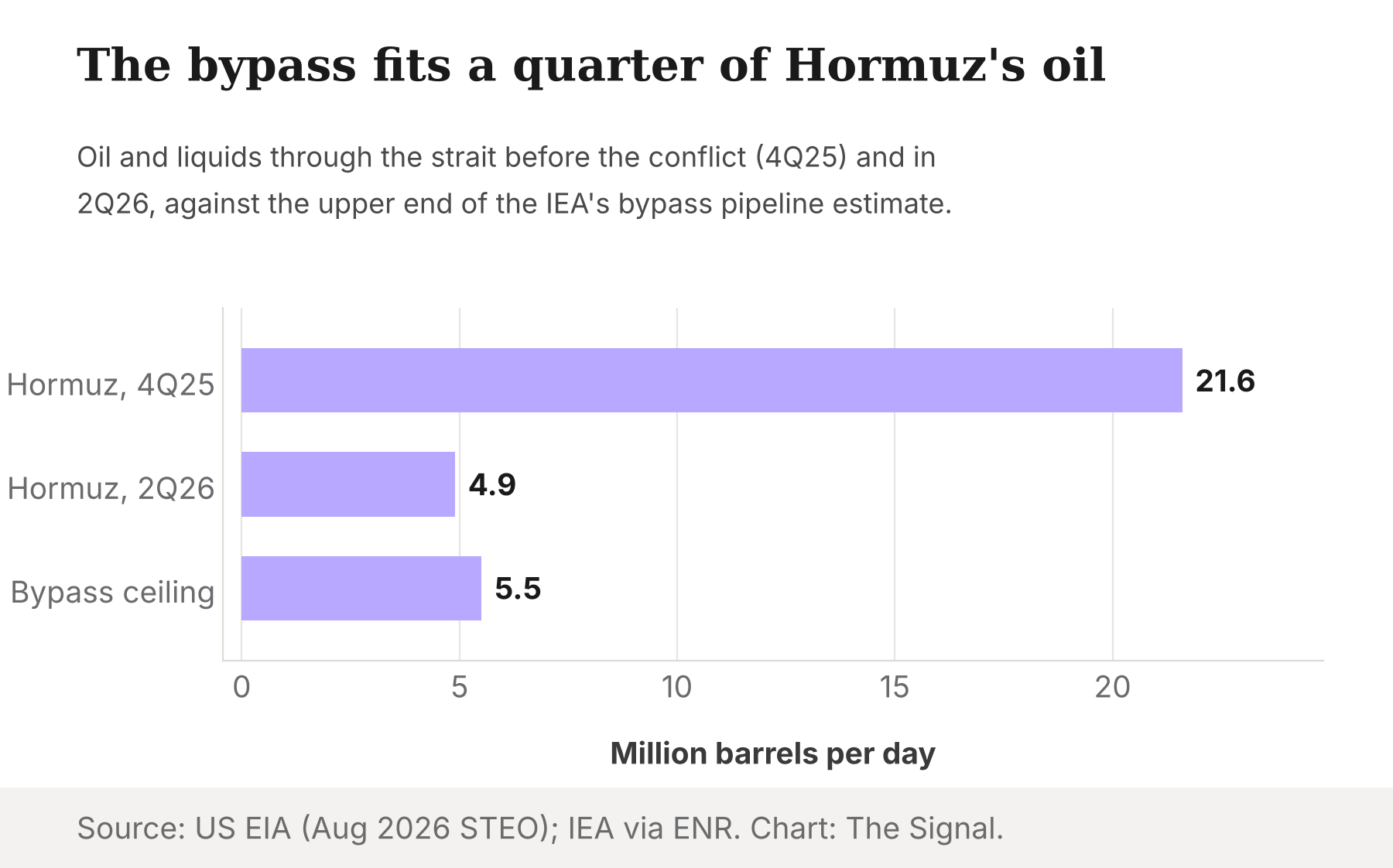
The war has already run the experiment. The EIA estimates that flows through the strait averaged 4.9 million barrels per day in the second quarter of 2026. Pipelines did not replace the missing 16.7 million. Much of the shortfall showed up as shut-in production instead: regional crude shut-ins averaged 4.8 million barrels per day in September, down from 5.8 million in August and 10.9 million at the May peak. The recovery from that peak is real, but the EIA still assumes that oil flows from the Middle East remain constrained through the fourth quarter of 2026.
The bypass has bottlenecks of its own
The two pipelines were built as a hedge against short disruptions. The EIA estimated before the war that only about 2.6 million barrels per day of spare Saudi and UAE pipeline capacity could be available to bypass the strait, against flows that averaged 20 million barrels per day in 2024. That is roughly one-eighth.
The UAE leg is the smaller one. The Habshan-Fujairah pipeline has a nameplate capacity of 1.5 million barrels per day, roughly 60% of the UAE's normal export volume, which leaves the other 40% designed to move through Hormuz.
The Saudi leg is larger but has a pinch point after the pipe. The East-West pipeline can move more than the port can load. Yanbu's two terminals have a nominal combined loading capacity of about 4.5 million barrels per day, according to ENR, citing Argus Media.
The September episode shows what that concentration costs. The EIA reports that before attacks on the East-West pipeline, it was shipping more than 5.0 million barrels per day of oil exports via Yanbu. The EIA's own account says the Brent spot price reached as high as $131 per barrel on September 15 as buyers scrambled for supply. A bypass that concentrates its flow in one pipe and one port is a chokepoint in its own right.
Where India is exposed
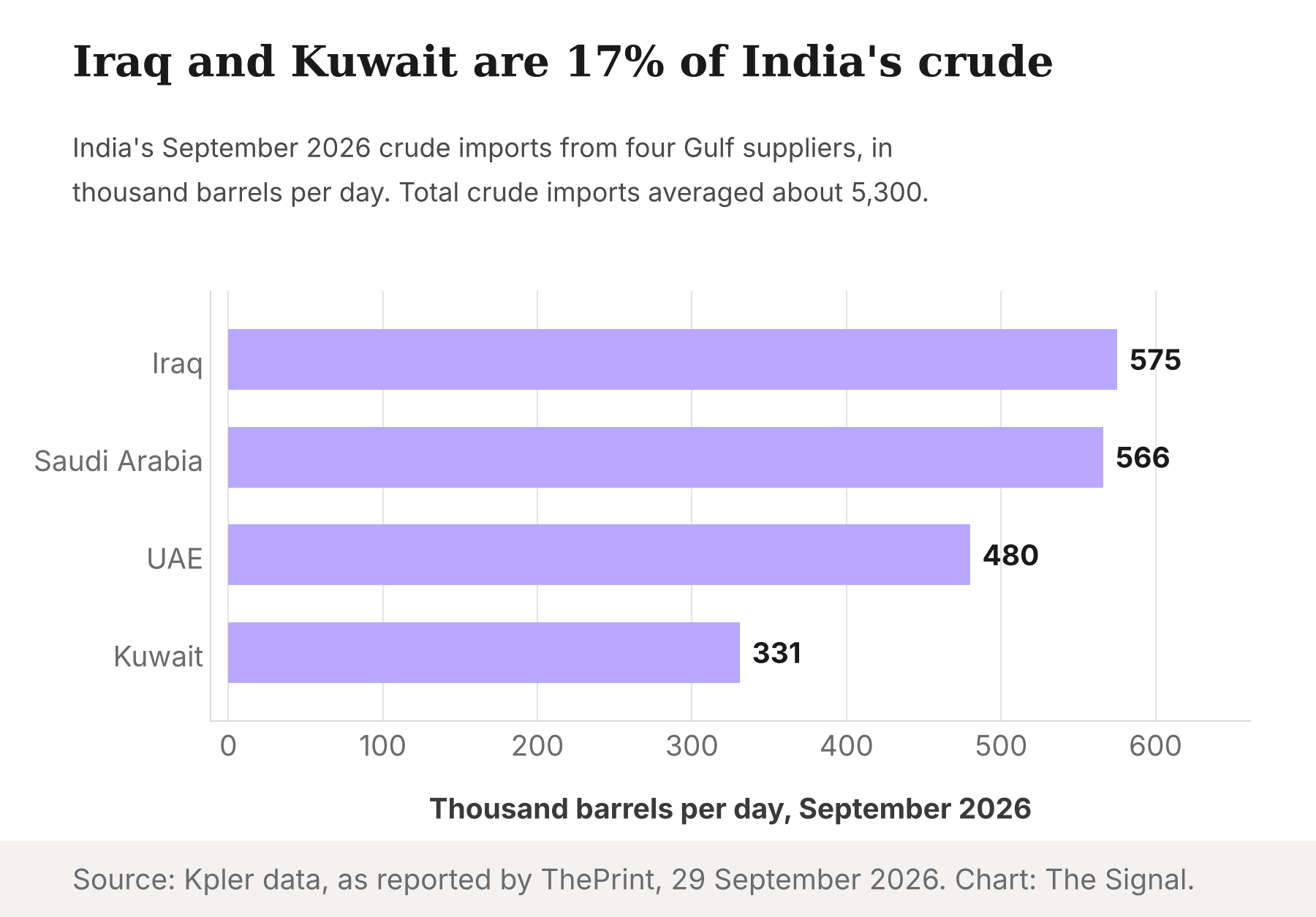
India buys heavily from the Gulf, and the exposure is not evenly spread. Kpler data show India's September crude imports from Iraq at around 575,000 barrels per day, Saudi Arabia 566,000, the UAE nearly 480,000 and Kuwait about 331,000. Overall imports averaged around 5.3 million barrels per day as of September 28.
The EIA's bypass estimate counts only Saudi and UAE pipelines. Iraq and Kuwait do not appear in it. Their combined September volume to India, 575,000 plus 331,000 barrels per day, is 906,000, which is about 17% of India's crude imports. Saudi and UAE barrels, the two suppliers with a pipeline option, add up to about 20%.
Iraq and Kuwait alone supplied about one barrel in six of India's September crude.
The honest objection
The strongest case for the HSBC view is that five years is a long time, and that the numbers above describe the pipes the region had, not the ones it will have. HSBC's CEO tied the forecast to investment in alternative logistics routes. A pipeline program sized for a permanent problem, rather than a short disruption, would look different from the one the region built as a hedge.
That case is real, but it answers a different question. Redundant would mean the strait no longer matters, and that requires building towards the 15 to 17 million barrels per day that the IEA's bypass ceiling leaves uncovered. A much larger bypass would reduce the strait's leverage. It would not remove it, and the terminals, ports and routes at the end of each pipe would carry the same risk the strait does today.
The Signal
The claim that Hormuz will be redundant in five years confuses a hedge with a replacement. The pipelines were sized to cover a fraction of the strait's flow, and in September one disrupted pipe was enough to push Brent to $131. India buys roughly one barrel in six from producers outside the EIA's bypass count.
Watch whether any Gulf government commits to capacity near the 15 to 17 million barrels per day gap, and whether India's Iraq and Kuwait share moves. A bypass built to cover a quarter of the flow protects a quarter of the oil. Everyone else still waits on the strait.
Reporting basis: strait flows, shut-in figures, pipeline volumes, the Brent price path and the outlook assumption are from the US Energy Information Administration's Today in Energy note and its August and October Short-Term Energy Outlooks. The UAE and Saudi pipeline capacities and the IEA's bypass ceiling are per Engineering News-Record's March article, which cites Global Energy Monitor, Argus Media and the IEA, so those figures rest on one relayed source and were not checked against the IEA's own publication. India's crude imports by supplier are Kpler data as relayed by ThePrint, a single source. The HSBC remarks are per Zawya. All shares, ratios and shortfalls computed in the text are The Signal's calculations from those figures.