On October 8, Vice President JD Vance announced that nine US universities are under investigation over how they use J-1 exchange visas. The Department of Labor's inspector general has issued subpoenas to examine "whether foreign influence, improper financial relationships or visa abuse are compromising federally funded research." The named schools include Harvard, MIT, Yale, Stanford, Caltech and Arizona State. The headline claim is a number: Vance said these schools use J-1 holders on federally funded research at about 61%, against a 38% national average. The reading in most coverage is a story about American universities, wages and fraud.
It is worth slowing down on that. STAT could not confirm where the 61% comes from, and no findings have been announced. But the probe is aimed at the visa that carries much of the world's research labor into the United States, and India is one of the biggest senders of that labor. That makes this an Indian story before any verdict arrives.
The 61% is a claim, not a statistic
STAT reported the figures and added a caveat: it "could not confirm the source of these numbers". The administration did not release university-level evidence at the announcement. MIT told reporters that each of its J-1 holders has been vetted and authorized by the US government, and Stanford said it complies with all applicable visa laws. Harvard confirmed it received a subpoena.
So the honest position is narrow. A federal inspector general is asking questions under subpoena. Nine institutions are responding. Nobody has been charged, and no visa has been cancelled. Anything beyond that, including the pay-gap allegation that has been reported in conflicting directions, is not something a reader can check today.
The pipeline the probe sits on
What can be checked is how large the pipeline is. The Institute of International Education counted 116,540 international scholars at US institutions in 2024/25, a 4% increase. These are postdocs, visiting researchers, visiting faculty and short-term scholars, counted over the academic year from July 2024 to June 2025.
India supplied 19,156 of them, up 8% and second only to China's 25,983. IIE's release also lists India among the origins at an all-time high. Divide 19,156 by 116,540 and India accounts for about 16% of the total, roughly one scholar in six.
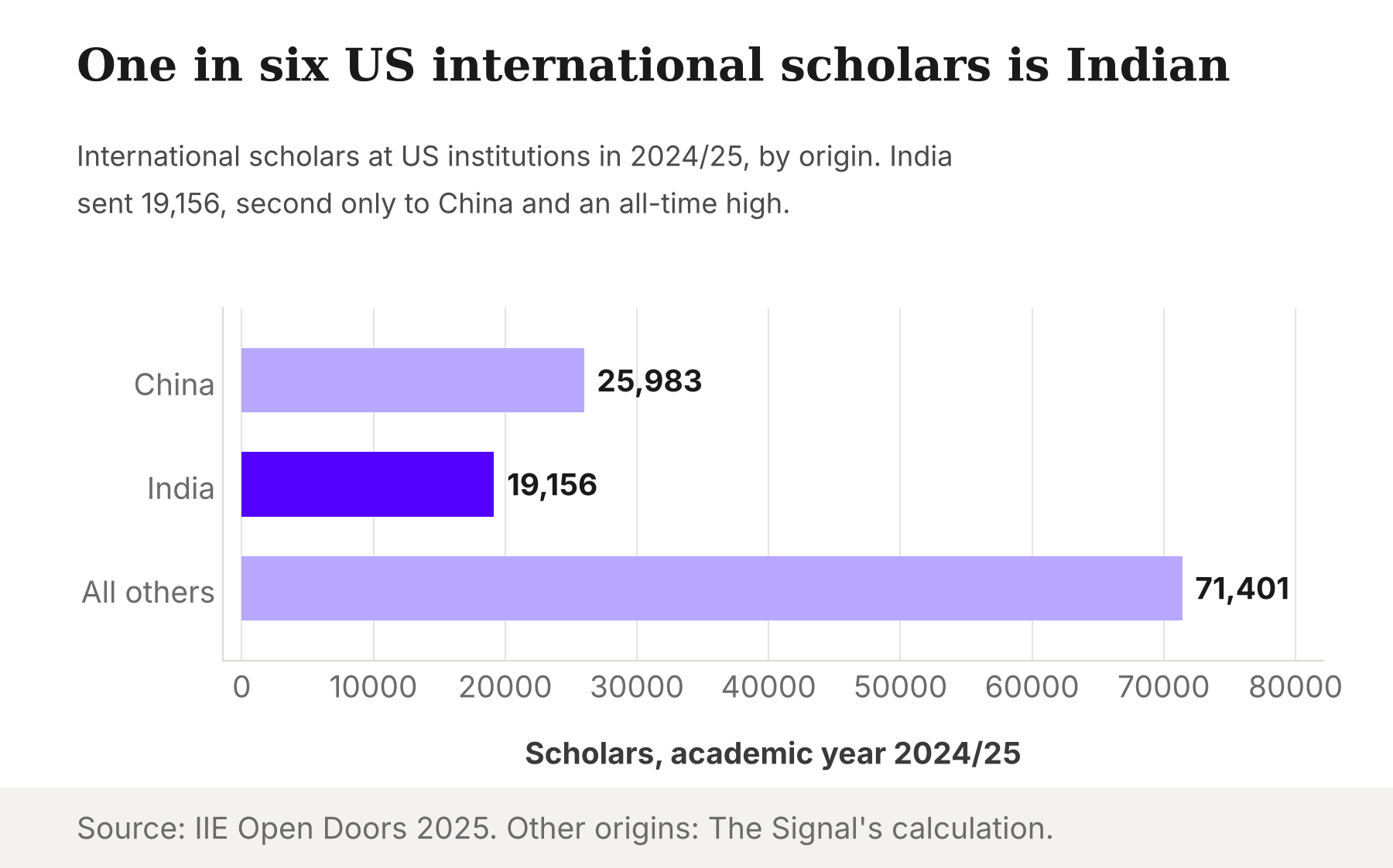
Note what the Open Doors count does not say: it does not break out J-1 holders, and it does not report how many of India's 19,156 sit at the nine universities under subpoena. Those links are missing from public data. What the numbers do show is scale: a probe of how universities use exchange visas is a probe of a labor pool in which Indians are a sixth of the total.
Why research labs feel it first
The work these scholars do is mostly research. IIE found that 75% of international scholars pursued research activities, and 78% worked in STEM fields. That is the opposite of a teaching-heavy visitor program.
Postdocs show the dependence most clearly. The National Science Foundation's 2024 survey found that 58.3% of US science, engineering and health postdocs were temporary visa holders, out of 69,877 in total. STAT's reading is that most of those are on J-1 visas, which is an inference from the article, not an NSF figure. Even so, the other side of the ledger is plain: citizens and permanent residents make up the remaining 41.7%, and a lab that loses a visiting postdoc cannot simply hire a local one at the same price and speed.
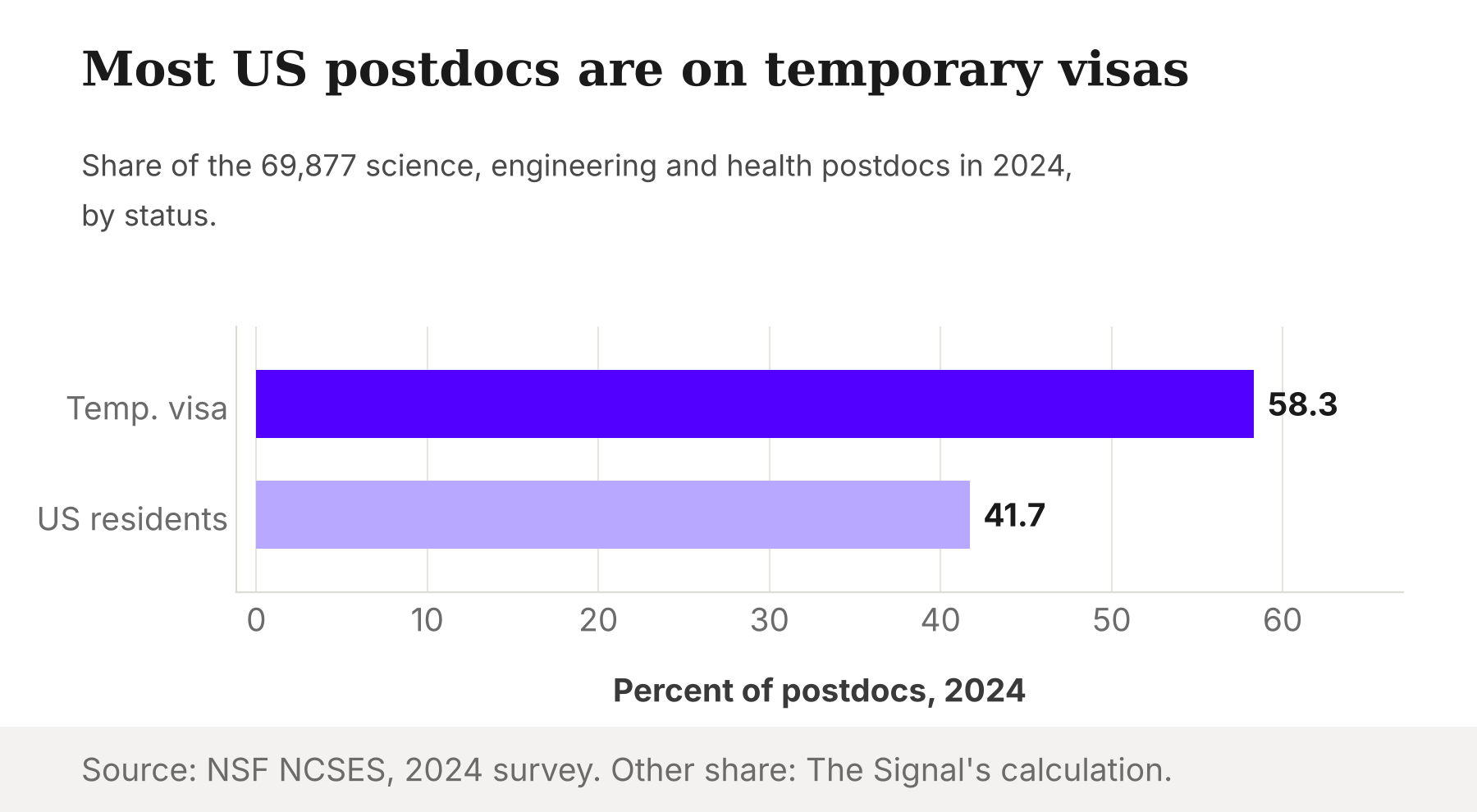
That is the revealed preference. Universities say they want American talent, and the funding rules favor it, yet the postdoc workforce leans on visitors. A probe that raises the cost of hiring them, through subpoenas, compliance reviews and the chilling effect on sponsors, raises the cost of running a lab.
A second squeeze, on hold
The probe is not the only pressure on this visa class. DHS published a final rule in the Federal Register on July 17, 2026 that replaces open-ended "duration of status" for F and J visa holders with a fixed admission period. UC Berkeley's international office reports that a federal court's preliminary injunction of September 14 put the rule on hold, so it did not take effect on September 15. The rule is paused, not dead, and the court's final decision is still to come.
The honest objection
The strongest case for the administration is that a visa meant for exchange can drift into cheap labor, and that concentration matters. If nine schools really do rely on J-1 holders far more than the national norm, as Vance said, asking why is a legitimate question, and wage effects on American graduate students are a real policy concern. An inspector general with subpoena power is the right instrument for testing it.
That case deserves a hearing. It does not answer the reverse risk. If the numbers do not hold, or if the finding is a handful of violations, the chilling effect still lands on every sponsor and every scholar, because universities rarely wait for a verdict before tightening hiring. The cost of the process can exceed the cost of the misconduct it targets.
The Signal
The probe has produced a claim and a subpoena, not a finding. But it lands on a pipeline at a record: India sent 19,156 scholars in 2024/25, up 8%, and 58.3% of US science, engineering and health postdocs were temporary visa holders in 2024. If sponsors respond to the investigation by hiring fewer visitors, the first place the reduction will show up is in the number of Indian scholars, which is a figure Open Doors will publish again in about a year. Watch that count, and watch which of the nine universities the Labor Department names first. A pipeline this size does not need to be shut to be damaged. It only needs to become a risk someone has to sign for.
Reporting basis: scholar counts, India's rank and the research and STEM shares are the Institute of International Education's Open Doors 2025 release, produced with the US State Department. Postdoc counts and visa shares are the National Science Foundation's NCSES survey for 2024. The 61% and 38% figures are Vice President Vance's, as reported by STAT, which could not confirm their source; the inspector general's subpoena language is per The Stanford Daily's account of the press conference, and the reporting rests on those two outlets for the announcement. The DHS rule is per the Federal Register, and its hold is per UC Berkeley's international office, which cites the court order and which The Signal did not check against the docket. India's one-in-six share and the 41.7% remainder are The Signal's calculations from those figures.