On 14 October 2026, the US Department of Homeland Security (DHS) finalised a rule titled "Removal of Automatic Extensions for Certain Employment Authorization Documents." The headlines called it the end of the 540-day extension for H-4 spouses, the dependants of H-1B workers, and left it there. Read as news, it is a procedural tidy-up: the rule adopts, without change, an interim rule that took effect on 30 October 2025.
It is worth slowing down on that. A timely renewal used to keep a work permit alive while US Citizenship and Immigration Services (USCIS) worked through its queue. That was the buffer between how long the agency takes and how early an applicant is allowed to file. DHS has removed the buffer, and the delay now lands on the person holding the permit.
What changed, and what did not
DHS says the rule does not change who is eligible: "This rule does not change the underlying eligibility of H-4, L-2, or other employment-based dependents to apply for employment authorization and/or EAD." H-4 spouses can still apply. What they lose is the right to keep working on a pending renewal once the old card expires.
That is the whole mechanism. The permit is only as continuous as the agency's processing is fast. The final rule records commenters telling DHS that "current processing times for H-4 EAD applications frequently exceed the recommended filing time of 180 days prior to the current EAD's expiration." Those are claims by commenters, not a DHS finding. But they describe the exact failure the old extension was built to absorb.
The number DHS itself prints
The strongest evidence that the gap is real comes from the rule's own impact analysis. DHS estimates that about 20,000 to 33,000 EADs will lapse in a single 18-month window starting in May 2027. The estimate rests on a 90-day renewal filing benchmark and has a midpoint of about 27,000. DHS also notes that this is not the entire population that would lapse.
Two cautions. These figures cover every category that lost the extension, not H-4 spouses alone, and DHS does not publish an H-4 split. And they are modelled lapses, not observed ones.
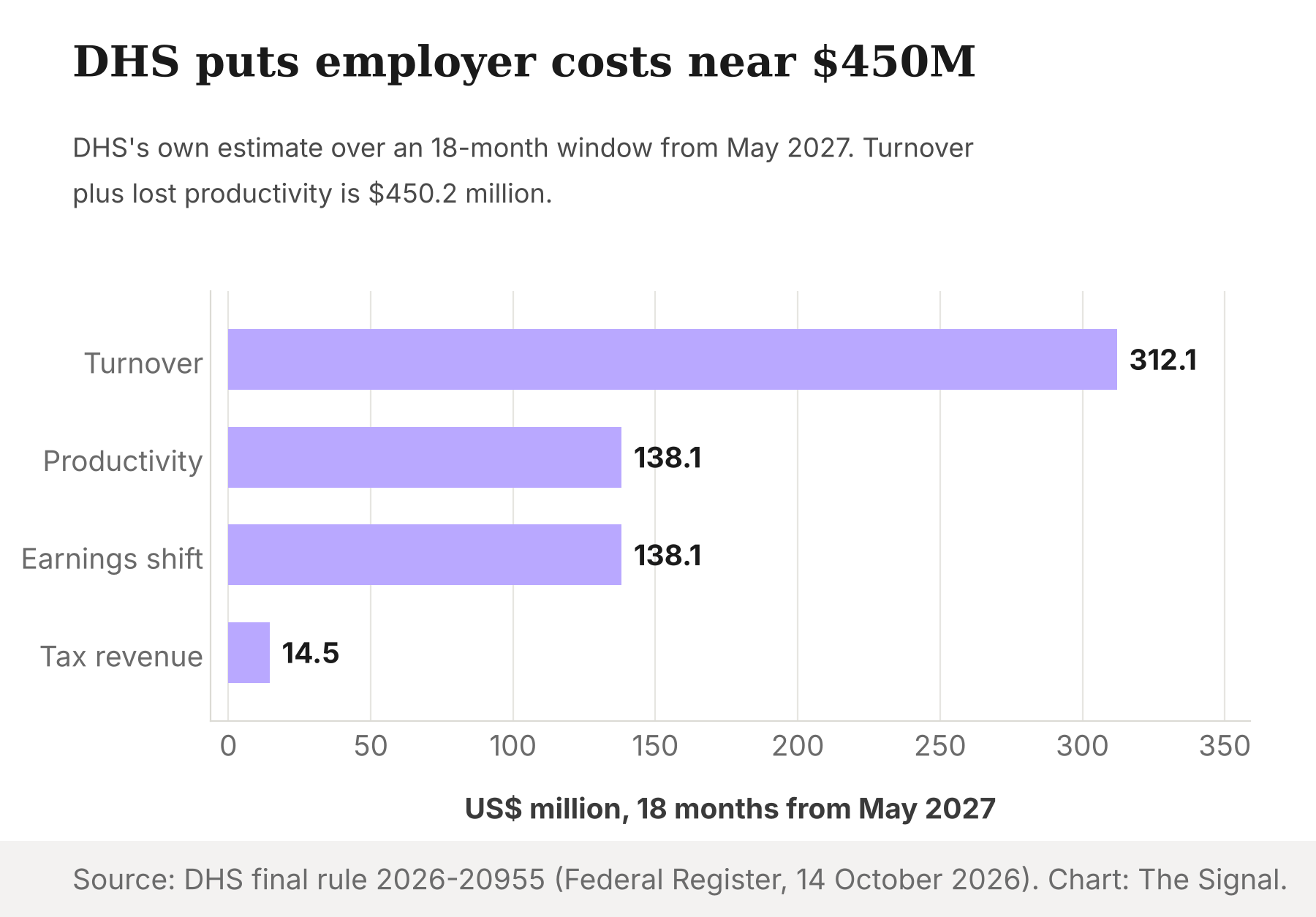
DHS then prices the damage. It puts $312.1 million in labour turnover costs on employers, $138.1 million in lost productivity, and $14.5 million in lost tax revenue over the 18 months, across 1,700 to 2,800 affected employers.
Who holds these permits
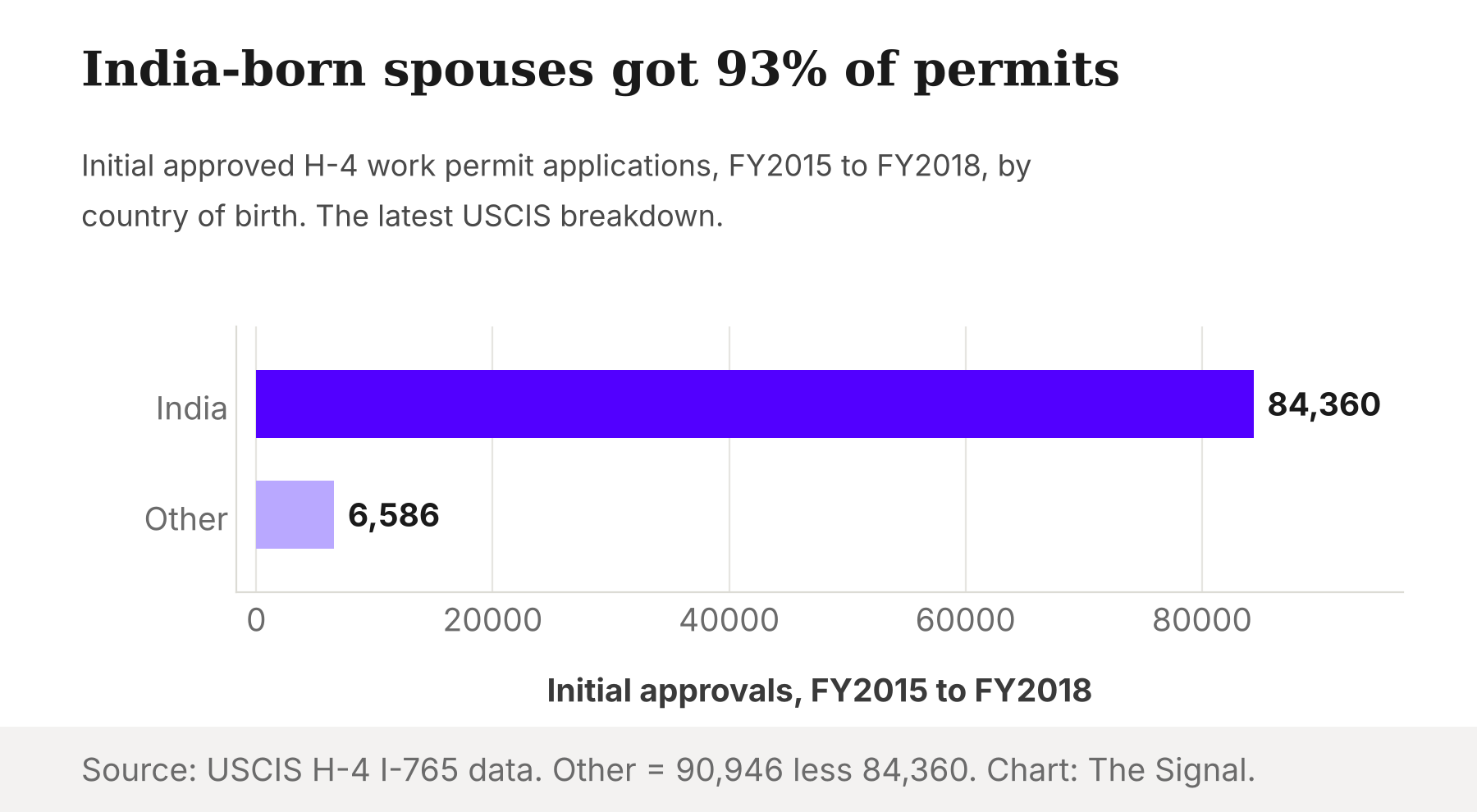
The latest breakdown found is USCIS's own H-4 data tables for fiscal years 2015 to 2018, so treat it as the composition of the pool, not a current headcount. In those four years, USCIS approved 90,946 initial H-4 work permit applications, and 84,935 of them were for women, about 93 percent.
By country of birth, USCIS lists India at 24,791 approvals in FY2015, 28,660 in FY2016, 24,779 in FY2017 and 6,130 in FY2018. Those add up to 84,360 of the 90,946, or about 93 percent. Every other country combined makes up the remaining 6,586.
The sponsoring side tells the same story. USCIS reports that 72 percent of H-1B petitions approved in FY2023 were for beneficiaries born in India, and the Congressional Research Service independently reports the same 72 percent. If the H-1B pool is mostly Indian, its spouses will be too.
Why the burden is not evenly spread
Put the two facts together. The rule applies to everyone in the covered categories, and DHS says it leaves eligibility alone. But the lapse risk depends on processing time, and the H-4 pool in USCIS's FY2015 to FY2018 tables is about 93 percent India-born and 93 percent female. A rule that is neutral on its face falls mostly on one group of people without naming them.
The mechanism also compounds. An H-4 spouse is, by definition, dependent on a principal's status. The permit was one of the few things the dependant held independently. A lapse converts a household with two incomes into one, and it does so on a date set by an agency queue.
The honest objection
DHS's case is not frivolous. It says ending automatic extensions strengthens vetting before a new period of work authorisation is granted. A permit that renews itself while a check is still pending is a permit issued before the check finishes, and that is a fair worry for any benefit programme.
There is also a fair reply to the lapse worry: DHS's estimate counts only filers who renew within a recommended window, so a spouse who files early may never see a gap.
Both points hold. They do not remove the problem. If processing regularly runs past the window, as commenters told DHS it does, early filing only shifts the exposure. And the 20,000 to 33,000 modelled lapses are DHS's own number, computed under its own 90-day benchmark.
The Signal
The rule is permanent now, and DHS's modelled lapse window opens in May 2027. The variable that decides how many H-4 spouses lose work time is no longer the rule. It is USCIS processing speed against the filing window.
Three things to watch: an H-4 specific lapse figure to replace DHS's all-category estimate, a post-2018 nationality breakdown so the India share can be measured, and H-4 renewal processing times that fit inside the filing window.
A permit that cannot be renewed on time is not a permit to keep working. It is a permit to keep waiting.
Reporting basis: the rule's text, the lapse and cost estimates and the public-comment summary are from DHS's final rule 2026-20955, as scheduled for Federal Register publication on 14 October 2026, read in the public inspection copy. The 2025 interim rule is from the Federal Register notice at 90 FR 48799. H-4 approval counts by gender and country of birth are from USCIS's data tables for FY2015 to FY2018, so they describe composition, not today's headcount. The H-1B India share is per USCIS's FY2023 report to Congress, as also stated by the Congressional Research Service, which draws on the USCIS report and counts as one origin. The processing-time claim is the commenters' as recorded by DHS, not a DHS finding, and DHS does not break its lapse estimates out for H-4 spouses. The 93 percent shares and the 6,586 other-country figure are The Signal's calculations from those figures.