On 8 October 2026 the US Labor Department froze the first step of the green card process for eight companies. Labor Secretary Keith Sonderling said the department "will not accept any new or process any pending permanent labor certification applications involving these companies", according to Human Capital Magazine. The list is Microsoft, Adobe, Cognizant, Infosys, Tata Consultancy Services, Wipro, HCL Technologies and Capgemini. The surface read is an immigration-politics story about American jobs, and that argument is real. But it skips what the freeze does to the people inside it.
For employment-based cases that require it, labor certification, known as PERM, is the step that comes first. The company asks the Labor Department to confirm that hiring a foreign worker does not displace a qualified American. Nothing else in the process can start until that step clears. The freeze does not cancel anyone's visa or status. It stops the paperwork that leads to a green card from moving at the eight named employers.
The clock starts at PERM
It is worth slowing down on one detail of how the line works. A green card applicant's place in the queue is set by a date, called the priority date. USCIS explains that for cases requiring labor certification, the priority date is when the Labor Department accepts the application for processing: "DOL accepts the labor certification application for processing."
That means the Labor Department's decision to stop accepting filings is also a decision to stop issuing places in line. A worker at one of the eight companies whose employer would have filed this month cannot be given a priority date this month. Whenever filing resumes, that worker joins the line later than they otherwise would have, and everyone with an earlier date moves ahead.
The cost of a late place depends on the length of the line. India's line is the one to look at.
India's line already trails the world by a decade
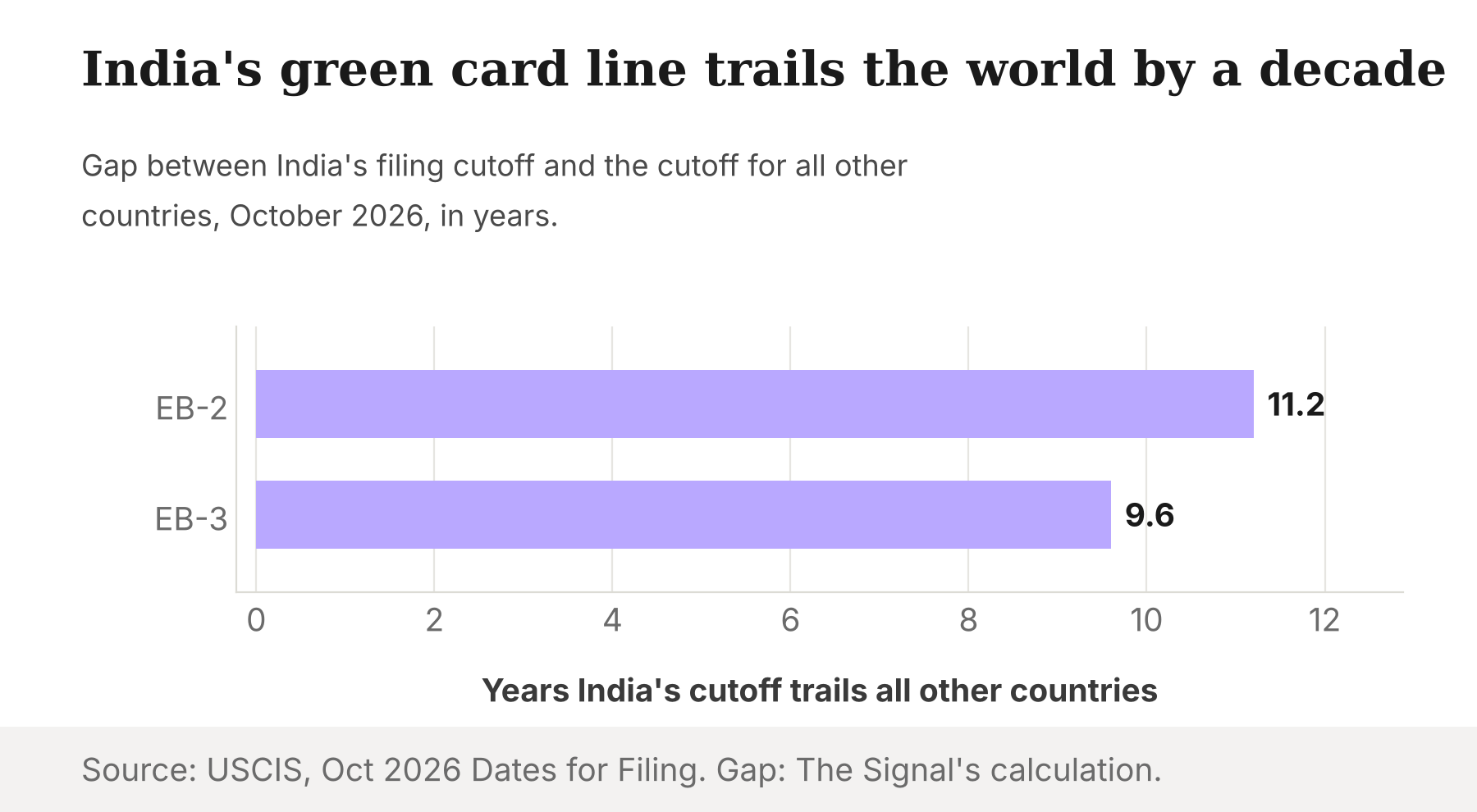
The State Department publishes a monthly Visa Bulletin that sets cutoff dates for each category and country, and USCIS reprints the filing chart. In October 2026, the filing cutoff for the EB-2 category, which covers advanced degrees, is 15 March 2026 for applicants from all areas except those with their own limits, and 15 January 2015 for India. In EB-3, which covers skilled workers, the cutoff is 1 August 2024 for all areas and again 15 January 2015 for India.
Put the dates from the filing chart side by side and the gap is plain. India's EB-2 cutoff sits about 11.2 years behind the cutoff for everyone else, and its EB-3 cutoff sits about 9.6 years behind. These are The Signal's calculations from the dates above. They measure the filing chart, which tells applicants when they may submit the final application, not when a green card arrives.
India's green card line trails the world's by a decade in both main work categories.
Read the two sets of dates together. For applicants from all other areas, the chart reaches paperwork begun in 2026 or 2024. For Indians it reaches only paperwork whose clock started in January 2015. A PERM filing that the Labor Department accepted in 2015 is only now reaching the final stage. The freeze interrupts the start of a process whose end sits a decade away.
What the freeze actually stops
It would be wrong to call the freeze a break in the whole system. The Labor Department certified 138,093 PERM applications in fiscal 2025 and received 117,849, a drop of 22.4 percent in applications received, according to its own statistics through 30 September 2025. The program was already processing more than it took in. At the end of that fiscal year, 157,669 applications were still waiting, so even in an ordinary year a worker's wait begins with a queue at the Labor Department itself.
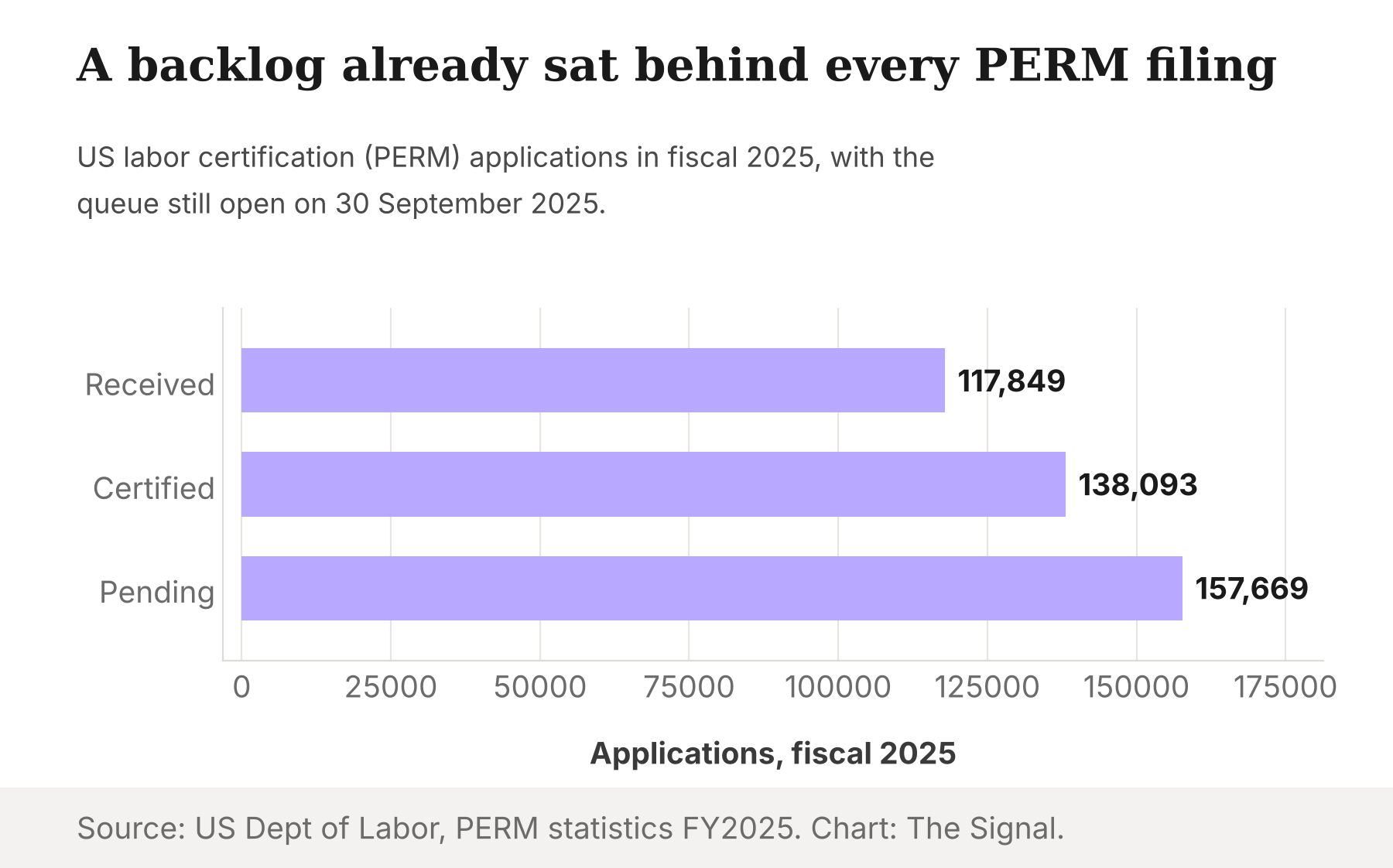
The freeze touches only the eight named employers, and the figures above do not say how much of that national volume is theirs. We do not have a reliable count of how many of the 138,093 certifications belonged to the eight, and we have not estimated one. What can be said is that the pending-applications figure of 157,669 includes anything the eight companies had already filed, and the order now says those cases will not be processed.
Who bears it
The employers can absorb a pause. The people inside the process cannot. A company that cannot file loses a retention tool, because sponsorship is how employers keep trained workers. The workers face the same problem from the other side: a new hire at one of the eight cannot have a priority date set this year, and a worker who was weeks from filing now waits on an announcement with no stated end.
Within that group, the Indian applicant has the most to lose from each month of delay, because the line behind the filing date is the longest. India's EB-2 cutoff trails the rest of the world's by 11.2 years, so the place lost is the one that already took the longest to reach.
The honest objection
The strongest case against this reading is that a freeze can be temporary, and a temporary freeze costs only what it lasts. Companies can resolve an investigation. The department can resume processing. Vice President JD Vance has said the suspensions would last as long as needed, and the department can lift them whenever it chooses. A worker delayed by three months has lost three months.
That is correct, and it is the best argument for patience. It also depends on an assumption nobody can check from outside: that the pause ends and that the department then accepts filings with dates that preserve the original order. If the freeze lasts, or if it ends with new conditions, then the loss is not three months at the front of a short line. It is three months, or thirty, at the front of the longest one. The honest read is that the damage depends on the duration, and the duration is the one fact the announcement left open.
The Signal
The freeze is being sold as a decision about eight companies. For Indians, it is a decision about a place in line. The filing cutoff for India sits a decade behind everyone else's, and the PERM filing is the first step, the one that fixes where each applicant stands. Stop that step and nobody moves, but the people at the back of the longest queue lose the most from standing still.
Watch two things. The first is whether the department publishes an end date or conditions for lifting a suspension officials say will last as long as needed. The second is whether the eight employers keep sponsoring Indian workers elsewhere in the process, or quietly start hiring around it. If the freeze lasts, the line will not shorten. It will lengthen for the workers who were next to enter it.
Reporting basis: the details of the freeze, the eight named companies and Labor Secretary Sonderling's quoted statement are per Human Capital Magazine's report on the announcement, the only source verified for the event; the department's own release was not accessible and was not checked. Labor certification counts for fiscal 2025 are from the Department of Labor's Office of Foreign Labor Certification. The October 2026 filing cutoffs are from USCIS, which reprints the State Department's Visa Bulletin, and the definition of a priority date is from USCIS. The 11.2-year and 9.6-year gaps between India's cutoffs and the rest of the world's are The Signal's calculations from those dates.