
On 5 October, Finance Minister Nirmala Sitharaman gave the clearest status report yet on the India-US trade deal. The Deccan Chronicle reports she said: "The agreement negotiations are still ongoing, although we'd like to believe that both sides have reached a plateau beyond which giving or taking might be very, very difficult."
The headline read is a stalemate that is hurting Indian exporters. The numbers say something more awkward. The tariff at the centre of the talks has already been reset, and the trade data do not agree on whether anyone is being hurt.
The tariff fight has already moved on
The earlier tariffs on India were based on an emergency-powers law that the US Supreme Court struck down. After that ruling, All India Radio News reported in February 2026 that "the tariff on India will drop to 10 per cent temporarily following US President Donald Trump's announcement of a new global tariff."
That temporary rate has since been replaced by a different one. In July 2026, the White House action on forced-labor imports set Section 301 duties of 10 percent for 17 economies including India, and 12.5 percent for all other investigated economies. The US Trade Representative explains that 10 percent applies to economies that have a forced-labor import ban, or have committed to one, or run a partial regime.
So India is in the lower tier, alongside the United Kingdom and Canada. A trade deal can still lower the cost further. But the negotiation is now about a modest duty, not the punitive one that made the talks urgent.
What Sitharaman said the US wants
The finance minister was candid about the other side's motive. She said: "Naturally, the deficit is there on their side, or the balance is unfavourable for the US, so they would want to reduce that imbalance."
That is the real sticking point. A tariff cut is a concession from Washington. Narrowing the deficit is a demand on India. The plateau she describes is the point where those two requests stop overlapping.
Two ledgers, two stories
If the stalemate were costing India exports, the figures should show it. They do not agree.
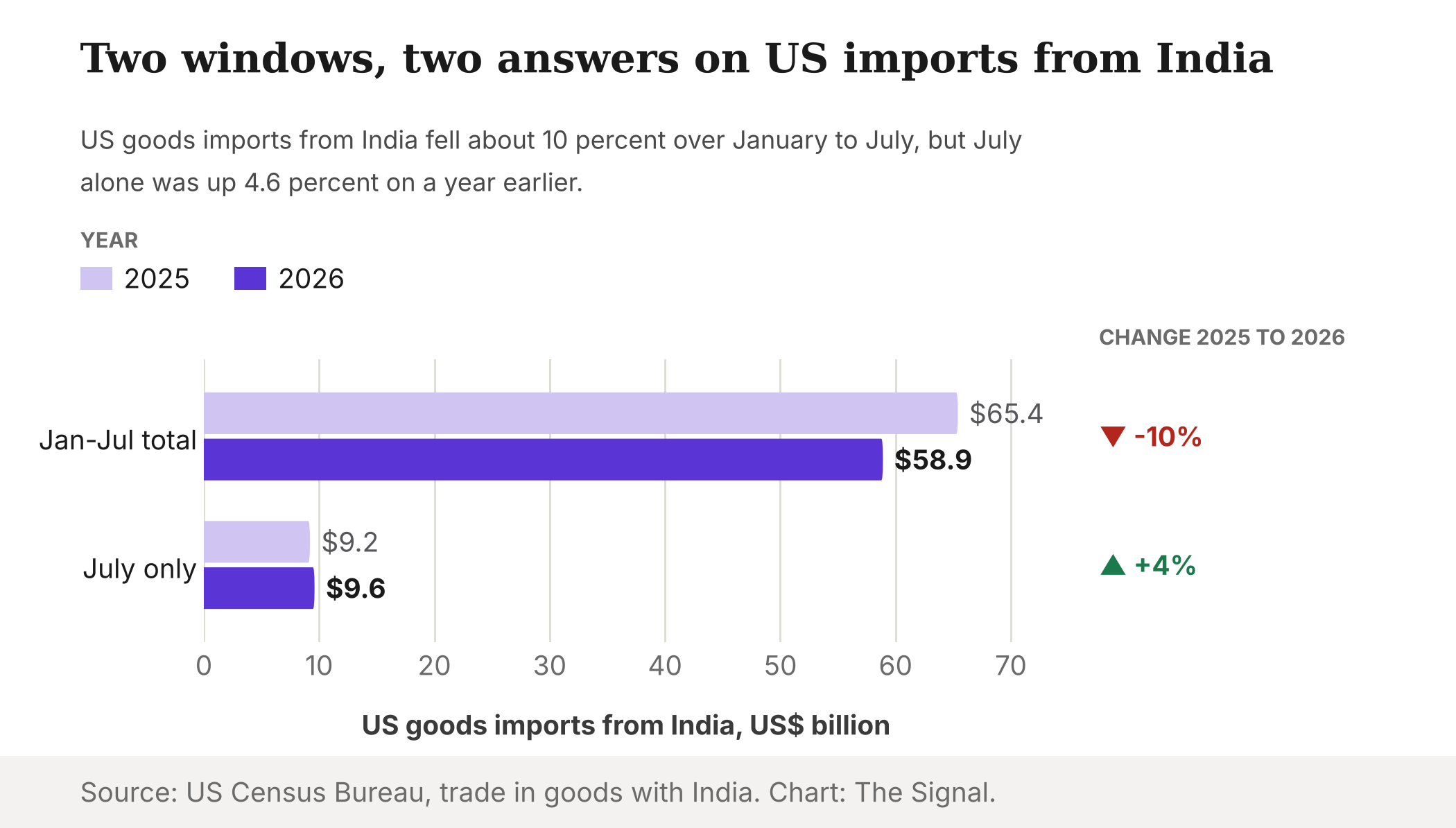
On the American side, the Census Bureau records US goods imports from India of $58,876.3 million in January to July 2026. For the same seven months of 2025, the monthly figures run from $8,144.6 million in January to $9,160.8 million in July and add up to $65,447.2 million. That is a fall of about 10 percent.
Yet July alone was $9,581.5 million in 2026, against $9,160.8 million in July 2025, a rise of about 4.6 percent.
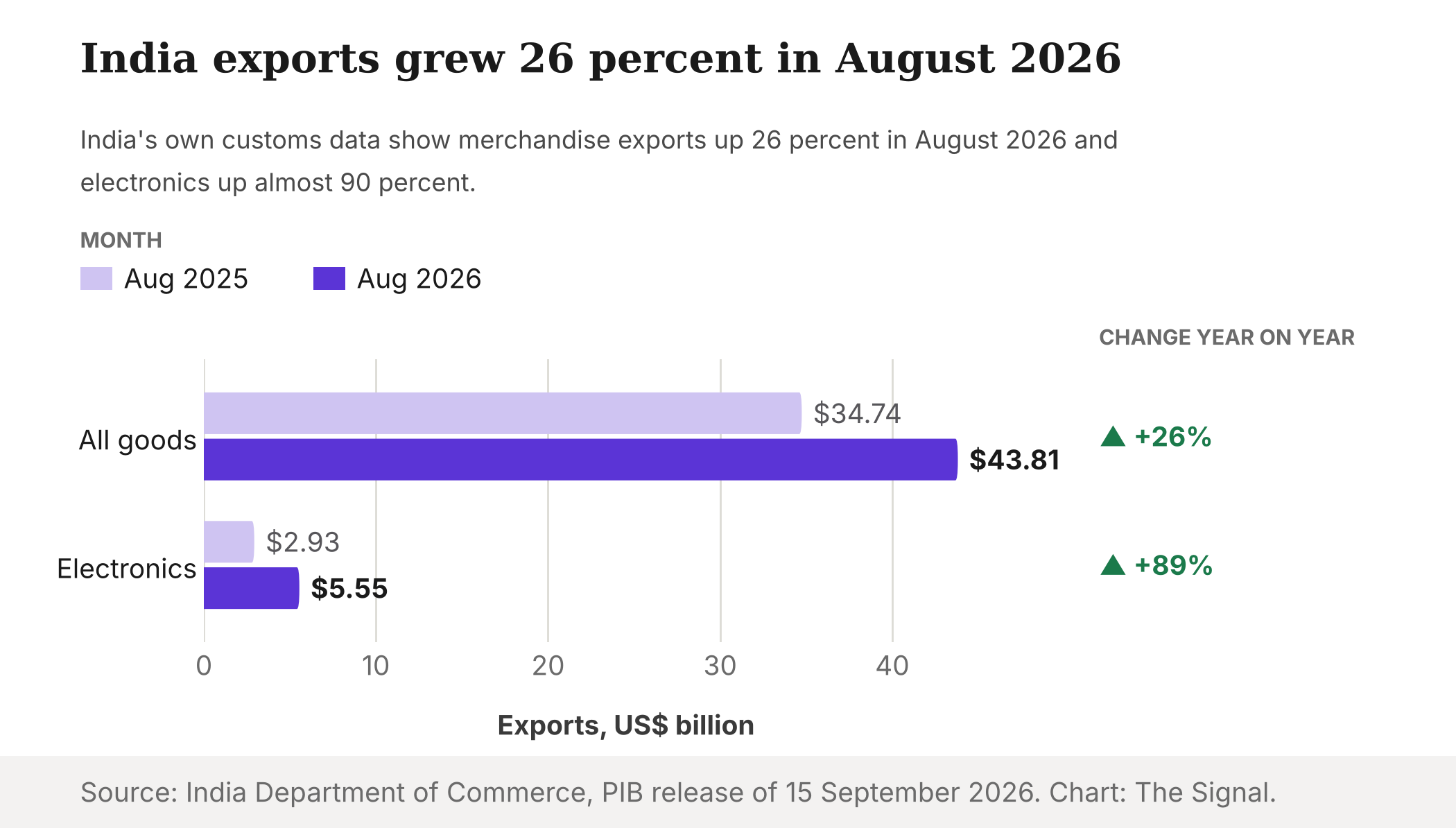
On the Indian side, the Commerce Department reports exports to the USA rose 21.83 percent in August 2026 and 6.17 percent in April to August 2026-27, year on year. Overall, merchandise exports were US$ 43.81 billion in August 2026 against US$ 34.74 billion a year earlier.
The two ledgers cover different periods and measure different things, so they cannot be reconciled line by line. Neither shows a collapse in the latest month, though: US imports rose in July and Indian exports rose in August.
The mix is changing, not just the total
The August gain was not evenly spread. Electronic goods exports rose 89.82 percent, from US$ 2.93 billion to US$ 5.55 billion. Over the same month, wood products fell 3.17 percent, leather 1.33 percent and organic and inorganic chemicals 0.51 percent.
Over April to August, merchandise exports were US$ 215.91 billion against US$ 183.21 billion a year earlier, growth of 17.85 percent.
The honest objection
The strongest case against this reading is that the Census data show a 10 percent fall over January to July, and one strong month proves little. India's own figures cover a different window and count exports, not US arrivals. The declines in leather and wood products may be early signs of the sectors most exposed.
All of that is fair. It is also why the claim here is narrow. The data do not show that the talks are unimportant. They show that the cost of failing to agree is smaller than the headline implies, which helps explain why neither side is rushing.
The Signal
A plateau is what a negotiation can look like when the pressure has eased. With India in the 10 percent tier and exports growing in the latest monthly release, delay looks cheaper than it did when the earlier tariffs applied.
Watch two things. The first is the next Census release, which will show whether the July rise was a blip or a trend. The second is whether the US keeps pressing the deficit demand Sitharaman named, because a lower tariff does not address it. A stalled deal is not the same as a damaging one, until the data say otherwise.
Reporting basis: Sitharaman's remarks are per The Deccan Chronicle's report of her comments, a single outlet account. The February tariff reset is per All India Radio News. The Section 301 rates are from the White House action and the US Trade Representative's announcement of 23 July 2026. US import figures are from the US Census Bureau's monthly goods trade series; export, commodity and destination figures are from the Indian Department of Commerce's release of 15 September 2026. The January to July 2025 total, the roughly 10 percent fall, the 4.6 percent July rise and the January to July sums are The Signal's calculations from those figures.