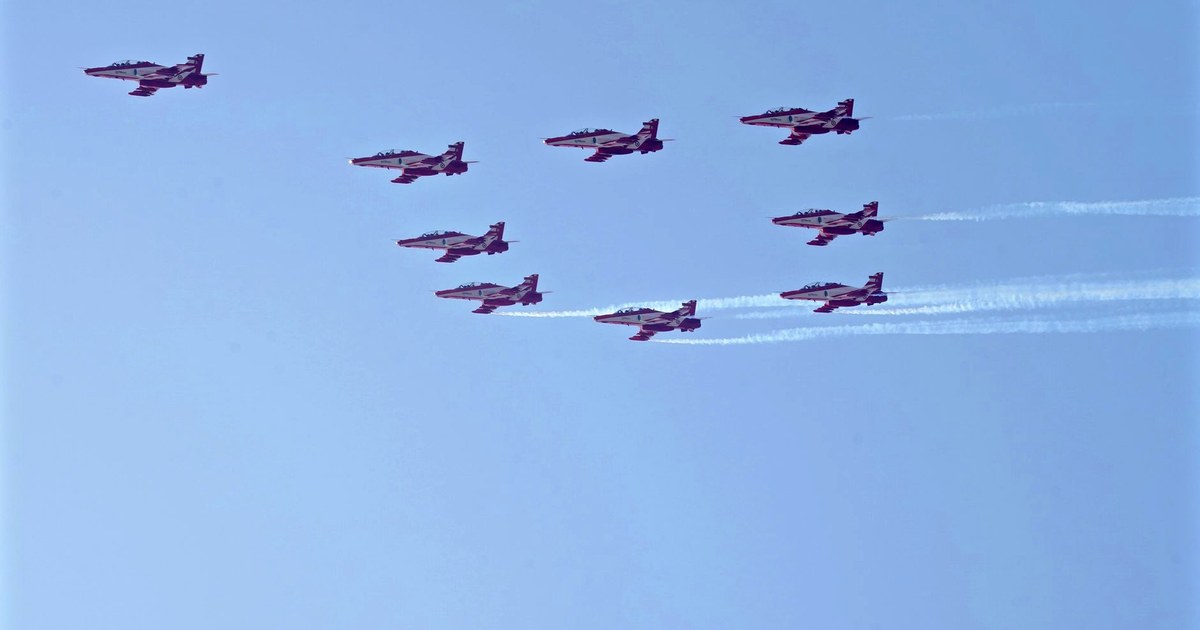
On 3 October 2026, the head of the Indian Air Force put the problem in one sentence. The force requires induction of at least 36-40 fighter jets annually for the next few years, Air Chief Marshal A P Singh said, according to ThePrint's report of his press conference. The headline reading is a delay story. The indigenous Tejas jet is late, the air force is hurting, and the fix is to hurry HAL along.
It is worth slowing down on that. Hurrying HAL does not close this gap, because the gap is bigger than the factory.
The need is a rate, not a stock
Squadron counts are the usual way to talk about this. PTI reports the force now operates 30 squadrons but requires 42 squadrons at full capacity. In February 2025, Singh said the IAF had 31 squadrons against a mandated 42, according to The Tribune. So the count fell from 31 to 30 in about twenty months.
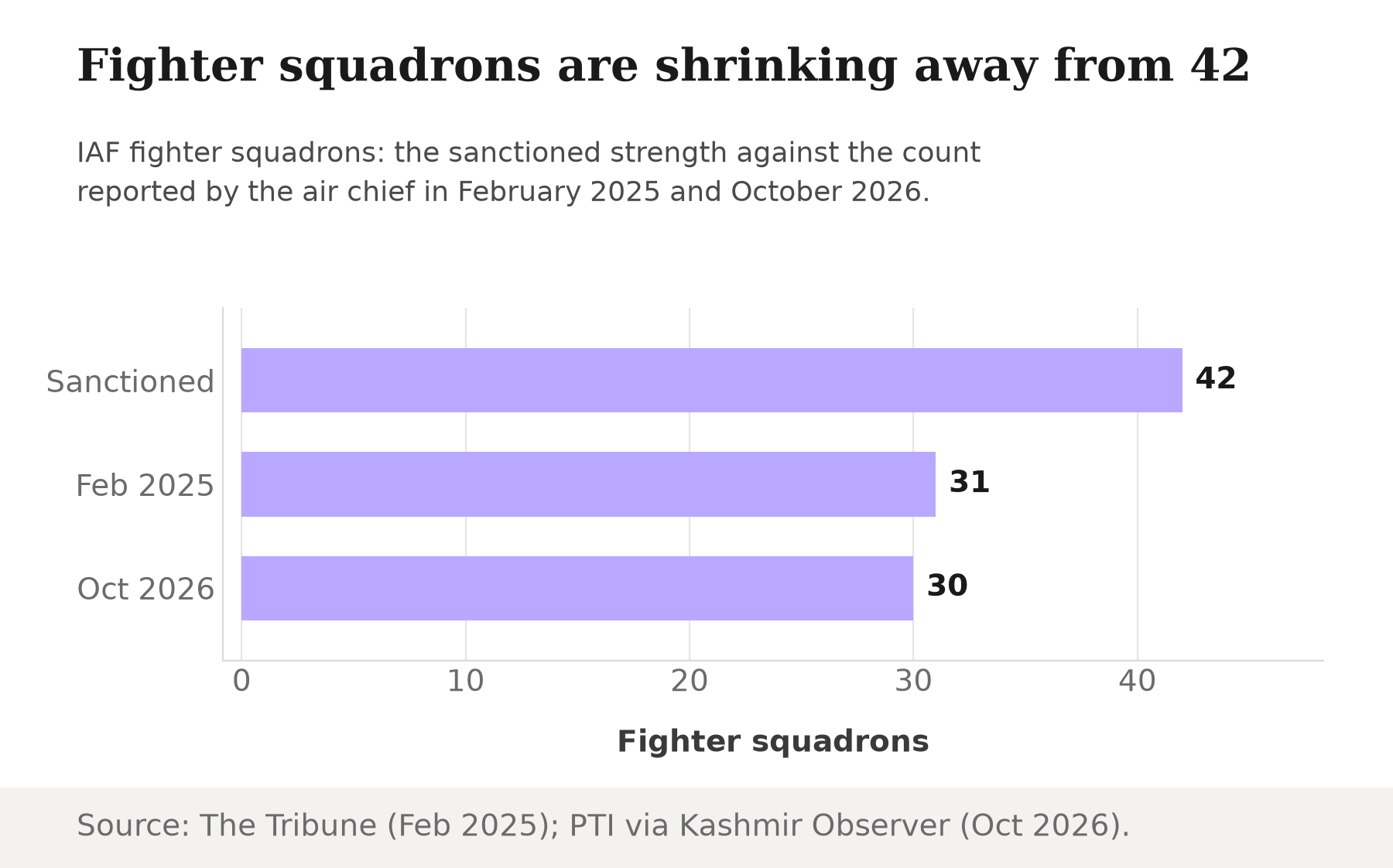
The 36 to 40 figure is the more useful number, because it is a rate. In the air chief's words, two squadrons a year, which means 35-40 planes a year, is what it takes to halt the decline. It is the induction pace required just to stand still, before any progress toward 42.
The factory ceiling is 24
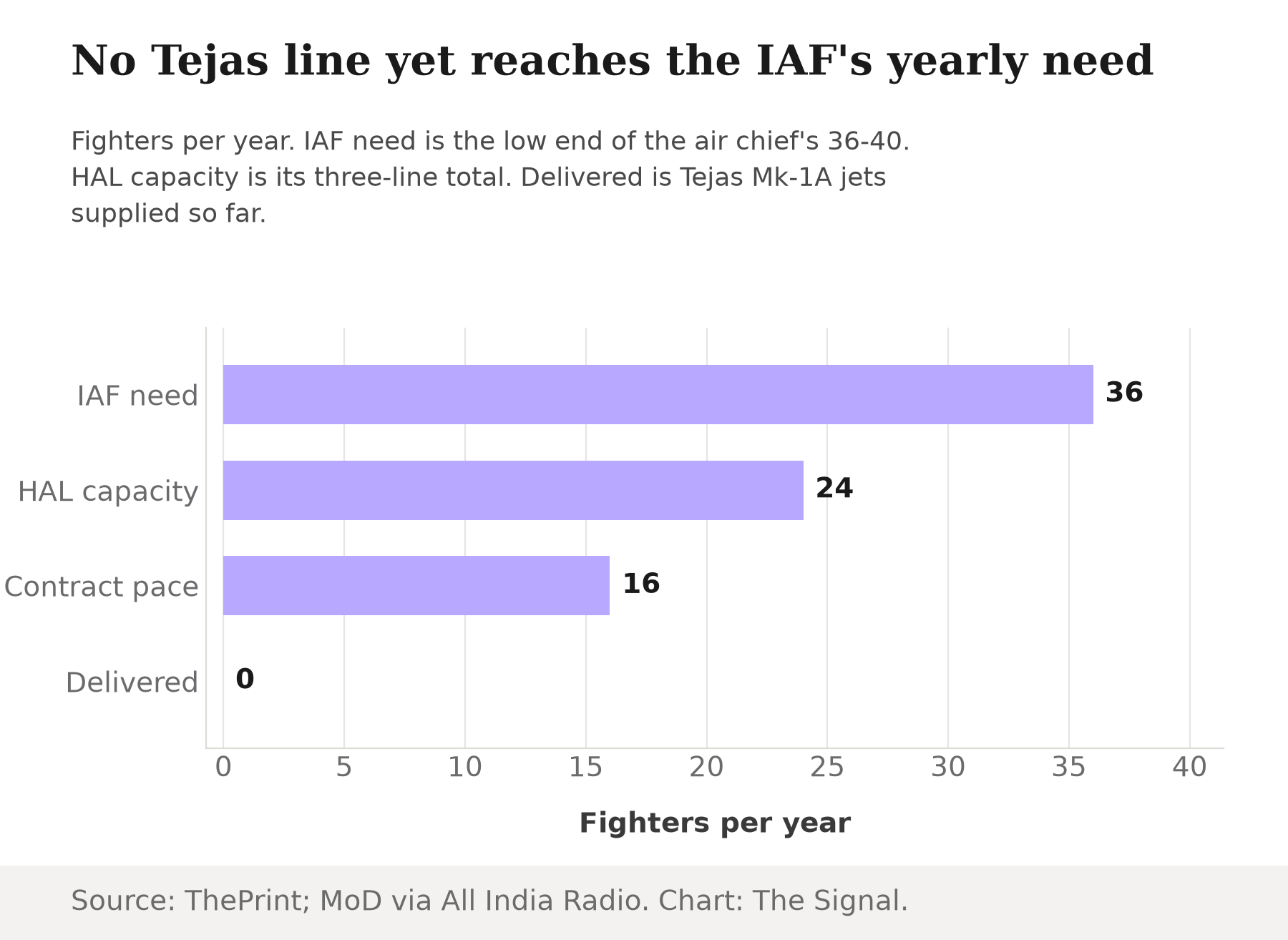
Now set that rate against the one domestic source. HAL's third Tejas production line at Nashik, a Ministry of Defence announcement carried by All India Radio says, adds eight more jets a year, lifting HAL's production capacity to 24 aircraft annually. The announcement is dated 17 October 2025.
The arithmetic is short. The low end of the IAF's need is 36. HAL's nameplate capacity is 24. The shortfall is 12 jets a year even if every line runs flat out, and 16 at the high end of the range. That is a ceiling, not a delivery record.
The delivery record is zero
Capacity is also a promise about the future. Here is what the past looks like. When the contract for 83 jets was signed in February 2021, ThePrint reported it as Rs 48,000 crore for 73 Tejas Mk 1A aircraft and 10 trainers, with a second assembly line meant to lift production capacity to 16 aircraft per year from the present eight.
The first aircraft were due in March 2024. PTI's account of the October 2026 press conference reads: the first set of aircraft was to be delivered in March, 2024, however not a single jet has been supplied to the IAF till now. That is roughly two and a half years late, with zero delivered.
Meanwhile the order book grew. In September 2025 the Ministry of Defence announced a further deal, worth over 62 thousand crore rupees, for 68 fighters and 29 twin-seat aircraft. The same release says delivery will commence during 2027-28 and be completed over a period of six years. Ninety-seven jets over six years is about 16 a year, well under the need.
Add the two orders and the total is 180 jets. At the full 24 a year, that is seven and a half years of production, for a force that needs 36 to 40 a year now.
The honest objection
The strongest case for patience is that this is a ramp, not a failure. HAL has widened its capacity from eight a year to 24 across three lines. Production lines mature, and a jet that arrives late can still arrive in bulk. In February 2025 Singh also pointed to a second source, saying the IAF could get 12-18 jets per year from private participation.
That case is real, and it is worth taking at full strength. HAL's 24 plus a private 12 to 18 would just about reach 36 to 40. But it is a sum of capacities that have not yet delivered a jet, and it assumes both sources hit their ceilings in the same year. Capacity on paper has so far not become aircraft in the IAF's hands.
The Signal
The delay is the visible story. The structural one is that the 36 to 40 a year target sits above the 24 a year the domestic pipeline can build even in a perfect year. Two things follow. Any plan to stop the squadron count falling needs aircraft from somewhere other than HAL's three lines, whether private producers or imports. And the date that matters is not when the first Tejas arrives, but when annual inductions first reach 36.
Watch for a Tejas handover to the IAF, and for a year in which more jets join the force than leave it. Until then, squadron strength is set by arithmetic, not by announcements. A factory's capacity is not a squadron.
Reporting basis: the induction need, the squadron counts and the Tejas delivery status come from Air Chief Marshal A P Singh's remarks as reported by ThePrint and by PTI via Kashmir Observer for October 2026, and by The Tribune for February 2025. These are press reports of his statements, not the air force's own records. The 2021 contract terms are per ThePrint's report at signing. The 2025 order and the Nashik capacity figure are from Ministry of Defence announcements as carried by All India Radio. The HAL capacity figure is a nameplate number, not a delivery record. The shortfall, the 16-a-year pace of the second order, the 180-jet total and the 7.5-year production span are The Signal's calculations from those figures.