On October 4, 2026, New Delhi told a parliamentary committee that Russia is opening its doors to Indian labour. External Affairs Minister S Jaishankar said Russia has agreed to take around 70,000 Indian skilled workers this year, especially in construction and logistics. Read alone, that sounds like a new corridor opening: tens of thousands of jobs, a fresh destination beyond the Gulf.
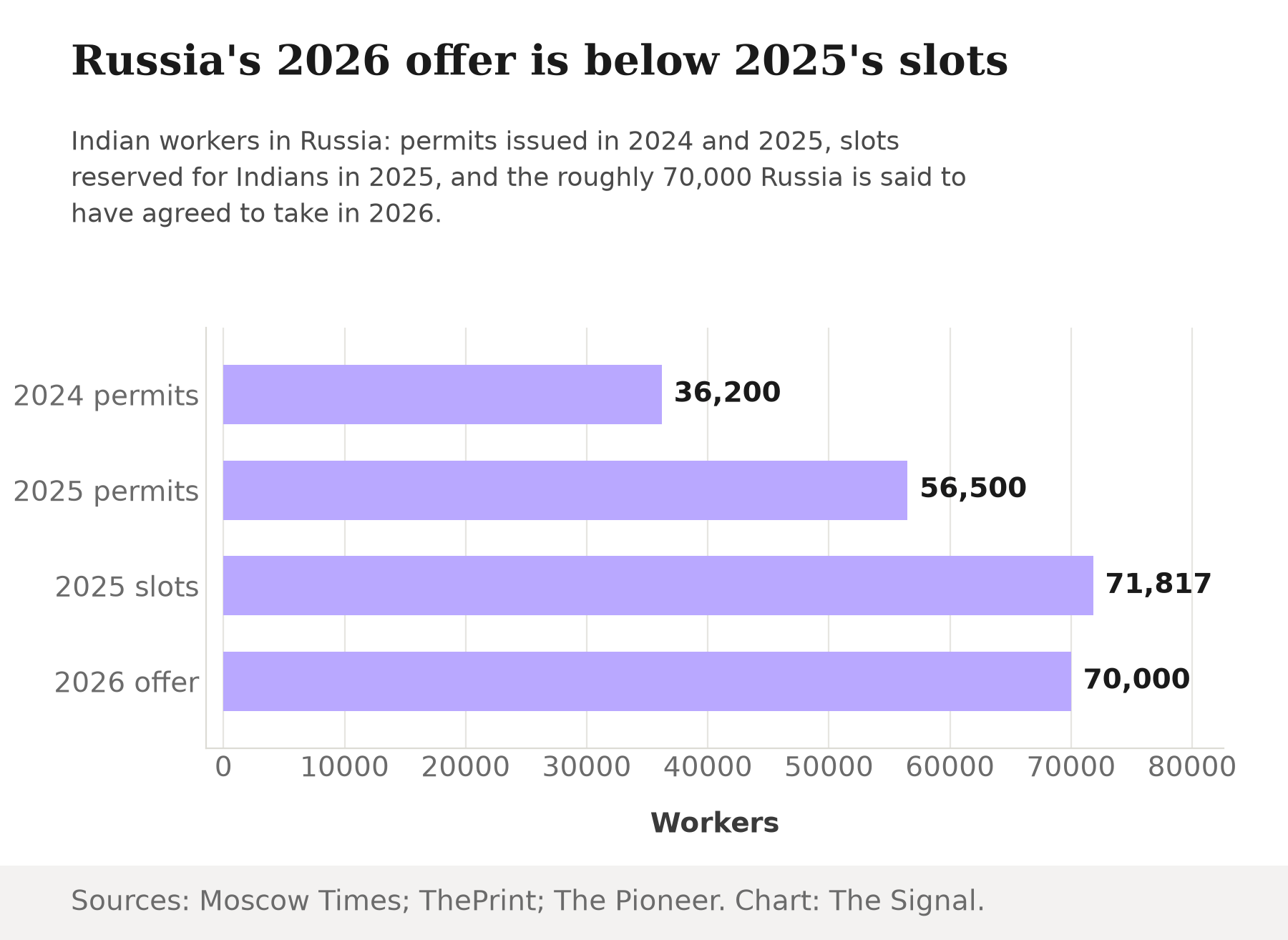
It is worth putting the number next to last year's. Russia reserved 71,817 slots for Indian workers out of its 2,34,900 foreign-worker quota for 2025. That is nearly a third of the whole quota set aside for one country. The 2026 figure of about 70,000 is roughly 1,800 below it.
Three different counts
The comparison needs care, because the figures measure different things. A reserved slot is a ceiling. A permit is a document actually issued. An "agreement to take" is a political statement whose exact meaning has not been published. We cannot tell from the reporting whether the 2026 figure is a quota, a target or a pledge.
What the permit count shows is that the flow is already moving. Russian authorities issued 56,500 work permits to Indian citizens in 2025, up from 36,200 in 2024, according to Interior Ministry statistics reported by Vyorstka and relayed by The Moscow Times. That is a 56 percent rise in a single year, and 56,500 is about 79 percent of the 71,817 slots reserved.
Now run the same growth forward. If permits to Indians rose another 56 percent in 2026, they would reach about 88,000, well above the roughly 70,000 offered. On the trend, the headline is not a stretch target. It is below where last year's momentum points. That is our calculation, and it assumes the 2025 pace holds, which is not guaranteed.
The gap is the real story
Russia is not offering these jobs as a favour. It needs the workers. Bloomberg estimated earlier this year that Russia faces a shortfall of about 1.5 million workers, while researchers at Moscow's Higher School of Economics put the figure at 2.6 million. The same report says the Labor Ministry has forecast that the gap could widen to 3.1 million workers by 2030.
Against that, the 70,000 offer is small. It is 4.7 percent of the 1.5 million estimate and 2.7 percent of the 2.6 million one, per the same report.
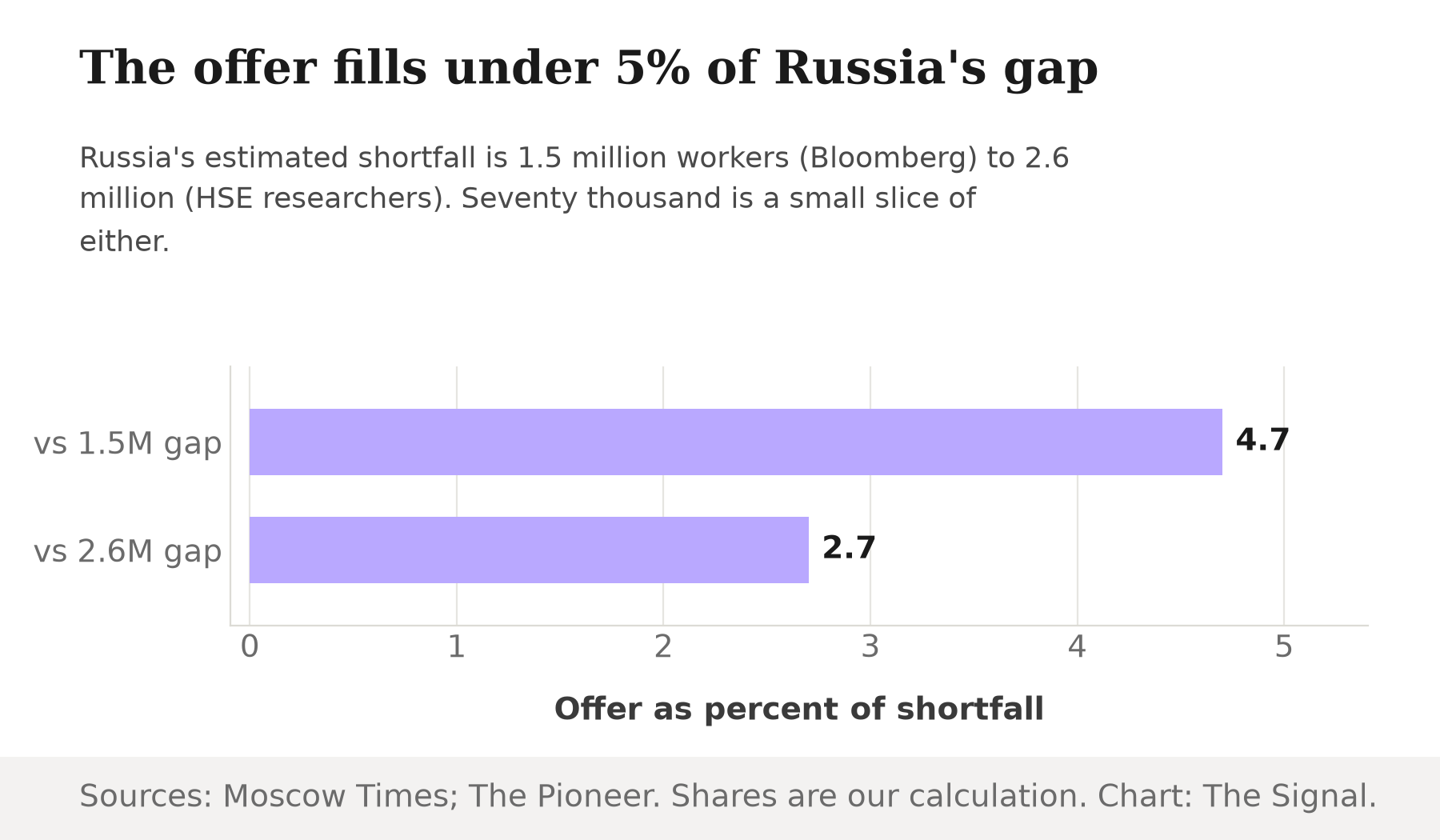
This reframes who holds the leverage. If Russia's need is in the millions and its offer to India is in the tens of thousands, the binding limit is not Russian demand. It is how many permits Russia chooses to issue, how fast, and on what terms. India is a supplier in a market where the buyer is short by a large multiple of what it is buying.
How big is this for India?
For India the stake is mostly in the wage, not the headcount. India is the world's largest remittance recipient, and it received $120 billion in remittances in 2023, a 7.5 percent increase, according to the World Bank. The Reserve Bank of India's survey puts 2023-24 inflows at US$118.7 billion, with the Gulf economies contributing 38 percent. Russia is a rounding error in that picture today. The Gulf is the corridor that built it.
ThePrint's reporting captures why workers still look north. It cites a Moscow wage of Rs 1 lakh a month against around Rs 40,000 a month in Saudi Arabia for one worker it interviewed. That is a single account, not a survey, and it should not be read as an average. It does show the pull.
The honest objection
The strongest case against this reading is that a government-to-government commitment, like the one Mr Jaishankar described, is worth more than a quota slot. A slot says Russia may admit up to a number. An agreement can bind both sides on recruitment, contracts and recourse. If the 2026 figure reflects firmer terms, then equal headcount could still be a better deal for workers.
That may be true, and the reporting so far does not rule it out. But it is a claim about terms, and the report of the minister's briefing publishes none. Until they appear, the only verifiable fact is the number, and the number matches what Russia had already set aside.
The Signal
The 70,000 figure continues a flow that was already growing, not the opening of a new door. Russia's shortfall is large enough that it can absorb far more Indian workers than it has offered, so the number to watch is not the pledge. It is the Interior Ministry's count of permits issued to Indians for 2026. If that passes 88,000, the offer was conservative and the real constraint is Delhi's willingness to supply workers into a country at war. If it stalls near 70,000, the pledge was a ceiling all along.
Reporting basis: the 70,000-worker figure is per The Pioneer's report of the External Affairs Minister's statement to a parliamentary consultative committee, and we did not verify it against a government transcript. The 2025 permit counts are Russian Interior Ministry statistics as reported by Vyorstka and relayed by The Moscow Times, a single chain of sourcing. The 71,817-slot and 2,34,900-quota figures and the Moscow and Saudi wage anecdote are per ThePrint. The labour-shortfall estimates and forecast are Bloomberg, Higher School of Economics and Russian Labor Ministry figures as reported by The Moscow Times. Remittance totals are from the Reserve Bank of India's March 2025 Bulletin and a World Bank press release. The shares, the 79 percent and 56 percent ratios, the 1,800 gap and the 88,000 projection are The Signal's calculations from those figures.