On 29 September 2026, at the Asia Society in New York, India's foreign minister said that there is going to be a major food crisis probably in the coming months, pointing to grain exporters around the Black Sea that may not be able to ship and to fertiliser shortages. The same day, the Centre set a 2026-27 foodgrain production target of 373.93 million tonnes, 2.63 million tonnes below last year's output, citing El Nino. Put the two together and the reading writes itself: a warning abroad, a lowered target at home, and a country bracing for a bad harvest.
It is worth slowing down on that. The target was cut by 2.63 million tonnes from a base of 376.563 million tonnes, the highest foodgrain output in India's history in 2025-26, up 5.3 percent on the year before. That is a trim of about 0.7 percent, from a record. The target is a caution about the weather. It is not a forecast of scarcity.
The buffer is not the exposed part
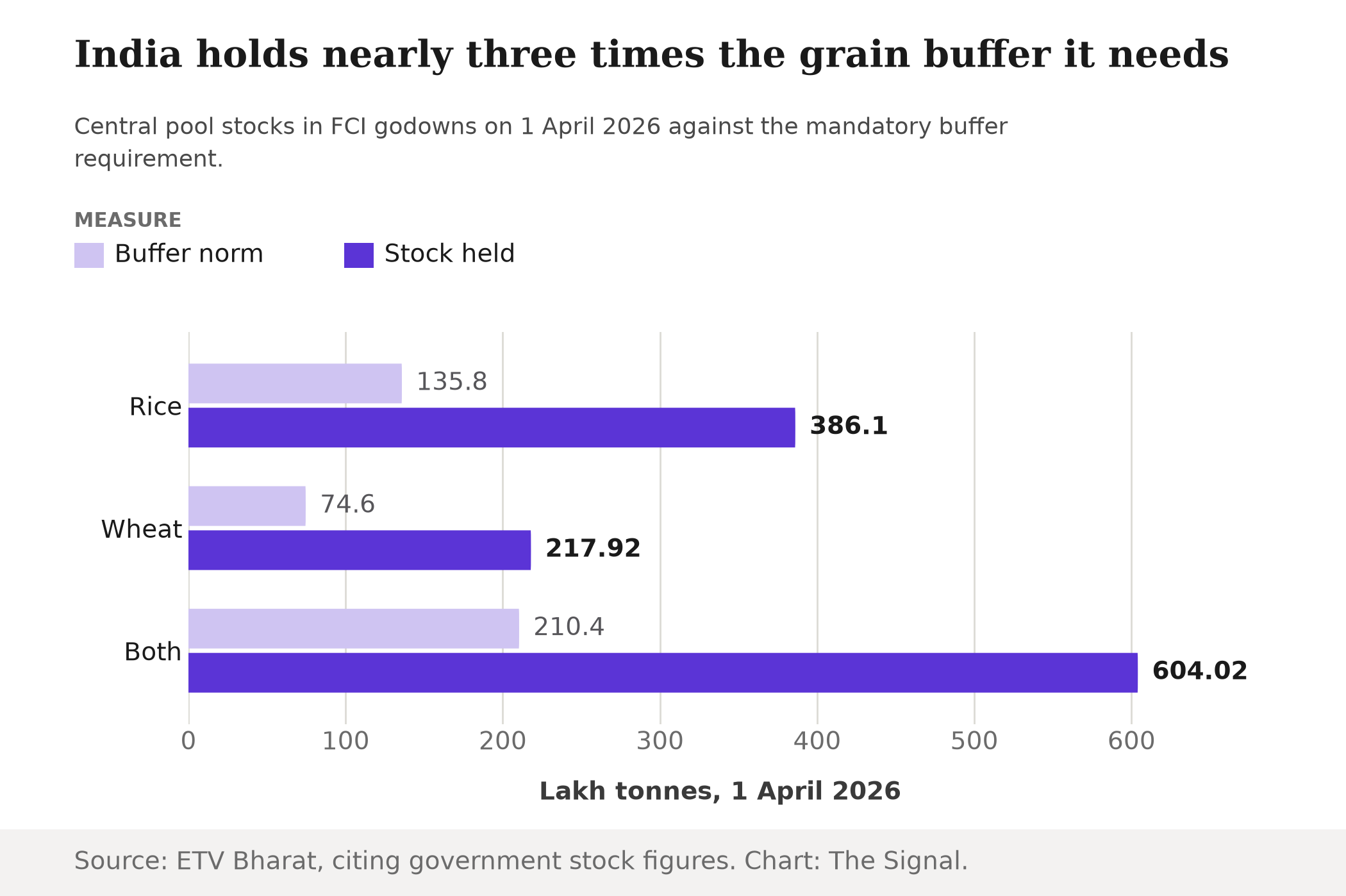
The number that separates India's grain position from the warning is 2.9. Rice and wheat in the central pool stood at 604.02 lakh tonnes on 1 April 2026, against a mandatory buffer requirement of 210.40 lakh tonnes. Split by grain, rice was at 386.10 against a norm of 135.80, and wheat at 217.92 against 74.60. Both clear their norm by close to three times, which our arithmetic puts at 2.84 for rice and 2.92 for wheat.
India held nearly three times its required rice and wheat buffer on 1 April 2026.
The agriculture ministry drew the same conclusion in June. On 23 June 2026 it said that buffer stocks of both rice and wheat remain comfortable, with no immediate threat to food security despite concerns over a weak monsoon. The same release identified about 315 districts as potentially affected by weak monsoon conditions. That is a large number of districts, but it describes stress on farm incomes and local output, not an empty granary.
The stock figure is six months old, and the crop year is not over. A weak monsoon can still cut procurement for the year ahead, and the April figure says nothing about what the next harvest adds. What it does establish is the starting point: the country held 604.02 lakh tonnes against a 210.40 lakh tonne requirement as the El Nino season began.
What a fertiliser shortage would have looked like, and did not
Jaishankar named fertiliser as a pressure point. The domestic numbers so far show supply running ahead of demand. In the Department of Fertilizers' table for the kharif season, urea availability from 1 April to 19 July 2026 was 163.78 lakh tonnes against a requirement of 109.40 lakh tonnes, with 69.01 lakh tonnes still in closing stock on 19 July. Availability ran about 50 percent above requirement.
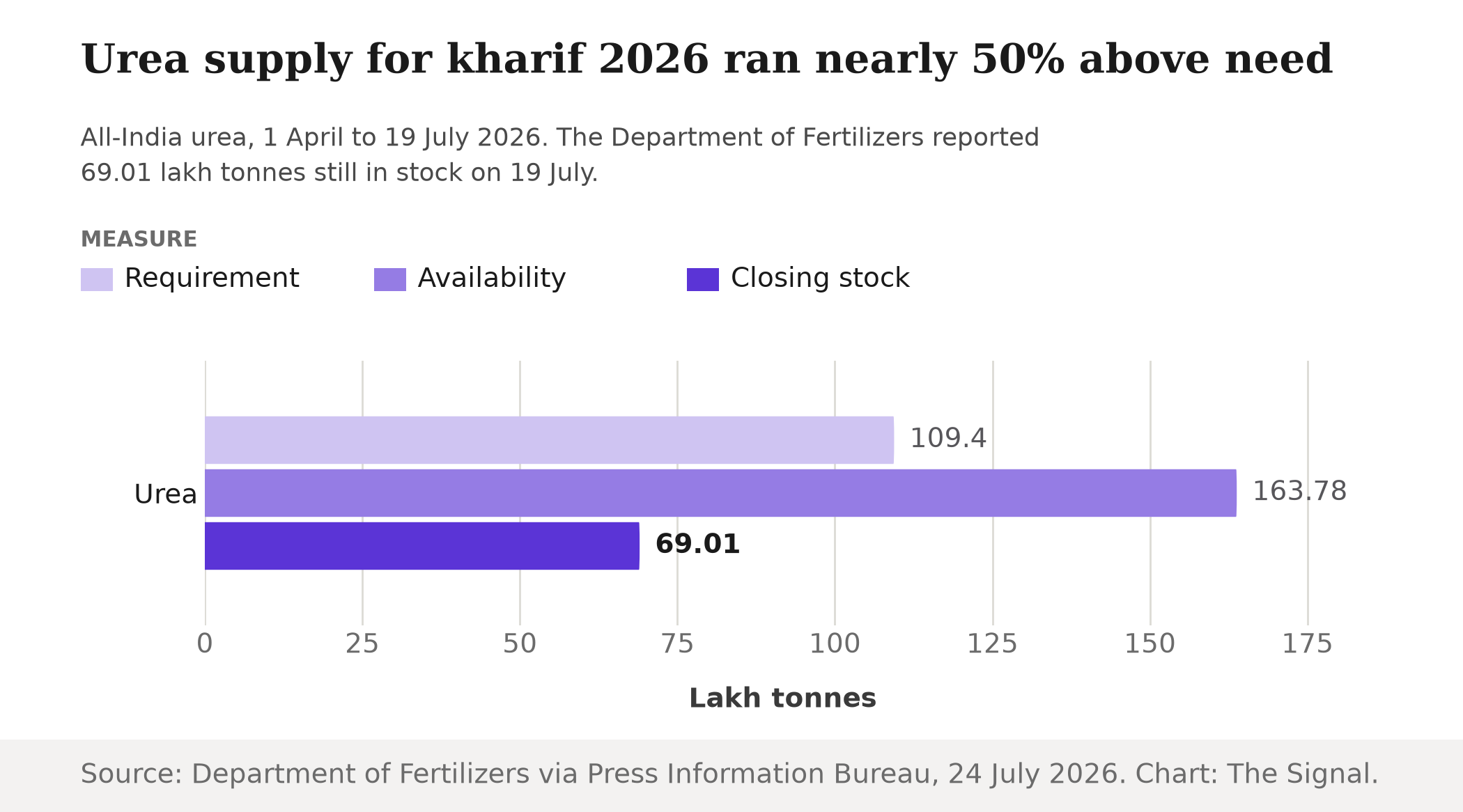
That is the picture for one fertiliser and one season, reported by the department that supplies it. It does not cover the rabi sowing season that follows, and it says nothing about the price farmers or the exchequer pay. But it shows that the minister's fertiliser warning, whatever it means for the global market, had not translated into a domestic shortfall by late July.
Where the exposure actually sits
If grain and urea are covered, the warning has to be about something else, or about someone else. Two readings fit the evidence.
The first is that the warning is about the world, not India. Jaishankar was speaking to an international audience about the Global South, and the FAO's cereal price index averaged 116.3 points in August 2026, its highest since May 2024. A higher world grain price lands first on countries that buy on the open market, not on a country drawing on its own stocks.
The second is that India's real import exposure is in food that is not rice or wheat. India's import dependence on edible oils was 56.25 percent in 2023-24, down from 63.2 percent in 2015-16. That is the latest year in the government's own figures, and it means more than half of the edible oil India consumes crosses a border. Meanwhile the FAO's vegetable oil price index averaged 196.9 points in August 2026, its highest since June 2022, after a third straight monthly rise. The two figures are not a measurement of India's exposure in rupees, and we have not seen a source that puts one on it. But they point at the category where a global price move reaches Indian kitchens without a domestic buffer to absorb it.
The honest objection
The strongest case against this reading is that a foreign minister has more information than a press release. Jaishankar spoke of grain exporters that cannot ship out of the Black Sea and of producers in West Asia and Russia whose fertiliser output has been hit. If those disruptions deepen, the buffer can drain faster than a norm written for ordinary years assumes. A stock of 604 lakh tonnes is a comfortable number today. It is not a permanent one, and government food policy has to plan for the year after next as well as this one.
That case is fair, and nothing here contradicts it. But it is an argument for watching the drawdown, not for calling the current position a crisis. The evidence that exists points the other way: a record harvest, a buffer near three times its norm, and urea supply ahead of requirement. A crisis warning that skips all three is describing the world market, not India's granaries.
The Signal
The two announcements of 29 September are not in conflict. One is a diplomat saying a major food crisis is coming for a global audience. The other is a target set at 373.93 million tonnes, an agriculture ministry pricing in an El Nino year from a record base. Read together they say that India is well placed on the grain it grows and less clearly so on the oils it buys.
Three things will show which reading is right. The first is the next central pool stock figure against its norm of 210.40 lakh tonnes. The second is the FAO's next price index and whether vegetable oils, at 196.9 points in August, keep rising. The third is the kharif harvest itself, against a target that was lowered by 0.7 percent. If stocks stay near three times the norm, the food crisis will be somebody else's. A buffer is only news when it starts to shrink.
Reporting basis: Jaishankar's remarks are per The Federal's report of his 29 September 2026 appearance, and the 2026-27 foodgrain target and the 1 April 2026 stock and buffer figures are per ETV Bharat, which reported them from government figures without naming the compiling agency, so each rests on that single outlet. The 2025-26 production estimate and the 23 June statement on buffers are from the Ministry of Agriculture and Farmers Welfare, and the urea table is from the Department of Fertilizers, all via Press Information Bureau releases. Edible oil import dependence is per a Press Information Bureau release on the National Mission on Edible Oils, and the cereal and vegetable oil price indices are from the FAO. The 0.7 percent target trim, the stock-to-norm multiples and the urea availability-over-requirement margin are The Signal's calculations from those figures.