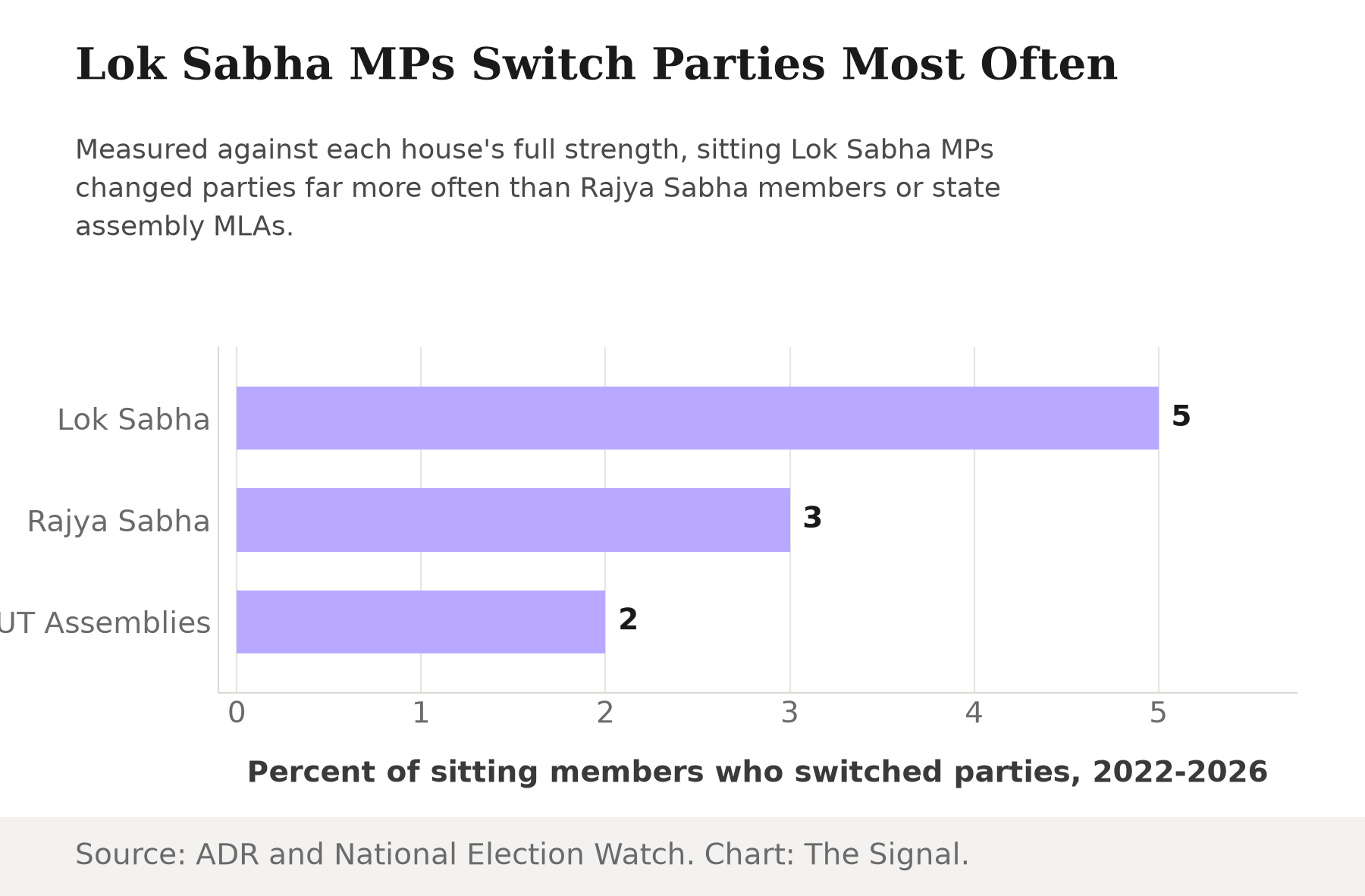
On September 24, 2026, the Association for Democratic Reforms and National Election Watch published an accounting of party loyalty inside India's elected chambers. A total of 111 sitting MPs and MLAs changed their political parties after being elected to the current Lok Sabha, Rajya Sabha and State Assemblies, using figures current to July 2026. The underlying data table puts that at 111 of 4,876 sitting legislators nationwide, about 2 percent, with the Lok Sabha's rate more than double the state assemblies': 26 of 543 MPs switched, 5 percent, against 78 of 4,100 MLAs, 2 percent, and 7 of 233 Rajya Sabha members, 3 percent. Most coverage of the report reached for a familiar shape: a governing party pulling loose lawmakers toward itself.
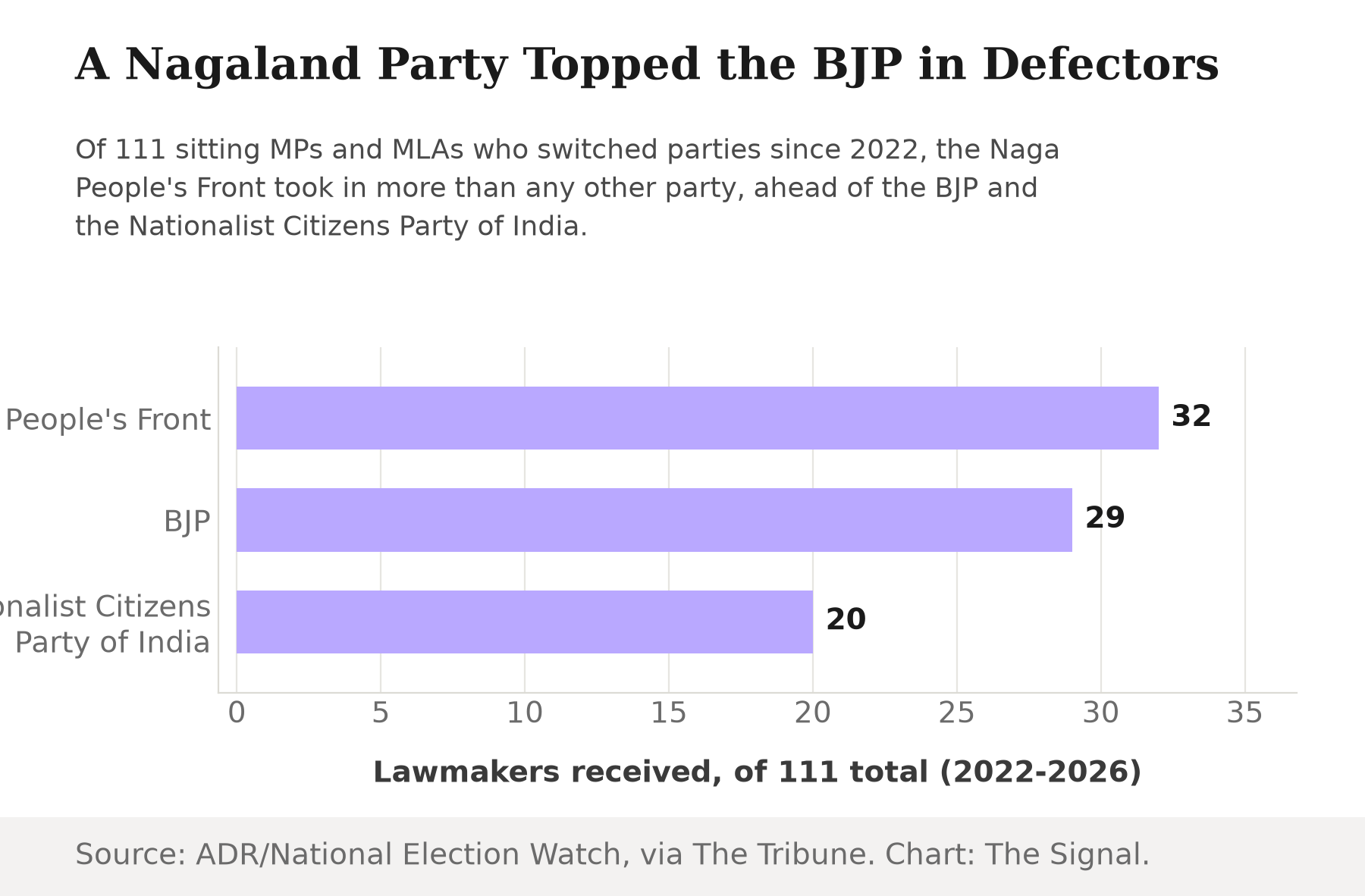
It is worth slowing down on that shape. The Tribune's reporting on the same ADR analysis found the Naga People's Front led the list of parties that received the maximum number of lawmakers, with 32, 29 percent, followed by the BJP with 29, 26 percent, and the Nationalist Citizens Party of India with 20, 18 percent. A party most national readers could not place on a map took in more defecting lawmakers than the party that runs the government in New Delhi.
Where the switches actually landed
Beyond Nagaland's 32 and West Bengal's 20, the remaining switches were scattered across states with different party flows: Telangana nine, Goa and Punjab eight each, Maharashtra and Meghalaya six each, and Manipur five. Nagaland and West Bengal together account for 52 of the 111 switches nationwide, and Nagaland's 32 lines up exactly with the Naga People's Front's 32 defectors cited above: the NPF operates almost entirely inside that one assembly, so the party count and the state count are, in effect, the same lawmakers counted two ways.
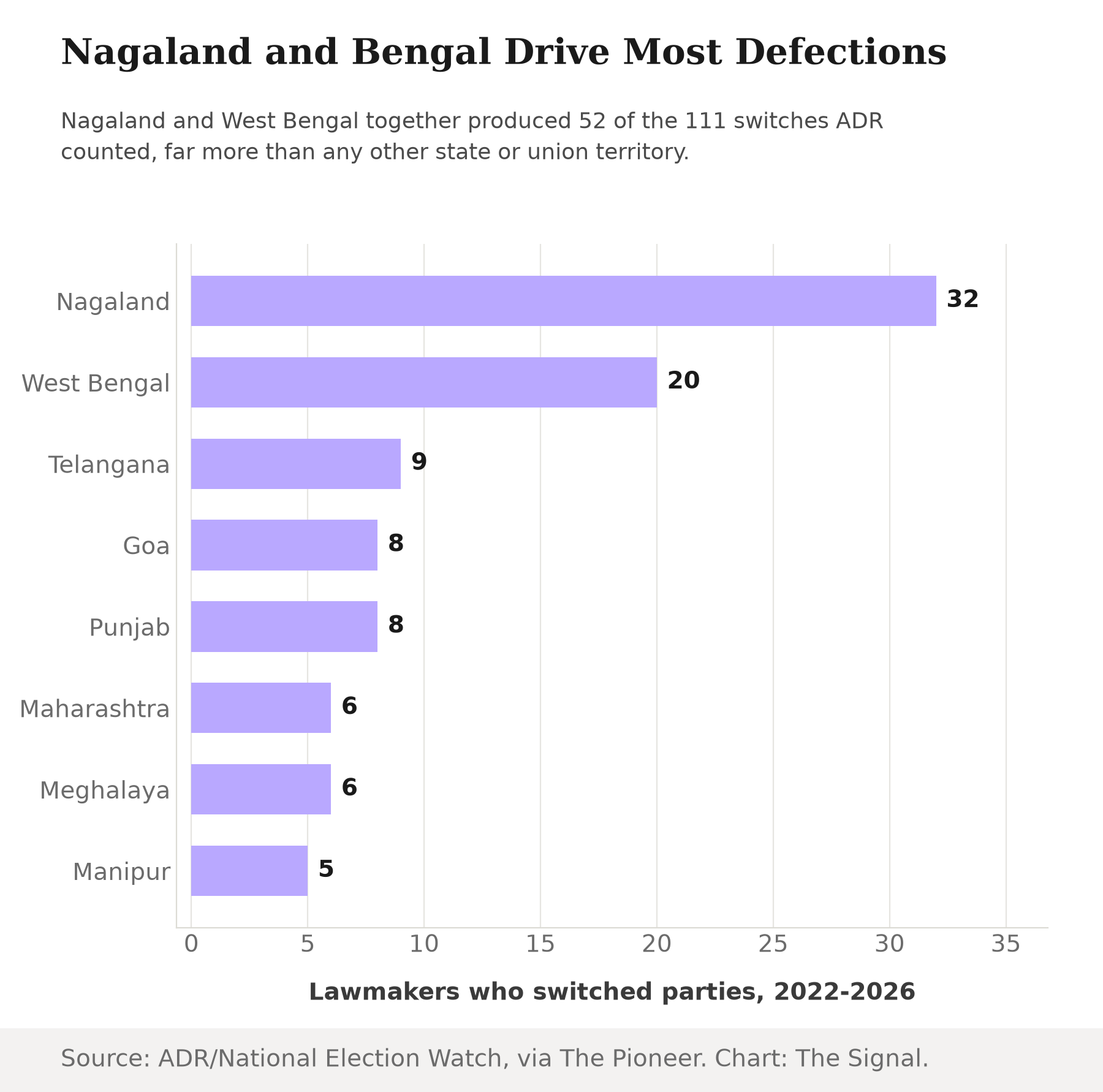
West Bengal's 20 is not a scatter of individual switches either. Those are the same 20 lawmakers who moved from West Bengal's Trinamool Congress to the Nationalist Citizens Party of India, and who are calling that move a merger rather than individual defection, a claim still pending before Lok Sabha Speaker Om Birla. If Birla accepts the merger claim, all 20 keep their seats without the anti-defection law ever being tested against them. Reject it, and the move becomes 20 individual defections, precisely the outcome the law was written to punish.
The merger clause the whole case turns on
That is not a technicality. Under the Tenth Schedule's merger exception, a party is treated as having merged, and its members spared disqualification, only if at least two-thirds of that party's legislators agree to the merger. Twenty lawmakers moving together as a bloc is exactly the scale the merger clause was built to test: large enough to plausibly clear a two-thirds threshold, and organized enough to look, on paper, indistinguishable from opportunistic bulk defection.
A decision with no deadline
Nothing in law compels Birla to rule quickly, and that gap is well documented. Multiple expert bodies, including the Law Commission, have recommended taking that decision away from the Speaker or Chairman altogether: the President should decide for MPs and the Governor for MLAs, each acting on the Election Commission's advice, because the law sets no deadline for a Presiding Officer to decide. A ruling can sit unresolved for months while the 20 lawmakers in question keep voting, hold office and draw salaries as though the question were already settled in their favor. Delay here is not neutral. It is a default outcome that favors whoever currently holds the seats.
The party that dominated the last defection cycle is not the party leading this one.
| Cycle | Recipient party | Lawmakers | Share |
|---|---|---|---|
| 2014-2021 | BJP | 173 of 500 | 35% |
| 2014-2021 | INC | 61 of 500 | 12% |
| 2014-2021 | AITC | 31 of 500 | 6% |
| 2022-2026 | Naga People's Front | 32 of 111 | 29% |
| 2022-2026 | BJP | 29 of 111 | 26% |
| 2022-2026 | Nationalist Citizens Party of India | 20 of 111 | 18% |
Source: ADR and National Election Watch's 2021 report and The Tribune's report of ADR's 2026 analysis.
Between 2014 and 2021, 173 of 500 recontesting MPs and MLAs who switched parties, 35 percent, joined the BJP, followed by 61, 12 percent, who joined the INC and 31, 6 percent, who joined the AITC. That earlier cycle really was a single-party story. The current one is not, and treating it as a rerun of the last cycle is exactly the misreading the top-line 29 percent invites.
The honest objection
The strongest case against calling any of this evasive is that mergers are the release valve the law was designed to allow, not a loophole in it. The two-thirds threshold in the Tenth Schedule is a real numerical bar, not a rubber stamp, against a handful of lawmakers dressing up an opportunistic jump as a merger. And the scale of the whole exercise may be smaller than the headline number implies: ADR itself cautions that its count of 111 is not necessarily exhaustive, because India has no systematically maintained, readily accessible official database of legislators who change parties, so the true rate of switching could run either above or below what this one accounting captures.
That case holds up as far as the two-thirds threshold goes. It does not explain why a merger claim filed by 20 MPs can sit unresolved for months after the switch, with no institutional clock forcing an answer. Expert bodies have recommended taking that decision away from the Speaker for exactly this reason, cited above. A high bar tested by no deadline is not a high bar. It is a bar nobody has to clear on any particular schedule.
The Signal
The 111 number was always going to be read as a scoreboard of party rivalry. That reading misses what actually decides anything. A Nagaland party outdrawing the BJP nationally is a curiosity. Twenty West Bengal lawmakers arguing that their party switch is not a party switch at all, pending before a Speaker under no obligation to rule by any date, is the mechanism the whole law hinges on. Watch Om Birla's ruling, not the next ADR count. If the merger claim is accepted, the two-thirds threshold has just been shown to work exactly as designed for a bloc of 20. If it drags on unresolved for another year, the anti-defection law's real weakness was never the switching. It was always the silence that follows it.
Reporting basis: the headline count of 111 sitting MPs and MLAs, the by-house switching rates, and ADR's own caveat about the count's completeness are from the Association for Democratic Reforms and National Election Watch's report and underlying data table, published September 24, 2026. The party-by-party and state-by-state breakdowns, and the pending West Bengal merger claim before the Lok Sabha Speaker, are as independently reported by The Tribune, The Pioneer and PTI, via Kashmir Observer, each covering the same ADR release. The 2014-2021 comparison is from ADR and National Election Watch's own 2021 report. The Tenth Schedule's merger threshold is from the Law Commission of India's 255th Report, and the case for moving disqualification decisions away from the Speaker is from PRS Legislative Research. The observation that Nagaland's state total and the Naga People's Front's national total are the same lawmakers counted two ways is The Signal's own reading of those figures.