On September 25, 2026, The Washington Post reported, via The Spokesman-Review, that a classified U.S. intelligence assessment given to Congress concludes Saudi Arabia has not ruled out developing a nuclear weapons program. That lands two months after the United States and Saudi Arabia signed a peaceful nuclear cooperation, or "123," agreement on July 22, 2026, opening Saudi Arabia's prospective civil nuclear program to American companies. Put those two facts together and the anxious read writes itself: Washington just handed Riyadh the on-ramp to the enrichment technology a bomb eventually needs.
It is worth slowing down on that. U.S. law bars any funding for nuclear cooperation with Saudi Arabia until Riyadh commits to renounce uranium enrichment and reprocessing and signs an IAEA Additional Protocol, a restriction Congress has renewed every year since. The July 2026 deal did not touch that bar. Saudi Arabia's energy minister said as far back as January 2023 that the kingdom intends to use its own uranium resources to produce low enriched fuel, and well over three and a half years later Riyadh still has no enrichment program the United States will fund, no cascade, and no fuel cycle. The enrichment path moves in years, when it moves at all. There is a faster hedge, and Saudi Arabia is already on it. It runs through Pakistan, not through a centrifuge hall.
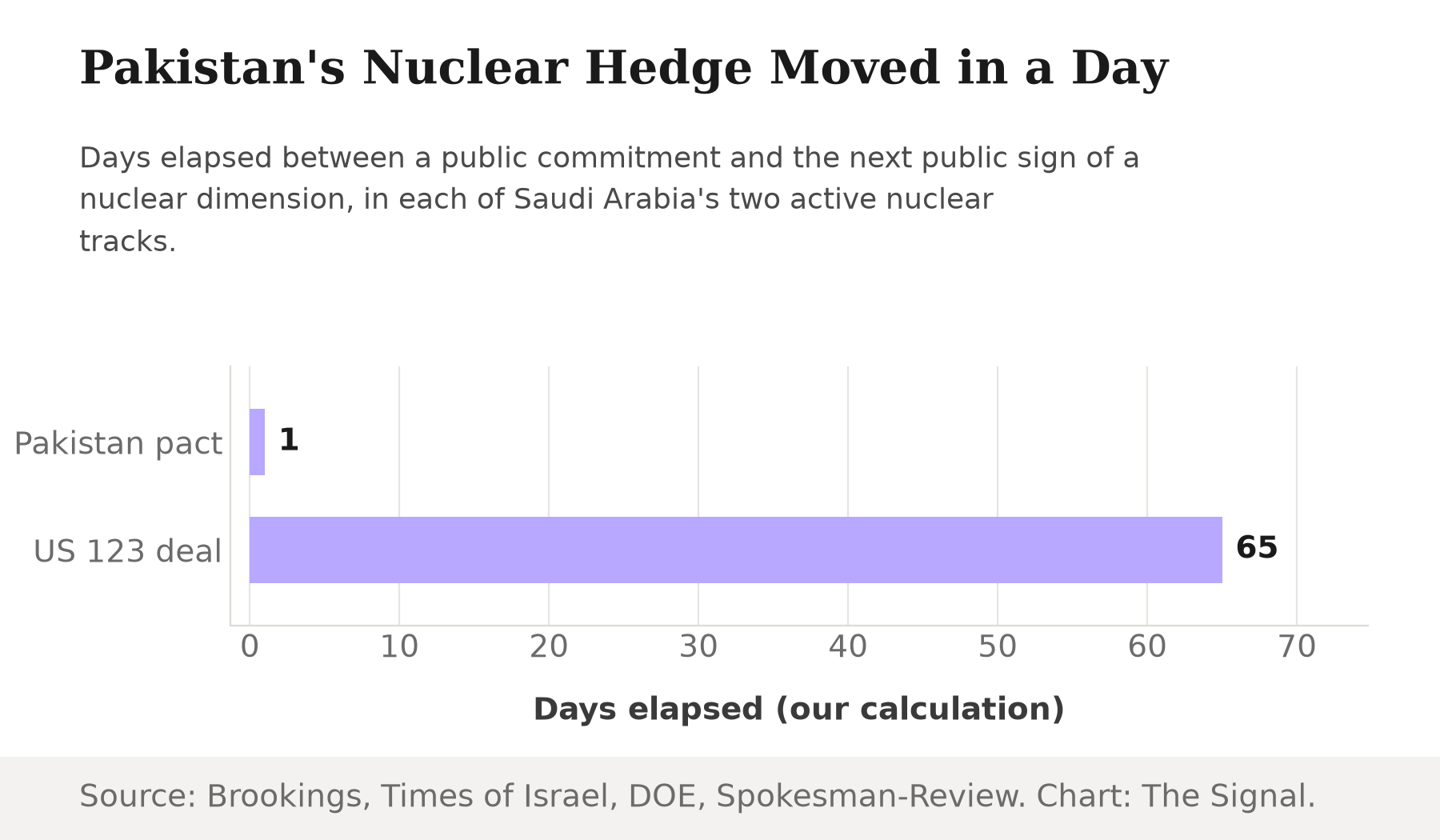
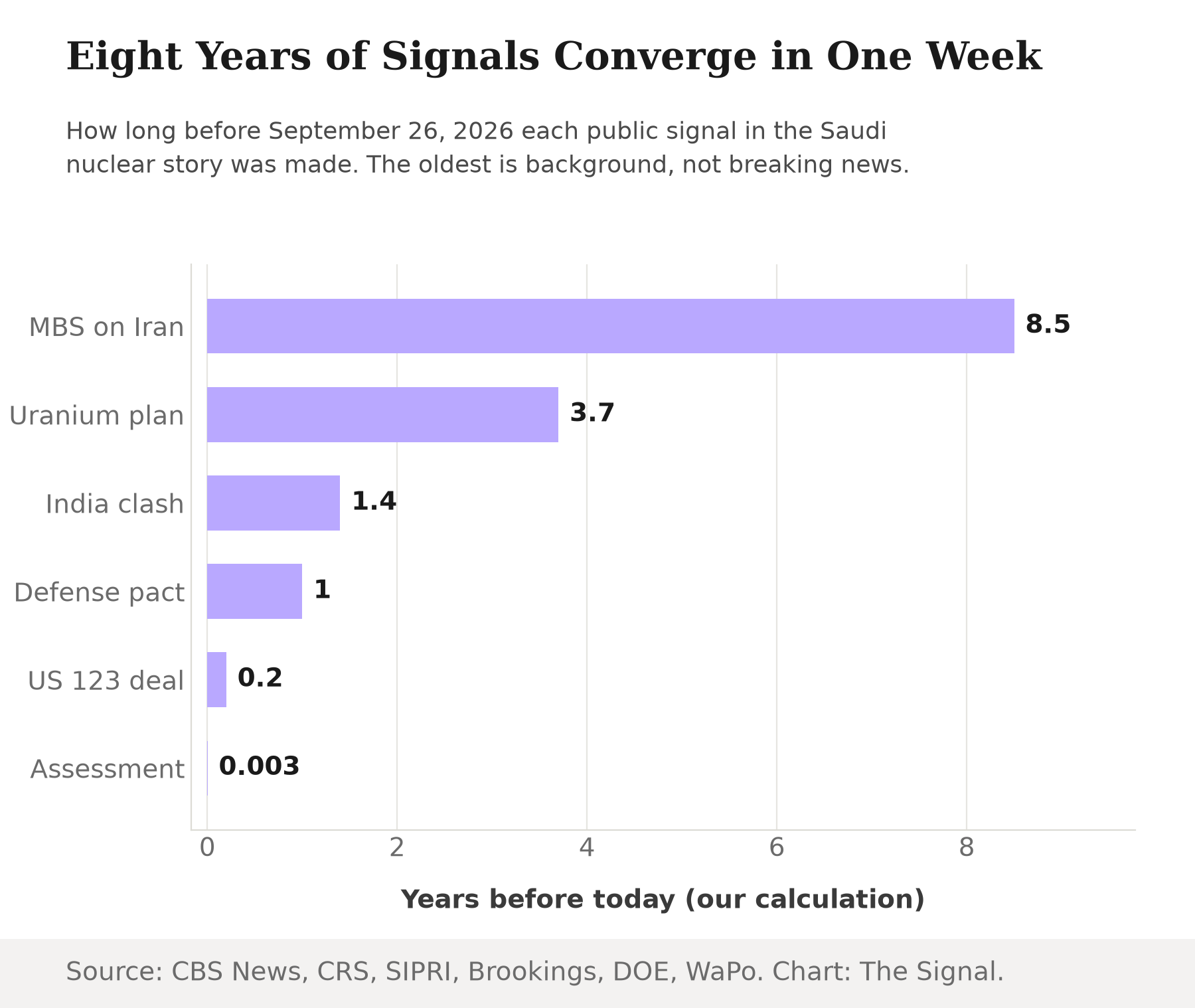
On September 17, 2025, Saudi Arabia and Pakistan signed a Strategic Mutual Defense Agreement. By the next day, Pakistan's defense minister, Khawaja Asif, told Geo TV that "what we have, and the capabilities we possess, will be made available to (Saudi Arabia) according to this agreement": a nuclear-armed state's own defense minister putting its arsenal on the table roughly one day after the ink dried. The U.S. civil deal took far longer to raise the same question about intentions: sixty-five days passed between the July 22, 2026 123 agreement and the classified assessment that surfaced before Congress doubting Riyadh's ambitions at all.
The enrichment path is slow, legal, and unfinished
The enrichment case against Saudi Arabia is the one most coverage reaches for, and it is real. Crown Prince Mohammed bin Salman told CBS's "60 Minutes" in March 2018 that Saudi Arabia would pursue a nuclear weapon if Iran built one first: "Saudi Arabia does not want to acquire any nuclear bomb, but without a doubt if Iran developed a nuclear bomb, we will follow suit as soon as possible." That pledge is more than eight years old and has never been renewed on the record; treat it as a standing posture, not fresh news. Congress has kept a specific legal lock on the door since: no funds for nuclear cooperation with Saudi Arabia until it renounces enrichment and reprocessing and signs an Additional Protocol with the IAEA. The July 2026 123 agreement, which the U.S. Department of Energy says gives American companies access to the Saudi nuclear energy program, operates inside that lock. It sells reactors and services. It does not sell centrifuges, and the enrichment ambition Saudi Arabia stated in January 2023 remains just that, an ambition.
Pakistan's arsenal needed no legislation
Pakistan's nuclear weapons already exist, already work, and answer to no American funding restriction. That is what makes the September 2025 pact a faster hedge than any enrichment program Riyadh could build from scratch. What it is lending is not symbolic: SIPRI's 2026 Yearbook estimates Pakistan's warhead stockpile held stable at around 170 as of January 2026, with land- and air-based delivery already mature and only its sea-based leg still in testing; its longest-range deployed missile, the Shaheen-III, can already fly roughly 2,750 kilometers, well past Iran and across the Gulf. A Brookings Institution analysis of the agreement found that officials initially intimated the deal extended Pakistan's nuclear deterrence to Saudi Arabia, before walking that characterization back: the text itself never uses the word. But as Brookings puts it, the resulting ambiguity about the security arrangement's nuclear dimension generates its own kind of deterrence; a threat that is neither confirmed nor denied still shapes what Iran, Israel, and everyone else assumes about Riyadh's options. Iran's own on-record reaction cuts against the alarmed read: Iranian President Masoud Pezeshkian told the UN General Assembly that same month that Tehran welcomed the pact as the start of a "comprehensive regional security system", not a threat aimed at anyone in particular. India's Ministry of External Affairs said on September 18, 2025 that it would study the pact's implications for India's national security and for regional and global stability, a studiously neutral line for a government watching its western neighbor's nuclear posture extend, however ambiguously, toward a Gulf capital.
Two hedges, two very different speeds.
| Path | Legal status | Public signal | Time to next confirmation |
|---|---|---|---|
| Saudi enrichment program | Blocked by US law until Riyadh renounces enrichment and reprocessing | Energy minister states intent to enrich domestic uranium, January 2023 | Still pending, more than three and a half years later |
| Saudi-Pakistan defense pact | No US law applies; a sovereign bilateral agreement | Strategic Mutual Defense Agreement signed, September 17, 2025 | One day, to defense minister's on-record nuclear offer |
Source: Congressional Research Service (IF10799); Brookings Institution; The Times of Israel.
Why Pakistan's arsenal is already India's problem
None of this is abstract for India. In May 2025, India and Pakistan fought a brief armed conflict in which India struck Pakistani air and missile bases that SIPRI says are likely to have nuclear-related roles, though both sides took steps to avoid escalation. That is the same Pakistani nuclear infrastructure that now sits, at least rhetorically, behind a Gulf ally's hedge against Iran. A crisis that once involved only Pakistan's own nuclear calculus now has a second capital with a stated interest in how that arsenal is perceived. India's government has already said it will study what the pact means for its own security; the answer depends less on whether Riyadh ever asks Islamabad for anything than on whether the ambiguity itself changes what Pakistan is willing to risk on its border with India.
The honest objection
The strongest case against reading too much into this: officials on both sides walked back the explicit extended-deterrence language once it drew attention, and a defense minister's answer in a television interview is not a treaty clause. Khawaja Asif's comment plays as well to a domestic and regional audience keen to look strong as it does as a literal commitment. On this reading, the hedge is rhetoric, not capability transfer, and the real proliferation risk still sits with Saudi Arabia's own uranium ambitions.
That case does not survive the walk-back it relies on. Brookings' own point is that the ambiguity is the strategy: neither government has denied that the pact could touch nuclear matters, and a defense minister saying capabilities "will be made available" is the kind of statement a government does not leave standing if it is false. Nothing here requires an actual transfer of a weapon. The deterrent effect works whether or not Riyadh ever takes possession of anything.
The Signal
Enrichment is the hedge that shows up in press releases, environmental reviews, and congressional appropriations riders, because it has to. It can be delayed by law, watched by inspectors, and measured in centrifuges nobody has built yet. A defense pact needs none of that. Congress's own restriction has held for years and the July 2026 123 agreement left it standing; the fact that Riyadh keeps restating enrichment ambitions it cannot yet act on is close to a distraction from the arrangement next door that already delivers what enrichment is supposed to someday provide: a credible answer to Iran. Watch two things. First, whether Saudi or Pakistani officials again let the word nuclear slip into public remarks about the pact without the swift walk-back Brookings documented in 2025; the walk-backs are themselves the tell. Second, whether Washington starts treating the Pakistan pact, not the enrichment file, as the thing it actually needs to negotiate around. A bomb you can borrow is faster to acquire than one you have to build, and Riyadh does not have to admit it owns one to benefit from everyone assuming it might.
Reporting basis: the classified intelligence assessment given to Congress is per The Washington Post's reporting, as carried by The Spokesman-Review. The July 2026 123 agreement is per the U.S. Department of Energy's own announcement. The September 2025 Saudi-Pakistan Strategic Mutual Defense Agreement and the ambiguity around its nuclear dimension are per a Brookings Institution analysis by Joshua T. White. Pakistan's defense minister's on-record comment is per his Geo TV interview, as reported by The Times of Israel. India's Ministry of External Affairs statement is per News on Air, Prasar Bharati. Saudi Arabia's 2023 domestic enrichment intent and the U.S. legal restriction on nuclear cooperation funding are both per Congressional Research Service report IF10799. Crown Prince Mohammed bin Salman's 2018 comment is per CBS News's "60 Minutes" interview. The May 2025 India-Pakistan conflict and its nuclear-adjacent target assessment, and Pakistan's warhead stockpile and delivery-system estimates, are per the Stockholm International Peace Research Institute's 2026 Yearbook. Iranian President Masoud Pezeshkian's UN General Assembly remarks are per Dawn's reporting. The day counts and year gaps between these events are The Signal's own calculations from the dates each source reports.