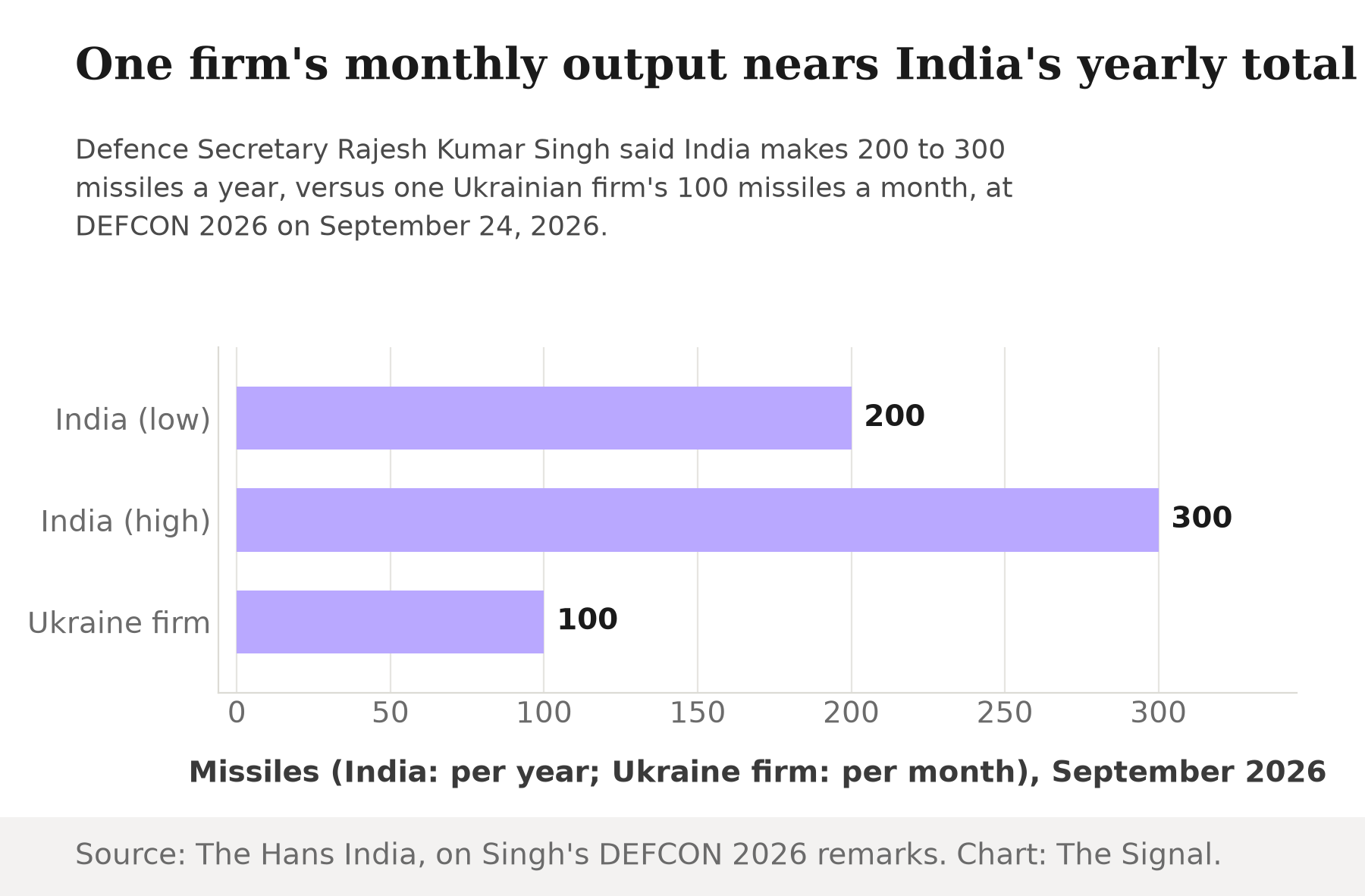
On September 24, 2026, at News18's DEFCON 2026 summit in New Delhi, The Hans India reports Defence Secretary Rajesh Kumar Singh said India makes only 200 to 300 missiles a year, against a single Ukrainian company's monthly run of 100 missiles and 1,000 drones: "One company in Ukraine is able to manufacture 100 missiles and a thousand drones a month. We can't continue in a situation where we are making 200-300 missiles a year." Read on its own, it sounds like a defence bureaucrat venting about a capacity shortfall. Coverage of the remark treated it that way: DRDO isn't building enough, so DRDO needs fixing.
It is worth slowing down on that framing. Singh is not an outside critic of DRDO's output. The government gave Rajesh Kumar Singh additional charge as DRDO Chairman effective May 31, 2026, after Samir V. Kamat's tenure ended, India Strategic reports, folding authority over which DRDO projects continue into the same office that sets defence-industrial policy. The man diagnosing the capacity gap in September is the man who has spent the four months before that deciding how much of the future weapons pipeline goes to somebody else.
The monopoly that ended first
Start with what actually changed, not what was said. Republic World reports that under the Defence Acquisition Procedure 2026, the Ministry of Defence ended Bharat Dynamics Limited's decades-long monopoly on tactical missile production in June 2026, distributing 10 to 12 tactical missile projects, including the Pralay and NASM-SR, to public and private Development-cum-Production Partners such as Adani Defence & Aerospace, Bharat Forge, ICOMM and Solar Defence. Singh's own words that June 2026 were blunter than his September 2026 remarks: "The time has come to involve private industry in ballistic missile production."
A state monopoly on tactical missiles became a field of public and private producers.
| Before DAP 2026 | Under DAP 2026, from June 2026 | |
|---|---|---|
| Who builds tactical missiles | Bharat Dynamics Limited, sole producer for decades | Public and private Development-cum-Production Partners, including Adani Defence & Aerospace, Bharat Forge, ICOMM and Solar Defence |
| Projects reassigned | Held entirely within BDL | 10 to 12 tactical missile projects, including the Pralay and the NASM-SR |
Source: Republic World, June 7, 2026.
That is not a response to a capacity complaint made in September. It happened three months earlier, before Singh ever stood on a stage and cited Ukraine.
A sequence, not a single decision
Line up everything on the record and the September remark stops looking like the start of a story and starts looking like its punchline.
Four separate announcements move in the same direction inside five months.
Sources: as linked in each row.
The capacity complaint in row seven is not new information. It is the same argument Singh's office had already been acting on since row two.
The paperwork chase after
On paper, the government's headline fix for DRDO is procedural, not structural. All India Radio's News on Air reports that Rajnath Singh released DFP-2026 on June 29, 2026, a reform meant to speed up timely execution of DRDO's strategic R&D projects, described as a way to "foster stronger collaboration with the industry and academia, reinforcing the vision of Aatmanirbhar Bharat." Read that release alone and the story is about DRDO getting faster at its own job.
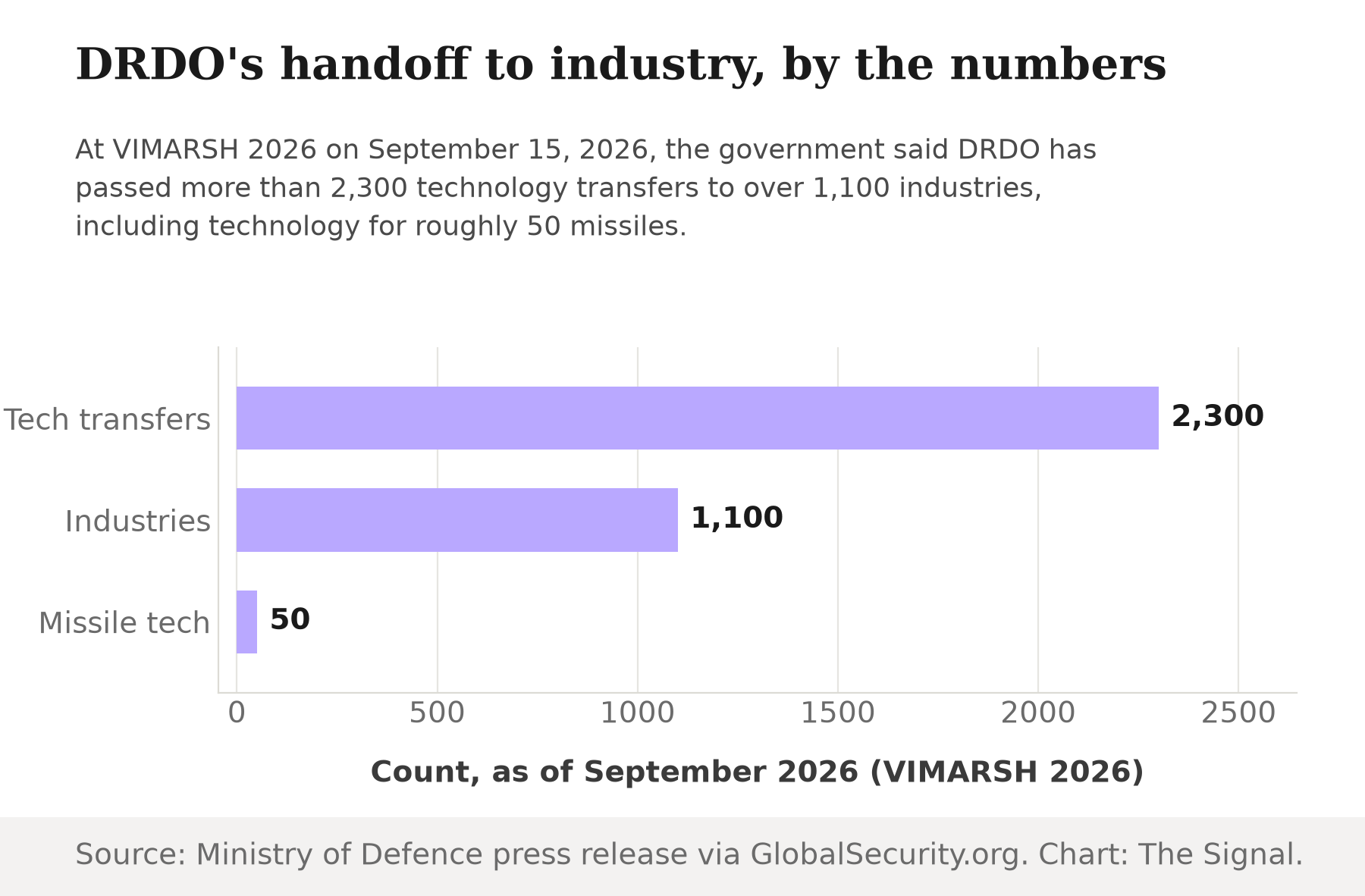
Less than three months later, the emphasis had shifted. All India Radio's News on Air reports that Rajnath Singh inaugurated VIMARSH 2026, DRDO's industry-synergy meet, on September 15, 2026 at DRDO Bhawan in New Delhi, pressing India's push for indigenous defence technologies. At that same event, a Ministry of Defence press release republished via GlobalSecurity.org states that DRDO has handed over more than 2,300 technology transfers to over 1,100 industries to date, including technology for roughly 50 missiles now accessible to industry, with Rajnath Singh saying DRDO-industry collaboration "should no longer be limited to production alone, but expanded across the entire value chain encompassing research, design, testing, certification, and manufacturing."
DFP-2026 was framed as making DRDO itself execute faster. VIMARSH, ten weeks later, was framed as handing DRDO's own work to everyone else. Both are true. They are just not the same fix.
The honest objection
The strongest case against reading this as a deliberate handoff is that the man who first flagged the problem was warning against exactly this kind of expansion. The Week reports that DRDO chairman Samir V. Kamat said in April 2026 that aggressive underbidding by private defence firms was delaying some DRDO projects, even as 30 DRDO projects had already been completed under the Development-cum-Production Partner model with private industry: "there were delays to some projects due to low bidding by private industry players." If cut-rate private bidders are already slowing DRDO down, routing more of India's most sensitive weapons work to more private firms should make the delay problem worse, not better.
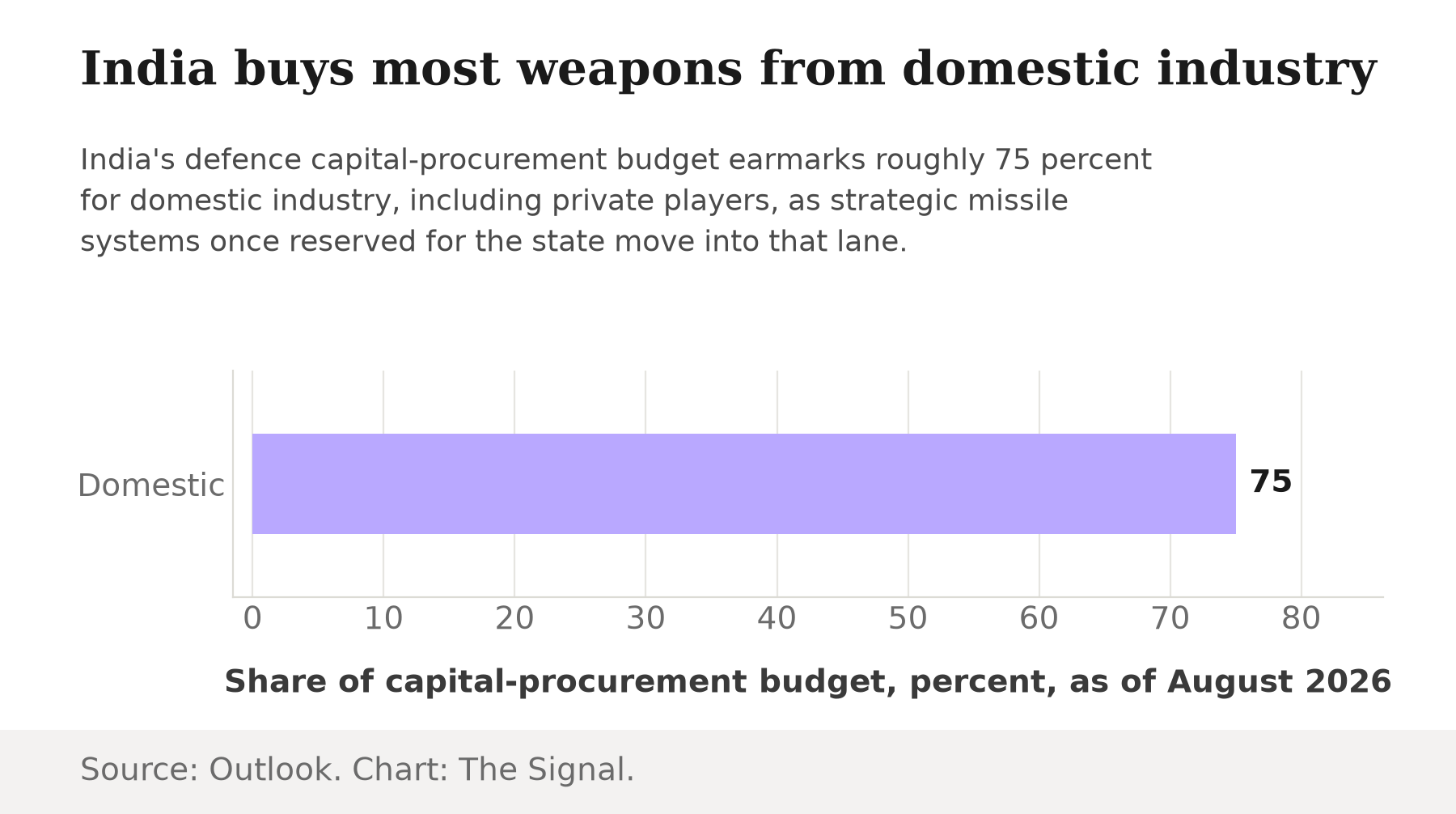
That objection is real, and it is the same organization's own chief making it, five weeks before his replacement took the dual charge. But it answers a different question than the one the reforms are aimed at. The government's response was never that underbidding stopped being a risk. It was to reduce how much that risk falls on the state. Outlook reports that India's defence capital-procurement budget now earmarks roughly 75 percent for domestic industry, including private players, as strategic missile systems once reserved for the state move into that expanded private-sector lane. Whether a given private contractor finishes on schedule or not, DRDO is no longer the party answering for it. A slipped deadline used to be DRDO's problem to explain to Parliament. Increasingly, it is a vendor's.
The Signal
None of the individual pieces here are secret. A monopoly ended, a financial reform was released, a technology-transfer count was announced, a procurement share was reported, a comparison to Ukraine was made. Read separately, each is a routine defence-ministry story. Read in sequence, with one office now holding both the diagnosis and the remedy, they describe a single decision taken in stages: DRDO's job is shrinking relative to India's total weapons output, not because its labs got worse, but because the government decided the state should build a smaller share of what it buys. Watch what happens to the DcPP list over the next two DEFCONs. If it keeps growing while DRDO's own in-house tally stays flat, the redirection is real and durable. If a string of missed private deadlines instead brings work back in-house, the September remark about Ukraine will have been the high-water mark of the handoff, not its opening line. Either way, the number worth tracking from here is not how many missiles DRDO builds. It is how many it no longer has to.
Reporting basis: Defence Secretary Rajesh Kumar Singh's DEFCON 2026 remarks on India's missile-production gap are per The Hans India. The end of Bharat Dynamics Limited's tactical-missile monopoly and the list of new Development-cum-Production Partners are per Republic World, citing the Ministry of Defence's order under DAP 2026. The DFP-2026 financial-powers reform is per All India Radio's News on Air, as is the VIMARSH 2026 inauguration; the VIMARSH technology-transfer figures come from a Ministry of Defence release as republished by GlobalSecurity.org. DRDO chairman Samir V. Kamat's remarks on private-sector underbidding are per The Week. Rajesh Kumar Singh's additional charge as DRDO Chairman is per India Strategic, citing the government's appointment order. The 75 percent domestic-industry capital-procurement earmark is per Outlook. Each of these is a single-outlet account of a named official's remarks or a government order, with no second independent origin confirming it; the sequencing argument connecting them is The Signal's own reading of the public record.