Bangladesh and Pakistan have spent the past year and a half acting like a bad chapter is behind them. Direct flights between Dhaka and Karachi resumed on 29 January 2026, ending a 14-year suspension the Hasina government had imposed in 2012 on security grounds, and Biman Bangladesh now flies the route twice weekly. Five months earlier, Pakistan's deputy prime minister and foreign minister, Ishaq Dar, made the highest-level Pakistani visit to Dhaka since 2012, signing trade agreements and discussing new flight links. Read the calendar in order and the story writes itself: fourteen years of estrangement, undone.
It is worth slowing down on that. On 24 September 2026, a Rosatom cargo flight carrying low-enriched uranium fuel for Unit 2 of Bangladesh's Rooppur nuclear plant needed to cross Pakistani airspace to arrive on schedule, and Pakistan did not grant the clearance. Bangladesh's own science ministry says it does not know why. Russia has since proposed a new date, indicating the fuel could arrive in the first week of October, Bangladesh's science minister told reporters. But as of this week, the plane that was meant to carry Russian nuclear fuel to a newly friendly neighbor is still grounded by that same neighbor.
A supply chain that had otherwise worked
Rooppur is not a new or fragile arrangement. Russia's first shipment of nuclear fuel for the plant was delivered on 5 October 2023, in a ceremony Russian President Vladimir Putin and then-Prime Minister Sheikh Hasina joined by video link. Two and a half years later, workers began sequentially loading 163 fuel assemblies into the VVER-1200 reactor core at Rooppur Unit 1 on 28 April 2026, with Rosatom's director general, Alexey Likhachev, and Bangladesh's science minister both attending. None of that route ran through Pakistani airspace controversy. The September shipment, bound for Unit 2, is the first to hit this specific obstacle.
The scale of what is riding on that route is large. Rooppur's two VVER-1200 reactors, each rated at 1,200 MW, are designed to add 2,400 MW of combined generating capacity to Bangladesh's grid once both units are running. Set against Bangladesh's total installed power generation capacity of 31,389 MW as of December 2025, Rooppur alone would add roughly 7.6% to everything the country can currently generate, which means a single stalled fuel flight matters to Bangladesh's energy planners.
Nearly finished, still not on schedule
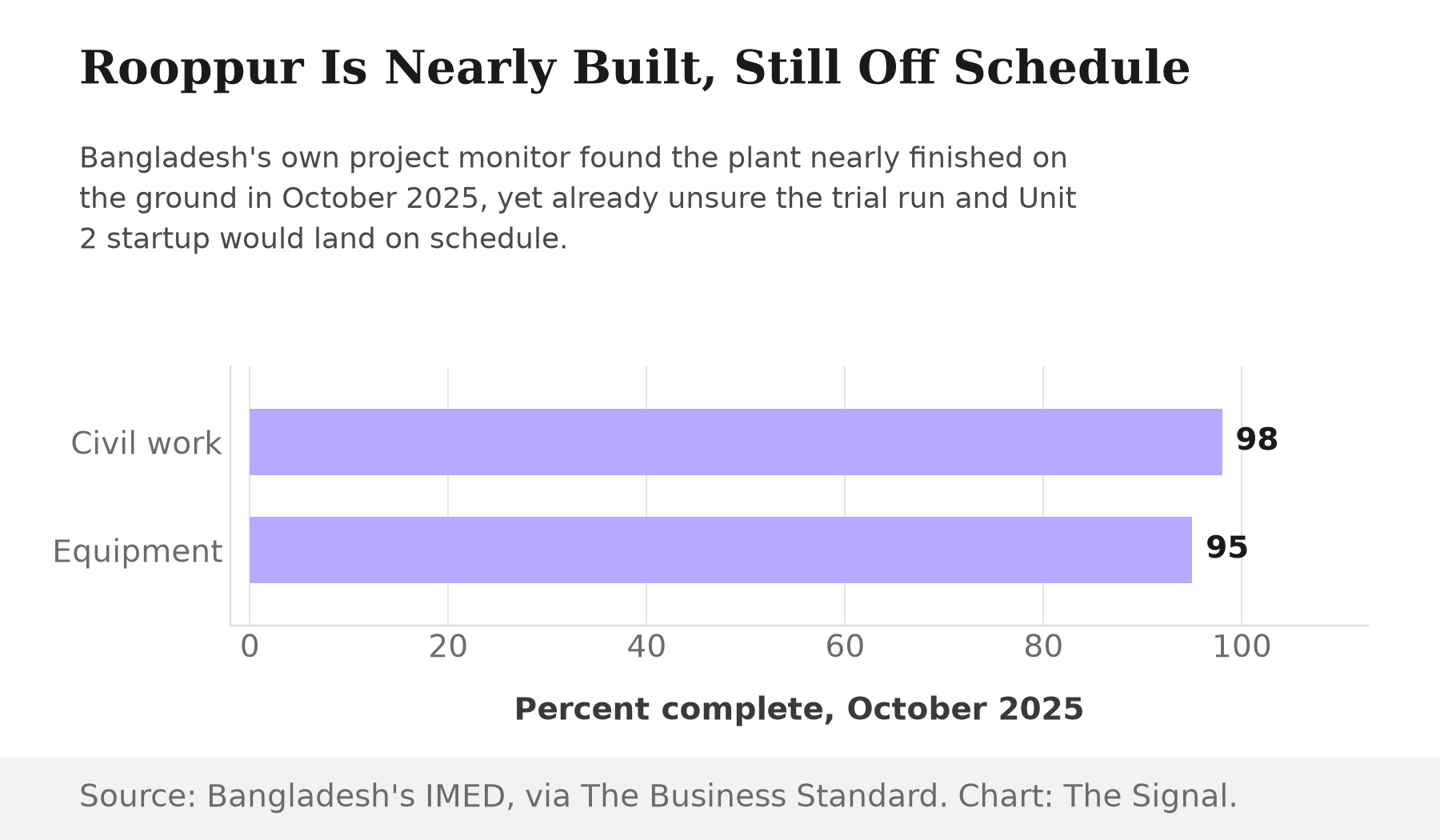
Bangladesh's own project monitor, the Implementation Monitoring and Evaluation Division, found in October 2025 that Rooppur Unit 1's trial run, already rescheduled to December 2025, was unlikely to happen on time, and that it was uncertain whether Unit 2 could begin production as planned in December 2026, even though reactor-building civil work stood at 98% complete and equipment installation at 95%.
That gap, a plant that is almost entirely built but still missing its own dates, is the pattern the fuel shipment now fits into. The slippage carries a running cost: a Dhaka University nuclear engineering professor estimated in March 2026 that Bangladesh was paying Rosatom roughly Tk10-12 crore in extra interest for every day the schedule slips.
The bill nobody voted for
Some of Rooppur's cost growth has nothing to do with construction at all. Rooppur's project cost has already been revised upward 23.15%, to Tk1,39,274.17 crore, largely because currency depreciation on Russia's dollar-denominated credit line was not fully priced into an earlier revision, pushing the completion target from December 2025 to June 2028.
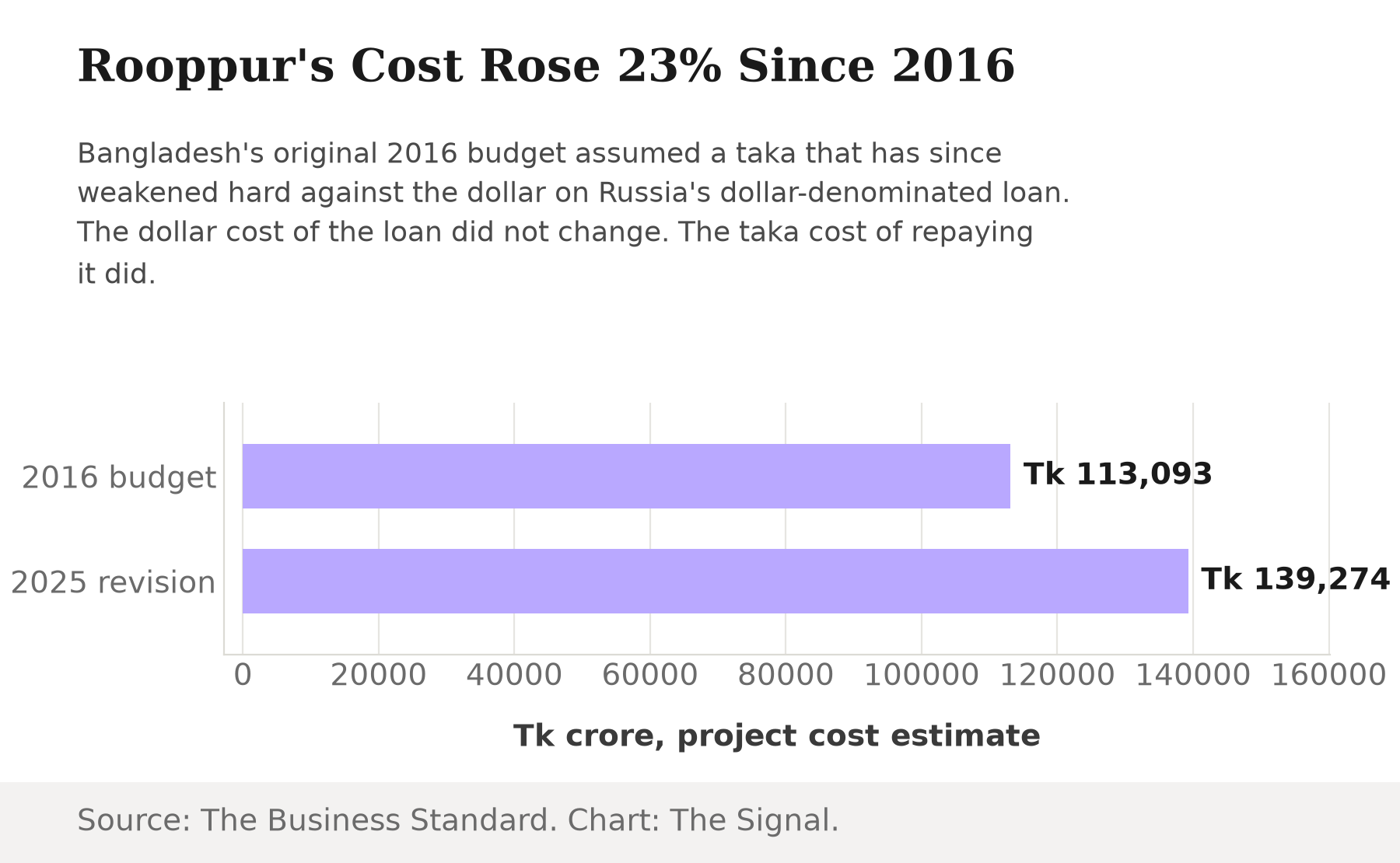
The currency move behind that number is stark. As of 28 September 2026, Bangladesh Bank's official reference rate puts the taka at 122.7955 to the dollar, more than 50% weaker than the roughly Tk80/dollar rate used when Rooppur's original Tk1,13,092.91 crore budget was approved in 2016.
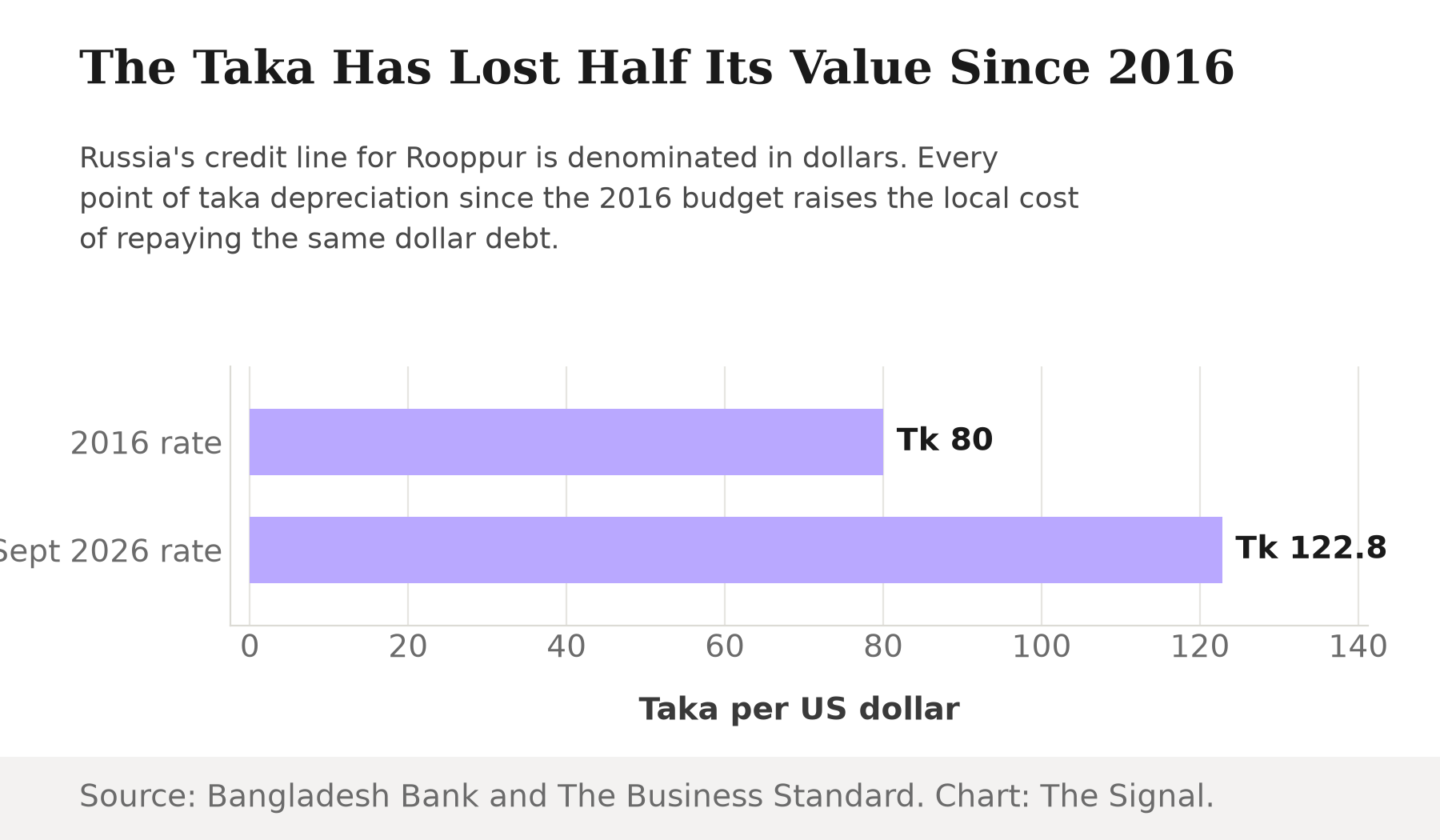
The loan is dollar-denominated; the debt did not grow. What grew is the number of taka Bangladesh must print to service it, and the IMF has noticed the pattern beyond Rooppur alone. The IMF's Debt Sustainability Analysis, published alongside Bangladesh's January 2026 Article IV consultation, downgraded the country's risk of external debt distress from low to moderate, citing large external financing needs for infrastructure projects including Rooppur. This is not even the first time Western financial friction has complicated the loan directly: as of mid-2024, Bangladesh owed Russia $587 million in overdue interest, commitment fees, and late payment penalties on the Rooppur loan, after US sanctions on Russia's VEB.RF blocked the loan agreement's designated repayment channel.
Why Pakistan, why now
None of that explains why Islamabad, specifically, chose this week to sit on a clearance request. Bangladesh's government has not offered a technical reason, and Pakistan has not offered a public one either. What both governments agree on is the sequence: warmer bilateral ties on almost every visible track, and a hard stop the moment the cargo is Russian.
| Date | Event |
|---|---|
| 2012 | Hasina government suspends direct Dhaka-Karachi flights on security grounds |
| 5 Oct 2023 | First Russian nuclear fuel shipment delivered to Rooppur |
| 24 Aug 2025 | Pakistan's Dar visits Dhaka, the highest-level visit since 2012 |
| 29 Jan 2026 | Direct Dhaka-Karachi flights resume after 14 years |
| 28 Apr 2026 | Fuel loading begins at Rooppur Unit 1 |
| 24 Sep 2026 | Pakistan withholds airspace clearance for Rosatom's Unit 2 fuel flight |
| Early Oct 2026 (proposed) | Russia's new target date for the delayed shipment |
Laid out this way, the reset and the refusal are not competing stories. They are the same reset, tested at its one genuinely sensitive seam. Pakistan can normalize flights, trade missions and ministerial visits with Dhaka without touching its own difficult relationship with Moscow. A Russian state cargo flight is a different kind of ask, and Islamabad's silence on why it said no is doing more work than an explanation would.
The honest objection
The strongest case against reading anything into this is that overflight clearances get denied or delayed for mundane reasons all the time: paperwork, staffing, a diplomatic note that arrived too late, nothing to do with Moscow at all. Bureaucratic friction is the more common explanation for a single delayed flight than a deliberate signal, and one clearance denial is a thin base for a geopolitical thesis.
That case would be stronger if either government had said so. Instead, Bangladesh's science ministry says it does not know the reason, and Pakistan has offered no public justification, technical or otherwise. An ordinary scheduling problem is usually named as one, quickly, to avoid exactly the reading now attached to this delay. The silence does not prove intent. It does mean the more innocent explanation has not actually been offered, only assumed.
The Signal
Bangladesh and Pakistan can be genuinely friendlier than they have been in fourteen years and still have a limit that shows up the moment Russia enters the picture. That is not a contradiction; it is the more precise description of what a "thaw" usually is, a widening of cooperation that still runs into the harder constraints each side has elsewhere. Watch two things from here. First, whether the fuel actually arrives in the first week of October as Russia has now proposed, since a second miss would be much harder to wave off as paperwork. Second, whether Rooppur's next Rosatom shipment, whenever it comes, needs Pakistani airspace again, because a policy repeats in a way a one-off clearance delay does not. A friendship that stops at Moscow's cargo is still a friendship. It is just one with a border drawn inside it.
Reporting basis: the 24 September 2026 airspace clearance denial and the ministry's stated uncertainty over the reason are per The Business Standard, quoting Bangladesh's science and technology minister; the proposed early-October arrival date is per The Tribune's ANI wire report, quoting the same minister. The April 2026 fuel-loading ceremony is per World Nuclear News; the October 2023 first fuel delivery is per Voice of America. Rooppur's 2,400 MW combined capacity and Bangladesh's 31,389 MW total installed capacity (as of December 2025) are both per The Business Standard; the resulting 7.6% share of national capacity is The Signal's calculation from those two figures. Rooppur's revised project cost and pushed completion date are per The Business Standard's report on the project's revised cost proposal; the October 2025 construction-progress and schedule findings are per The Business Standard, citing Bangladesh's Implementation Monitoring and Evaluation Division. The daily interest-cost estimate is a single op-ed source, a Dhaka University nuclear engineering professor writing in Prothom Alo, and should be read as one expert's estimate rather than an official figure. The taka-dollar reference rate is Bangladesh Bank's own published data; the IMF's debt-risk downgrade is from its Debt Sustainability Analysis; the $587 million overdue-interest figure is per The Business Standard, citing Bangladesh government and Bangladesh Bank officials. The flight-resumption and Dar-visit details are per Anadolu Agency and Al Jazeera respectively. The characterization of the reset and the refusal as one sequence is The Signal's own reading of those dated events.