When reports surfaced that its own commissioners had objected to the Chief Election Commissioner's conduct, the Election Commission of India's public answer was reassuringly plain. The Commission said on 23 September 2026 that all its decisions, including the electoral roll revision, were taken unanimously, and that a difference of views is simply a normal part of deliberation in any institution before a final decision is reached. Read on its own, that is an unremarkable thing for any collective body to say.
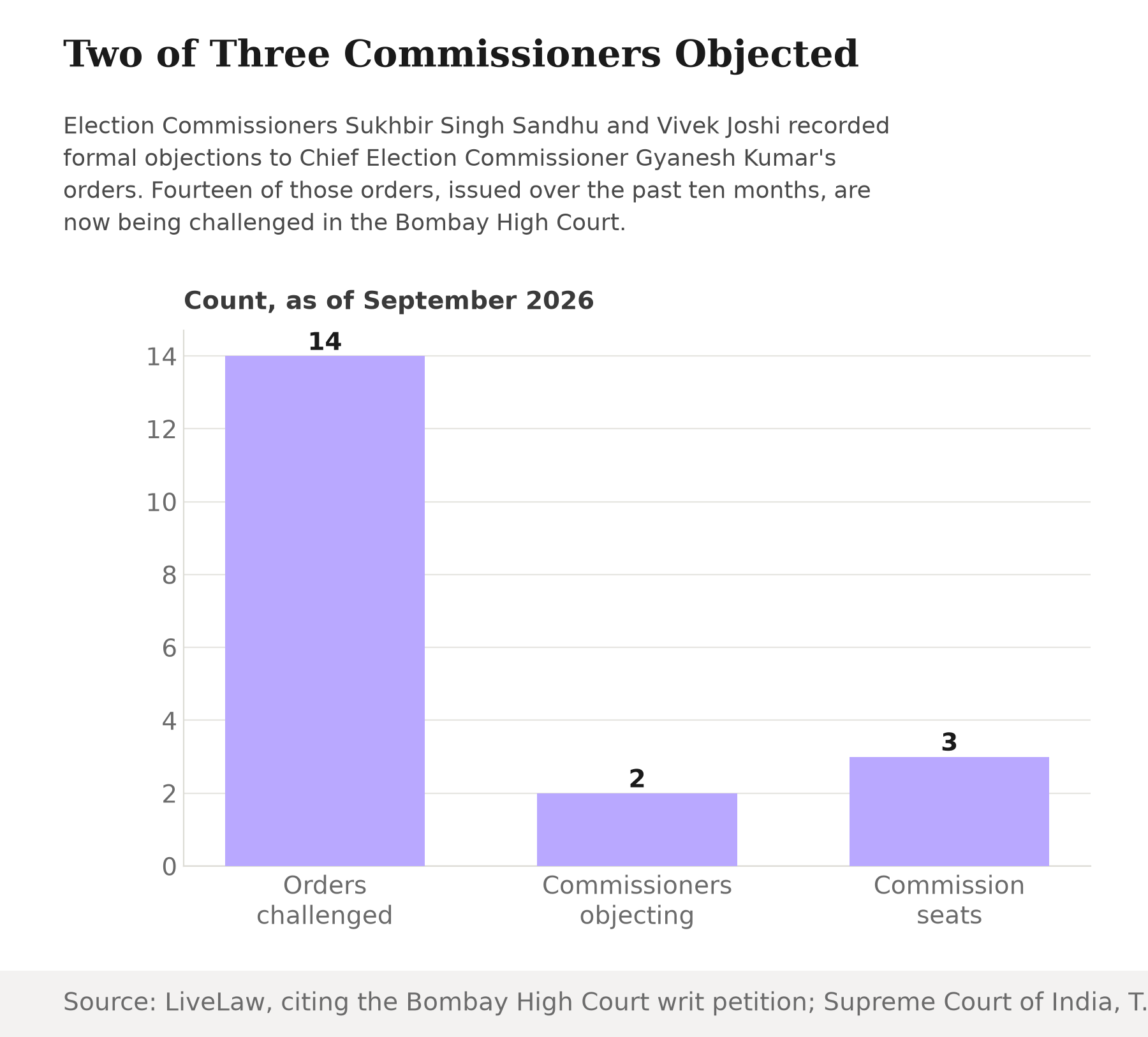
It is worth slowing down on the word deliberation. A writ petition filed before the Bombay High Court on 24 September 2026 asks the court to quash fourteen administrative orders and actions issued by CEC Gyanesh Kumar over the preceding ten months, actions that, according to an Indian Express report cited in the petition, were the subject of objections recorded in writing by Election Commissioners Sukhbir Singh Sandhu and Vivek Joshi. Fourteen orders is not a single disagreement smoothed over in a meeting. It is a pattern, and it now sits in front of a judge rather than inside the Commission's own record.
Two of the Commission's three members are on record objecting to work the Commission did anyway.
One of those objections is specific enough to check against what actually happened next. Commissioner Sandhu objected in writing to changes made to Form 6, the form new and first-time voters use to register, arguing that "the changes must be removed immediately so that young and would-be first time voters, who are otherwise eligible, can register themselves as voters as per law, without any harassment". The change was not reversed. The order stood.
The law names a Commission, not a man
India's election law is specific about how a disagreement inside the Commission is supposed to be resolved, and it is not left to the CEC's discretion. Under Section 18(2) of the Chief Election Commissioner and Other Election Commissioners Act, 2023, Commission business is meant to be transacted unanimously where possible, but where the CEC and the other Election Commissioners differ in opinion, the matter is decided according to the opinion of the majority, not according to the Chief Election Commissioner alone.
That is not a new or untested principle. In T.N. Seshan v. Union of India in 1995, a Constitution Bench of the Supreme Court held that treating the CEC's word as final over the other Election Commissioners would render them "non-functional or ornamental," because Article 324 of the Constitution vests the power to conduct elections in a Commission, not in an individual. The design has stood for three decades specifically to prevent one person from being the Election Commission in practice.
The rule has existed since 1995. It has never before had to answer what happens when the CEC proceeds anyway.
The first attempt went through Parliament
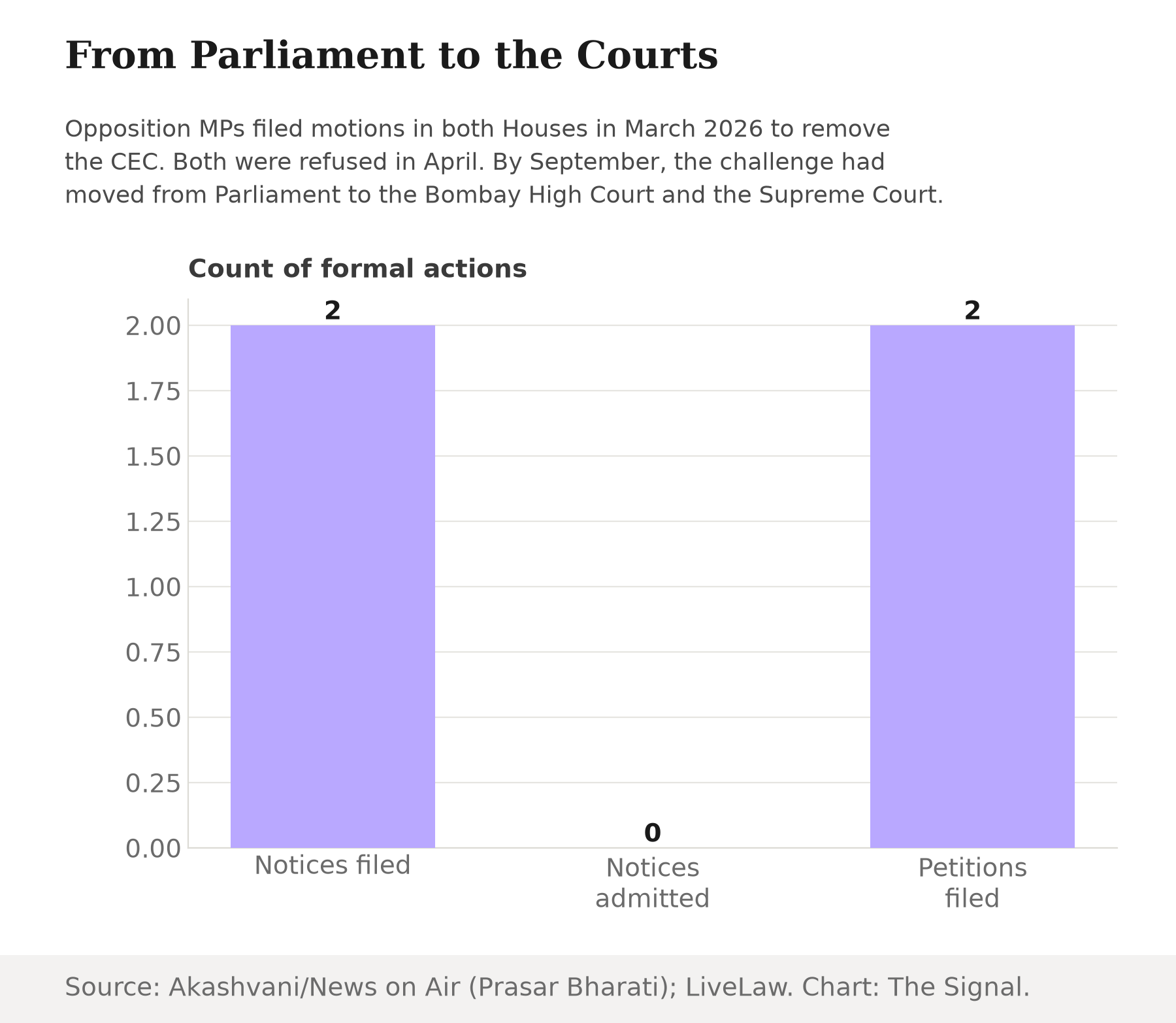
The dispute over the CEC's conduct did not begin with the Bombay High Court petition. On 13 March 2026, opposition MPs including the Trinamool Congress's Saugata Roy filed notices in both Houses of Parliament seeking a motion to remove Gyanesh Kumar, citing the removal of voters' names from West Bengal's electoral rolls during the Special Intensive Revision. On 7 April 2026, the Rajya Sabha Chairman and the Lok Sabha Speaker refused to admit either notice, the first time removal notices against a sitting CEC had been filed simultaneously in both Houses. That route closed within a month of opening.
Same complaint, different venue
The complaint moved rooms. It did not change.
| Date | Development | Source |
|---|---|---|
| 13 Mar 2026 | Opposition MPs file removal-motion notices against the CEC in both Houses | News on Air |
| 7 Apr 2026 | Rajya Sabha Chairman and Lok Sabha Speaker refuse to admit the notices | News on Air |
| 27 May 2026 | Supreme Court upholds the Election Commission's power to conduct the SIR | LiveLaw |
| 23 Sep 2026 | ECI states publicly that all its decisions, including the SIR, were unanimous | News on Air |
| 24 Sep 2026 | Bombay High Court writ petition filed to quash 14 CEC orders | LiveLaw |
| 25 Sep 2026 | Supreme Court petition filed seeking the CEC's prosecution | LiveLaw |
| 26 Sep to 2 Oct 2026 | Left parties hold week-long protests demanding the CEC's removal | ThePrint |
Source: Akashvani/News on Air (Prasar Bharati); LiveLaw; ThePrint. Table: The Signal.
The Supreme Court petition filed on 25 September 2026 seeks the CEC's prosecution under Section 32 of the Representation of the People Act, 1950, and cites, among other alleged breaches, 16.10 lakh appeals filed in West Bengal challenging voter inclusions purportedly filed in the Election Commission's own name. Five Left parties, the CPI(M), CPI, CPI(ML) Liberation, RSP and AIFB, called the underlying dissent report "an indictment of the office of the CEC, which stands compromised" and announced week-long nationwide protests from 26 September to 2 October 2026 demanding Kumar's removal and a halt to the SIR. None of that is proof of wrongdoing. It is proof that the argument has run out of institutional venues willing to hear it and has landed, for now, in the two that remain: the Bombay High Court and the Supreme Court.
The honest objection
The strongest defense of the CEC's conduct rests on a real distinction his critics sometimes blur. The Supreme Court, ruling on 27 May 2026, already upheld the Election Commission's power to conduct the Special Intensive Revision of electoral rolls as within its statutory mandate under Article 324, calling it a step that advances free and fair elections. That ruling settled whether the SIR itself is lawful. It said nothing about how the Commission's internal process worked while conducting it, which is the narrower question the Bombay High Court petition and the recorded objections raise. On this reading, the September petitions and the Left parties' protests are politics riding on the coattails of a legal question the Supreme Court already closed.
That case is real, but the Commission's own public defense undercuts it. It has said that differing views are simply a normal part of deliberation in any institution. If that were the whole story, there would be no daylight between a difference of view that gets resolved through discussion and a formal written objection that, on the petition's account, went unanswered for ten months across fourteen separate orders. Normal deliberation ends in a decision the dissenter can point to as considered and rejected. What is described here is closer to a process the dissent never actually stopped.
The Signal
An institution built specifically to prevent one person from being the Election Commission has now been tested by ten months of paper, and the paper did not hold it. The law says a disagreement between the CEC and the other commissioners is supposed to be resolved by majority vote, not simply overridden. Whether that rule has any force now depends on litigation rather than statute: the Bombay High Court and the Supreme Court, not the Commission itself, will decide whether Section 18(2) of the Chief Election Commissioner and Other Election Commissioners Act, 2023 has teeth. If either court reads it that way and voids even one of the fourteen orders for want of a majority vote, a written objection inside the Commission stops being a private memo and becomes something closer to a veto. If both courts decline, the collegial design will keep existing on paper while operating, in practice, as one man's institution. Watch the courts, not the Commission's statements, for the answer.
Reporting basis: the Bombay High Court writ petition's contents, including the fourteen challenged orders and the objections of Commissioners Sandhu and Joshi, are as reported by LiveLaw. Commissioner Sandhu's written objection over Form 6 is as reported by The Quint, relaying The Indian Express's original reporting. The Election Commission's public rebuttal, the March 2026 removal-motion notices, and their April 2026 rejection are per Akashvani/News on Air (Prasar Bharati), carrying the Commission's own statement and the Rajya Sabha and Lok Sabha Secretariats' communications. The statutory majority-vote rule is per The Tribune's reproduction of the Chief Election Commissioner and Other Election Commissioners Act, 2023, and the 1995 Seshan precedent is per the Supreme Court's judgment as reproduced by Indian Kanoon. The Left parties' protest announcement is per ThePrint. The Supreme Court prosecution petition, including the 16.10 lakh West Bengal appeals figure, and the Supreme Court's May 2026 ruling upholding the SIR, are both per LiveLaw. None of the figures in this piece required calculation; each is a count reported directly by its source.