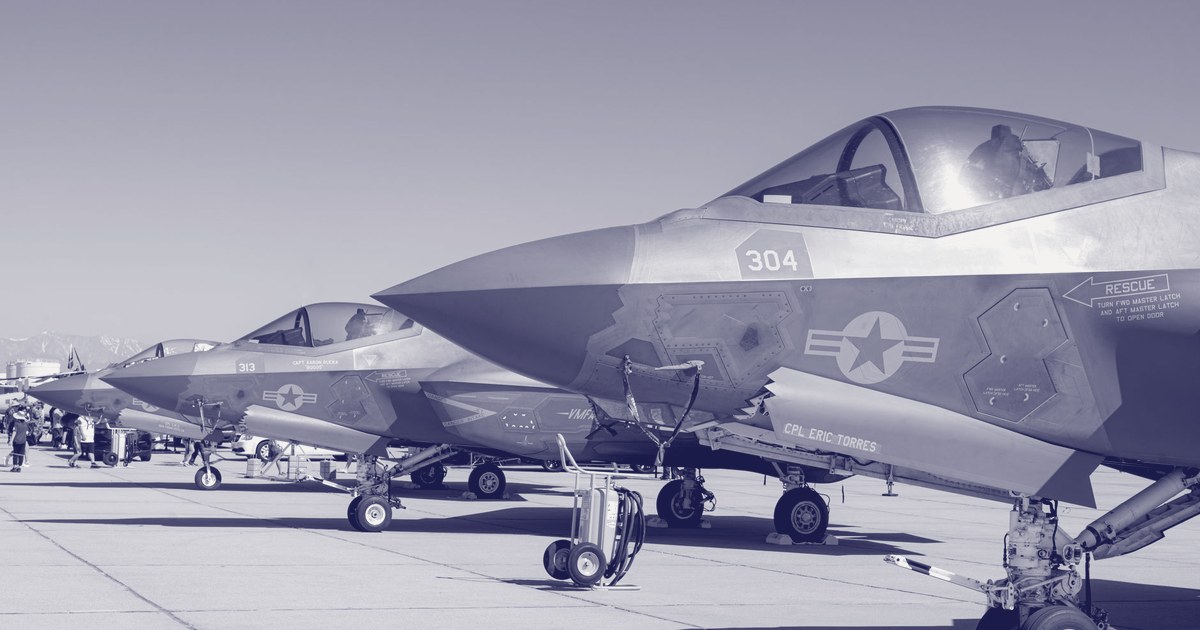
Politico first reported on September 18, 2026 that F-35 parts meant for the United States never arrived. The Aviationist reports that an intermediary company, which transports F-35 spare parts for the jet's manufacturer Lockheed Martin, had sent an assortment of components from Australia to Hong Kong instead of their intended US destination. Days later, the Pentagon's F-35 Joint Program Office said in a statement that it is aware of a shipment issue involving unserviceable F-35 components, including a cockpit canopy coated in radar-absorbent material, and is working with US authorities and Lockheed Martin to retrieve the parts and investigate.
The parts moved through Australia because, as of September 2026, Australia operates a fleet of 72 F-35s and is one of eight countries that share a common F-35 spare-parts pool, the same pooled logistics system the diverted repair shipment was moving through. On September 22, 2026, Australian Defence Minister Richard Marles said the parts were mistakenly diverted to Hong Kong but that none of them were sensitive equipment.
It is worth slowing down on that reassurance. A canopy coated in radar-absorbent material is not the kind of thing officials usually wave off, and the timeline suggests Washington did not treat it that way either. The Aviationist reports that State Department and Pentagon officials briefed congressional staff on key national security committees in June 2026, three months before Politico's story went public, amid concern about China's access to the components, which officials said could pose a significant national security risk to the US and its allies. A quiet briefing in June and a public statement in September are not the same reaction to "nothing sensitive."
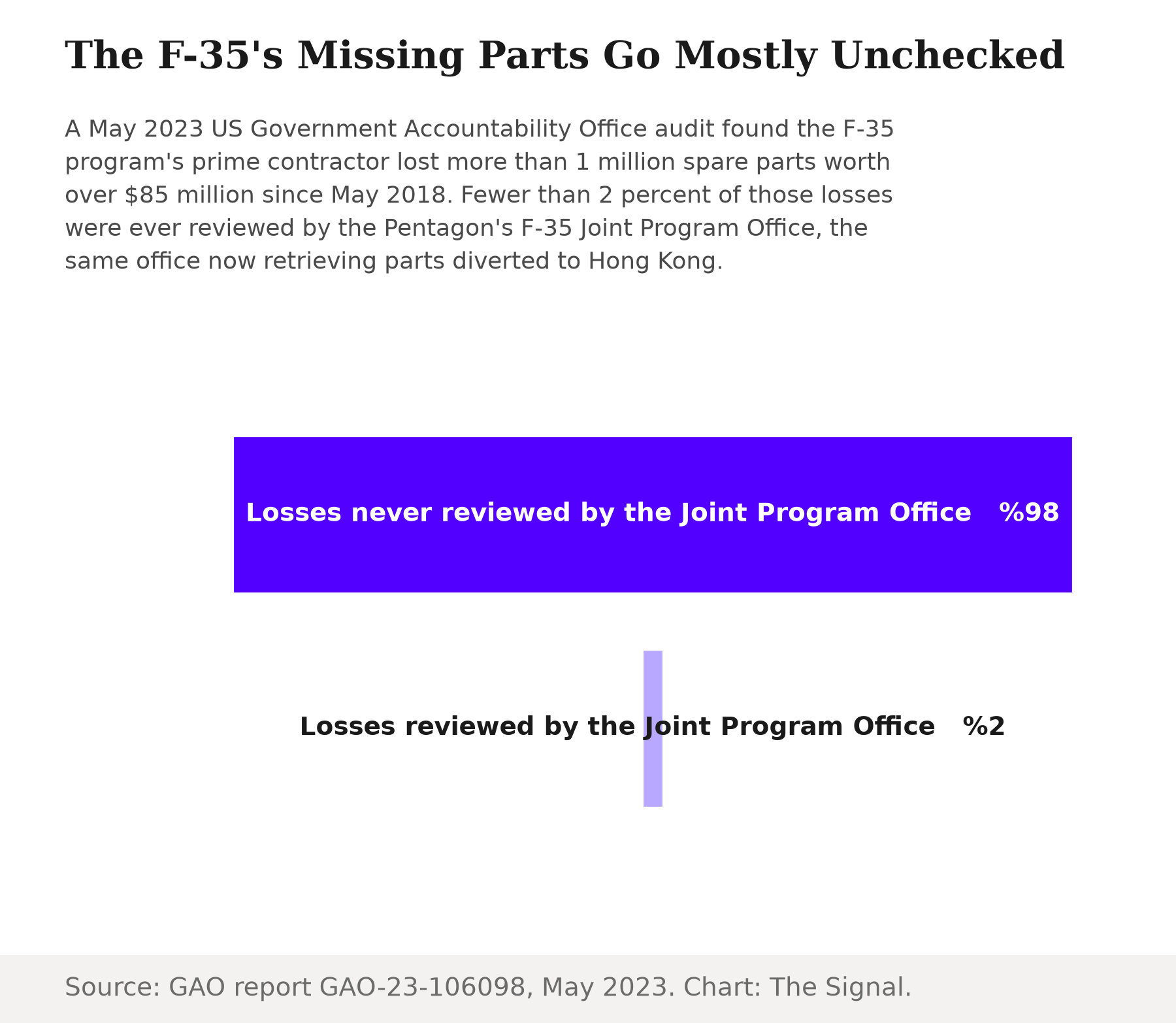
The number that explains how this could happen without anyone breaking into anything is older than the incident itself. Since May 2018, a US Government Accountability Office audit found that the F-35 program's prime contractor had lost track of more than 1 million spare parts worth over $85 million, and fewer than 2 percent of those losses were ever reviewed by the Pentagon's own F-35 Joint Program Office. That audit, published in May 2023, is about domestic inventory control, not exports to Hong Kong. But it documents a supply chain with a long-standing habit of losing track of its own hardware, years before this particular shipment made headlines.
A rule built for exactly this risk
Hong Kong's role here is not incidental to the story; it is the story. The US Commerce Department's Bureau of Industry and Security ruled, per the Federal Register, that any US item needing a license for export to China also needs one for Hong Kong, explicitly citing the risk that sensitive US technology would be diverted to unauthorized end users in China. That rule dates to December 2020, nearly six years before this shipment moved. It exists precisely because paperwork, not a physical border, is what is supposed to stop a part from reaching China by way of Hong Kong. In this case, an intermediary transport company sent the shipment to Hong Kong instead of the parts' intended US destination. No hack, intrusion or breach appears anywhere in any official account of the incident. Every description on the record is of a shipping error inside a licensing system that was built for exactly this scenario and still did not catch it.
Every public account of the incident describes a shipping failure, not a break-in.
| Who | What they said | Source and date |
|---|---|---|
| Pentagon's F-35 Joint Program Office | Aware of a shipment issue involving unserviceable components, including a radar-absorbent-coated cockpit canopy; retrieving them and investigating with US authorities and Lockheed Martin | Statement, September 2026 |
| Australian Defence Minister Richard Marles | Parts were mistakenly diverted to Hong Kong; none of them were sensitive equipment | Comments, September 22, 2026 |
| Hong Kong government spokesman | Would not comment on the individual case | Statement to SCMP, September 20, 2026 |
| State Department and Pentagon officials | Briefed congressional national security staff amid concern about China's access, three months before the story became public | Reporting, June to September 2026 |
Source: as linked in each row. Table: The Signal.
The reassurance and its limit
The strongest case for reading this as a paperwork mistake, not a leak, rests on the people closest to it. Marles said plainly that none of the diverted parts were sensitive, and a Hong Kong government spokesman told the South China Morning Post on September 20, 2026 that it would not comment on individual cases, the standard non-answer for an active matter rather than an admission of anything.
That case is real, but it sits uneasily next to what the Pentagon itself has confirmed. The F-35 Joint Program Office's own statement lists a cockpit canopy coated in radar-absorbent material among the components it is retrieving, and the congressional briefings described by The Aviationist happened months before the public ever heard about the shipment. A minister calling the parts "not sensitive" and a program office quietly working to recover a stealth-coating canopy are not strictly contradictory; "sensitive" can carry a narrow classification meaning the minister is using precisely. But the distance between the public reassurance and the private urgency is itself the more honest signal of how officials actually rate the risk.
The shipment itself was not an unnamed "assortment": the Associated Press reports, citing Bloomberg's reporting, that it specifically comprised a cockpit canopy and a weapons-bay door. On the single most consequential open question this piece has, the record still does not close: the same report says Bloomberg's sources described China as having taken possession of the parts, while China's own Foreign Ministry said it was not aware of the incident, and the Hong Kong government said, as elsewhere, that it would not comment on specific cases. That is an anonymously sourced claim set against a flat denial, not a confirmed answer, and nothing on the public record shows any Chinese authority has visibly inspected, photographed or handled the parts.
Same mechanism, different buyer
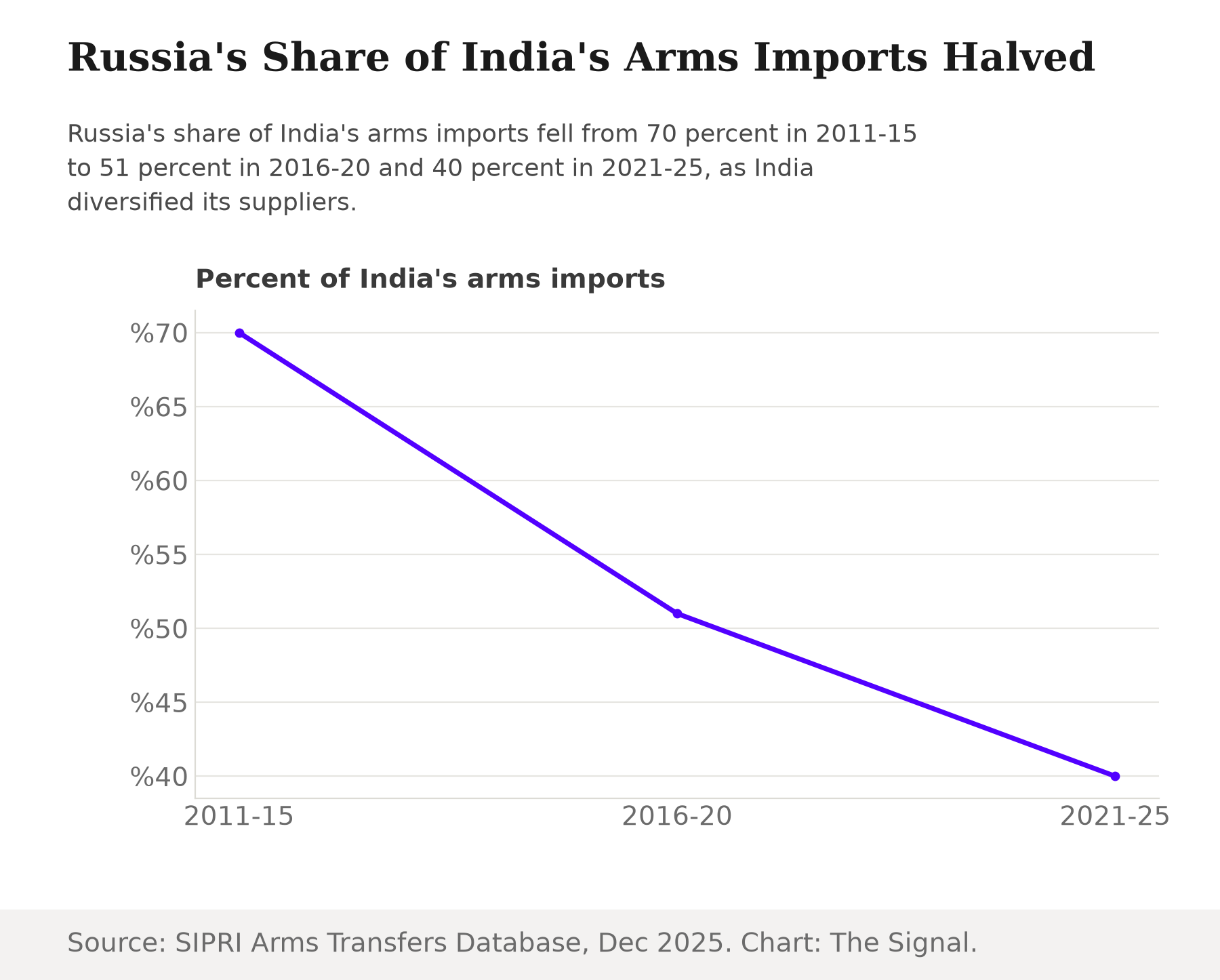
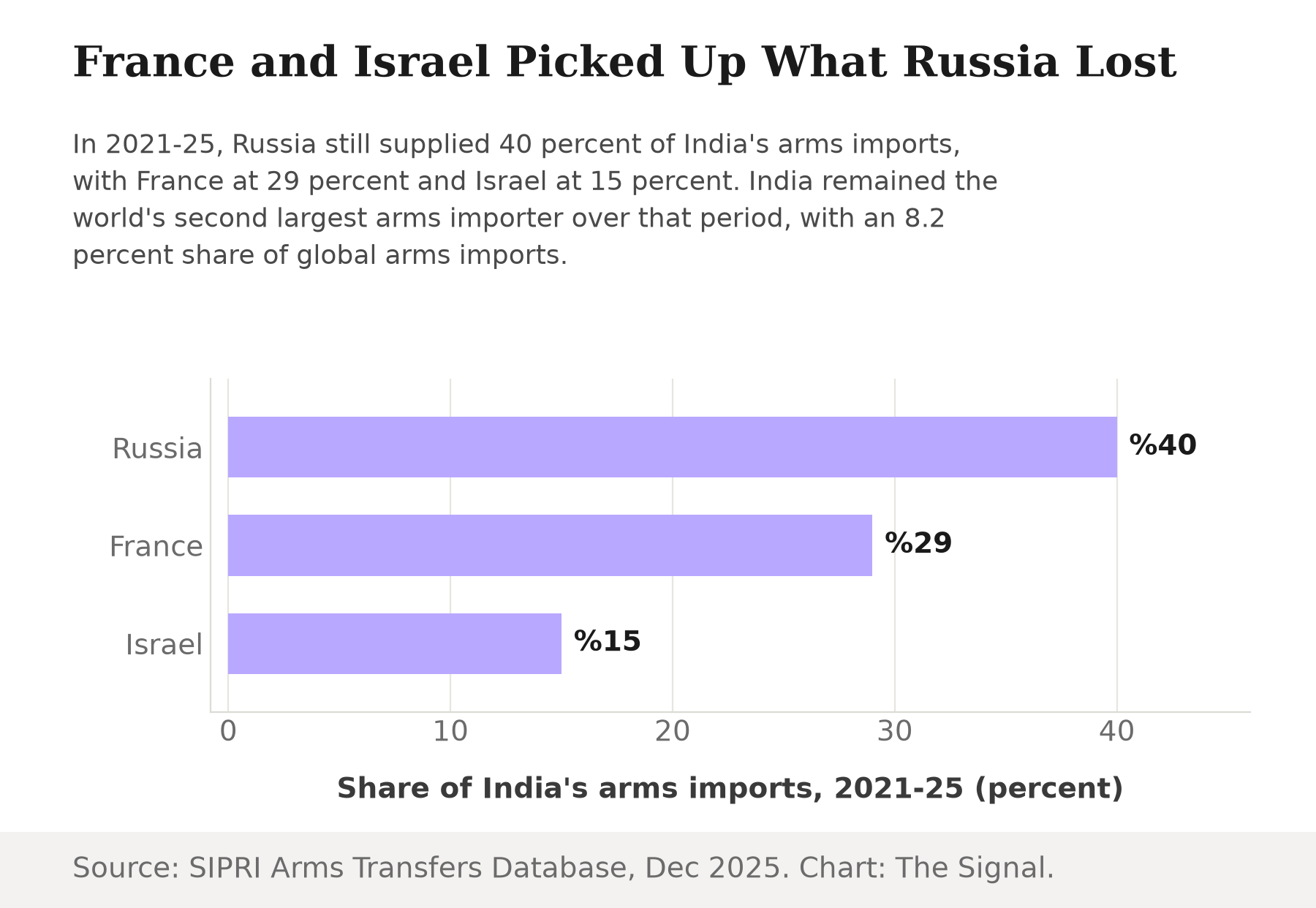
This matters past the US-Australia relationship because the mechanism, not the country, is the vulnerability. SIPRI's Arms Transfers Database shows, in a fact sheet published in December 2025 covering 2021-25, that India remained the world's second largest arms importer over that period, with an 8.2 percent share of total global arms imports, even as it diversified away from a single supplier. Russia's share of India's arms imports fell from 70 percent in 2011-15 to 40 percent in 2021-25, while France's share rose to 29 percent and Israel's to 15 percent.
Every one of those import relationships runs on the same underlying assumption the F-35's own multinational parts pool runs on: that a licensing and paperwork regime, not a wall, keeps sensitive hardware out of the wrong hands once it leaves the seller's factory. The Commerce Department's own justification for stripping Hong Kong's differential export treatment in December 2020 was exactly this risk: that items would be diverted to unauthorized end users once they left direct US control. A buyer that diversifies its suppliers, as India has, inherits the same exposure every diversified seller does. More suppliers means more shipping routes, more intermediaries and more paperwork that has to hold every single time.
The Signal
The F-35 parts sitting in Hong Kong were not stolen from a server. They were delivered to the wrong address by a company that was supposed to know better, inside a licensing regime built six years ago for exactly this scenario. The program's own history suggests the failure is not exotic: fewer than 2 percent of a million-plus lost parts ever got a second look before this particular shipment made headlines. Watch what the F-35 Joint Program Office actually changes, not what it says. If the safeguards it promises mean a new checkpoint on where parts physically travel, the system is learning something. If they mean only a stronger statement the next time this happens, the paperwork was always the weakest link, and every buyer whose defense pipeline runs on the same kind of licensing trust, India's newly diversified one included, is leaning on a chain that just showed exactly where it breaks.
Reporting basis: the diversion itself, the timeline of the congressional briefings, and the description of the intermediary transport company are per The Aviationist's account of Politico's original September 18, 2026 report. The Pentagon's F-35 Joint Program Office statement on the shipment issue is via Military.com. Australian Defence Minister Richard Marles' comments are via Breaking Defense, and the ABC is the source for Australia's F-35 fleet size and its place in the shared spare-parts pool. The Hong Kong government's declined comment is via the South China Morning Post. The specific two-part inventory (cockpit canopy and weapons-bay door), Bloomberg's sourcing on China's possession of the parts, and China's Foreign Ministry's denial of awareness are via the Associated Press. The 2023 finding on unreviewed lost F-35 parts is from a US Government Accountability Office audit. Hong Kong's 2020 loss of differential export-control treatment is from the US Commerce Department's ruling in the Federal Register. India's arms-import figures are from SIPRI's Arms Transfers Database, published December 2025. The 98 percent share of F-35 parts losses never reviewed, and the framing of the incident as a shipping failure rather than a breach, are The Signal's own reading of those figures.