Xi Jinping lands in Washington on Wednesday for a three-day state visit built around a formal welcome and a state dinner the next day, followed by a stop at the National Archives on Friday, as the White House's own visit schedule lays out. Off the official schedule but very much on the table is a $14 billion Taiwan arms package that has sat frozen for months. Reuters reports that Xi is expected to press Trump to keep it that way, invoking a 1982 US-China agreement under which Washington pledged to wind such sales down.
It is worth slowing down on what that 1982 pledge actually says, and on how long the United States has been sitting on it. In the August 1982 US-China Joint Communique, the US government stated that it does not seek to carry out a long-term policy of arms sales to Taiwan, and that it intends to reduce its arms sales gradually, leading over a period of time to a final resolution. That commitment is 44 years old this year.
Arms sales have not moved in that direction. They have accelerated.
In his second term, Trump approved more Taiwan arms sales in his first year in office than the Biden administration approved across all four years of its term. Whatever "gradual reduction" was meant to describe, the trend line for 44 years has run the other way, and it is running faster now than before. Xi is asking Trump to start that restraint for the first time, not continue one that already exists.
The chip and the freeze
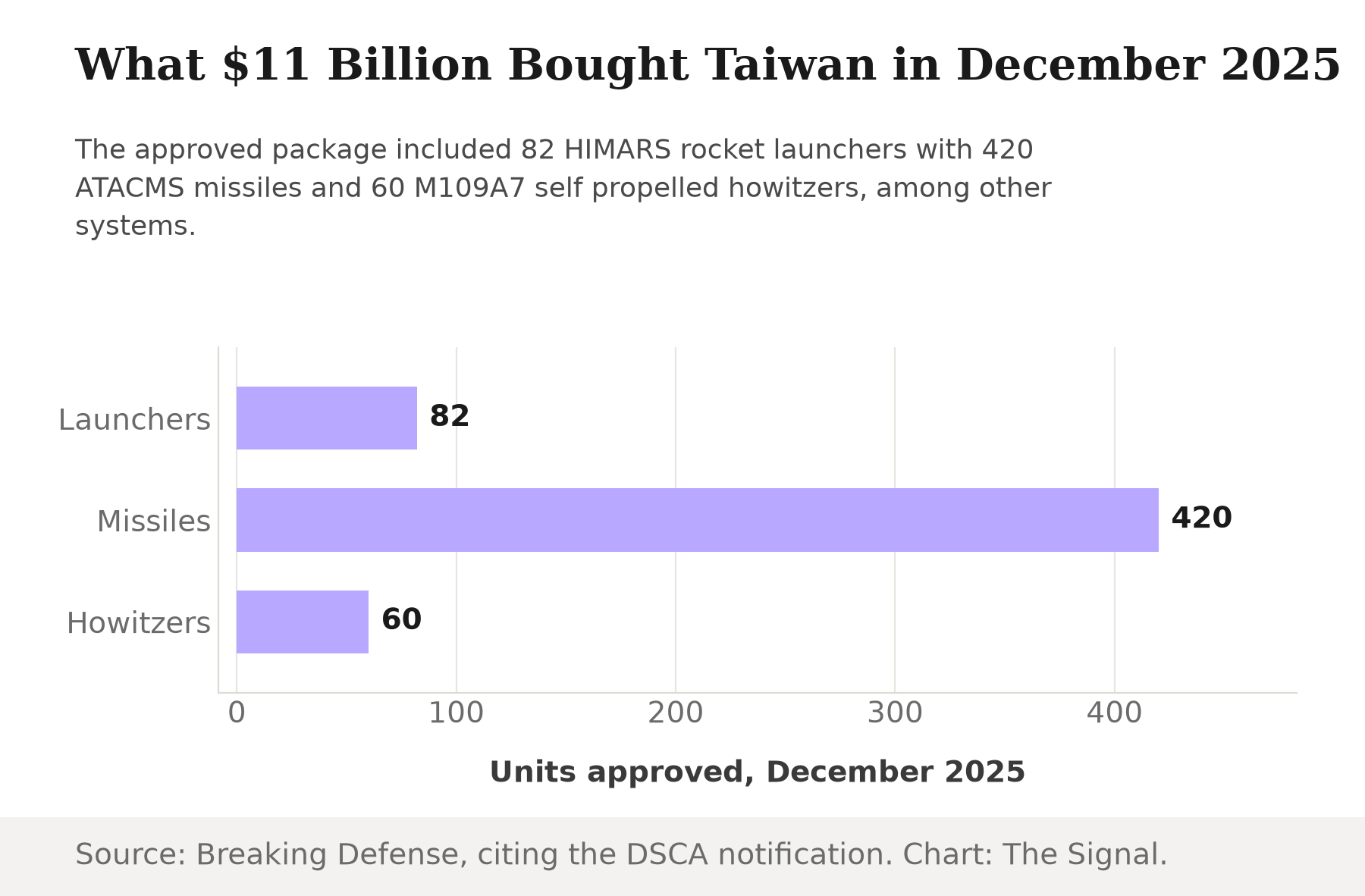
A second Taiwan arms package, worth some $14 billion, has been on hold for months, sitting behind a package that already cleared. In December 2025, the Trump administration approved an $11 billion Taiwan arms package covering 82 HIMARS rocket launchers with 420 ATACMS missiles and 60 M109A7 self-propelled howitzers, among other systems.
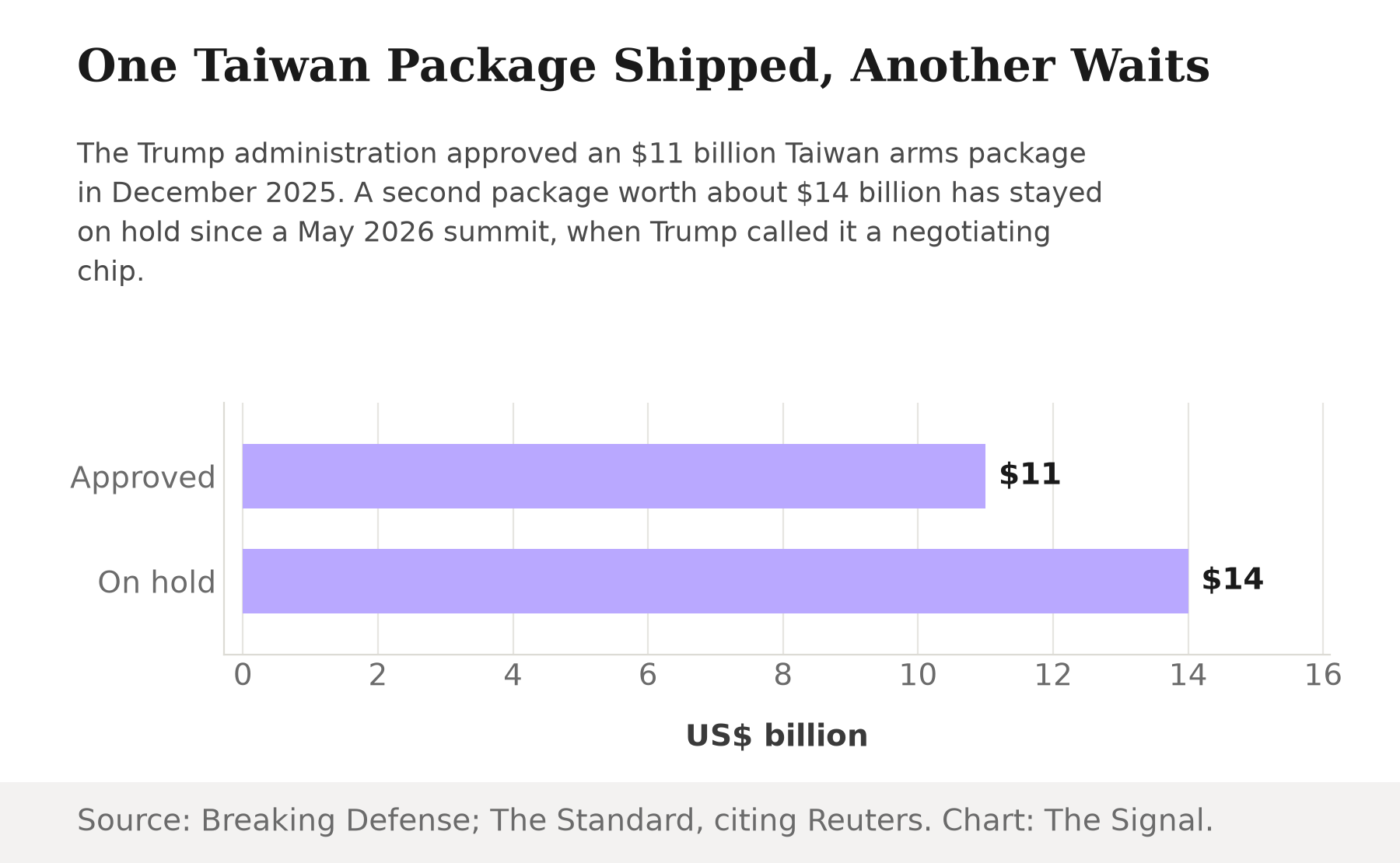
The second package is the one in question this week. After a May 2026 summit with Xi in Beijing, Trump described the pending $14 billion package as a "very good negotiating chip" and said he was holding it in abeyance. That is leverage Trump intends to spend at the table this week, not the 1982 communique's language of gradual, principled reduction.
A pledge that a stronger law overrides
The 1982 communique was never the only document governing this relationship, and it was not even the first. The Taiwan Relations Act of 1979 legally requires the United States to make available to Taiwan such defense articles and defense services in such quantity as may be necessary to enable Taiwan to maintain a sufficient self-defense capability. That is US domestic statute, passed by Congress three years before the communique existed.
| Instrument | Date | What it commits the US to |
|---|---|---|
| Taiwan Relations Act | 1979 | Make available defense articles "as may be necessary" for sufficient self-defense |
| US-China Joint Communique | 1982 | Reduce arms sales gradually, "leading over a period of time to a final resolution" |
A binding US law and a diplomatic pledge to China have pointed in opposite directions for 44 years.
Sources: 22 U.S.C. 3302; the 1982 Joint Communique, Reagan Presidential Library archive.
A communique is a diplomatic statement of intent. A statute passed by Congress is domestic law that survives changes of administration, and in practice it has outranked the informal pledge every time the two have conflicted. That is the mechanism behind the table above: not that any single president chose to defy Beijing, but that the legal floor under Taiwan arms sales has always sat above the ceiling the communique described. Forty-four years of sales that never "gradually reduced" is not a string of individual bad-faith decisions. It is what happens when a statute and a communique disagree, deal after deal, administration after administration.
India runs the same pipeline
The mechanism Beijing wants Trump to interrupt for Taiwan is not exotic. It is the same US foreign military sale process that supplies India. In 2024, India's government requested and received approval to buy 31 MQ-9B Sky Guardian aircraft and associated munitions, at an estimated total cost of $3.99 billion, a deal roughly a quarter the size of the Taiwan package on hold, run through the identical DSCA notification system.
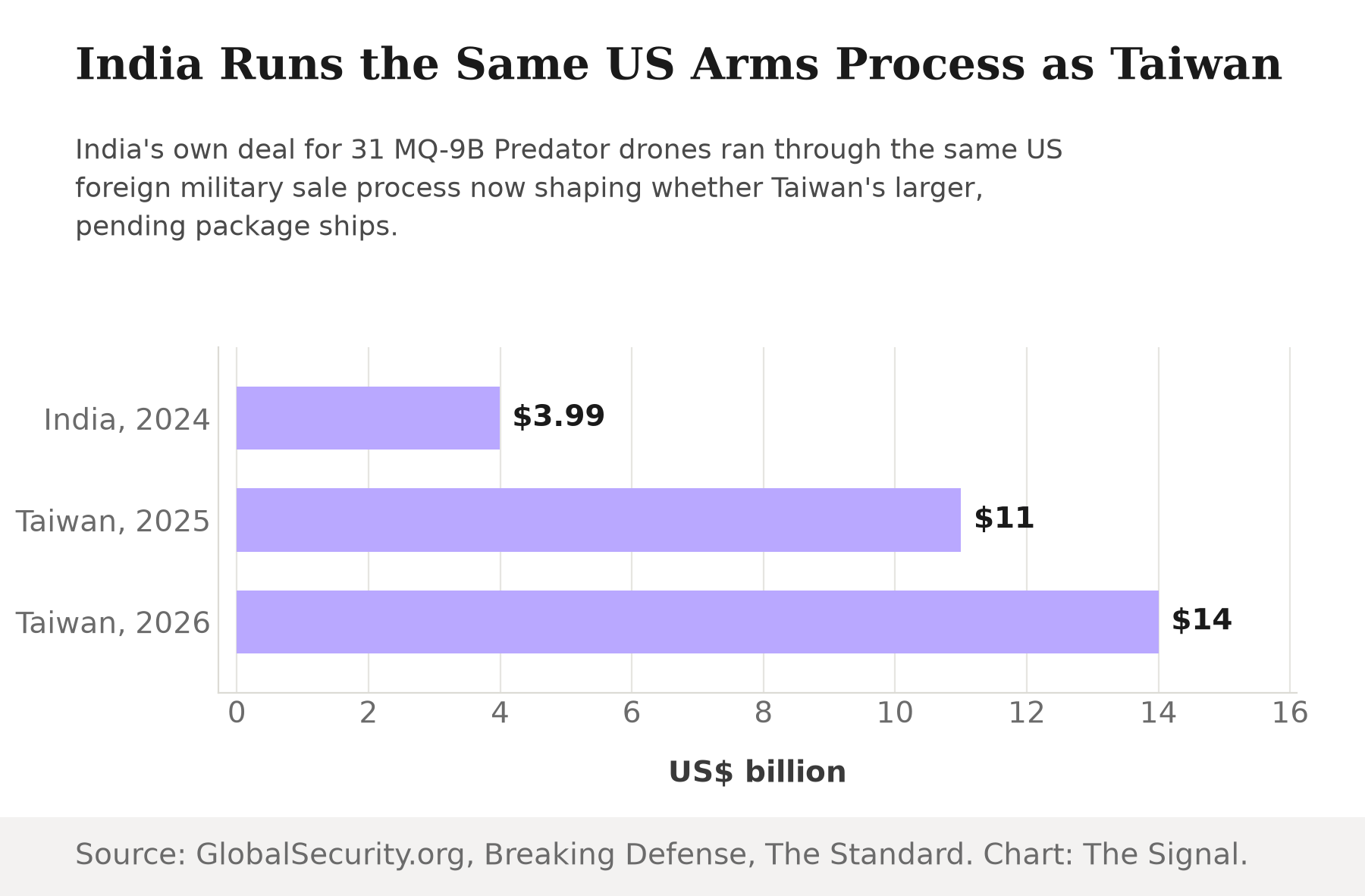
That is the stake for a reader well outside the Taiwan Strait. If a Congress-notified, priced arms package can be parked indefinitely and traded for leverage with a third country, that possibility exists for any partner's pending notification, not only Taiwan's. A precedent set this week over Taiwan is a precedent about how conditional that whole class of deal really is, for every government that leans on the same pipeline.
The honest objection
The strongest case for taking this freeze seriously, unlike 44 years of unmet pledges before it, is that it is concrete rather than aspirational. Trump personally held a specific, already-priced $14 billion package in abeyance after a real summit with Xi. A dealmaker treating one transaction as a chip has more reason to hold it than a government reciting a decades-old formula it has never enforced.
That case is real, but it explains a pause, not a reduction. The $11 billion package still moved in December 2025, in the same presidential term as the freeze, carrying real offensive-capable systems into Taiwan's inventory. The pace across Trump's first year in his second term already exceeds four full years under his predecessor. Holding one large, already-notified package back as a negotiating instrument is not the same as reducing the underlying flow, and the flow, on the only comparison the record supports, is faster than it has been in years.
The Signal
The thing to watch after this week's summit is not whether Xi raises the old pledge. He will. It is whether the frozen package still sits frozen a month from now, or whether it quietly clears once the cameras are gone. If it clears, this week was theater over a promise nobody intended to keep. If it stays frozen well past the visit, something genuinely new will have happened: an administration treating Taiwan's air defense hardware as fungible with something else it wanted from Beijing, a shift the old pledge never actually produced. Every government relying on the same foreign military sale pipeline, India included, has a stake in which of those two outcomes is true.
Reporting basis: the $14 billion package on hold, and Xi's expected use of the 1982 communique, are per Reuters, as also carried by the Taipei Times and The Standard on the same Reuters wire. The comparison of Trump's first-year approval pace against Biden's full four years is also from that Reuters wire, as carried by the Taipei Times. The December 2025 $11 billion package and its contents are per Breaking Defense's reporting of the DSCA notification. Trump's "negotiating chip" description is per The Standard's report of the Reuters wire. The 1982 Joint Communique text is from the Reagan Presidential Library's archive; the Taiwan Relations Act provision is from the US House's own published Code; the visit schedule is from the White House's own release. India's MQ-9B deal is per a DSCA notification as reproduced by GlobalSecurity.org. The 44-year span and the ratio between the India and Taiwan deals are The Signal's calculations from those figures.